



Refined fish oil
(Food ingredient / lipid source)
Description
Refined fish oil is an edible oil obtained from marine fish, purified to remove odours, flavours, pigments and contaminants, and standardised mainly for its omega-3 fatty acid content.
It is typically produced from fatty fish species (e.g. anchovy, sardine, mackerel, menhaden, salmon) and often derived as a co-product of fishmeal manufacture.
Commercial products include bulk refined oil for food industry use, bottled oils and soft-gel capsules for supplements, and specialised concentrates with higher EPA/DHA levels.
Compared with crude fish oil, refined fish oil has lighter colour, milder odour/taste, lower levels of oxidation products and regulated levels of contaminants (dioxins, PCBs, heavy metals).
Indicative nutritional values (per 100 g refined fish oil)
(Typical composition for standard, non-concentrated refined fish oil; exact values depend on species and processing.)
Energy: ≈ 880–900 kcal
Water: ≈ 0 g
Protein: 0 g
Total fat: ≈ 100 g
first occurrence: SFA/MUFA/PUFA = saturated / monounsaturated / polyunsaturated fatty acids
typical distribution (highly variable by species):
SFA: ≈ 20–35 g
MUFA: ≈ 25–45 g
PUFA: ≈ 20–35 g, including n-3 and n-6
Carbohydrates: 0 g (no fibre, no sugars)
Cholesterol: often ≈ 400–800 mg/100 g, depending on raw material
Typical omega-3 content in a standard fish oil:
EPA (eicosapentaenoic acid): ≈ 18% of total oil (~180 mg per 1 g oil)
DHA (docosahexaenoic acid): ≈ 12% of total oil (~120 mg per 1 g oil)
These levels are higher or lower in enriched or diluted products.
(Rule of thumb: 1 g refined fish oil ≈ 9 kcal; 5 ml ≈ 4,5–5 g ≈ 40–45 kcal.)
Key constituents
Fatty acids
Long-chain n-3 PUFA dominate the nutritional interest: mainly EPA and DHA; smaller amounts of other n-3 (e.g. DPA) and n-6 PUFA.
Presence of SFA (palmitic, stearic) and MUFA (oleic, palmitoleic) varies with species and season.
TFA (trans fatty acids) are normally very low in high-quality refined fish oil; process conditions are designed to limit their formation.
Minor components
Residual tocopherols (vitamin E) and added antioxidants (e.g. mixed tocopherols, ascorbyl palmitate) to protect against oxidation.
Trace levels of sterols, fat-soluble vitamins (A, D) depending on raw material and degree of refining.
Process-related contaminants are tightly controlled; modern refining aims to minimise 3-MCPD esters, glycidyl esters, MOSH/MOAH, etc.
Contaminants (controlled)
Potential environmental contaminants include dioxins, dioxin-like and non-dioxin-like PCBs, PAHs and heavy metals (Hg, Cd, Pb, As).
Refining and, where used, molecular/short-path distillation greatly reduce many of these; final products must comply with strict legal limits.
Production process
(Typical modern process for edible refined fish oil; steps may be adapted or combined.)
1. Raw material and crude oil production
Fatty fish and trimmings are cooked and pressed; the liquid phase is separated into fishmeal press liquor and crude fish oil by decanting and centrifugation.
Crude oil is roughly clarified to remove suspended solids and stored under inert gas at low temperature to reduce oxidation.
2. Degumming
Hydration with water/acid to remove phospholipids, gums and some metals, followed by separation of hydrated gums.
3. Neutralisation (chemical or physical)
Removal of free fatty acids (FFA) by alkali neutralisation (soapstock separation) or by physical/steam/short-path distillation.
Neutralisation significantly improves flavour stability and reduces some contaminants.
4. Washing and drying
Water washing removes residual soaps, followed by vacuum drying to remove moisture.
5. Bleaching
Treatment with adsorbents (bleaching earths, activated carbon) to remove pigments, oxidation products and trace contaminants.
6. Winterisation / fractionation (optional)
Controlled cooling and filtration to separate higher-melting triglycerides, improving clarity at low temperature and allowing adjustment of fatty acid profile.
7. Deodorisation
High-vacuum steam stripping removes volatile compounds responsible for fishy odour/flavour and further reduces some contaminants.
8. Concentration (for omega-3 concentrates, if applied)
Processes like urea complexation, molecular distillation or re-esterification are used to increase the proportion of EPA/DHA (e.g. “concentrated” and “highly concentrated” fish oils as defined by Codex).
Physical properties
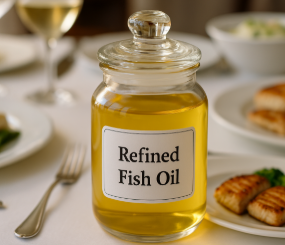
Appearance: clear, transparent liquid; colour from very pale yellow to light amber, depending on species and refining intensity.
Odour and flavour: mild, neutral to slightly fishy; strong rancid or sharp odour indicates oxidation or poor quality.
Density: typically ~0.90–0.93 g/ml at room temperature.
Melting behaviour: remains liquid at room temperature; cloud/solidification points depend on fatty acid profile and winterisation.
Oxidation indices: peroxide value, anisidine value and Totox are used to monitor freshness and oxidative status; refined oils are kept well below specified limits.
Sensory and technological properties
Sensory profile
Properly refined fish oil should have minimal fishy odour/taste, allowing use in softgels and fortified foods without strong off-notes.
Flavour defects (rancid, metallic, “paint-like”) are associated with lipid oxidation and indicate poor handling or excessive storage time.
Technological functionalities
Lipid carrier for EPA/DHA in supplements and fortified foods.
Can be emulsified into beverages, dairy analogues, sauces with appropriate emulsifiers and antioxidants.
Sensitive to heat, light and oxygen; requires careful process and packaging control (inert gas blanketing, dark bottles, low-oxygen caps).
Food applications
Direct consumption / supplements
Bottled refined fish oil (spoonful doses) and soft-gel capsules as dietary sources of EPA/DHA.
Fortified foods
Enrichment of dairy products and dairy analogues, bakery products, bars, infant formula, medical nutrition and other functional foods.
Use of microencapsulated fish oil to reduce off-flavours and improve stability in dry matrices.
Industrial uses
Ingredient in dressings, spreads, nutraceutical beverages, where formulation masks flavour and protects the oil from oxidation.
Nutrition & health
Refined fish oil provides energy-dense fat and is essentially pure lipid, with no protein or carbohydrate.
Its main nutritional interest lies in long-chain n-3 PUFA (EPA and DHA), which:
contribute to maintenance of normal heart function, blood triglyceride management and brain/vision development and function, according to widely accepted scientific evidence and health-claim frameworks;
may influence inflammatory pathways and membrane fluidity in many tissues.
Health considerations:
For most adults, food-safety authorities consider combined intakes of up to several grams/day of EPA+DHA from supplements as generally safe, but specific recommendations vary by authority and health status.
Very high supplemental doses have been associated, in some studies, with increased risk of atrial fibrillation in susceptible individuals; medical supervision is advised for pharmacological-range doses.
People on anticoagulant/antiplatelet therapy, with bleeding disorders or scheduled surgery should discuss fish-oil supplementation with their physician.
For the general population, many guidelines prefer obtaining omega-3 primarily from whole fish (1–2 portions/week or more), using supplements to complement low fish intake rather than replace food.
Portion note (typical supplemental uses):
Common capsule doses: ≈ 1 g fish oil providing ~300 mg EPA+DHA per capsule (varies by product).
Frequent daily regimens: 1–3 g fish oil/day (≈ 300–900 mg EPA+DHA) for general maintenance, higher under medical supervision for specific indications (e.g. very high triglycerides).
Allergens and intolerances
Fish oil originates from fish, which are major allergens; however,
refined oil contains negligible fish proteins, so the allergenic risk is lower than for whole fish but not necessarily zero.
Sensitive individuals with fish allergy are often advised to avoid fish-oil supplements unless the product is specifically evaluated and their allergist approves.
Cross-contact with other allergens (e.g. soy, gelatin used in capsules) must be considered in product formulation and labelling.
Quality & specification (typical topics)
Compositional parameters
Fatty acid profile: % of EPA, DHA, total n-3 and n-6, SFA/MUFA/PUFA ratio.
Level of EPA+DHA per gram of oil (e.g. standard vs concentrated products).
Oxidation indicators
Peroxide value (PV), anisidine value (AV), Totox; product specs often follow or improve upon codified standards for fish oil freshness.
Contaminants
Verification that levels of heavy metals, dioxins, PCBs, PAHs comply with applicable regulations (e.g. EU, Codex, national standards).
Sensory and physical
Colour (Lovibond or similar), clarity, odour/taste (absence of rancid or strongly fishy notes), absence of sediment.
Storage & shelf-life
Refined fish oil is highly sensitive to oxidation. Good practice includes:
Storage in full, tightly closed, light-protected containers, preferably under nitrogen or another inert gas.
Temperature: generally cool (< 25 °C) for short-term storage; refrigeration/freezing used for long-term bulk storage.
Avoid repeated opening and headspace oxygen; small retail packs reduce consumer-level oxidation.
Shelf-life depends on antioxidant system, packaging and storage, but is often in the range of 1–3 years for sealed products, shorter after opening.
Safety & regulatory
Refined fish oil must comply with:
general food safety regulations for edible oils;
specific standards for fish oils (e.g. Codex Standard for Fish Oils) detailing identity, purity and quality parameters;
maximum levels for contaminants (metals, dioxins, PCBs, etc.) laid down in regional legislation and guidance.
Production facilities operate under GMP/HACCP to manage hazards at: raw-material reception, crude-oil handling, refining steps, deodorisation and packaging.
Labelling
Typical ingredient designations:
“fish oil”, “refined fish oil”, or fish-species-specific names when relevant (e.g. “refined salmon oil”).
For supplements, labels should indicate:
total fish oil per dose,
EPA and DHA content per dose,
other ingredients (antioxidants, capsule materials),
allergen and origin statements as required (e.g. “from fish”, specific species, fishing area where claimed),
usage instructions, warnings and storage advice per local regulations.
Troubleshooting (quality and process)
Strong fishy or rancid smell/taste
Cause: oxidation, poor storage (heat, light, oxygen), aged raw material.
Action: reject or downgrade lot; improve antioxidant system, packaging and cold-chain/stock rotation.
Unusual colour or turbidity
Cause: incomplete refining, improper winterisation, contamination, oxidation or precipitation at low temperature.
Action: review bleaching/winterisation, check storage temperature and filtration; adjust specifications.
High peroxide or anisidine values
Cause: oxidative damage during processing or storage.
Action: tighten control of temperature and oxygen, shorten storage times, improve use of inert gases and antioxidants.
Contaminant non-compliance
Cause: raw materials from contaminated areas, insufficient removal in refining/distillation.
Action: change sourcing, reinforce molecular/short-path distillation, segregate or discard non-compliant batches.
Sustainability & supply chain
Refined fish oil is often produced from by-products of the fish processing industry (trimmings, by-catch species used for fishmeal), which can improve resource efficiency.
Sustainability considerations include:
responsible sourcing from well-managed fisheries, ideally with third-party certifications (e.g. MSC/other schemes);
traceability of batches back to species and fishing areas;
monitoring and managing environmental contaminants in source stocks.
Processing plants should manage oily effluents with high BOD/COD through appropriate wastewater treatment and, where feasible, energy recovery (e.g. anaerobic digestion).
Efficient logistics and FIFO stock rotation help maintain oil freshness, limit waste and minimise the carbon footprint associated with discarding oxidised product.
Main INCI functions (cosmetics and related uses)
In cosmetics, fish-derived oils may appear as Fish Oil, Marine Oil, or more specific INCI names.
Main functions:
emollient and skin-conditioning agent,
component of lipid phases in creams/ointments, sometimes chosen for its omega-3 profile.
However, due to odour/oxidation issues and regulatory expectations, many cosmetic formulations now prefer stabilised or encapsulated forms or use plant-derived omega-3 as alternatives.
Conclusion
Refined fish oil is a highly energy-dense lipid ingredient whose primary technological role is to deliver EPA and DHA in a stable, palatable form. Modern refining (degumming, neutralisation, bleaching, winterisation, deodorisation and, where applicable, molecular distillation) allows significant reduction of impurities and contaminants while shaping sensory properties and shelf-life. From a nutritional perspective, refined fish oil can meaningfully contribute to long-chain omega-3 intake, especially when fish consumption is low, but its use should be framed within evidence-based limits and personalised medical advice at high doses. Robust GMP/HACCP systems, strict adherence to contaminant regulations, and sustainable raw-material sourcing are essential to ensure that refined fish oil remains both a safe and responsible ingredient for foods and supplements.
Mini-glossary
SFA – saturated fatty acids; fatty acids with no double bonds. Excessive SFA intake is associated with higher LDL-cholesterol in many populations, so a moderate SFA share is generally preferred.
MUFA – monounsaturated fatty acids; fatty acids with one double bond (e.g. oleic acid). MUFA-rich patterns are often linked with favourable lipid profiles when replacing SFA.
PUFA – polyunsaturated fatty acids; fatty acids with two or more double bonds, including n-3 and n-6 families. Marine n-3 PUFA (EPA, DHA) are a key health benefit of fish oil.
EPA – eicosapentaenoic acid (C20:5 n-3); long-chain omega-3 fatty acid from marine sources, involved in eicosanoid pathways and often targeted for triglyceride management and cardiovascular support.
DHA – docosahexaenoic acid (C22:6 n-3); long-chain omega-3 fatty acid abundant in brain and retina, important for normal visual and cognitive function, especially in development.
ALA – alpha-linolenic acid (C18:3 n-3); plant-derived omega-3 precursor. Conversion to EPA/DHA in humans is limited, so fish-oil EPA/DHA provide a more direct source.
TFA – trans fatty acids; unsaturated fatty acids with at least one trans double bond. Industrial TFAs are associated with adverse cardiovascular effects; good-quality refined fish oil has very low TFA levels.
MCT – medium chain triglycerides; triglycerides with medium-length fatty acids (C8–C12). They are rapidly oxidised for energy. Fish oil is not an MCT-rich oil, but MCTs are sometimes used as carriers in omega-3 formulations.
GMP/HACCP – good manufacturing practices / hazard analysis and critical control points; structured systems used in fish-oil plants to control hygiene, process parameters and safety hazards (e.g. oxidation, contaminants).
BOD/COD – biochemical oxygen demand / chemical oxygen demand; indicators of organic and oxidisable load in processing wastewater, important for designing and monitoring effluent treatment from fish-processing and refining plants.
FIFO – first in, first out; stock-rotation principle where older lots are used first, crucial for maintaining refined fish oil freshness and preventing oxidation.

