



Blue crabs
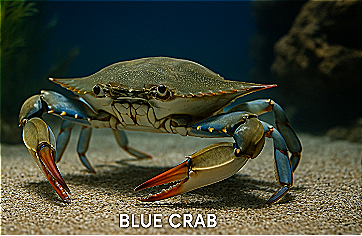
Blue crab
(Callinectes sapidus)
Description
Blue crab is a marine/estuarine crustacean whose meat is used as a lean, high-protein seafood ingredient. Commercial products include fresh, pasteurised, frozen and canned crab meat, as well as value-added preparations (cakes, patties, fillings).
Edible meat is obtained mainly from the body (lump/backfin) and claws, sometimes also from legs.
The ingredient is typically a white to off-white, slightly translucent meat, with a delicate, sweet, mildly briny flavour and a tender, flaky texture.
Indicative nutritional values (per 100 g cooked blue crab meat)
(Typical composition for cooked blue crab; values may vary by cut, origin, and processing.)
Energy: ≈ 80–95 kcal
Water: ≈ 75–78 g
Protein: ≈ 18–21 g
Total fat: ≈ 0.5–1.5 g
first occurrence: SFA/MUFA/PUFA = saturated / monounsaturated / polyunsaturated fatty acids; total fat is low and the profile is relatively rich in unsaturated fat, with only a small SFA fraction and a meaningful share of marine n-3 PUFA, generally favourable for cardiometabolic health as part of a balanced diet.
Carbohydrates: ≈ 0–1 g (virtually negligible)
Cholesterol: ≈ 55–80 mg
Sodium (natural + process): typically ≈ 250–400 mg (can be higher in salted/canned products)
Key micronutrients (approximate):
Vitamin B12: very high (often > 200–300% of daily value per 100 g)
Niacin (B3), B6, folate: small–moderate amounts
Minerals: phosphorus, selenium, zinc, copper, and, in marine-caught crabs, some iodine.
Key constituents
Proteins and amino acids
Blue crab meat is protein-dense and contains all essential amino acids, making it a complete protein.
Studies on blue crab composition show breast and claw meat with ~19 g protein/100 g and particularly high levels of lysine, alanine and glutamic acid + glutamate, which support umami taste and nutritional quality.
Lipid fraction
Overall fat content is low, but the residual fat includes marine n-3 fatty acids, especially EPA/DHA (eicosapentaenoic / docosahexaenoic acid), alongside MUFA and SFA.
This lipid profile is generally considered favourable compared to many terrestrial animal fats, provided the product is not heavily enriched with added fats.
Minerals and vitamins
Excellent source of phosphorus, selenium and sodium, with useful contributions of zinc, copper, magnesium and sometimes calcium if small shell fragments are present.
High vitamin B12 and moderate niacin support normal energy metabolism and neurological function.
Other components
Small amounts of chitin and carotenoid pigments (especially astaxanthin) may be present, particularly in meat close to the shell.
Production process
(Overview for food-grade blue crab meat and derived ingredients.)
Harvesting and reception
Blue crabs are captured via traps, pots, trawls or small-scale gears in coastal and estuarine environments (native western Atlantic; invasive in parts of the Mediterranean and other regions).
Crabs are landed alive or freshly killed, chilled on ice and transported quickly to processing plants.
Cooking and picking
Whole crabs are washed and heat-treated (typically steam or boiling) to cook the meat and loosen it from the shell.
After cooling, meat is manually or mechanically picked from body, claws and legs. Mechanical extraction is sometimes used to recover additional meat from by-products (picking-room scraps).
Sorting and grading
Meat is graded into categories such as jumbo lump, lump, backfin, special, claw, etc., based on particle size, location and colour.
Further processing
For pasteurised refrigerated products: meat is packed in cans/tubs, sometimes with minimal brine, then pasteurised and rapidly cooled.
For frozen meat: quick freezing (often IQF blocks or trays).
For canned products (shelf-stable): more intense thermal processing in sealed containers.
For ingredient use (e.g., minced or comminuted crab): meat may be minced, mixed, vacuum-packed and pasteurised or frozen.
Physical properties
Appearance: white to off-white flaky meat; claw meat may be slightly darker or more orange-tinted due to pigments.
Texture: tender, flaky but cohesive, able to hold together in cakes/patties when bound with small amounts of starch or crumbs.
Odour and flavour: fresh, sweet, marine/briny; off-odours (ammoniacal, sour, oxidised) indicate deterioration.
Water activity: high in fresh/pasteurised and thawed products; lowered in dried or intermediate-moisture preparations.
Sensory and technological properties
Sensory profile
Characteristic sweet, delicate flavour with light marine salinity; less “fishy” than some finfish.
Pronounced umami due to amino acids (glutamate, aspartate) and nucleotides.
Technological functionalities
Binding and structure: combines well with egg, starches and crumbs to form stable crab cakes, patties, dim sum fillings.
Water-holding capacity: moderate; sufficient to maintain juiciness if not overcooked or over-pressed.
Heat behaviour: overcooking leads to dry, fibrous meat; gentle heating preserves moisture and tenderness.
Food applications
Home and foodservice
Core ingredient in crab cakes, croquettes, fritters, crab salads, pasta dishes, risottos, soups, chowders, bisques, stews and stuffed vegetables.
Used in sandwiches, sushi, cold appetisers and canapés.
Food industry
Ingredient in chilled and frozen ready meals, seafood mixes, filled pastas, savoury pastries and pies.
Used in soups, sauces, spreads, dips, surimi-type products and flavour concentrates/broths containing crab.
Mechanically recovered minced crab meat from by-products can be incorporated into value-added products and flavour bases.
Nutrition & health
Blue crab meat provides high-quality complete protein with relatively low energy and fat per 100 g.
The residual lipid fraction contributes marine n-3 PUFA, including EPA/DHA, which are associated with cardiovascular and cognitive benefits when consumed in adequate amounts as part of total seafood intake.
Rich vitamin B12 content supports normal neurological function and red blood cell formation; selenium and zinc support antioxidant defence and immune function.
Low carbohydrate content and modest calorie density make blue crab suitable for energy-controlled, low-carb or higher-protein diets, provided that sauces and coatings are also controlled.
Portion note:
Typical culinary portions:
60–90 g cooked crab meat as part of a mixed dish (pasta, risotto, salad).
100–150 g cooked crab meat as main protein portion, depending on overall meal design and energy needs.
Allergens and intolerances
Blue crab is a crustacean shellfish and therefore a major food allergen in many jurisdictions. Fish- and shellfish-allergic individuals may react differently: some tolerate finfish but react to crustaceans, and vice versa.
Major identified crab allergens include tropomyosin and arginine kinase, which can trigger reactions from mild oral symptoms to anaphylaxis in sensitised subjects.
For allergic consumers, any form of blue crab (fresh, cooked, processed, hydrolysates) must be considered unsafe.
Processed foods containing blue crab must declare crustacean presence according to local allergen labelling regulations.
Quality and specification (typical topics)
Compositional criteria
Moisture, protein, fat, ash, and salt (especially for brined/canned products).
Limits for TVB-N (total volatile basic nitrogen) and TMA-N (trimethylamine) as freshness indicators.
Sensory and physical
Odour: clean, sweet, marine; no sour or ammonia notes.
Appearance: bright, not slimy, minimal shell fragments, absence of black spots from melanosis.
Texture: tender, flaky, not mushy or stringy.
Microbiological
Compliance with limits for total aerobic counts, Enterobacteriaceae, and absence of pathogens (e.g., Salmonella, Listeria monocytogenes, Vibrio spp. depending on jurisdiction).
Contaminants
Heavy metals (e.g., Hg, Cd, Pb, As) and organic pollutants (dioxins, PCBs) must meet regulatory limits for crustaceans.
Storage and shelf-life
Fresh, chilled meat (non-pasteurised):
0–2 °C; typically a few days shelf-life; rapid use needed.
Pasteurised refrigerated crab meat:
Kept at 0–4 °C, often several weeks to a few months unopened (depending on process); shorter once opened.
Frozen crab meat:
≤ −18 °C; typical shelf-life 6–18 months, depending on glaze, packaging and fat content; avoid repeated thaw–freeze cycles to limit texture damage and oxidation.
Canned crab:
Shelf-stable at ambient temperature for 1–5 years, subject to can integrity and best-before date.
After opening any refrigerated or canned product, keep chilled and use within a few days following manufacturer instructions.
Safety and regulatory
Processing plants operate under GMP/HACCP systems, with critical control points typically at:
raw material reception (live/freshness, origin, contamination risks),
time–temperature control during cooking and cooling,
prevention of cross-contamination,
pasteurisation/retorting parameters,
packaging integrity.
Blue crab and other crustaceans must comply with:
fisheries and resource management rules for harvesting,
food safety legislation (microbiological criteria, contaminants, additives),
mandatory allergen labelling for crustacean shellfish.
Labelling
Typical ingredient declarations:
“blue crab meat”, sometimes with grade (e.g. “jumbo lump blue crab meat”, “claw meat”).
Finished products should clearly indicate:
the common/market name of the species (e.g. “Blue crab (Callinectes sapidus)” where required),
crustacean allergen presence (e.g. in a “Contains: Crab (crustacean)” statement),
net weight, best-before/expiry date, storage conditions, batch/lot number, producer/packer details.
Troubleshooting (quality and process)
Ammonia or strong “fishy” odour
Cause: loss of freshness, microbial spoilage, excessive storage time or temperature abuse.
Action: reject batch, improve chilling, reduce time from catch to processing.
Mushy texture
Cause: overcooking, enzyme activity, freeze–thaw damage or extended storage.
Action: optimise cooking times, ensure rapid chilling, minimise storage and refreezing, adjust glazing/packaging.
Shell fragments in meat
Cause: inadequate picking or mechanical separation settings.
Action: improve manual trimming, sieving/sorting, and operators’ training; adjust equipment.
Oxidative rancidity or off-flavours
Cause: lipid oxidation during storage (especially frozen/canned products with higher fat).
Action: improve oxygen barrier, glazing, temperature control; consider antioxidants where permitted.
Sustainability and supply chain
In its native range (U.S. Atlantic and Gulf coasts, Mexico), blue crab supports valuable commercial fisheries; in several non-native regions (e.g., Mediterranean, Black Sea) it is considered an invasive alien species with ecological and economic impacts.
Sustainable management aims to:
maintain or rebuild stocks in native areas,
use harvesting as a control tool in invaded ecosystems while limiting bycatch and habitat damage,
integrate blue crab into biorefinery approaches, valorising meat, shells and by-products (chitin/chitosan, pigments, protein hydrolysates) to reduce waste.
Processing plants should manage shell and organic waste and high-load effluents (high BOD/COD) via suitable wastewater treatment and by-product valorisation (e.g., animal feed, fertiliser, biogas).
Robust logistics and FIFO stock rotation help preserve quality, limit losses and improve overall resource efficiency.
Main INCI functions (cosmetics and related uses)
There is no common cosmetic INCI entry specifically labelled “Blue crab extract”, but derivatives from crab and other crustaceans (e.g., chitin, chitosan, glucosamine, marine collagen) are used in personal care:
film-forming, moisturising and conditioning agents in skin and hair products,
viscosity modifiers and stabilisers in gels and creams.
These cosmetic ingredients are produced via separate extraction and purification chains from shells and other by-products, and are distinct from food-grade crab meat.
Conclusion
Blue crab meat is a lean, protein-rich seafood ingredient with a delicate, sweet flavour and low fat content, providing complete protein, high vitamin B12 and valuable minerals at a relatively low caloric cost. Its technological properties allow incorporation into a broad range of products, from simple crab cakes to complex ready meals and flavour bases. At the same time, blue crab is a priority allergen and requires strict allergen management and labelling. In both native and invaded regions, well-designed fisheries and processing strategies can support sustainable use, valorise by-products and limit waste, making blue crab both a culinary resource and a potential tool for managing invasive populations.
Mini-glossary
SFA/MUFA/PUFA – saturated / monounsaturated / polyunsaturated fatty acids; in blue crab the overall fat level is low and relatively enriched in unsaturated PUFA (including n-3) compared with many terrestrial animal fats, which is generally considered favourable when part of an overall balanced diet.
EPA/DHA – eicosapentaenoic acid / docosahexaenoic acid; long-chain n-3 fatty acids typical of marine species, associated with cardiovascular and neurocognitive benefits when consumed in adequate amounts through seafood.
BV (biological value) – index of how efficiently dietary protein is used for body protein synthesis; crab protein has high BV thanks to its complete essential amino acid profile.
GMP/HACCP – good manufacturing practices / hazard analysis and critical control points; structured systems to ensure hygienic, controlled, and traceable production of seafood products including pasteurised and canned crab.
BOD/COD – biochemical / chemical oxygen demand; measures of organic and oxidisable load in processing wastewater (e.g., from crab picking and cooking), important for designing and monitoring effluent treatment.
FIFO – first in, first out; stock-rotation principle whereby oldest batches are used first to maintain freshness, reduce spoilage and limit quality loss along the cold chain.

