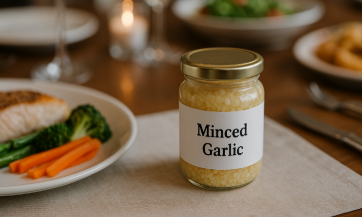
Minced garlic
(Food ingredient obtained from Allium sativum cloves – fresh, refrigerated, dehydrated or processed)
Description
Minced garlic is prepared from peeled garlic cloves finely chopped into uniform particles.
Commercial forms include fresh-minced, refrigerated, frozen, dehydrated/rehydrated, and oil-packed versions.
It provides immediate aroma, pungency and savoury depth without the handling time of whole cloves.
Colour ranges from creamy-white to pale yellow, depending on processing.
Indicative nutritional values (per 100 g, fresh minced garlic)
(Typical values; dehydrated forms show higher nutrient density per 100 g due to lower moisture.)
Energy: 140–150 kcal
Water: ≈ 58–65 g
Protein: 6–7 g
Total fat: 0.3–0.6 g
Carbohydrates: 30–33 g
Fibre: 2 g
Sodium: naturally low unless salt is added in processing
Micronutrients: small amounts of vitamin C, calcium, phosphorus, selenium, manganese, and bioactive sulfur compounds.
Key constituents
Organosulfur compounds
Alliin, the precursor to allicin (formed when garlic is cut or crushed).
Allicin → responsible for pungency and antimicrobial activity.
Diallyl sulfides, ajoene, S-allyl cysteine, and related volatiles that define aroma intensity.
Carbohydrates
Minor components
Production process
(Varies by type: fresh-minced, refrigerated, dehydrated, or oil-packed.)
Physical properties
Colour: creamy-white to yellowish depending on processing and acidity.
Aroma: intense, sulphury, characteristic of freshly cut garlic.
Texture: fine, moist granules (fresh/refrigerated), or dry crispy granules (dehydrated).
Water activity: high in fresh versions; low in dehydrated forms (shelf-stable).
Sensory and technological properties
Quickly releases aroma and flavour, more intense than garlic powder but milder than crushed garlic.
In sauces and cooked dishes it offers rapid diffusion of garlic notes.
Acidified minced garlic has a brighter, slightly tangy flavour due to the acidic medium.
Dehydrated versions hydrate rapidly and give clean, sharp garlic aroma in hot preparations.
Food applications
Domestic/foodservice
Seasoning for soups, sauces, marinades, sautés, stir-fries, dressings, vegetable dishes, meats and seafood.
Used in garlic bread, dips, aioli, stews and slow-cooked dishes.
Industry
Ingredient in canned sauces, ready meals, frozen entrées, spice blends, condiments, flavoured oils and meat products.
Dehydrated minced garlic is widely used in seasoning mixes, snack coatings, instant meals, and dry soup bases.
Oil-packed forms used in pasta sauces, dressings and spreads.
Nutrition & health
Provides phytochemicals with potential physiological effects, including allicin and related sulfur compounds associated with antioxidant and antimicrobial properties.
Caloric contribution is modest; main nutritional role is flavour and bioactive content, not macronutrients.
Contains small amounts of vitamin C, manganese, and selenium.
Garlic may cause digestive sensitivity in some individuals due to fructans, a type of FODMAP.
Heating reduces allicin content but maintains general garlic flavour.
Portion note:
Typically used in small quantities: 3–6 g per portion (≈ ½–1 tsp) in home cooking; higher levels in sauces or blended products.
Allergens and intolerances
Garlic is not a major allergen, but:
can cause intolerance in individuals sensitive to FODMAPs (fructans);
can rarely trigger contact dermatitis or mild allergic reactions;
oil-packed garlic requires careful handling due to risks related to anaerobic storage if not properly acidified.
Commercial products may include preservatives or acidifiers; check labels for sulphites or other additives.
Quality & specification parameters
Appearance: uniform mince; absence of green sprouts or darkened particles.
Aroma: strong garlic scent without sour, fermented or rancid notes.
Moisture: controlled depending on the product (fresh vs dried).
Particle size: consistent, often specified for industrial use.
Chemical: pH strictly controlled in acidified versions (to ensure safety).
Microbiological: absence of pathogens; low yeast/mold counts; validated thermal or acidification steps for refrigerated/oil-packed forms.
Storage & shelf-life
Fresh minced: refrigerated at 0–4 °C, typically 1–3 weeks.
Refrigerated acidified: refrigerated, shelf-life 2–6 months unopened; shorter after opening.
Dehydrated minced: shelf-stable for 12–36 months in airtight packaging.
Oil-packed: refrigerate after opening; observe use-by dates strictly.
Avoid moisture intrusion in dried products; avoid temperature abuse in refrigerated and oil-based products.
Safety & regulatory
Must be produced under GMP/HACCP.
Oil-packed garlic requires strict acidification or heat treatment to prevent Clostridium botulinum growth.
Compliance with limits for preservatives, acidity, microbiological criteria and labelling (e.g., allergen statements, additives).
Labelling
Troubleshooting
Green/blue coloration → reaction of sulfur compounds with amino acids or metals; controlled by pH and processing conditions.
Bitter flavour → overcooking or garlic harvested too mature.
Off-odours → microbial spoilage or oxidative degradation.
Loss of pungency → prolonged storage, excessive heating, or low-quality raw material.
Clumping in dried minced garlic → moisture exposure; improve packaging or include desiccant.
Sustainability & supply chain
Garlic cultivation has a moderate environmental footprint, though fertiliser use and transport (often long-distance) contribute to impact.
Key sustainability concerns:
Processing plants aim to optimise:
water use,
energy efficiency (especially drying),
waste utilisation (peels can be composted or used in extracts).
INCI functions (cosmetics)
When used in cosmetic products (rare), appears as Allium Sativum Bulb Extract:
antimicrobial and purifying functions,
potential skin-conditioning activity,
used in niche formulations (e.g., scalp lotions).
Conclusion
Minced garlic is a high-impact aromatic ingredient that offers convenience, rapid flavour release and versatility in both home cooking and industrial food production. Its technological functionality varies with format (fresh, refrigerated, dried, oil-packed), allowing application across sauces, ready meals, spice mixes and snack seasonings. Nutritionally modest, it is valued primarily for its bioactive sulfur compounds, aroma and culinary performance, provided that safety (especially in oil-packed forms) and proper storage are maintained.
Mini-glossary
SFA/MUFA/PUFA – saturated/monounsaturated/polyunsaturated fatty acids; present in negligible amounts in garlic.
FODMAPs – fermentable carbohydrates (including fructans) that may cause digestive discomfort in sensitive individuals.
GMP/HACCP – good manufacturing practices / hazard analysis and critical control points for safe garlic processing.
MAP – modified atmosphere packaging, used for fresh refrigerated minced garlic.
Studies
It has been shown to be antihypertensive (1), cardioprotective (degenerative diseases of the cardiovascular system) (2), cholesterol-lowering against the risk of atherosclerosis (3).
Its intake reduces the risk of prostate cancer (4).
Useful in the wound healing process (5).
Garlic studies
References_________________________________________________________________________
(1) Ried K, Frank OR, Stocks NP. Aged garlic extract reduces blood pressure in hypertensives: a dose-response trial. Eur J Clin Nutr. 2013 Jan;67(1):64-70. doi: 10.1038/ejcn.2012.178.
Abstract. Background/objectives: Hypertension affects about 30% of adults worldwide. Garlic has blood pressure-lowering properties and the mechanism of action is biologically plausible. Our trial assessed the effect, dose-response, tolerability and acceptability of different doses of aged garlic extract as an adjunct treatment to existing antihypertensive medication in patients with uncontrolled hypertension. Subjects/methods: A total of 79 general practice patients with uncontrolled systolic hypertension participated in a double-blind randomised placebo-controlled dose-response trial of 12 weeks. Participants were allocated to one of three garlic groups with either of one, two or four capsules daily of aged garlic extract (240/480/960 mg containing 0.6/1.2/2.4 mg of S-allylcysteine) or placebo. Blood pressure was assessed at 4, 8 and 12 weeks and compared with baseline using a mixed-model approach. Tolerability was monitored throughout the trial and acceptability was assessed at 12 weeks by questionnaire. Results: Mean systolic blood pressure was significantly reduced by 11.8±5.4 mm Hg in the garlic-2-capsule group over 12 weeks compared with placebo (P=0.006), and reached borderline significant reduction in the garlic-4-capsule group at 8 weeks (-7.4±4.1 mm Hg, P=0.07). Changes in systolic blood pressure in the garlic-1-capsule group and diastolic blood pressure were not significantly different to placebo. Tolerability, compliance and acceptability were high in all garlic groups (93%) and highest in the groups taking one or two capsules daily. Conclusions: Our trial suggests aged garlic extract to be an effective and tolerable treatment in uncontrolled hypertension, and may be considered as a safe adjunct treatment to conventional antihypertensive therapy.
(2) Zeb I, Ahmadi N, Nasir K, Kadakia J, Larijani VN, Flores F, Li D, Budoff MJ. Aged garlic extract and coenzyme Q10 have favorable effect on inflammatory markers and coronary atherosclerosis progression: A randomized clinical trial. Cardiovasc Dis Res. 2012 Jul;3(3):185-90. doi: 10.4103/0975-3583.98883. -
Abstract. Background: Aged garlic extract (AGE) and coenzyme Q10 (CoQ10) have been shown to affect multiple cardiovascular risk factors. The current study evaluates the effect of AGE combined with CoQ10 on inflammatory markers and progression of coronary atherosclerosis compared with placebo. Methods and results: In this placebo-controlled, double-blind, randomized trial, 65 intermediate risk firefighters (age 55 ± 6 years) were treated with a placebo capsule or a capsule containing AGE and CoQ10 (AGE+CoQ10, 1200 and 120 mg, respectively) daily for 1 year. All participants underwent coronary artery calcium (CAC) scanning and C-reactive protein (CRP) at baseline and at 12 months. At 1 year, mean CAC progression was significantly lower in AGE+CoQ10 (32 ± 6 vs. 58 ± 8, P = 0.01) than placebo. Similarly, CRP were significantly decreased in AGE+CoQ10 compared with placebo (-0.12 ± 0.24 vs. 0.91 ± 0.56 mg/L, P < 0.05). After adjustment for age, gender, conventional cardiac risk factors, and statin therapy, AGE+CoQ10 was associated with 3.99 fold (95% 1.3-12.2, P = 0.01) lack of CAC progression compared with the placebo. Conclusion: AGE+CoQ10 are associated with beneficial effects on inflammatory markers and reduced progression of coronary atherosclerosis.
(3) Lu Y, He Z, Shen X, Xu X, Fan J, Wu S, Zhang D. Cholesterol-lowering effect of allicin on hypercholesterolemic ICR mice. Oxid Med Cell Longev. 2012;2012:489690. doi: 10.1155/2012/489690.
Abstract. Allicin was discussed as an active compound with regard to the beneficial effects of garlic in atherosclerosis. The aim of this study was to investigate the cholesterol-lowering properties of allicin. In order to examine its effects on hypercholesterolemia in male ICR mice, this compound with doses of 5, 10, or 20 mg/kg body weight was given orally daily for 12 weeks. Changes in body weight and daily food intake were measured regularly during the experimental period. Final contents of serum cholesterol, triglyceride, glucose, and hepatic cholesterol storage were determined. Following a 12-week experimental period, the body weights of allicin-fed mice were less than those of control mice on a high-cholesterol diet by 38.24 ± 7.94% (P < 0.0001) with 5 mg/kg allicin, 39.28 ± 5.03% (P < 0.0001) with 10 mg/kg allicin, and 41.18 ± 5.00% (P < 0.0001) with 20 mg/kg allicin, respectively. A decrease in daily food consumption was also noted in most of the treated animals. Meanwhile, allicin showed a favorable effect in reducing blood cholesterol, triglycerides, and glucose levels and caused a significant decrease in lowering the hepatic cholesterol storage. Accordingly, both in vivo and in vitro results demonstrated a potential value of allicin as a pronounced cholesterol-lowering candidate, providing protection against the onset of atherosclerosis.
(4) Zhou XF, Ding ZS, Liu NB.Allium vegetables and risk of prostate cancer: evidence from 132,192 subjects Asian Pac J Cancer Prev. 2013;14(7):4131-4.
Abstract. Objective: To evaluate the relationship between allium vegetable intake and risk of prostate cancer. Methods: A systematic literature search up to May 2013 was carried out in PubMed, EMBASE, Scopus, Web of Science, Cochrane register, and Chinese National Knowledge Infrastructure (CNKI) databases, and the references of retrieved articles were also screened. The summary relative risks with 95% confidence interval for the highest versus the lowest intake of allium vegetables were calculated. Heterogeneity and publication bias were also evaluated. Results: A total of nine epidemiological studies consisting of six case-control and three prospective cohort studies were included. We found a significantly decreased risk of prostate cancer for intake of allium vegetables (OR = 0.82, 95% CI 0.70, 0.97). Moreover, in the subgroup analysis stratified by allium vegetable types, significant associations were observed for garlic (OR = 0.77, 95% CI 0.64-0.91) but not onions (OR = 0.84, 95% CI 0.62-1.13). Conclusions: Allium vegetables, especially garlic intake, are related to decreased risk of prostate cancer. Because of the limited number of studies, further well-designed prospective studies are warranted to confirm the findings of our study.
Salem S, Salahi M, Mohseni M, Ahmadi H, Mehrsai A, Jahani Y, Pourmand G.Major dietary factors and prostate cancer risk: a prospective multicenter case-control study. Nutr Cancer. 2011;63(1):21-7. doi: 10.1080/01635581.2010.516875.
Abstract. The association between diet and prostate cancer (PC) risk, although suggestive, still remains largely elusive particularly in the Asian population. This study sought to further evaluate the possible effects of different dietary factors on risk of PC in Iran. Using data from a prospective hospital-based multicenter case-control study, dietary intakes of red meat, fat, garlic, and tomato/tomato products, as well as thorough demographic and medical characteristics, were determined in 194 cases with the newly diagnosed, clinicopathologically confirmed PC and 317 controls, without any malignant disease, admitted to the same network of hospitals. Odds ratios (ORs) and corresponding 95% confidence intervals (CIs) were obtained after adjustment for major potential confounders, including age, body mass index, smoking, alcohol, education, occupation, family history of PC, and total dietary calories. Comparing the highest with the lowest tertile, a significant trend of increasing risk with more frequent consumption was found for dietary fat (OR: 1.79, 95% CI: 1.71-4.51), whereas inverse association was observed for tomato/tomato products (OR: 0.33, 95% CI: 0.16-0.65). A nonsignificant increase in PC risk was revealed for dietary red meat (OR: 1.69, 95% CI: 0.93-3.06). For garlic consumption, a borderline reduction in risk was observed (OR: 0.58, 95% CI: 0.32-1.01; P = 0.05). In conclusion, our study supports the hypothesis that total fat may increase PC risk and tomatoes/tomato products and garlic may protect patients against PC.
Colli JL, Amling CL. Chemoprevention of prostate cancer: what can be recommended to patients? Curr Urol Rep. 2009 May;10(3):165-71. Review.
Abstract. Prostate cancer is third to lung and colon cancer as the cause of cancer-related deaths in American men. It is estimated that there will have been more than 28,000 deaths and 186,000 new cases in 2008 that will impose a significant burden on national health care costs. Chemoprevention aims to reduce both incidence and mortality through the use of agents to prevent, reverse, or delay the carcinogenic process. This study provides clinicians with information on some chemoprevention agents that have been considered to reduce prostate cancer risks, including 5-alpha-reductase inhibitors; statins (a class of compounds used to reduce cholesterol); NSAIDs; selenium; vitamins E and D; lycopene; allium vegetables (garlic, scallions, onions, chives, and leeks); soy/isoflavones; and green tea polyphenols. The evidence to support prostate cancer risk reduction benefits for each chemoprevention agent based on a review of the literature is provided.
(5) Alhashim M, Lombardo J. Effect of Topical Garlic on Wound Healing and Scarring: A Clinical Trial. Dermatol Surg. 2019 Sep 2. doi: 10.1097/DSS.0000000000002123.
Abstract. Background: Historically, garlic containing compounds have been used on wounds to improve healing and ward off infection. Researchers have tested many of these ancient ointments, discovering that garlic is a common ingredient in those that are effective. Objective: To determine the efficacy of topical garlic on surgical wounds compared with Vaseline by analysis of visual analog scales and digital photograph analysis. Materials and methods: Seventeen patients with 2 skin excisions applied a 30% garlic ointment to one surgical wound and Vaseline to the other surgical wound twice daily. They were followed up at 2 weeks and 4 weeks post-op. Digital photographs were taken of the sites, and wound visual analog scales were filled out by the patient and the physician. Results: Patients and the onsite physician stated the garlic site healed better in 59% and 65% of the wounds, respectively, at 2 weeks. At 4 weeks, the patients and the onsite physician stated the garlic site healed better in 76% and 88% of wounds, respectively. Digital photograph analysis revealed less erythema at the garlic sites (p-value = .02). Conclusion: Surgical wounds treated with 30% garlic ointment healed with more cosmetically appealing scars than the Vaseline-treated sites.




