



Vegetable broth
(broth obtained from vegetables, herbs and sometimes spices; liquid, concentrated or dehydrated form)
Description
Liquid preparation obtained by boiling or infusing vegetables, herbs and sometimes spices in water, with or without added salt, vegetable fats and other seasonings.
Available as:
fresh broth (homemade or foodservice);
ready-to-use liquid broth (carton/bottle);
liquid or paste concentrates;
dehydrated bouillon cubes or granules, to be reconstituted in water.
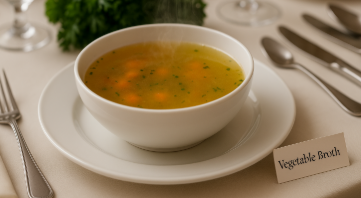
Typical colour ranges from pale yellow to amber, sometimes light green or light brown depending on the vegetables used and concentration; flavour is delicate, “vegetable-like”, with variable intensity.
Indicative nutritional values (per 100 g/ml ready-to-eat vegetable broth)
(Clear broth, ready to consume; average values, strongly recipe- and concentration-dependent.)
Energy: 5–15 kcal
Water: ≈ 97–99 g
Protein: 0.2–0.8 g
Total fat: 0–0.5 g
First occurrence: SFA/MUFA/PUFA = saturated/monounsaturated/polyunsaturated fatty acids; vegetable broth usually contains very little fat (from added oils or vegetable extracts), with a very low share of saturates. This is favourable for cardiometabolic profile within a balanced diet, especially when the rest of the meal also moderates saturated fat intake.
Carbohydrates: 0.5–2 g (mainly simple sugars and dextrins extracted from vegetables)
Fibre: 0 g (most fibre remains in the discarded solids)
Sodium: 200–600 mg per 100 ml in standard commercial products; “low-salt” versions may be considerably lower
Potassium, calcium, magnesium: trace to low amounts, depending on vegetable load and water/vegetable ratio
For dehydrated cubes/granules, values per 100 g are very different (high density of salt, flavours and nutrients), but the typical serving is only 4–10 g per 500–1000 ml water.
Key constituents
Water as the dominant component.
Water-soluble compounds extracted from vegetables and herbs:
simple sugars, organic acids, minerals, some free amino acids, natural nucleotides and non-protein nitrogen compounds.
Aroma compounds:
aldehydes, terpenes, esters, sulphur compounds (from onion, garlic, leek, celery, etc.) that define the aromatic profile.
Minerals:
primarily sodium (if added), plus potassium and other ions extracted from vegetables.
In concentrated/dehydrated products:
may also contain vegetable fats (e.g. sunflower oil), yeast extract, hydrolysed vegetable proteins, starches and other carriers/functional ingredients.
Production process
Fresh/homemade broth:
washing and trimming of vegetables;
chopping into coarse pieces;
cooking in cold water brought to a boil, then simmering for a variable time (typically 30–90 minutes);
draining or filtering to separate liquid from cooked vegetables;
optional addition of salt, oil, herbs and spices at the end.
Industrial liquid broth:
selection of vegetables (fresh, frozen or concentrated), mixing with water;
controlled cooking/extraction (time/temperature);
filtration/centrifugation;
possible partial concentration;
addition of salt, natural flavours, vegetable fats, acidity regulators;
thermal treatment (pasteurisation or sterilisation) and aseptic filling.
Bouillon cubes / granules:
preparation of a mixture of salt, vegetable extracts, fats, yeast extracts, spices, dehydrated vegetables, starches and other carriers;
blending and forming (pressing into cubes) or granulation;
drying (if needed), cooling and packaging.
Physical properties
Physical state: low-viscosity liquid, similar to water; slightly higher viscosity for concentrated broths or those containing thickeners.
Colour: pale yellow to amber, light green or pale orange/brown, depending on carrots, celery, onion, tomato, herbs, and reduction level.
pH: typically 5.0–6.5, influenced by recipe (e.g. presence of tomato or acidulants).
Stability: in liquid form, vegetable broth has high water activity and needs refrigeration or heat treatment for safe storage; dehydrated forms are much more microbiologically stable.
Sensory and technological properties
Aroma: vegetal, herbal, sometimes slightly sweet or roasted; strongly dependent on the combination of vegetables (e.g. celery–carrot–onion), herbs (parsley, rosemary, bay, thyme) and spices (pepper, nutmeg).
Taste: umami–salty–slightly sweet profile, with variable intensity; salt, yeast extract and vegetable extracts can amplify umami.
Main technological functions:
liquid base for soups, sauces, risottos, stews and braises;
carrier for spices and aromatic compounds, ensuring even flavour distribution;
contributes to glaze and shine when reduced.
Dehydrated cubes/granules are concentrated ingredients that make dosing and storage easier and allow standardised flavour in industrial production.
Food applications
Home cooking and foodservice:
base for vegetable or cereal soups, legume soups, pureed vegetable soups;
cooking liquid for risottos, couscous, bulgur, barley, spelt and other grains;
liquid for vegetable braises, stews, light sauces;
flavour adjustment and dilution medium for ready dishes.
Food industry:
ready-to-eat soups, chilled/frozen ready meals, dehydrated soup mixes;
instant broth powders;
seasoning bases for savoury snacks (chips, crackers, extruded snacks) via dry broth powders.
Nutrition & health
Vegetable broth typically has low energy density, with negligible fat and protein content, acting more as a flavour and fluid vehicle than as a primary nutrient source.
It may provide small amounts of minerals (especially potassium) and bioactive aromatic compounds extracted from vegetables, though the contribution is much lower than eating whole vegetables.
The main nutritional concern is usually sodium content, especially in:
conventional cubes/granules;
standard ready-to-use liquid broths.
Excess sodium intake is associated with increased risk of hypertension and cardiovascular disease; therefore it is advisable to:
prefer low-salt broths or use fewer cubes/concentrate;
avoid extra salt in cooking or at the table when using a salty broth;
rely more on herbs and spices to maintain appealing flavour with less salt.
Vegetable broth can be useful as a light, rehydrating food in light diets, convalescence or whenever a liquid/semi-liquid texture is required.
Serving note: a typical serving is 200–250 ml ready-to-eat broth (one bowl), providing roughly 10–30 kcal, with salt content that may reach 0.8–1.5 g per serving in standard commercial products and should be considered in daily sodium balance.
Allergens and intolerances
Vegetable broth does not inherently contain major animal-derived allergens, but may include:
celery, which is a regulated allergen in many jurisdictions;
sometimes soy, gluten, milk (e.g. cheese powders, whey), yeast, mustard or other allergenic ingredients in industrial recipes.
It is essential to check the label of cubes, granules and ready broths to identify declared allergens and possible traces.
For vegetarian/vegan diets:
watch for animal fats, meat or chicken extracts, which may appear in “mixed” or poorly specified broths;
verify “vegetarian” / “vegan” claims and ensure absence of animal ingredients.
Quality and specifications (typical themes)
Liquid broth:
declared composition (vegetables, minimum extract content, salt);
key chemical-physical parameters (pH, Brix for concentrated products);
absence of sensory defects (off-flavours, abnormal turbidity, phase separation).
Dehydrated products (cubes, granules):
controlled moisture content;
salt, fat, protein, vegetable extract and additives within specification;
flowability, minimal lumping and good dispersion in water.
Microbiology:
for thermally treated liquid broths: absence of pathogens, low counts and stability over shelf-life;
for dry products: very low microbial loads and absence of relevant moulds or toxins.
Storage and shelf-life
Homemade fresh broth:
cool quickly to ≤ 4 °C;
use within 1–3 days;
for longer storage, portion and freeze (commonly up to 2–3 months).
Commercial liquid broth:
sterilised/UHT products: ambient storage until the stated best-before date, then refrigerate and consume within a few days after opening;
pasteurised products: require refrigerated distribution.
Cubes/granules:
store in a cool, dry place with packaging tightly closed;
avoid high humidity to prevent caking and loss of free-flowing properties;
typical shelf-life: 12–24 months in unopened packaging.
Safety and regulatory
Vegetable broth is covered by general rules for compound foods, ingredients, additives and food safety.
Industrial production follows GMP/HACCP, with control of:
quality and safety of vegetables (residues within limits, hygienic processing);
pasteurisation/sterilisation parameters for liquid products;
dosage of additives (e.g. flavour enhancers, antioxidants, acidity regulators) where used.
Allergen declaration and additive labelling must fully comply with local regulations.
Labeling
Possible denominations:
“vegetable broth”, “vegetable stock”, “vegetable bouillon”, “vegetable broth mix”, “vegetable bouillon cube/granules”.
Labels should include:
full ingredient list in descending order, with clear highlighting of allergens (e.g. celery, soy, gluten, milk);
nutrition declaration (energy, fat, carbohydrates, protein, salt) per 100 ml/100 g and often per portion of reconstituted broth;
instructions for use (amount of product per litre of water).
Claims such as “low salt”, “no added MSG”, “no hydrogenated fats” must be supported by actual composition and comply with claim regulations.
Troubleshooting
Broth too salty
Cause: excessive cube/granule use or concentrated broth in already salty recipes.
Actions: dilute with water, add low-salt vegetables or cereals, reduce or omit added salt in subsequent preparation steps.
Flat / weak flavour
Cause: insufficient base, too few vegetables or too short cooking time.
Actions: increase the amount of vegetables or concentrated base, extend simmering (or slightly reduce broth volume), use fresh herbs and spices.
Cloudy broth when a clear broth is desired
Cause: vigorous boiling, foam not removed, excessive stirring.
Actions: cook at a gentle simmer, skim foam from the surface, filter through a fine sieve or cloth.
Sediment and phase separation in packaged liquid broths
Cause: dispersion instability, long storage, temperature fluctuations.
Actions: shake before use; in formulation, consider light stabilisers or suitable homogenisation steps.
Sustainability and supply chain
Vegetable broth can help reduce food waste when made using:
less prized vegetable parts (stems, outer leaves, trimmings that are still clean and sound);
surplus vegetables that still meet quality and safety standards.
Industrial production should consider:
efficient energy use in cooking, concentration and thermal treatment;
proper management of washing and process water, including BOD/COD control;
recyclable packaging and optimised pack sizes to reduce material and transport impacts.
Sourcing vegetables from sustainable farming systems (integrated or organic agriculture) can be a differentiating element communicated to consumers.
Main INCI functions (cosmetics)
Cosmetics do not use “vegetable broth” as such, but may include individual plant extracts from the same vegetables (carrot, celery, onion, etc.), each with its own INCI name.
Typical functions: skin conditioning, antioxidant, soothing or sensorial support (vegetal fragrance).
Cosmetic use requires specific standards for purity, solvents, preservatives and microbiological quality.
Conclusion
Vegetable broth is a low-calorie culinary base that mainly provides water, flavour and a modest contribution of minerals, making it highly versatile for home cooking, foodservice and industrial applications. The key technical–nutritional aspect to watch is its salt content, which can be high in cubes, granules and some liquid broths. Choosing low-salt products, relying on herbs and spices instead of extra salt, and favouring broths with a generous vegetable content can significantly improve the overall nutritional profile of dishes while maintaining good sensory quality and supporting more sustainable use of vegetable raw materials.
Mini-glossary
SFA/MUFA/PUFA – Saturated/monounsaturated/polyunsaturated fatty acids; in vegetable broth total fat is very low, but diets overall should keep saturated fats moderate and favour unsaturated fats for cardiovascular health.
aw (water activity) – Measure of “free” water available for microbial growth; values near 1 (as in liquid broth) indicate high perishable potential.
GMP/HACCP – Good Manufacturing Practices / Hazard Analysis and Critical Control Points; core systems to ensure hygienic, safe and traceable food production.
BOD/COD – Biochemical/Chemical Oxygen Demand; indicators of organic load in wastewater, used to design and monitor treatment plants.
FIFO – First In, First Out; stock rotation rule ensuring older lots are used before newer ones, reducing waste and expiry issues.

