



Enriched wheat flour
(refined wheat flour fortified with vitamins and minerals; bleached or unbleached)
Description
• Refined flour milled from Triticum aestivum endosperm and fortified with selected micronutrients (typically iron and B-vitamins) to restore or enhance levels reduced during milling.
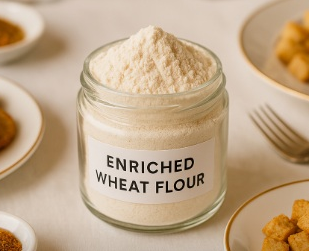
• Fine, free-flowing off-white powder; neutral aroma and mild cereal taste; formulated for consistent baking performance (strength and color).
• Common market names: “enriched flour,” “enriched wheat flour,” “wheat flour (enriched).”
Indicative nutritional values (per 100 g; typical all-purpose grade)
• Energy: 350–370 kcal • Protein: 9–12 g • Total fat: 1–2 g • Carbohydrates: 72–76 g
• Dietary fiber: 2–3 g • Sugars: <1 g • Sodium: <5 mg
• Fortified micronutrients (typical targets, jurisdiction-dependent): Iron ~4–5 mg; Thiamin (B1) ~0.5–0.7 mg; Riboflavin (B2) ~0.3–0.5 mg; Niacin (B3) ~4–6 mg; Folic acid ~120–180 µg.
Key constituents
• Starch (predominantly amylopectin with ~25–30% amylose) providing structure and gelatinization.
• Gluten-forming proteins (gliadins + glutenins) enabling dough elasticity and gas retention.
• Lipids (~1–2%), minerals (ash ~0.40–0.65% on 14% moisture basis), residual enzymes (amylases, proteases).
• Fortificants: reduced iron/ferrous sulfate, thiamine mononitrate, riboflavin, niacin/niacinamide, folic acid; calcium sometimes added.
Production process
• Wheat reception and cleaning → tempering (moisture conditioning) → roller milling with sifting and purification (endosperm separation) → flour blending to specification → optional bleaching/maturing → addition of premix of vitamins/minerals → quality control → packing.
• In many markets, enrichment levels are set by regulation; calcium and enzymes (amylase) may be added for performance.
Physical properties
• Particle size: typically 80–95% passing 212 μm; bulk density 0.55–0.75 g/mL.
• Color: high brightness (L* > 90); low speck count.
• Moisture: ≤14.0% (legal/contract limit).
• Dough metrics (typical all-purpose): Alveograph W 150–250; P/L 0.5–0.9; Falling Number 250–350 s; water absorption 55–63%.
Sensory and technological properties
• Forms gluten upon hydration and mixing → elastic, extensible dough with good gas retention.
• Amylase activity supports fermentation and crust browning; controlled ash/color for white crumb.
• Versatile performance across yeasted breads, pastries, cookies, batters, and thickening applications.
Food applications
• Bakery: pan and hearth breads, rolls, buns, pizza bases, laminated doughs, cakes, muffins, cookies, crackers.
• Culinary/industrial: batters/breading, roux, noodles, tortillas, sauces and soups as a thickener, snack pellets.
• Premixes: pancake/waffle mixes, cake mixes, instant gravies.
Nutrition and health
• Enrichment provides iron and B-vitamins (B1, B2, B3, folic acid) that support energy metabolism and, for folate, neural-tube-defect risk reduction in pregnancy.
• Lower fiber and micronutrient diversity than whole-grain flour; for higher fiber and micronutrients, combine with whole wheat.
• Moderate-to-high GI (glycemic index); portion control and pairing with fats/proteins/fiber can temper post-prandial response.
• Contains gluten; unsuitable for celiac disease and certain wheat/gluten sensitivities.
Serving note
• Typical baker’s inclusions: breads 100% flour basis; cakes 60–80% of batter weight; sauces/roux 6–10% of finished weight (guide values; adjust to recipe).
Allergens and intolerances
• Contains wheat (gluten) — a major allergen requiring clear labeling.
• May contain traces of soy (from processing aids) or other cereals via cross-contact unless controlled.
• Gluten-free diets must avoid enriched wheat flour; use certified gluten-free alternatives.
Quality and specifications (typical values)
• Moisture ≤14.0% • Protein (N×5.7) 9.0–12.0% • Ash 0.40–0.65% (14% mb)
• Wet gluten 24–32% • Gluten index ≥ 80 • Falling Number 250–350 s
• Alveograph W 150–250; P/L 0.5–0.9 • Granulation ≥ 80–95% pass 212 μm
• Microbiology: Salmonella absent/25 g; low total plate count; molds/yeasts within flour norms
• Contaminants: mycotoxins (e.g., DON) within regulatory limits; heavy metals and pesticide residues compliant.
Storage and shelf-life
• Store cool, dry, dark (≤ 25 °C; RH < 65%), pest-free, off the floor; keep sealed to prevent moisture uptake and infestation.
• Shelf-life: typically 6–12 months unopened (shorter in warm/humid climates).
• Avoid odors/chemicals; flour readily absorbs volatiles.
Safety and regulatory
• Produced under GMP/HACCP; enrichment levels and permitted bleaching/maturing agents are jurisdiction-specific.
• “Enriched” designation generally requires listing of added nutrients in the ingredient statement and compliance with minimum/maximum levels.
• Country rules may differ on folic acid addition and calcium requirements; verify local standards.
Labeling
• Example (US style): “Enriched Wheat Flour (Wheat Flour, Niacin, Reduced Iron, Thiamine Mononitrate, Riboflavin, Folic Acid).”
• Declare allergens (“wheat”), enrichment nutrients, and any processing aids (enzymes) as required.
• Optional descriptors: “bleached/unbleached,” “bromate-free,” “non-GMO” if substantiated.
Troubleshooting
• Low loaf volume/weak dough → protein/gluten strength too low; increase protein, add vital wheat gluten, adjust water/mixing.
• Tearing/stiff dough → overly strong flour or low hydration; reduce mixing, increase hydration, blend with softer flour.
• Gray crumb/specks → higher ash or bran carryover; tighten sifting/specs.
• Poor browning → low amylase; add fungal amylase or small sugar addition.
• Lumps/caking or pests → humidity/infestation; improve storage, fumigation controls, sieving before use.
Sustainability and supply chain
• Impacts driven by wheat cultivation (land, nitrogen fertilizer, water) and milling energy.
• By-products (bran, germ) valorized for feed or edible oil/extracts; dust control and explosion prevention are critical.
• In-plant: energy recovery, low-loss conveying, and wastewater treatment with BOD/COD reduction; recyclable sacks/liners.
Main INCI functions (cosmetics)
• Triticum Vulgare (Wheat) Flour — absorbent, viscosity-controlling; limited cosmetic use due to gluten allergen considerations.
• More common cosmetic derivatives: Hydrolyzed Wheat Protein, Triticum Vulgare (Wheat) Germ Oil (separate ingredients with distinct safety profiles).
Conclusion
Enriched wheat flour is a consistent, high-functionality baking ingredient fortified with iron and B-vitamins to support nutritional adequacy. It delivers reliable dough formation, fermentation performance, and crumb structure across a wide range of bakery and culinary applications when stored and handled correctly.
Mini-glossary
• GMP/HACCP — Good manufacturing practices / hazard analysis and critical control points; food-safety systems used in mills.
• GI — Glycemic index; relative measure of post-prandial blood-glucose response.
• W (Alveograph W) — Dough strength index from the Chopin alveograph test.
• DON — Deoxynivalenol; a wheat mycotoxin (vomitoxin) with regulated limits.
• BOD/COD — Biochemical / chemical oxygen demand; indicators of organic load in wastewater.
• aw — Water activity; proportion of free water available for microbial growth (low in dry flour).
Studies
Resistant starch is the fraction of starch that escapes digestion in the small intestine (1) and is considered a form of dietary fiber with beneficial health properties (2). Because foods high in resistant starch are digested more slowly, they have been shown to improve insulin response and increase satiety (3).
The advantages of resistant starch also extend to colon health where fermentation occurs in the large intestine (4).
The most relevant studies on this ingredient have been selected with a summary of their contents:
References_______________________________________________
(1) Ann J Slade, Cate McGuire, Dayna Loeffler, Jessica Mullenberg, Wayne Skinner, Gia Fazio, Aaron Holm, Kali M Brandt, Michael N Steine, John F Goodstal, Vic C Knauf Development of high amylose wheat through TILLING BMC Plant Biol. 2012; 12: 69. Published online 2012 May 14. doi: 10.1186/1471-2229-12-69
Abstract. Background: Wheat (Triticum spp.) is an important source of food worldwide and the focus of considerable efforts to identify new combinations of genetic diversity for crop improvement. In particular, wheat starch composition is a major target for changes that could benefit human health. Starches with increased levels of amylose are of interest because of the correlation between higher amylose content and elevated levels of resistant starch, which has been shown to have beneficial effects on health for combating obesity and diabetes. TILLING (Targeting Induced Local Lesions in Genomes) is a means to identify novel genetic variation without the need for direct selection of phenotypes. Results: Using TILLING to identify novel genetic variation in each of the A and B genomes in tetraploid durum wheat and the A, B and D genomes in hexaploid bread wheat, we have identified mutations in the form of single nucleotide polymorphisms (SNPs) in starch branching enzyme IIa genes (SBEIIa). Combining these new alleles of SBEIIa through breeding resulted in the development of high amylose durum and bread wheat varieties containing 47-55% amylose and having elevated resistant starch levels compared to wild-type wheat. High amylose lines also had reduced expression of SBEIIa RNA, changes in starch granule morphology and altered starch granule protein profiles as evaluated by mass spectrometry. Conclusions: We report the use of TILLING to develop new traits in crops with complex genomes without the use of transgenic modifications. Combined mutations in SBEIIa in durum and bread wheat varieties resulted in lines with significantly increased amylose and resistant starch contents.
(2) Englyst HN, Macfarlane GT. Breakdown of resistant and readily digestible starch by human gut bacteria. J Sci Food Agric. 1986;37:699–706.
Abstract. Cooking and processing of starch‐containing foodstuffs results in a portion of the starch becoming resistant to hydrolytic enzymes secreted in the small intestine of man. In order to determine whether this resistant starch (RS) was degraded in the colon, samples of RS and readily digestible starch (RDS) for comparisons were incubated with (a) cell‐free supernatants from faecal suspensions and (b) washed faecal bacterial cell suspensions. The data obtained showed that, whereas pancreatic amylase and faecal supernatants hydrolysed RDS, with the production of oligosaccharides, RS totally resisted breakdown. In contrast, both RS and RDS were completely degraded by the washed bacterial cells with the generation of volatile fatty acids (VFA) and organic acids. Hydrolysis and fermentation of RDS was extremely rapid and, as a consequence, oligosaccharides and lactate initially accumulated in the culture medium. RS was broken down more slowly, howevér, and oligosaccharides and lactate never accumulated. The rate of polysaccharide hydrolysis had a significant effect on the quantities of VFA produced, in that 54% of carbohydrate was fermented to VFA in cultures incubated with RDS as sole carbon source as compared to only 30% in cultures incubated with RS. However no qualitative difference was observed in the VFA produced by fermentation of RDS or RS.
(3) Robertson MD, Currie JM, Morgan LM, Jewell DP, Frayn KN. Prior short-term consumption of resistant starch enhances postprandial insulin sensitivity in healthy subjects. Diabetologia. 2003;46:659–665.
Abstract. Aims/hypothesis: Diets rich in insoluble-fibre are linked to a reduced risk of both diabetes and cardiovascular disease; however, the mechanism of action remains unclear. The aim of this study was to assess whether acute changes in the insoluble-fibre (resistant starch) content of the diet would have effects on postprandial carbohydrate and lipid handling. Methods: Ten healthy subjects consumed two identical, low-residue diets on separate occasions for 24 h (33% fat; <2 g dietary fibre). Of the diets one was supplemented with 60 g resistant starch (Novelose 260). On the following morning a fibre-free meal tolerance test (MTT) was carried out (59 g carbohydrate; 21 g fat; 2.1 kJ) and postprandial insulin sensitivity (SI(ORAL)) assessed using a minimal model approach. Results: Prior resistant starch consumption led to lower postprandial plasma glucose (p=0.037) and insulin (p=0.038) with a higher insulin sensitivity(44+/-7.5 vs 26+/-3.5 x 10(-4) dl kg(-1) min(-1) per micro Uml(-1); p=0.028) and C-peptide-to-insulin molar ratio (18.7+/-6.5 vs 9.7+/-0.69; p=0.017). There was no effect of resistant starch consumption on plasma triacylglycerol although non-esterified fatty acid and 3-hydroxybutyrate levels were suppressed 5 h after the meal tolerance test. Conclusion: Prior acute consumption of a high-dose of resistant starch enhanced carbohydrate handling in the postprandial period the following day potentially due to the increased rate of colonic fermentation.
Robertson MD, Bickerton AS, Dennis AL, Vidal H, Frayn KN. Insulin-sensitizing effects of dietary resistant starch and effects on skeletal muscle and adipose tissue metabolism. Am J Clin Nutr. 2005;82:559–567
Abstract. Background: Resistant starch may modulate insulin sensitivity, although the precise mechanism of this action is unknown. Objective: We studied the effects of resistant starch on insulin sensitivity and tissue metabolism. Design: We used a 4-wk supplementation period with 30 g resistant starch/d, compared with placebo, in 10 healthy subjects and assessed the results by using arteriovenous difference methods. Results: When assessed by euglycemic-hyperinsulinemic clamp, insulin sensitivity was higher after resistant starch supplementation than after placebo treatment (9.7 and 8.5 x 10(-2) mg glucose x kg(-1) x min(-1) x (mU insulin/L)(-1), respectively; P = 0.03); insulin sensitivity during the meal tolerance test (MTT) was 33% higher (P = 0.05). Forearm muscle glucose clearance during the MTT was also higher after resistant starch supplementation (P = 0.03) despite lower insulin concentrations (P = 0.02); glucose clearance adjusted for insulin was 44% higher. Subcutaneous abdominal adipose tissue nonesterified fatty acid (NEFA; P = 0.02) and glycerol (P = 0.05) release were lower with resistant starch supplementation, although systemic NEFA concentrations were not significantly altered. Short-chain fatty acid concentrations (acetate and propionate) were higher during the MTT (P = 0.05 and 0.01, respectively), as was acetate uptake by adipose tissue (P = 0.03). Fasting plasma ghrelin concentrations were higher with resistant starch supplementation (2769 compared with 2062 pg/mL; P = 0.03), although postprandial suppression (40-44%) did not differ significantly. Measurements of gene expression in adipose tissue and muscle were uninformative, which suggests effects at a metabolic level. The resistant starch supplement was well tolerated. Conclusion: These results suggest that dietary supplementation with resistant starch has the potential to improve insulin sensitivity. Further studies in insulin-resistant persons are needed.
(4) Topping DL, Clifton PM. Short-chain fatty acids and human colonic function: roles of resistant starch and nonstarch polysaccharides. Physiol Rev. 2001;81:1031–1064.
Abstract. Resistant starch (RS) is starch and products of its small intestinal digestion that enter the large bowel. It occurs for various reasons including chemical structure, cooking of food, chemical modification, and food mastication. Human colonic bacteria ferment RS and nonstarch polysaccharides (NSP; major components of dietary fiber) to short-chain fatty acids (SCFA), mainly acetate, propionate, and butyrate. SCFA stimulate colonic blood flow and fluid and electrolyte uptake. Butyrate is a preferred substrate for colonocytes and appears to promote a normal phenotype in these cells. Fermentation of some RS types favors butyrate production. Measurement of colonic fermentation in humans is difficult, and indirect measures (e.g., fecal samples) or animal models have been used. Of the latter, rodents appear to be of limited value, and pigs or dogs are preferable. RS is less effective than NSP in stool bulking, but epidemiological data suggest that it is more protective against colorectal cancer, possibly via butyrate. RS is a prebiotic, but knowledge of its other interactions with the microflora is limited. The contribution of RS to fermentation and colonic physiology seems to be greater than that of NSP. However, the lack of a generally accepted analytical procedure that accommodates the major influences on RS means this is yet to be established.

