



Buttermilk powder
(dehydrated product from sweet or cultured buttermilk, with or without additives)
Description
• Buttermilk powder is obtained by drying liquid buttermilk derived from butter manufacturing (sweet buttermilk) or from fermented dairy (cultured buttermilk).
• It concentrates dairy proteins, phospholipids from the milk fat globule membrane (MFGM), lactose, and minerals, delivering a creamy, dairy-like flavor and natural emulsification.
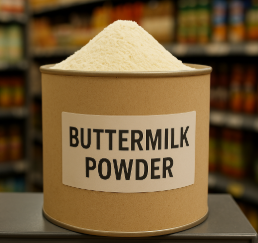
• Appearance is a free-flowing, off-white to light cream powder; available as standard or instantized (agglomerated) grades.
Indicative nutritional values (per 100 g)
• Energy: 430–480 kcal
• Protein: 30–35 g (high-quality dairy proteins; BV ≈ 80–85)
• Total fat: 4–8 g — SFA/MUFA/PUFA on a dairy-typical pattern (SFA predominant; notable oleic MUFA; minor PUFA)
• Carbohydrates: 50–56 g (mostly lactose 48–52 g)
• Sodium: 400–700 mg • Calcium: 900–1200 mg • Phosphorus: 700–900 mg • Potassium: 1300–1700 mg
• Moisture: ≤ 5%
Key constituents
• Casein and whey proteins with good emulsifying and foaming capacity.
• MFGM phospholipids (e.g., phosphatidylcholine, sphingomyelin) providing natural emulsification and creamy mouthfeel.
• Lactose (primary carbohydrate), minerals (Ca, P, K), and flavor compounds from mild Maillard and fermentation (in cultured grades).
Production process
• Pasteurized cream → churning → sweet buttermilk; or cultured skim/cream → cultured buttermilk.
• Clarification/standardization → concentration (vacuum evaporation) → spray drying (or drum drying for specialty textures) → cooling → sieving/agglomeration → packaging under inert/low-oxygen conditions.
• Optional: instantization and anti-caking systems to improve dispersion and flow.
Physical properties
• Color: ivory to light cream; particle size depends on dryer and agglomeration.
• Bulk density: typically 0.45–0.60 g/mL (non-instant); lower for instantized.
• pH (reconstituted, 10% w/w): sweet 6.3–6.6; cultured 5.0–6.0.
• Highly hygroscopic; aw low when sealed, but rises quickly with ambient humidity.
Sensory and technological properties
• Delivers dairy flavor, body, and opacity; rounds acidity and enhances umami/savory notes.
• Strong emulsifying and water-binding functionality (proteins + MFGM).
• Aids browning and crust color via lactose (Maillard); improves foaming in some systems.
• Heat stability is moderate; prolonged high heat may cause cooked notes and viscosity rise.
Food applications
• Bakery & snacks: dough conditioners, color/flavor enhancement, seasoning bases, cheese-style coatings.
• Sauces, soups, dressings: creamy mouthfeel and emulsion stability.
• Confectionery & desserts: caramels, ice cream, milk drinks, yogurt mixes.
• Meat & plant analogs: binders, yield improvement, flavor rounding.
• Beverage mixes: smoothies, powdered shakes, cocoa/tea mixes for creaminess.
Nutrition and health
• Provides complete dairy proteins, bioavailable calcium and phosphorus, plus MFGM phospholipids with functional properties.
• Naturally contains lactose; suitable only for those tolerant to lactose or when using lactose-reduced versions.
• Dairy fat is modest (4–8 g/100 g), with saturated fraction predominant; consider portion size in low-SFA dietary patterns.
Serving note
• Typical inclusion: 2–8% in dry blends or 3–10 g per serving in beverages/sauces; higher in bakery/coatings as needed.
Allergens and intolerances
• Contains milk (Reg. EU 1169/2011; major allergen).
• Contains lactose; not suitable for individuals with lactose intolerance unless specifically lactose-reduced.
• May contain traces of soy (lecithinated grades) or gluten/egg if processed in multipurpose facilities — verify specifications.
Quality and specifications (typical)
• Moisture ≤ 5% • Protein ≥ 30% • Fat 4–8% • Ash 7–9% • Lactose 48–52%
• pH (10% sol.): sweet 6.3–6.6; cultured 5.0–6.0
• Solubility index and dispersibility within dairy powder standards; low scorched particles (ADPI/Codex grades).
• Microbiology: Salmonella absent/25 g; coliforms < 10 CFU/g; total plate count typically ≤ 30,000 CFU/g; yeast/mold low.
• Sensory: clean dairy flavor; no oxidized, sour, or burnt notes.
Storage and shelf-life
• Store cool, dry, dark (≤ 25 °C; RH < 65%) in oxygen- and moisture-barrier packaging.
• Reseal promptly after opening; avoid condensation (temperature equilibration).
• Shelf-life: 12–24 months unopened; 1–3 months once opened, depending on conditions.
• Protect from humidity to prevent caking and from oxygen/light to limit oxidation and flavor loss.
Safety and regulatory
• Produced under GMP/HACCP with compliance to EU/US dairy hygiene rules (e.g., Reg. EC 852/853; Codex STAN 207 for milk powders).
• Allergen labeling “milk” required; declare processing aids (anti-caking, lecithin).
• Monitor contaminants, cleaning chemicals, and pathogens per dairy powder criteria.
Labeling
• Name: “Buttermilk Powder” (specify sweet or cultured).
• Ingredients list (milk; plus any emulsifiers/anti-caking agents), nutrition table, lot, net weight, storage, date code, origin.
• For instantized or lecithinated grades: declare the emulsifier source (e.g., soy/sunflower lecithin).
Troubleshooting
• Caking/clumping → Moisture ingress or high RH → Use barrier packs, desiccants, good resealing.
• Poor dispersibility → Fine particle size or insufficient instantization → Agglomerate/lecithinate; warm water premix.
• Cooked/oxidized flavors → Excess heat/oxygen → Optimize dryer outlet T, use nitrogen flushing, rotate stock (FIFO).
• Browning in finished goods → High lactose/low moisture → Adjust formula water activity and bake profile.
Sustainability and supply chain
• Valorizes a dairy side stream from butter production, improving resource efficiency.
• In-plant: heat recovery on evaporators/dryers, wastewater treatment with BOD/COD reduction, recyclable/mono-material packaging.
• Quality programs on milk sourcing, animal welfare, and cold-chain logistics reduce losses and footprint.
Main INCI functions (cosmetics)
• Buttermilk Powder / Lactis Powder — Skin-conditioning, humectant, soothing; used in masks, bath powders, and lotions within dermal safety guidelines.
Conclusion
Buttermilk powder is a versatile dairy ingredient that delivers natural emulsification, creamy flavor, and nutritional value from proteins, minerals, and MFGM phospholipids. With proper storage and specification control, it performs reliably across bakery, sauces, beverages, confectionery, and savory systems.
Mini-glossary
• SFA/MUFA/PUFA: Saturated / monounsaturated / polyunsaturated fatty acids — Limit SFA; MUFA/PUFA support a more favorable lipid profile.
• BV: Biological value — Index of protein quality based on amino-acid profile.
• MFGM: Milk fat globule membrane — Phospholipid- and protein-rich membrane with emulsifying properties.
• MAP: Modified atmosphere packaging — Gas systems that can protect sensitive powders (less common for dairy powders).
• aw: Water activity — Fraction of free water available for microbial growth.
• GMP/HACCP: Good manufacturing practices / hazard analysis and critical control points — Hygiene and safety systems.
• BOD/COD: Biochemical / chemical oxygen demand — Measures of organic load in effluents.

