Formaggio in polvere
(prodotto disidratato ottenuto da formaggi stagionati o freschi, con o senza additivi)
Descrizione
• Il formaggio in polvere è un ingrediente alimentare ottenuto mediante disidratazione di formaggi naturali, generalmente stagionati (come Cheddar, Parmigiano, Grana, Gouda) o freschi (come mozzarella o formaggi cremosi).
• Il processo di essiccazione rimuove l’acqua, concentrando aromi, grassi e proteine, e stabilizzando il prodotto.
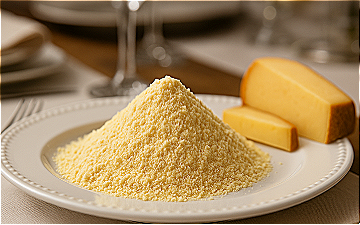
• Ha aspetto granulare o fine, colore giallo–avorio, aroma intenso e sapore tipico del formaggio d’origine.
• È utilizzato come aromatizzante, condimento o ingrediente funzionale in preparati alimentari secchi o istantanei.
Valori nutrizionali indicativi (per 100 g di prodotto)
• Energia: 480–520 kcal
• Proteine: 25–30 g
• Grassi totali: 30–35 g
– SFA (acidi grassi saturi): 18–22 g
– MUFA (monoinsaturi): 8–10 g
– PUFA (polinsaturi): 1–2 g
• Carboidrati: 10–15 g (lattosio residuo o maltodestrine)
• Zuccheri: 3–6 g
• Sodio: 800–1800 mg (in base al tipo di formaggio)
• Calcio: 700–900 mg; Fosforo: 500–600 mg; Vitamina A: 250–350 µg; Riboflavina (B2): 0,3–0,5 mg
Principali sostanze contenute
• Proteine del latte (caseina, α-lattoalbumina, β-lattoglobulina) con elevato valore biologico (VB ~80–85).
• Grassi del latte con prevalenza di SFA, ma contenenti anche MUFA e PUFA (in particolare acido oleico e linoleico).
• Sali minerali (calcio, fosforo, zinco) e vitamine liposolubili (A, D, E, K).
• Aromi naturali derivanti da lipolisi e proteolisi tipiche della maturazione del formaggio d’origine.
• Eventuali additivi (antiagglomeranti, stabilizzanti, maltodestrine) per migliorare la scorrevolezza e la conservabilità.
Processo di produzione
• Formaggio selezionato → fusione o triturazione → emulsione con eventuali coadiuvanti → disidratazione (spray drying o drum drying) → raffreddamento e setacciatura → confezionamento in ambiente controllato.
• Umidità finale: ≤ 4%.
• In alcuni casi può essere prodotto da miscele di formaggi e grassi vegetali (“preparato al gusto di formaggio”).
Proprietà fisiche
• Aspetto: polvere omogenea, da gialla chiara ad avorio.
• Umidità: < 4%.
• Densità apparente: 450–550 g/L.
• Solubilità variabile in acqua (aumenta con maltodestrine).
• Aroma: tipico del formaggio base, più o meno intenso.
Proprietà sensoriali e tecnologiche
• Conferisce aroma, sapidità e colore ai prodotti alimentari.
• Migliora la palatabilità e il valore proteico di snack, salse e piatti pronti.
• Si scioglie facilmente in matrici grasse o amidacee.
• Buona stabilità microbiologica grazie al basso contenuto di acqua.
• Compatibile con processi di cottura, estrusione e miscelazione.
Impieghi alimentari
• Industria alimentare:
– Snack salati, popcorn, patatine, condimenti in polvere.
– Preparati istantanei (pasta, salse, minestre, purè).
– Piatti pronti disidratati o surgelati.
– Ripieni, impasti per panificazione, grissini, cracker e prodotti da forno.
• Ristorazione e catering: salse pronte, fondute, aromatizzazioni e topping.
• Integratori nutrizionali: in formulazioni proteiche o energetiche, per il contenuto di calcio e proteine del latte.
Nutrizione e salute
• Il formaggio in polvere conserva le qualità nutrizionali del formaggio d’origine, ma in forma concentrata.
• Ottima fonte di proteine complete e calcio biodisponibile.
• Elevato contenuto di SFA e sodio, da considerare in diete ipolipidiche o iposodiche.
• Apporta vitamine liposolubili (A, D, E) e minerali essenziali.
• In quantità moderate, contribuisce a una dieta equilibrata e al mantenimento della massa muscolare.
Nota porzione: 10–20 g per porzione come condimento o ingrediente (≈ 1–2 cucchiai).
Allergeni e intolleranze
• Contiene latte e derivati (allergene obbligatorio Reg. UE 1169/2011).
• Può contenere lattosio in quantità variabile (fino a 5–6 g/100 g).
• Non adatto a persone con allergia alle proteine del latte o intolleranza al lattosio.
• In prodotti misti: possibile presenza di soia, glutine o uova come coadiuvanti o aromi (da dichiarare in etichetta).
• Naturalmente gluten-free se ottenuto da solo latte e formaggio.
Qualità e specifiche (valori tipici)
• Umidità ≤ 4%
• Grassi totali 30–35%
• Proteine ≥ 25%
• Sale 2–4%
• pH: 5,2–5,6
• Salmonella assente/25 g; Listeria monocytogenes assente/25 g; carica totale < 10⁴ ufc/g
• Additivi ammessi (UE): E551 (biossido di silicio), E341 (fosfato di calcio), E472e (mono-/diacetiltartarato di mono-/digliceridi).
Conservazione e shelf-life
• Conservare in luogo fresco e asciutto (T ≤ 25 °C, U.R. < 65%).
• Una volta aperto, richiudere ermeticamente per evitare l’assorbimento di umidità.
• Durata media: 12–24 mesi (integro); 1–3 mesi dopo l’apertura.
• Sensibile a luce, calore e ossigeno → rischio di irrancidimento e perdita di aroma.
Sicurezza e regolatorio
• Prodotto secondo sistemi GMP/HACCP, conforme al Reg. CE 852/2004 e 853/2004.
• Etichettatura obbligatoria: origine del formaggio, elenco ingredienti, allergeni, valori nutrizionali, modalità di conservazione e TMC.
• Controlli su micotossine, residui e carica microbica conformi alle norme UE per i lattiero-caseari.
Etichettatura
• Denominazione: “formaggio in polvere” o “polvere di [tipo di formaggio]” (es. formaggio in polvere tipo Cheddar).
• Indicazione degli additivi usati, allergeni (latte), origine del formaggio e contenuto di grassi.
• In caso di mix: specificare “preparato aromatizzante al gusto di formaggio”.
Troubleshooting
• Impaccamento o agglomerazione → umidità eccessiva → conservare in ambiente secco e chiudere ermeticamente.
• Sapore rancido → ossidazione dei grassi → evitare esposizione a calore e luce.
• Colore sbiadito → ossidazione o vecchia produzione → verificare TMC.
• Scarsa solubilità → eccessiva stagionatura o ridotta emulsione → migliorare granulometria o aggiungere maltodestrine.
Sostenibilità e filiera
• La sostenibilità dipende dall’origine del latte e dal tipo di formaggio utilizzato.
• Possibile uso di sottoprodotti caseari (formaggi invenduti o rifusi) → riduzione sprechi.
• In impianto: gestione effluenti con riduzione BOD/COD, utilizzo di energia termica recuperata, packaging riciclabile.
Principali funzioni INCI (cosmesi)
• Hydrolyzed Milk Protein / Lactis Powder — emolliente, nutriente, condizionante cutaneo e capillare.
• Utilizzato in creme nutrienti, shampoo e maschere per capelli secchi o danneggiati.
Conclusione
Il formaggio in polvere è un ingrediente versatile e stabile, che conserva l’aroma e le proprietà nutrizionali del formaggio d’origine. Fornisce proteine, calcio e gusto intenso, risultando utile per l’industria alimentare, la ristorazione e le formulazioni funzionali. La sua qualità dipende dal formaggio di partenza, dal processo di essiccazione e dalle condizioni di conservazione.
Mini-glossario
• SFA/MUFA/PUFA: acidi grassi saturi/mono/polinsaturi — i PUFA (soprattutto n-3) favoriscono la salute cardiovascolare.
• VB: valore biologico — indice della qualità proteica in base al profilo amminoacidico.
• MAP: modified atmosphere packaging — confezionamento in atmosfera protettiva.
• BOD/COD: domanda biochimica/chimica di ossigeno — indicatori del carico organico dei reflui.
• GMP/HACCP: buone pratiche di fabbricazione / analisi dei pericoli e punti critici di controllo.
• aw: attività dell’acqua — misura della quantità di acqua disponibile per la crescita microbica.
Bibliografia__________________________________________________________________________
Laithier C, Coulon JB, Vuitton DA, Lortal S, Loukiadis E. Bénéfices et risques pour la santé de la consommation de fromage. Health benefits and risks of cheese consumption. Rev Prat. 2025 Sep;75(7):779-786.
Abstract. The positive influence of cheese consumption on the intestinal microbiota and the immune system has received solid scientific support over the last 20 years, from cohort studies concerning protection against the clinical manifestations of atopic allergy and its mechanisms. Some of the benefits of eating cheese go against conventional wisdom. In fact, recent studies show that cheese, as part of a healthy diet and lifestyle, is neutral or even protective against cardiovascular diseases; it does not increase either the risk of obesity, high blood pressure or type 2 diabetes. Complementary research is needed to shed light on the role of cheese in the development of neuro-psychiatric illnesses and cancer. Without losing sight of the infectious risks, which are rare in France but can be a serious cause for concern, cheeses appear to offer several health benefits, notably because of their microbial biodiversity, which is particularly rich in raw milk cheeses. However, further work is needed to clarify the specific benefits of these cheeses.
Tilocca B, Soggiu A, Iavarone F, Greco V, Putignani L, Ristori MV, Macari G, Spina AA, Morittu VM, Ceniti C, Piras C, Bonizzi L, Britti D, Urbani A, Figeys D, Roncada P. The Functional Characteristics of Goat Cheese Microbiota from a One-Health Perspective. Int J Mol Sci. 2022 Nov 16;23(22):14131. doi: 10.3390/ijms232214131.
Abstract. Goat cheese is an important element of the Mediterranean diet, appreciated for its health-promoting features and unique taste. A pivotal role in the development of these characteristics is attributed to the microbiota and its continuous remodeling over space and time. Nevertheless, no thorough study of the cheese-associated microbiota using two metaomics approaches has previously been conducted. Here, we employed 16S rRNA gene sequencing and metaproteomics to explore the microbiota of a typical raw goat milk cheese at various ripening timepoints and depths of the cheese wheel. The 16S rRNA gene-sequencing and metaproteomics results described a stable microbiota ecology across the selected ripening timepoints, providing evidence for the microbiologically driven fermentation of goat milk products. The important features of the microbiota harbored on the surface and in the core of the cheese mass were highlighted in both compositional and functional terms. We observed the rind microbiota struggling to maintain the biosafety of the cheese through competition mechanisms and/or by preventing the colonization of the cheese by pathobionts of animal or environmental origin. The core microbiota was focused on other biochemical processes, supporting its role in the development of both the health benefits and the pleasant gustatory nuances of goat cheese.
Farsi DN, Mathur H, Beresford T, Cotter PD. Cottage cheese, a relatively underexplored cultured dairy product with potential health benefits? Crit Rev Food Sci Nutr. 2025;65(32):7953-7963. doi: 10.1080/10408398.2025.2487682.
Abstract. Cottage cheese (CC) is a member of the "fresh cheese" family of cheeses and is widely consumed due to its culinary versatility and some perceived health benefits. However, the evidence of direct health effects of CC is not well established. This review describes the production and nutritional characteristics of CC, before exploring the evidence of health effects from human intervention, in vitro, and in vivo models. Despite widespread consumption and advocated health benefits, there is a dearth of evidence pertaining to the health effects of CC from high-quality human randomized controlled trials. To date, a limited number of human intervention models with CC have explored nutrient bioavailability, metabolic health, and appetite regulation, in small, niche study populations. Findings with in vitro and in vivo models suggest that CC may be an efficacious vehicle for bioactive compounds. In conclusion, CC is a cultured dairy product that could impose a myriad of benefits across health outcomes including cardiometabolic, gastrointestinal, body composition, appetite regulation, and nutrient status. However, there is a need for high-quality human randomized controlled trials to develop a substantiated evidence base relating to the full potential of CC in human health.
Milani C, Longhi G, Alessandri G, Fontana F, Viglioli M, Tarracchini C, Mancabelli L, Lugli GA, Petraro S, Argentini C, Anzalone R, Viappiani A, Carli E, Vacondio F, van Sinderen D, Turroni F, Mor M, Ventura M. Functional modulation of the human gut microbiome by bacteria vehicled by cheese. Appl Environ Microbiol. 2025 Mar 19;91(3):e0018025. doi: 10.1128/aem.00180-25.
Abstract. Since cheese is one of the most commonly and globally consumed fermented foods, scientific investigations in recent decades have focused on determining the impact of this dairy product on human health and well-being. However, the modulatory effect exerted by the autochthonous cheese microbial community on the taxonomic composition and associated functional potential of the gut microbiota of human is still far from being fully dissected or understood. Here, through the use of an in vitro human gut-simulating cultivation model in combination with multi-omics approaches, we have shown that minor rather than dominant bacterial players of the cheese microbiota are responsible for gut microbiota modulation of cheese consumers. These include taxa from the genera Enterococcus, Bacillus, Clostridium, and Hafnia. Indeed, they contribute to expand the functional potential of the intestinal microbial ecosystem by introducing genes responsible for the production of metabolites with relevant biological activity, including genes involved in the synthesis of vitamins, short-chain fatty acids, and amino acids. Furthermore, tracing of cheese microbiota-associated bacterial strains in fecal samples from cheese consumers provided evidence of horizontal transmission events, enabling the detection of particular bacterial strains transferred from cheese to humans. Moreover, transcriptomic and metabolomic analyses of a horizontally transmitted (cheese-to-consumer) bacterial strain, i.e., Hafnia paralvei T10, cultivated in a human gut environment-simulating medium, confirmed the concept that cheese-derived bacteria may expand the functional arsenal of the consumer's gut microbiota. This highlights the functional and biologically relevant contributions of food microbes acquired through cheese consumption on the human health.IMPORTANCEDiet is universally recognized as the primary factor influencing and modulating the human intestinal microbiota both taxonomically and functionally. In this context, cheese, being a fermented food with its own microbiota, serves not only as a source of nourishment for humans, but also as a source of nutrients for the consumer's gut microbiota. Additionally, it may act as a vehicle for autochthonous food-associated microorganisms which undergo transfer from cheese to the consumer, potentially influencing host gut health. The current study highlights not only that cheese microbiota-associated bacteria can be traced in the human gut microbiota, but also that they may expand the functional repertoire of the human gut microbiota, with potentially significant implications for human health.
Kuhfeld RF, Eshpari H, Atamer Z, Dallas DC. A comprehensive database of cheese-derived bitter peptides and correlation to their physical properties. Crit Rev Food Sci Nutr. 2024;64(27):10105-10119. doi: 10.1080/10408398.2023.2220792.
Abstract. Bitterness is a common flavor attribute of aged cheese associated with the peptide fraction, but excessive levels are a defect leading to consumer rejection. Bitterness in cheese has been primarily associated with peptides that arise from the breakdown of casein. The last review of bitter peptides was published in 1992. This updated review compiled information about the bitter peptides published up to 2022. Our comprehensive search of the literature compiled 226 peptides associated with bitterness and cheese protein origins into a database (Supplemental Materials). The influences of a peptide's physical properties, such as molecular weight, average hydrophobicity, peptide length, number of prolines and the presence of hydrophobic amino acids in the peptide's terminus, were assessed for correlation with bitterness threshold values this assessment found that, among variables considered, higher molecular weight had the strongest correlation with higher bitterness among known peptides. Heatmaps of bitter peptides and their bitterness threshold values highlight β-casein as the primary source of known bitter peptides in cheese. This comprehensive database of cheese protein-derived bitter peptides and this discovery of the correlation of a peptide's physical properties to bitterness will aid future researchers in the identification and discovery of contributors to cheese bitterness.
Nájera AI, Nieto S, Barron LJR, Albisu M. A Review of the Preservation of Hard and Semi-Hard Cheeses: Quality and Safety. Int J Environ Res Public Health. 2021 Sep 17;18(18):9789. doi: 10.3390/ijerph18189789.
Abstract. Cheese is a dairy product with potential health benefits. Cheese consumption has increased due to the significant diversity of varieties, versatility of product presentation, and changes in consumers' lifestyles. Spoilage of hard and semi-hard cheeses can be promoted by their maturation period and/or by their long shelf-life. Therefore, preservation studies play a fundamental role in maintaining and/or increasing their shelf-life, and are of significant importance for the dairy sector. The aim of this review is to discuss the most effective methods to ensure the safety and sensory quality of ripened cheeses. We review traditional methods, such as freezing, and modern and innovative technologies, such as high hydrostatic pressures, chemical and natural vegetable origin preservatives, vacuum and modified atmosphere packaging, edible coatings and films, and other technologies applied at the end of storage and marketing stages, including light pulses and irradiation. For each technology, the main advantages and limitations for industrial application in the dairy sector are discussed. Each type of cheese requires a specific preservation treatment and optimal application conditions to ensure cheese quality and safety during storage. The environmental impact of the preservation technologies and their contribution to the sustainability of the food chain are discussed.
Gaglio R, Todaro M, Settanni L. Improvement of Raw Milk Cheese Hygiene through the Selection of Starter and Non-Starter Lactic Acid Bacteria: The Successful Case of PDO Pecorino Siciliano Cheese. Int J Environ Res Public Health. 2021 Feb 13;18(4):1834. doi: 10.3390/ijerph18041834.
Abstract. This review article focuses on the technological aspects and microbiological critical points of pressed-cooked cheeses processed from raw ewe's milk without the inoculation of starter cultures, in particular "Pecorino" cheese typology produced in Italy. After showing the composition of the biofilms adhering to the surface of the traditional dairy equipment (mainly wooden vat used to collect milk) and the microbiological characteristics of PDO Pecorino Siciliano cheese manufactured throughout Sicily, this cheese is taken as a case study to develop a strategy to improve its hygienic and safety characteristics. Basically, the natural lactic acid bacterial populations of fresh and ripened cheeses were characterized to select an autochthonous starter and non-starter cultures to stabilize the microbial community of PDO Pecorino Siciliano cheese. These bacteria were applied at a small scale level to prove their in situ efficacy, and finally introduced within the consortium for protection and promotion of this cheese to disseminate their performances to all dairy factories. The innovation in PDO Pecorino Siciliano cheese production was proven to be respectful of the traditional protocol, the final cheeses preserved their typicality, and the general cheese safety was improved. An overview of the future research prospects is also reported.




