Buffalo meat
(Bubalus bubalis — fresh or processed cuts, bone-in or boneless)
Description
• Red meat from Bubalus bubalis (water buffalo), raised mainly in India, SE Asia, South America, and Italy (Mediterranean buffalo).
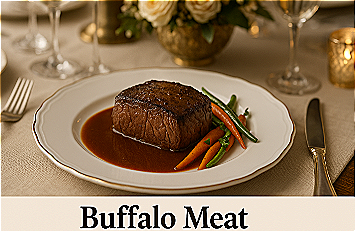
• Similar to beef but darker in color with a finer grain; robust yet clean flavor, often milder than mature beef.
• Available as fresh, chilled or frozen cuts (steak, rib, tenderloin, mince) and preparations (burgers, roasts, cured meats, sliced products).
Indicative nutritional values (per 100 g raw, lean cut)
• Energy: 95–120 kcal
• Protein: 21–23 g
• Total fat: 1–3 g
• SFA (saturated fatty acids; excessive intake may raise LDL): ~0.6–1.0 g
• Cholesterol: 45–60 mg
• Carbohydrates: 0 g
• Intrinsic sodium: 50–70 mg
• Micronutrients (typical): Heme iron 2.0–3.0 mg; Zinc 2.5–4.0 mg; Phosphorus 180–220 mg; Niacin (B3) 6–10 mg; B12 1–2 µg; Selenium 15–25 µg
Key constituents
• Proteins of high biological value (actin, myosin, tropomyosin) with a complete amino acid profile.
• Lipids: lower content than beef; predominance of MUFA/PUFA (monounsaturated/polyunsaturated fatty acids; generally favorable for cardiometabolic health) over SFA; balanced n-6/n-3.
• Pigments: higher myoglobin → darker red color and greater oxidative tendency.
• Minerals: good source of heme iron, zinc, and phosphorus; moderate copper and selenium.
Production process
• Buffaloes from meat herds or dairy culls → slaughter in approved facilities → quartering and controlled aging/maturation (7–14 days at 0–2 °C) → cutting and vacuum or MAP (modified atmosphere packaging) packing → cold chain.
• For processed items: mincing, salting or marination, optional cooking, hygienic slicing/packaging for RTC/RTE products.
Physical properties
• Color: deep ruby red, trending brown with age.
• Texture: fine, compact, slightly firmer than beef.
• Final pH: 5.6–5.8; aw (water activity) ≈ 0.98.
• WHC (water-holding capacity): good, but sensitive to pre-slaughter stress.
Sensory and technological properties
• Rich, slightly “ferrous” taste; tenderness driven by age, cut, and maturation.
• Good cooking yield; often lower drip loss than very lean beef.
• Responds well to light marinades (oil, mild organic acids, herbs) that enhance tenderness and flavor.
• In processed products (burgers, cured/cooked meats, jerky): stable protein matrix and intense color.
Food applications
• Home and foodservice: steaks, braises, stews, roasts, tartare, burgers.
• Industry: minced products, cooked or dry-cured meats (e.g., buffalo bresaola), meat preserves, sauces, chilled ready meals.
Nutrition and health
Buffalo meat supplies complete proteins with low fat and reduced cholesterol versus beef. Its lipid profile is more balanced (more MUFA/PUFA, less SFA) and it provides bioavailable heme iron and zinc.
• Choose lean cuts and gentle cooking (grill, moderate oven, sous-vide).
• Limit added salt and fats; pair with vegetables or whole grains.
• Safety: cook to ≥ 70 °C at the core; keep the cold chain (0–4 °C); avoid cross-contamination.
Portion note: 150–180 g cooked (≈ 200–240 g raw) for whole cuts; 100–130 g for sauced dishes; 40–60 g for cured/sliced products.
Quality and specifications (typical parameters)
• Composition: moisture, protein, fat, collagen, iron.
• Physicochemical: pH, color (Lab*), WHC, cooking loss.
• Microbiology: Salmonella absent in 25 g; Listeria monocytogenes controlled in RTE; low total viable counts.
• Residues/contaminants: compliant with veterinary drug and heavy-metal limits.
• Packaging: vacuum or MAP; seal integrity and full traceability checks.
Storage and shelf-life
• Chilled: 0–4 °C → 7–10 days (vacuum); 4–6 days in MAP.
• Frozen: ≤ −18 °C → 8–12 months.
• Avoid temperature swings and light/oxygen exposure to limit oxidation and browning.
Safety and regulatory
• Production under red-meat regulations and GMP/HACCP (good manufacturing practices / hazard analysis and critical control points).
• Label species (“buffalo”), origin, lot, storage temperature, and cooking instructions where relevant.
• No intrinsic allergens; manage cross-contact in facilities.
• For processed items: comply with permitted additive limits (nitrites, ascorbates, phosphates).
Labeling
• Name: “buffalo meat” or product-specific (e.g., “buffalo bresaola”).
• Product state (fresh/frozen), cut, presence of seasonings/marinades.
• Nutrition table, date (BBD/expiry), origin; optional claims (“lean meat”, “sustainably raised”) only when substantiated.
Troubleshooting
• Excessive toughness → insufficient aging or harsh cooking; improve post-slaughter rest or use mild acid/enzymatic marinades.
• Surface oxidation → light/oxygen exposure; use barrier films or vacuum pack.
• Over-dark color → older animals or pre-slaughter stress; select younger stock and manage stress.
• High drip loss → low pH or rapid freezing; optimize chilling and prefer slow thawing.
Sustainability and supply chain
• Good feed-conversion efficiency; valorization of dairy by-products.
• Lower GHG (greenhouse gas) footprint than mature beef in many systems; improve via forage-based diets and water reuse.
• Effluents: treat with BOD/COD (biochemical/chemical oxygen demand) reduction; consider reuse where allowed.
• Packaging: recyclable mono-materials; energy optimization and heat recovery in plants.
• Food-waste reduction: calibrated portions, clear post-opening guidance, uses for trimmings/ends.
Main INCI functions (cosmetics)
• Hydrolyzed Buffalo Protein / Hydrolyzed Collagen (bovine-type): skin/hair conditioning, film-forming, toning; use subject to source and purity requirements.
Conclusion
Buffalo meat is a nutrient-dense, lean alternative to beef: high in quality protein, with lower fat and cholesterol and a more favorable fat profile. With proper herd management, slaughter, aging, and cold-chain control, it delivers quality, safety, and environmental benefits.
Mini-glossary
• SFA/MUFA/PUFA: saturated / monounsaturated / polyunsaturated fatty acids — higher MUFA/PUFA and lower SFA are generally associated with better cardiometabolic outcomes.
• MAP: modified atmosphere packaging — protective gas mix to extend shelf-life.
• aw: water activity — fraction of “free” water available for microbial growth.
• WHC: water-holding capacity — ability of muscle to retain water.
• GMP/HACCP: good manufacturing practices / hazard analysis and critical control points — hygiene and safety management systems.
• BOD/COD: biochemical / chemical oxygen demand — indicators of organic load in effluents.
• GHG: greenhouse gases — emissions contributing to climate change.
References__________________________________________________________________________
Tamburrano, A., Tavazzi, B., Callà, C. A. M., Amorini, A. M., Lazzarino, G., Vincenti, S., ... & Laurenti, P. (2019). Biochemical and nutritional characteristics of buffalo meat and potential implications on human health for a personalized nutrition. Italian journal of food safety, 8(3), 8317.
Abstract. The human consumption of food animal products is the main topic of an important debate among professionals in this sector: dietologists, dietitians and nutritional biologists. The red meat provides all the essential amino acids, bioavailable iron, zinc, calcium, lipids and B-group vitamins. A valid alternative to beef could be the buffalo meat. Italy is the largest European producer of buffalo meat and derivatives. The high nutritional characteristics of buffalo meat make it suitable to be included in the Mediterranean diet to customize it in relation to the needs and conditions of the population. Polyunsaturated/saturated fatty acids ratio can be influenced by diet, breed and type of breeding, but muscle tissue fat percentage is the main factor in determining a favorable fatty acid composition. This review focuses on the biochemical and nutritional characteristics of the buffalo meat (content of fats, cholesterol, amino acids, vitamins and minerals), explaining their variability depending on the different breeds, and the favorable implications on the human health. These results suggest that buffalo meat can be a healthier alternative to beef, not only for healthy people in particular physiological conditions (i.e. pregnancy), but also for persons at risk for cardiovascular and cerebrovascular diseases, thus achieving the goal of a personalized nutrition.
Chiariotti A, Borghese A, Boselli C, Barile VL. Water Buffalo's Adaptability to Different Environments and Farming Systems: A Review. Animals (Basel). 2025 May 24;15(11):1538. doi: 10.3390/ani15111538. PMID: 40509004;
Abstract. The buffalo species (Bubalus bubalis) is crucial for the global economy, supplying high-nutritional-value animal proteins vital for children's growth. These animals efficiently convert fiber into energy and thrive in various harsh environments, from frigid climates to hot, humid areas, including wetlands. They produce milk and meat while supporting the sustainability of ecosystems that other ruminants cannot inhabit. Buffalo offers a unique opportunity to supply resources for both rural communities and larger farms located in specific regions, such as marshlands and humid savannahs. They also thrive on extensive pastures and family farms, thus preserving biodiversity, habitats, and cultural practices. Intensive farming brings distinct challenges and is often criticized for its negative effects on climate change. To counter these impacts, multiple strategies have been researched and implemented. These include enhancing livestock genetics, adopting sustainable agricultural practices, optimizing local feed resources (including by-products), managing manure (with an emphasis on renewable energy), and improving animal health and welfare. This review explores various buffalo farming system applications in different global contexts. It is based on the hypothesis that the adaptable traits of buffalo, as well as the environmental and economic challenges that must be addressed for sustainability, are the key factors in determining the viability of such enterprises.
Naveena, B. M., & Kiran, M. (2014). Buffalo meat quality, composition, and processing characteristics: Contribution to the global economy and nutritional security. Animal frontiers, 4(4), 18-24.
Abstract. Buffaloes (Bubalus bubalis) are large-ruminant animals that play an important role in the lives of millions of human beings as a source of milk, meat, draught power, transportation, and on-farm manure in several developing countries of Asia, including India. Disease resistance, the ability to adapt to various climatic conditions, greater digestibility of poor quality pasture, faster growth, and body weight gain in buffaloes shows their versatility and ability to positively contribute towards sustainable livestock production. Buffalo meat is almost similar to beef in terms of composition, quality, and organoleptic characteristics and has an added advantage of less fat, cholesterol, and calories. Buffalo meat also has superior processing characteristics and is suitable for development of value-added meat products. Buffalo production makes an important contribution to economic development, rural livelihood, poverty alleviation, and meets the fast-growing demand for animal protein requirement.
Di Stasio, Liliana, and Alberto Brugiapaglia. "Current knowledge on river buffalo meat: A critical analysis." Animals 11.7 (2021): 2111.
Abstract. The estimated world population of water buffalo counts around 204 million head, mostly reared for milk production. However, buffaloes also largely contribute to the meat sector, with around 4.3 million tonnes produced in 2019, mainly derived from old animals at the end of their productive or working life and only to a small extent from young animals. Therefore, buffalo meat production has been generally considered unsatisfactory for both quantity and quality. In fact, the dressing percentage is generally lower than 50% and the meat is considered of poor quality mainly due to its dark colour and reduced tenderness. However, in recent years, the healthy properties highlighted by some studies have led to a renewed interest in buffalo meat, with a parallel increase in research. Therefore, this review aims at providing an updated picture on carcass and meat quality traits in river buffalo, with special attention to the intrinsic and extrinsic factors contributing to their variability. The research done so far has demonstrated that river buffaloes can efficiently contribute to the quanti-qualitative production of meat, provided that the meat supply chain is specifically organised for this purpose. The analysis of the available data also showed that further research is needed on the factors affecting meat production in order to gain greater knowledge essential for planning more targeted interventions.
Lombardi SJ, Nazzaro F, Grazia L, Coppola R, Fratianni F, Pellegrini M, Iarusso I, Tremonte P, Coppola F. Use of Inulin and Pumpkin Oil in the Manufacture of High-Quality Mortadella-Style Sausage from Buffalo Meat. Foods. 2025 Apr 21;14(8):1427. doi: 10.3390/foods14081427.
Abstract. The growing demand for healthier meat products has driven the reformulation of processed meats to reduce saturated fat while preserving sensory and technological attributes. Buffalo meat (Bubalus bubalis), with its high protein content, low intramuscular fat, and favorable fatty acid profile, offers a promising base for healthier formulations. However, its fat content may compromise texture, juiciness, and flavor, necessitating strategies to optimize product quality. This study investigated the effects of replacing pork fat with inulin and pumpkin seed oil in a cooked buffalo meat product, focusing on compositional, oxidative, microbiological, and sensory parameters. Two plant-based ingredients were selected: inulin from chicory, used as a fat mimic due to its gel-forming ability, and pumpkin seed oil, a structural analog with antimicrobial activity. Preliminary trials identified optimal concentrations for balancing technological and functional performance. A 2% inclusion of pumpkin seed oil, exceeding its in vitro MIC (0.4-1.5%), ensured effectiveness in the food matrix. Reformulated products exhibited significantly reduced fat (p < 0.05), enhanced fiber, and a lipid profile rich in polyunsaturated fatty acids (>45%), qualifying for European Union health claims. Oxidative stability improved (p < 0.01), and sensory analysis revealed enhanced aroma complexity, with nutty and roasted notes. Microbiological assessments confirmed a protective effect against spoilage bacteria. These results support the development of a nutritionally improved, microbiologically safer cooked product, such as mortadella-style sausage, while also offering strategies for broader innovation in reformulating functional meat products.
Rodrigues LS, Silva JARD, Silva WCD, Silva ÉBRD, Belo TS, Sousa CEL, Rodrigues TCGC, Silva AGME, Prates JAM, Lourenço-Júnior JB. A Review of the Nutritional Aspects and Composition of the Meat, Liver and Fat of Buffaloes in the Amazon. Animals (Basel). 2024 May 29;14(11):1618. doi: 10.3390/ani14111618.
Abstract. Thus, this review aims to deepen the understanding of buffalo farming in the Amazon, presenting the quality and nutritional value of buffalo meat and liver. This information serves as a subsidy to improve practices related to the breeding system, nutrition, health and sustainability associated with aquatic buffaloes. For this, a review of the databases was carried out using the descriptors "nutritional value of buffalo meat", "nutritional value of buffalo liver" and "buffalo breeding in the Amazon". Thus, the consumption of foods derived from aquatic buffaloes has important nutritional value for human consumption. In view of this, it is possible to conclude that the nutrition of these animals is influenced by the biodiversity of the Amazon, giving unique characteristics to its products, also highlighting the importance of carrying out research that aims to value the potential use of this species and strengthen the economy of the region.




