



Wheat and corn flours
(from Triticum aestivum L. and Zea mays L.)
Description
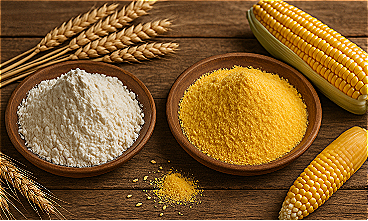
• Food ingredients obtained by milling mature kernels of wheat and corn. Blending combines wheat’s gluten functionality with corn’s sweet note and golden colour.
• Used together or separately in bakery, snacks, pasta, instant mixes, and coatings.
• Grades vary by refinement (wholemeal, semi-whole, refined) and particle size (fine/medium/coarse), directly affecting texture, flavour, and nutrition.
Indicative nutrition values (per 100 g of a 70% wheat – 30% corn blend)
• Energy: 340–360 kcal
• Total carbohydrate: 70–75 g (sugars 1–2 g)
• Protein: 8–11 g
• Fat: 1–3 g
• Dietary fiber: 3–5 g
• Sodium: <10 mg
• Vitamins & minerals: variable B1, B3, B6, iron, magnesium, phosphorus, zinc, potassium.
Key constituents
• Starch: main structural/energy component.
• Gluten (wheat only): gliadins + glutenins forming the elastic network.
• Corn proteins (zeins): gluten-free; contribute friability and yellow colour.
• Lipids: minor triglycerides and phospholipids.
• Natural pigments: corn carotenoids (lutein, zeaxanthin).
• Fiber: arabinoxylans and cellulose from bran.
Production process
• Cleaning & selection of kernels.
• Degerm/decortication (for refined flours) to remove bran and germ.
• Roller- or stone-milling to target particle size.
• Blending to desired ratios (e.g., 70:30 or 50:50 wheat/corn).
• Sifting & packing under controlled conditions.
Physical properties
• Appearance: fine powders, pale to golden yellow.
• Aroma/flavour: cereal note with light sweetness/toast.
• Particle size: ~100–500 μm.
• Moisture: <14%.
• pH: 5.5–6.5.
Sensory & technological properties
• Wheat provides elasticity and cohesion via gluten.
• Corn adds colour, friability, and mild sweetness.
• Blends optimise volume, structure, and crispness.
• Suitable for bread, flatbreads, snacks, fresh pasta, polenta-style items, and gluten-mix formulations.
Food applications
• Bakery: bread, focaccia, biscuits, crackers, pizza.
• Pasta/gnocchi: blends with durum and corn for colour and bite.
• Snacks/frying: coatings and crisp blends.
• Traditional dishes: corn as main base (polenta, grits).
• Desserts: tender, aromatic doughs.
Nutrition & health
Wheat–corn flours deliver complex carbohydrates for sustained energy.
• Wheat gluten enables leavening and structure but makes products unsuitable for coeliac disease.
• Corn is gluten-free and brings carotenoids (lutein, zeaxanthin) with eye-health antioxidant roles.
• Protein content is moderate; quality improves when combined with other plant proteins.
• Fiber supports regularity and satiety.
• Fat is low and mainly unsaturated: first occurrence SFA (saturated fatty acids, to limit), MUFA (monounsaturated, generally favourable), PUFA (polyunsaturated, n-6/n-3 balance matters).
• Choosing less-refined grades helps with glycaemic control in balanced diets.
Portion note: typical cooked serving 80–100 g per person for bread/pasta/polenta equivalents.
Allergens & intolerances
• Wheat flour contains gluten (allergenic for coeliac disease and non-coeliac gluten sensitivity).
• Corn flours are naturally gluten-free, but cross-contact can occur if milled/packed on shared lines.
• Wheat–corn blends are not suitable for gluten-free diets.
• FODMAP concern: some individuals may react to wheat fructans; corn is generally lower but tolerance varies.
• Allergen labelling must follow applicable regulations (e.g., mandatory highlight of gluten/wheat; gluten-free products must meet <20 ppm).
Quality & specifications (typical topics)
• Moisture ≤14% • Ash 0.5–1.5% (by refinement) • Controlled particle size.
• Protein: ≥10% (soft wheat); ≥8% (corn).
• Mycotoxins (aflatoxins, DON, fumonisins) within legal limits.
• Free from infestation/foreign matter.
• Gluten-free claims only for dedicated, certified lines.
Storage & shelf-life
• Store cool, dry, ventilated (<20 °C; RH <60%).
• Protect from light and insects.
• Typical shelf-life: 6–12 months wholemeal; up to 18 months refined.
Safety & regulatory
• Manufactured under food hygiene/traceability rules and GMP/HACCP.
• Comply with MRL for pesticides and contaminants; routine microbiology and moisture checks.
• Gluten-free variants require validated controls and testing (<20 ppm).
Labeling
• Name: “wheat and corn flour” or specify the blend percentage.
• Declare gluten (wheat) where applicable.
• Indicate origin, lot, net weight, storage conditions.
Troubleshooting
• Low dough elasticity → excessive corn fraction → increase wheat share or add vital gluten (if not GF).
• Dulled colour → carotenoid oxidation → protect from light/heat.
• Rancid note → lipid oxidation → control moisture and storage temperature.
• Lumps → high humidity → sift before use and improve packaging.
Sustainability & supply chain
• Sourced from traceable cereal chains; options for organic/integrated farming.
• Milling by-products (bran, germ) valorised in feed or energy.
• Plants manage effluents to BOD/COD targets and use recyclable packaging.
INCI functions (cosmetics)
• Triticum Vulgare (Wheat) Flour / Zea Mays (Corn) Starch/Flour — absorbent, abrasive, viscosity-increasing, soothing in powders, masks, and natural cosmetics.
Conclusion
Wheat and corn flours offer a versatile base balancing technological functionality and nutritional value. The blend yields well-structured doughs, pleasant flavour, and natural colour, supporting products that are stable, palatable, and aligned with clean-label expectations.
Mini-glossary
• SFA — saturated fatty acids; limit excessive intake.
• MUFA — monounsaturated fatty acids; generally favourable for lipid profile.
• PUFA — polyunsaturated fatty acids (n-6/n-3); balance is relevant to health.
• MRL — maximum residue limit for pesticides/contaminants.
• GMP/HACCP — good manufacturing practice / hazard analysis and critical control points.
• BOD/COD — biochemical/chemical oxygen demand, key wastewater impact metrics.
• FODMAP — fermentable oligo-, di-, mono-saccharides and polyols; may trigger GI symptoms in sensitive individuals.

