



Beetroot concentrate
(from Beta vulgaris L. subsp. vulgaris var. rubra)
Description
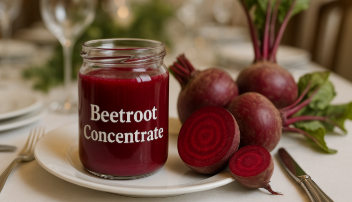
• Food ingredient obtained from red beetroot, produced by vacuum evaporation of the expressed juice from mature roots. It retains the characteristic red–violet colour and a sweet–earthy flavour.
• Used as a natural colourant and functional ingredient in foods and beverages to contribute colour, natural sweetness, and bioactives (betalains, polyphenols).
Indicative nutrition values (per 100 g concentrate; varies with concentration grade)
• Energy: 180–260 kcal
• Total carbohydrates: 40–60 g (mainly sucrose, glucose, fructose)
• Fibre: <1 g
• Protein: 1–2 g
• Fat: <0.5 g
• Sodium: 40–80 mg
• Vitamins & minerals: small amounts of potassium, magnesium, folate, vitamin C, and betaine.
Key constituents
• Betalains (betacyanins and betaxanthins): water-soluble pigments responsible for the red–purple colour.
• Betaine: osmolyte with supportive effects on hepatic metabolism.
• Natural sugars: sucrose, glucose, fructose.
• Polyphenols and minor flavonoids with antioxidant activity.
• Minerals: potassium, magnesium, manganese.
Production process
• Harvesting and cleaning of mature roots.
• Pressing/diffusion to obtain the juice.
• Filtration and clarification to remove fibre and impurities.
• Vacuum or low-temperature concentration to preserve thermolabile compounds and pigments.
• Optional colour standardisation (E162) and stabilisation with citric or ascorbic acid.
Physical properties
• Appearance: dense or syrupy liquid, deep red.
• Odour and taste: sweet, typical beet, slightly earthy.
• Solubility: fully water-soluble.
• pH: 4.0–5.5.
• Stability: sensitive to light, alkaline pH, high temperatures, and oxygen.
Sensory & technological properties
• Provides natural red colour to beverages, yogurts, ice creams, baked goods, sauces, and desserts.
• Contributes light natural sweetness, useful when reducing added sugars.
• Betalains may undergo thermal degradation and colour shift at pH > 6.
• Compatible with aqueous, dairy, and gelled matrices.
Food applications
• Beverages: juices, shots, smoothies, energy/soft drinks.
• Bakery & desserts: muffins, cakes, cookies, ice creams, mousses.
• Ready meals & sauces: to naturally colour purées, dressings, and vegetable pastes.
• Cured meats and plant-based products: to support the characteristic red colour.
Nutrition & health
Beetroot concentrate supplies natural sugars and phytonutrients such as betaine and betalains, which are associated with antioxidant and vascular-supportive properties.
• Betalains may help counter oxidative stress and support endothelial function.
• Betaine supports liver function and homocysteine methylation.
• Fibre content is limited, but potassium and magnesium contribute to electrolyte balance.
• Calories derive almost entirely from sugars and are moderate: effective as a natural colour/sweetness source but should be dosed judiciously for total carbohydrate management.
Portion note: typical use 1–5% of total formula weight, equivalent to 5–20 g in a 400 g finished product.
Quality & specifications (typical topics)
• Colour strength (E162) or betalain content (mg/100 g).
• Brix (°Bx): 60–70 for dense concentrates.
• Moisture <25%; ash <3%.
• pH 4.0–5.5; density 1.2–1.3 g/mL.
• Microbiology: total aerobic count <10³ CFU/g; yeasts/moulds <100 CFU/g; pathogens absent/25 g.
• No synthetic preservatives or artificial colourants.
Storage & shelf-life
• Store sealed, protected from light and heat, at 5–15 °C.
• Once opened, refrigerate and use within 15–30 days.
• Typical shelf-life: 12–18 months unopened in cool storage.
Safety & regulatory
• Beetroot concentrate is considered a natural ingredient or food colour (E162) depending on concentration/purpose.
• Generally regarded as safe (GRAS).
• Must comply with limits for heavy metals, pesticide residues, and GMP/HACCP hygiene controls.
Labeling
• Name: “beetroot concentrate” or “natural colour: beetroot extract (E162)”.
• Declare any acidity regulators or antioxidants used.
• When used as a colourant, state the function (“for colouring”).
Troubleshooting
• Colour loss → excessive heat/light exposure → lower process temperature, add antioxidants (e.g., ascorbic acid).
• Red → brown shift → pH > 6 → keep pH 4–5 for optimal stability.
• Crystallisation → high sugar content → control °Bx and storage conditions.
• Oxidation → non-barrier packaging → use opaque/oxygen-barrier packs.
Sustainability & supply chain
• Raw material from temperate crops; also available organic.
• Production by-products (pulp) suitable for feed or biogas.
• Low GHG footprint and good water efficiency.
• In-plant: wastewater managed to BOD/COD targets, heat-recovery, recyclable packaging.
INCI functions (cosmetics)
• Beta Vulgaris (Beet) Root Extract / Juice / Powder: natural colourant, antioxidant, skin-conditioning and soothing.
• Used in make-up (lipsticks, blush), creams, and natural cleansers; compatible with aqueous or glycolic bases.
Conclusion
Beetroot concentrate is a natural, functional, and visually vibrant ingredient that combines colouring power with nutritional value thanks to betalains and betaine. With appropriate formulation and storage, it enables more natural-looking foods, beverages, and cosmetics with strong visual identity and good stability.
Mini-glossary
• Betalains — natural water-soluble pigments (red betacyanins, yellow betaxanthins) that are heat-sensitive.
• Betaine — methyl-donor osmolyte supportive of liver function and homocysteine metabolism.
• E162 — EU code for red beetroot colour.
• °Bx (Brix) — measure of sugar concentration in solution.
• BOD/COD — biochemical/chemical oxygen demand, indicators of wastewater organic load.
• GMP/HACCP — good manufacturing practice / hazard analysis and critical control points.
Studies
It grows in temperate climates and supplies about 20% of the world sugar production in the world (1).
The plant is very sensitive to water and needs, for its complete development and correct maturation, some biostimulant supports to speed up growth. Chlorella vulgaris and Scenedesmus quadricauda have demonstrated biological activities compatible with Beta vulgaris in the early stages of growth.
The red beet has a good content of polyphenols, the leaves and the juice of the stem have been shown to reduce high density lipoprotein cholesterol (2).
From sugar beet is obtained pectin that has a beneficial impact on the microbiota in vivo in humans as a beneficial modulation of the intestinal microbiota (3).

