

| "Descrizione" by Al222 (23420 pt) | 2025-Nov-10 12:18 |
Description
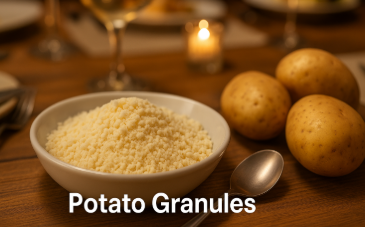
Potato granules are a dehydrated product made by cooking, mashing, drying, and granulating potatoes.
They appear as a coarse, off-white to light-yellow powder with the typical aroma and taste of cooked potato.
Commonly used as a base or texturizer in mashed potatoes, snacks, bakery items, soups, and industrial recipes.
Indicative nutritional values (per 100 g)
Energy: ~340 kcal
Carbohydrates: 75–80 g
of which sugars: 5–7 g
Protein: 7–10 g
Total fat: 0.5–1 g
SFA (saturated fatty acids): ~0.2 g
Dietary fiber: 4–5 g
Sodium: 50–150 mg
Vitamins: small amounts of vitamin C, B1 (thiamin), B6
Minerals: potassium, magnesium, phosphorus
Key constituents
Potato starch (primary component; energy source)
Potato proteins (patatin, tuberin)
Soluble and insoluble fibers
Simple sugars (glucose, fructose)
Micronutrients: potassium, vitamin C, minor phenolics
Production process
Selection and washing of fresh potatoes.
Peeling and steam/water cooking.
Mashing and homogenization to obtain a puree.
Drying (drum or fluid-bed) to remove moisture.
Granulation and sieving to target particle size.
Packaging under controlled conditions to prevent moisture uptake.
Physical properties
Appearance: coarse powder/granules, off-white to pale yellow
Residual moisture: 6–8%
Bulk density: ~0.6–0.8 g/cm³
Dispersibility: readily rehydrates in hot water
pH (1% solution): 5.5–6.5
Food applications
Instant preparations: mashed potatoes, soups, cream soups.
Bakery and pastry: improves dough water-holding and texture.
Snacks and extruded products: base for chips, sticks, croquettes.
Meat and frozen foods industry: natural thickener and binder.
Home cooking: quick, versatile thickening and base ingredient.
Nutrition & health
Source of complex carbohydrates with low fat content.
Provides fiber, which supports normal digestive function.
Naturally low in sodium and cholesterol-free.
A practical source of potassium, contributing to electrolyte balance.
Gluten-free, suitable for people with celiac disease.
Portion control is advisable in low-calorie diets due to energy density.
Portion note: a typical prepared serving uses 30–40 g dry granules, yielding ~150–200 g ready-to-eat mash.
Environmental and safety considerations
Generally recognized as safe for human consumption.
Store in a cool, dry place, away from humidity.
Prefer non-GMO supply and sustainably grown potatoes.
Overall low environmental footprint when using efficient drying and valorizing processing by-products.
INCI functions (cosmetic use)
May serve as an absorbent, natural thickener, and texturizer in powders and rinse-off masks.
SFA (saturated fatty acids): fats with no double bonds; excessive intake may be associated with cardiovascular risk.
GMO: genetically modified organism.
INCI: International Nomenclature of Cosmetic Ingredients (standardized cosmetic ingredient naming system).
Studies
About 80% of the weight of a fresh potato tuber is water; almost all the remaining dry matter is starch. Most of the starch (70%) is amylopectin, the rest being amylose (1).
Particular warning about the potato skin, which is a concentrate of phenolic compounds with antioxidant activity (2) and dietary fibres.
Potatoes are a source of carbohydrates in the diet all over the world and are generally considered high glycaemic index (3) foods, the parameter that indicates how much glucose is present in the blood.
Another problem with potato consumption is the pesticide residue that can be found in this tuber. Warning should be given as to where it is grown and what fertilisation it is subjected to.
In addition, warning must be given to prolonged frying at high temperatures, which degrades the qualities of the oil and the potato itself, generating acrylamide, a potentially carcinogenic molecule (4)
For more information:
"Potatoes : how to store, how to fry"
References_______________________________________________________________________
(1) Diego Fajardo, Sastry S. Jayanty, Shelley H. Jansky Rapid High Throughput Amylose Determination in Freeze Dried Potato Tuber Samples J Vis Exp. 2013; (80): 50407. Published online 2013 Oct 14. doi: 10.3791/50407
Abstract. This protocol describes a high through put colorimetric method that relies on the formation of a complex between iodine and chains of glucose molecules in starch. Iodine forms complexes with both amylose and long chains within amylopectin. After the addition of iodine to a starch sample, the maximum absorption of amylose and amylopectin occurs at 620 and 550 nm, respectively. The amylose/amylopectin ratio can be estimated from the ratio of the 620 and 550 nm absorbance values and comparing them to a standard curve in which specific known concentrations are plotted against absorption values. This high throughput, inexpensive method is reliable and reproducible, allowing the evaluation of large populations of potato clones.
(2) Akyol H, Riciputi Y, Capanoglu E, Caboni MF, Verardo V. Phenolic Compounds in the Potato and Its Byproducts: An Overview. Int J Mol Sci. 2016 May 27;17(6):835. doi: 10.3390/ijms17060835.
Abstract. The potato (Solanum tuberosum L.) is a tuber that is largely used for food and is a source of different bioactive compounds such as starch, dietary fiber, amino acids, minerals, vitamins, and phenolic compounds. Phenolic compounds are synthetized by the potato plant as a protection response from bacteria, fungi, viruses, and insects. Several works showed that these potato compounds exhibited health-promoting effects in humans. However, the use of the potato in the food industry submits this vegetable to different processes that can alter the phenolic content. Moreover, many of these compounds with high bioactivity are located in the potato's skin, and so are eliminated as waste. In this review the most recent articles dealing with phenolic compounds in the potato and potato byproducts, along with the effects of harvesting, post-harvest, and technological processes, have been reviewed. Briefly, the phenolic composition, main extraction, and determination methods have been described. In addition, the "alternative" food uses and healthy properties of potato phenolic compounds have been addressed.
(3) Lin Ek K, Wang S, Brand-Miller J, Copeland L. Properties of starch from potatoes differing in glycemic index. Food Funct. 2014 Oct;5(10):2509-15. doi: 10.1039/c4fo00354c.
Abstract. Potatoes are a popular source of dietary carbohydrate worldwide and are generally considered to be a high glycemic index (GI) food. Potato starch characteristics play a key role in determining their rate of digestion and resulting glycemic response. Starches isolated from seven potato cultivars with different GI values, including a low GI cultivar (Carisma), were examined for relative crystallinity, granule size distribution, amylopectin chain length, and thermal and pasting properties. Starch from the Carisma cultivar was more thermally stable and more resistant to gelatinization, with significantly higher (p < 0.05) pasting temperature and differential scanning calorimetry (DSC) gelatinization onset, peak and conclusion temperatures, compared to the other cultivars. Differences between the potatoes in the other properties measured did not align with the GI ranking. Thermal analysis and starch pasting properties may be useful indicators for preliminary identification of potato cultivars that are digested slowly and have a lower GI.
(4) Di Francesco A, Mari M, Ugolini L, Parisi B, Genovese J, Lazzeri L, Baraldi E. Reduction of acrylamide formation in fried potato chips by Aureobasidum pullulans L1 strain. Int J Food Microbiol. 2019 Jan 16;289:168-173. doi: 10.1016/j.ijfoodmicro.2018.09.018.
| Evaluate |