Speck
(coscia suina stagionata e leggermente affumicata — intero, trancio, affettato RTE)
Descrizione
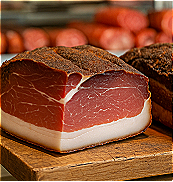
• Salume crudo semiduro ottenuto dalla coscia suina disossata, salata a secco con sale e spezie (tipicamente ginepro, alloro, pepe), leggermente affumicata a freddo e stagionata fino a sviluppo di aroma caratteristico.
• Disponibile come pezzo intero con cotenna, trancio o affettato in vaschetta (sottovuoto/MAP). Consumo tal quale (RTE) o come ingrediente.
Valori nutrizionali indicativi (per 100 g di prodotto)
• Energia 300–360 kcal; Proteine 27–32 g
• Grassi 25–32 g; SFA 8–12 g; MUFA 12–16 g; PUFA 2–4 g
• Carboidrati 0–1 g (talvolta tracce da zuccheri di salagione)
• Sale 3,5–5,5 g (sodio ~1,4–2,2 g)
• Colesterolo 70–90 mg
• Micronutrienti (medi, per 100 g): Tiamina (B1) 0,6–0,9 mg; Niacina (B3) 5–8 mg; B12 0,8–1,5 µg; Zinco 2–3 mg; Selenio 20–30 µg; Fosforo 180–220 mg; Ferro 1,0–1,8 mg
Principali sostanze contenute
• Proteine miofibrillari (miosina, actina) ad alto VB; frazione proteolitica (peptidi liberi) da maturazione.
• Lipidi intramuscolari: prevalenza di mufa su sfa; presenza di fosfolipidi suscettibili a ossidazione se esposti a O₂/luce.
• Composti dell’affumicatura: fenoli, acidi e carbonili volatili responsabili di note affumicate; livelli controllati dal processo.
• Sale (NaCl) come principale soluto conservante; residui tecnologici possibili (ascorbato; nitrito/nitrato ove impiegati secondo limiti di legge).
Processo di produzione
• Selezione cosce suine disossate → rifilatura → salagione a secco con sale, spezie ed eventuali coadiuvanti → riposo a freddo per diffusione salina.
• Affumicatura a freddo (tipicamente legni non resiniferi, es. faggio) a T basse, intervallata da periodi di riposo aerato per un profilo di fumo delicato.
• Stagionatura in ambienti controllati di T/UR fino a consistenza e aroma desiderati (tipicamente 5–6 mesi; per “Alto Adige IGP” minimo normato).
• Confezionamento: interi/tranci in vuoto; affettati in vuoto o MAP; catena del freddo.
Proprietà fisiche
• pH finale ~5,6–6,0; aw ridotta (≈0,90–0,92) grazie a salagione e disidratazione.
• Colore rosso rubino con marezzatura; grasso bianco perlaceo; lieve anello di fumo periferico.
• Tessitura compatta e facilmente affettabile; superficie asciutta.
Proprietà sensoriali e tecnologiche
• Aroma speziato-affumicato, note dolci/nocciolate da lipolisi e proteolisi controllate.
• Ottima affettabilità e resa in cubetti/julienne come ingrediente; sensibile a ossidazione se lasciato scoperto.
• In cottura breve sprigiona aromi; cotture prolungate possono aumentare la sapidità percepita e asciugare il prodotto.
Impieghi alimentari
• Antipasti e taglieri; panini, piadine, toast; condimento per canederli, risotti, paste, uova, verdure e pizze.
• Dadolato rosolato per basi aromatiche (soffritti leggeri), finitura croccante o emulsioni calde (panna/brodi).
Nutrizione e salute
Fonte di proteine ad alto valore biologico, B1 (e altre B), zinco e selenio. Allo stesso tempo, è stato dimostrato che un elevato consumo di carne rossa, in particolare di carne lavorata, può essere associato a un aumento del rischio di diverse importanti malattie croniche (1).
Il consumo moderato di carne, fino a ~ 100 g / die, non è stato associato a un aumento della mortalità per cardiopatia ischemica, ictus o malattie cardiovascolari totali (2).
I tagli magri riducono l’apporto di SFA e calorie; cucinare eliminando grasso visibile e preferendo metodi a umidità o sgrasso in cottura.
Sodio e nitriti/nitrati possono essere elevati nei prodotti trasformati (salumi): valutare il consumo e le porzioni.
Preferire porzioni moderate e abbinare alimenti ricchi di potassio e fibre (verdure, legumi) per bilanciare la sapidità.
• Limitare frequenza se si segue una dieta iposodica o in presenza di ipertensione.
• In gravidanza e per persone a rischio, considerare il riscaldamento al cuore (≥ 70–72 °C) per ridurre il rischio da Listeria nei RTE.
• Verificare in etichetta la presenza/assenza di nitriti/nitrati secondo preferenze personali.
Nota porzione: 20–40 g come ingrediente/antipasto; fino a 50–60 g occasionalmente come componente proteica del pasto, bilanciando sale e grassi del resto del menu.
Qualità e specifiche (temi tipici)
• Composizione: umidità, proteine, grassi totali, sale, rapporto grasso/magro, resa all’affettamento.
• Fisico-chimica: pH, aw, colore (Lab*), indice di ossidazione lipidica, composti fenolici da fumo.
• Microbiologia: assenza di patogeni (es. Salmonella su 25 g; Listeria controllata in RTE); conte totali contenute; Staphylococcus aureus sotto limiti.
• Additivi/contaminanti: conformità a limiti per nitriti/nitrati e residui tecnologici; metalli pesanti e ammine biogene sotto soglie.
• Confezionamento: vuoto/MAP con corretti gas; integrità sigilli, scadenza/TMC e tracciabilità.
Conservazione e shelf-life
• Intero/trancio sottovuoto: 0–4 °C; tipicamente alcuni mesi secondo produttore.
• Affettato in vaschetta: 0–4 °C; 60–120 giorni da chiuso; dopo apertura consumare entro 3–5 giorni ben coperto.
• Evitare sbalzi termici, luce e O₂ prolungati (ossidazioni, irrancidimenti). Congelamento non usuale: possibile ma può alterare tessitura.
Sicurezza e regolatorio
• Produzione in stabilimenti autorizzati con sistemi GMP/HACCP; controllo di sale, umidità, pH e attività dell’acqua per contenere crescita microbica.
• Prodotto RTE (ready to eat): attenzione a Listeria monocytogenes lungo tutta la catena del freddo; igiene rigorosa in affettamento e confezionamento.
• Additivi tipici (dove impiegati): nitrito di sodio (E250) e/o nitrato di potassio (E252) entro i limiti di legge; antiossidanti (es. ascorbati) per stabilità del colore e controllo dell’ossidazione.
• Affumicatura: gestione del fumo e della temperatura per minimizzare PAH; rispetto dei tenori massimi previsti.
• Speck tutelato (es. “Speck Alto Adige IGP”): disciplinare su materia prima, salagione a secco, legni ammessi per l’affumicatura, tempi minimi di stagionatura e caratteristiche sensoriali.
• Allergeni: nessuno intrinseco; gestire cross-contact in linea (glutine/latte/soia) secondo procedure documentate.
• Conservazione: catena del freddo 0–4 °C; una volta aperto, richiudere e consumare entro pochi giorni; evitare stazionamenti in area 5–60 °C.
Etichettatura
• Denominazione: “Speck” o “Speck Alto Adige IGP” se certificato; indicazione IGP con relativo logo quando applicabile.
• Ingredienti: coscia suina, sale, spezie/aromi (es. ginepro, pepe, alloro, coriandolo), fumo naturale; eventuali conservanti (E250/E252) e antiossidanti.
• Dati obbligatori: origine, lotto, peso, modalità di conservazione, termine minimo di conservazione/scadenza, valori nutrizionali, sede dello stabilimento.
• Claim facoltativi: “senza glutine”/“senza lattosio” solo se supportati da controlli; “senza nitriti/nitrati aggiunti” ammesso solo quando non impiegati come additivi (attenzione agli estratti vegetali con nitrati).
• Per affettato: data/ora di confezionamento, atmosfera protettiva MAP se usata, spessore medio di fetta (opzionale), istruzioni d’uso/consumo dopo apertura.
Troubleshooting
• Eccesso di salinità → salagione/stagionatura prolungata o squilibrata; mitigare con taglio sottile, abbinamento a pane/verdure dolci; in produzione, calibrare sale/spessore e uniformare pezzature.
• Aroma di fumo aggressivo/amaro → legno inadeguato o temperatura di affumicatura troppo alta; in impianto, controllare tempo, tiraggio e T; nel consumo, aerare il pezzo affettato 5–10 minuti.
• Ossidazione/rancido (odore di sego) → esposizione a luce/O₂; usare film barriera, ridurre headspace, aggiungere antiossidanti consentiti; a casa, conservare al buio e ben chiuso.
• Secchezza/fibrosità → stagionatura eccessiva o conservazione prolungata; affettare controfibra, servire a 16–18 °C; in produzione, bilanciare umidità relativa e tempi.
• Muffe indesiderate sulla cotenna → igiene/ventilazione non ottimali; sanificare locali, controllare umidità e ricorrere a spazzolatura/raschietto ove previsto dal disciplinare.
• Condensa in confezione → shock termico; stabilizzare temperatura prima del confezionamento e raccomandare al consumatore di aprire dopo breve acclimatazione.
Sostenibilità e filiera
• Materia prima suina: focus su benessere animale, tracciabilità e feed responsabile; valorizzazione dei sottoprodotti (cotenna/ossa) in logica di economia circolare.
• Processo: riduzione consumi energetici (recupero calore da affumicatoi/essiccatoi), uso di legni da gestione sostenibile, abbattimento e filtrazione fumi.
• Acque di processo: trattamento reflui con riduzione BOD/COD; riuso dove consentito e monitoraggi periodici.
• Packaging: preferenza per materiali riciclabili/monomateriale, inchiostri a bassa migrazione, ottimizzazione degli spessori per ridurre l’impronta.
• Sprechi alimentari: porzionatura calibrata, istruzioni chiare di conservazione post-apertura, proposte d’uso per rifili/estremità.
Principali funzioni INCI (cosmesi)
• Hydrolyzed Pork Protein / Hydrolyzed Collagen (porcine): skin/hair conditioning, film-forming; impiego limitato e soggetto a requisiti di purezza/igiene della materia prima.
• Sodium Lactate (da salagione/fermentazioni lattiche in filiera carni): umettante/regolatore di pH in cosmetici; non direttamente “da speck”, ma correlato alla tecnologia salina.
Conclusione
Lo speck è un salume stagionato e delicatamente affumicato, pronto al consumo e caratterizzato da profilo aromatico complesso. La qualità dipende da materia prima, salagione, gestione dell’affumicatura e stagionatura; la sicurezza si fonda su igiene in affettamento, controllo di Listeria, gestione di additivi e corretta refrigerazione. Per un consumo consapevole, privilegiare porzioni moderate e produttori che garantiscano tracciabilità, conformità ai disciplinari e pratiche sostenibili.
Mini-glossario
• GMP/HACCP: buone pratiche di fabbricazione / analisi dei pericoli e punti critici di controllo — sistemi per garantire sicurezza igienica.
• BOD/COD: domanda biochimica/chimica di ossigeno — indicatori di carico inquinante dei reflui.
• RTE: ready to eat — pronto al consumo senza ulteriore cottura.
• IGP: indicazione geografica protetta — qualità/renome legati a un’area, almeno una fase in zona.
• PAH: idrocarburi policiclici aromatici — contaminanti da fumo/combustione da mantenere sotto i limiti.
• MAP: modified atmosphere packaging — atmosfera protettiva per prolungare shelf-life.
• aw: water activity — quota di acqua “libera” disponibile per i microrganismi.
• SFA/MUFA/PUFA: acidi grassi saturi/monoinsaturi/poliinsaturi — bilanciamento favorevole a MUFA/PUFA nei regimi salutistici.
Bibliografia__________________________________________________________________________
(1) Wolk A. Potential health hazards of eating red meat. J Intern Med. 2017 Feb;281(2):106-122. doi: 10.1111/joim.12543.
Feingold KR,. The Effect of Diet on Cardiovascular Disease and Lipid and Lipoprotein Levels. 2024 Mar 31. In: Feingold KR, Ahmed SF, Anawalt B, Blackman MR, Boyce A, Chrousos G, Corpas E, de Herder WW, Dhatariya K, Dungan K, Hofland J, Kalra S, Kaltsas G, Kapoor N, Koch C, Kopp P, Korbonits M, Kovacs CS, Kuohung W, Laferrère B, Levy M, McGee EA, McLachlan R, Muzumdar R, Purnell J, Rey R, Sahay R, Shah AS, Singer F, Sperling MA, Stratakis CA, Trence DL, Wilson DP, editors. Endotext [Internet]. South Dartmouth (MA): MDText.com, Inc.; 2000–.
Singh B, Khan AA, Anamika F, Munjal R, Munjal J, Jain R. Red Meat Consumption and its Relationship With Cardiovascular Health: A Review of Pathophysiology and Literature. Cardiol Rev. 2025 Jan-Feb 01;33(1):49-53. doi: 10.1097/CRD.0000000000000575.
(2) Nagao M, Iso H, Yamagishi K, Date C, Tamakoshi A. Meat consumption in relation to mortality from cardiovascular disease among Japanese men and women. Eur J Clin Nutr. 2012 Jun;66(6):687-93. doi: 10.1038/ejcn.2012.6.
Abstract. Background/objectives: Although high or low (no) meat consumption was associated with elevated or reduced mortality from cardiovascular disease, respectively, few studies have investigated the association between moderate meat consumption and cardiovascular disease. We aimed to evaluate the associations between moderate meat consumption and cardiovascular disease mortality. Subjects/methods: We conducted a prospective cohort study of 51,683 Japanese (20,466 men and 31,217 women) aged 40-79 years living in all of Japan (The Japan Collaborative Cohort Study; JACC Study). Consumptions of meat (beef, pork, poultry, liver and processed meat) were assessed via a food frequency questionnaire administrated at baseline survey. Hazard ratios (HRs) of mortality from cardiovascular disease were estimated from Cox proportional hazards regression models according to quintiles of meat consumption after adjustment for potential confounding variables. Results: During 820,076 person-years of follow-up, we documented 2685 deaths due to total cardiovascular disease including 537 ischemic heart diseases and 1209 strokes. The multivariable HRs (95% confidence interval) for the highest versus lowest quintiles of meat consumption (77.6 versus 10.4 g/day) among men were 0.66 (0.45-0.97) for ischemic heart disease, 1.10 (0.84-1.43) for stroke and 1.00 (0.84-1.20) for total cardiovascular disease. The corresponding HRs (59.9 versus 7.5 g/day) among women were 1.22 (0.81-1.83), 0.91 (0.70-1.19) and 1.07 (0.90-1.28). The associations were similar when the consumptions of red meat, poultry, processed meat and liver were examined separately. Conclusion: Moderate meat consumption, up to ~100 g/day, was not associated with increased mortality from ischemic heart disease, stroke or total cardiovascular disease among either gender.
_______________
Hill ER, Wang Y, Davis EM, Campbell WW. Healthy Dietary Patterns with and without Meat Improved Cardiometabolic Disease Risk Factors in Adults: A Randomized Crossover Controlled Feeding Trial. Nutrients. 2024 Aug 3;16(15):2542. doi: 10.3390/nu16152542. PMID
Jung AJ, Sharma A, Chung M, Wallace TC, Lee HJ. The Relationship of Pork Meat Consumption with Nutrient Intakes, Diet Quality, and Biomarkers of Health Status in Korean Older Adults. Nutrients. 2024 Dec 4;16(23):4188. doi: 10.3390/nu16234188.
Abstract. Background: Pork meat is a widely consumed protein food with the potential to differentially affect health and nutritional status across social and cultural contexts. Objectives: We evaluated the association between pork meat consumption and nutrient intake, diet quality, and biomarkers of health among older adults (age ≥ 65 years) in Korea. Methods: Our analyses utilized dietary and health examination data from the 2016-2020 Korean National Health and Nutrition Examination Survey (n = 2068). Comparisons between variables derived from the nutrition survey and health examination by pork consumption (consumers vs. non-consumers) were assessed using regression analyses for survey data. Results: Pork consumption was found to be associated with younger age, greater educational attainment, and lower likelihood of living in a rural area. Consumption was also associated with a higher intake of energy and all nutrients except vitamin B6, retinol, ⍵3, and zinc in males and vitamin B6 in females. Diet quality was modestly higher among male (67.91 ± 0.93 vs. 65.74 ± 0.74; p = 0.0308) and female (70.88 ± 0.96 vs. 67.00 ± 0.73; p < 0.0001) pork consumers. Differences in biomarkers were clinically irrelevant, with inconsistencies between genders. Handgrip strength was slightly higher among male (33.84 ± 0.52 vs. 31.91 ± 0.40; p < 0.0001) and female (20.76 ± 0.34 vs. 19.99 ± 0.22; p < 0.0001) pork consumers. Conclusions: In Korean older adults, pork consumption may contribute to a higher intake of energy and most nutrients, improved diet quality scores, higher vegetable intake, and small improvements in health biomarkers. Further well-designed studies are needed to confirm these findings.
Barone G, Storelli A, Quaglia NC, Garofalo R, Meleleo D, Busco A, Storelli MM. Trace Metals in Pork Meat Products Marketed in Italy: Occurrence and Health Risk Characterization. Biol Trace Elem Res. 2021 Aug;199(8):2826-2836. doi: 10.1007/s12011-020-02417-z.
Abstract. This study provides valuable information on the levels of various trace metals (Pb, Cd, Hg, Zn, Cu, Cr) in meat products (baked ham, raw ham, mortadella, cured sausage, würstel, salami) from South Italy and calculates potential health risk toxicity associated with their consumption for the total population and for children. In the samples studied metal concentrations are within the permissible legal limits (Cd: 0.01-0.03 μg g-1 w.w., Hg: 0.01-0.02 μg g-1 w.w., Zn: 5.71-7.32 μg g-1 w.w., Cu: 1.08-1.21 μg g-1 w.w., Cr: 0.15-0.23 μg g-1 w.w.), except for Pb (Pb: 0.22-0.38 μg g-1 w.w.). The estimated intake values are within the provisional tolerable daily intake limits for toxic metals and recommended daily intake values for essential metals in both tested groups. The noncarcinogenic risk values of the individual metals indicate that there is no health risk, but their combined effects might constitute a potential risk for children. Furthermore, the cumulative cancer risk of all samples studied exceeds the recommended threshold risk limit (> 10-4) in both total population and children, indicating a risk of potential health problems for consumers especially for children, who are more vulnerable to toxic metal exposure.
Li G, Jiang J, Li Z. The relationship between processed meat, red meat, and risk of cardiovascular disease and type 2 diabetes: A Mendelian randomization study. Eur J Prev Cardiol. 2024 Mar 25:zwae117. doi: 10.1093/eurjpc/zwae117.
Abstract. Background: Numerous observational studies have indicated a potential association between the consumption of processed and red meat and an increased risk of cardiovascular disease and type 2 diabetes mellitus (T2DM). However, the presence of a causal relationship remains uncertain. Therefore, the purpose of this study is to evaluate the impact of processed meat and red meat (pork, lamb, and beef) on the risk of cardiovascular disease, including coronary artery disease (CAD), hypertension, and stroke, and T2DM, using a Two-Sample Mendelian randomization (MR) analysis. Methods: MR analysis was conducted using the inverse-variance weighted (IVW), weighted median (WM), and MR Egger methods. To identify heterogeneity and pleiotropy, Cochrane's Q test and MR-Egger test were employed. Additionally, the stability of the MR results was assessed using the leave-one-out method. Results: IVW analyses reveal no causal association between the consumption of processed and red meat and the incidence of CAD, hypertension, stroke, and T2DM (P > 0.05). When considering processed meat intake, heterogeneity is observed in hypertension and stroke outcomes (P < 0.05). For pork intake, heterogeneity is seen in hypertension, stroke, and T2DM (P < 0.05). Lamb intake shows heterogeneity in hypertension and T2DM (P < 0.05). However, other exposures and outcomes examined show no heterogeneity (P > 0.05). No significant pleiotropy is detected for all exposures through an MR-Egger test (P > 0.05). Furthermore, the Leave-one-out test demonstrates the robustness of the results. Conclusion: The study discerned no observable impact of red and processed meat consumption on CAD, hypertension, stroke, and T2DM. The findings of this study challenge the prevailing conventional perspective in the field.
Geiker NRW, Bertram HC, Mejborn H, Dragsted LO, Kristensen L, Carrascal JR, Bügel S, Astrup A. Meat and Human Health-Current Knowledge and Research Gaps. Foods. 2021 Jul 5;10(7):1556. doi: 10.3390/foods10071556.
Abstract. Meat is highly nutritious and contributes with several essential nutrients which are difficult to obtain in the right amounts from other food sources. Industrially processed meat contains preservatives including salts, possibly exerting negative effects on health. During maturation, some processed meat products develop a specific microbiota, forming probiotic metabolites with physiological and biological effects yet unidentified, while the concentration of nutrients also increases. Meat is a source of saturated fatty acids, and current WHO nutrition recommendations advise limiting saturated fat to less than ten percent of total energy consumption. Recent meta-analyses of both observational and randomized controlled trials do not support any effect of saturated fat on cardiovascular disease or diabetes. The current evidence regarding the effect of meat consumption on health is potentially confounded, and there is a need for sufficiently powered high-quality trials assessing the health effects of meat consumption. Future studies should include biomarkers of meat intake, identify metabolic pathways and include detailed study of fermented and other processed meats and their potential of increasing nutrient availability and metabolic effects of compounds.
Celada P, Sánchez-Muniz FJ, Delgado-Pando G, Bastida S, Rodilla ME, Jiménez-Colmenero F, Olmedilla-Alonso B. Effects of improved fat meat products consumption on emergent cardiovascular disease markers of male volunteers at cardiovascular risk. J Physiol Biochem. 2016 Dec;72(4):669-678. doi: 10.1007/s13105-016-0505-5.
Abstract. High meat-product consumption has been related to cardiovascular disease (CVD). However, previous results suggest the benefits of consuming improved fat meat products on lipoprotein-cholesterol and anthropometric measurements. Present study aims to assess the effect of consuming different Pâté and Frankfurter formulations on emergent CVD biomarkers in male volunteers at increased CVD risk. Eighteen male volunteers with at least two CVD risk factors were enrolled in a sequentially controlled study where different pork-products were tested: reduced-fat (RF), omega-3-enriched-RF (n-3RF), and normal-fat (NF). Pork-products were consumed during 4-week periods separated by 4-week washout. The cardiometabolic index (CI), oxidized low density lipoproteins (oxLDL), apolipoproteins (Apo) A1 and B, homocysteine (tHcys), arylesterase (AE), C-reactive Protein (CRP), tumor necrotic factor-alpha (TNFα), and lipoprotein (a) (Lp(a)) were tested and some other related ratios calculated. AE, oxLDL and Lp(a), AE/HDLc, LDLc/Apo B, and AE/oxLDL rate of change were differently affected (P<0.01) by pork-products consumption. RF increased (P < 0.05) AE, AE/HDLc and AE/oxLDL ratios and decreased TNFα, tHcys; n-3RF increased (P < 0.001) AE, AE/HDLc and AE/oxLDL ratios and decreased (P < 0.05) Lp(a); while NF increased (P<0.05) oxLDL and Lp(a) levels. In conclusion, RF and n-3RF products affected positively the level of some emergent CVD markers. The high regular consumption of NF-products should be limited as significantly increased Lp(a) and oxLDL values. The high variability in response observed for some markers suggests the need to perform more studies to identify targets for RF- and n-3RF-products. Graphical Abstract Emergent CVD markers.
Jafari F, Damani JJ, Petersen KS. The Effect of Red Meat Consumption on Circulating, Urinary, and Fecal Trimethylamine-N-Oxide: A Systematic Review and Narrative Synthesis of Randomized Controlled Trials. Adv Nutr. 2025 Jul;16(7):100453. doi: 10.1016/j.advnut.2025.100453. Epub 2025 May 24. PMID: 40419218; PMCID: PMC12273423.




