



Smoke flavorings (primary smoke condensate; derived smoke flavorings)
Description
• Flavoring preparations obtained by controlled pyrolysis of hardwood (e.g., hickory, oak, beech), capture of smoke, aqueous condensation, and fractionation to remove tar and reduce PAH.
• Supplied as liquid water-soluble concentrates, oil-soluble fractions, or powders (spray-dried on carriers such as salt or maltodextrin); intensity ranges from light “toast” to robust “bacon/ham” notes.
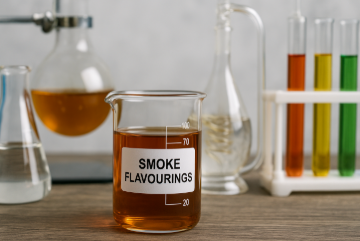
• Typical acidic profile with phenolic, carbonyl, and acidic notes; color from pale amber to dark brown.
Caloric value (per 100 g)
• Liquid concentrates: typically ≤20–60 kcal/100 g (mostly organic acids/carbonyls; negligible for use levels).
• Powders (spray-dried): 150–380 kcal/100 g depending on carrier; at flavor dosages the energy contribution is minimal.
Key constituents
• Phenols (e.g., guaiacol, syringol) → smoke character, antioxidant activity.
• Carbonyls (furfural, maltol, cyclotene) → sweetness/caramelized notes, browning reactivity.
• Organic acids (acetic, formic) → acidity, antimicrobial contribution; typical pH ~2.2–3.5.
• Trace lactones and other volatiles; PAH minimized by tar removal and purification.
• Analytical markers: total phenols, DNPH-carbonyls, pH, color (absorbance), volatile profile by GC–MS.
Production process
• Pyrolysis of selected hardwood chips under limited oxygen → smoke capture and water condensation.
• Phase separation (aqueous vs tar), filtration/centrifugation, optional extraction and rectification to tailor top/bottom notes.
• Concentration (vacuum), neutralization/blending, and standardization; spray-drying/encapsulation for powders.
• Manufactured under GMP/HACCP with controls for PAH, tar, and heavy metals.
Sensory and technological properties
• Provides authentic smoky aroma/taste without traditional smoking; can add surface color and mild antimicrobial effect (acids/phenols).
• Water-soluble liquids pick up well in brines/injections; oil-soluble types suit fats and coatings.
• Heat amplifies smoky, meaty and roasted notes (Maillard synergy with sugars/amino acids).
Food uses
• Meat and fish (brines, marinades, injections, surface sprays); snacks (seasonings), sauces, barbecue glazes, cheese/plant-based analogs, nuts, soups.
• Typical inclusion: 0.05–1.0% in finished products (optimize by pilot trials); surface treatments often in 2–10% solutions.
Nutrition and health
• Used at very low dosages; fat, sugar, and sodium depend on the carrier/system.
• Properly purified smoke flavors have far lower PAH than many traditionally smoked foods; compliance with applicable limits is essential.
• No specific health claims should be made unless authorized.
Lipid profile
• Fat negligible in aqueous concentrates; powder fat content reflects carrier systems (usually trace).
• Any residual lipids are trace and nutritionally insignificant (no relevant SFA/MUFA/PUFA contribution).
Quality and specifications (typical topics)
• pH, total phenols, DNPH-carbonyls, density/°Plato, color (A₄₂₀/A₄₅₀), and sensory intensity grade.
• PAH (e.g., benzo[a]pyrene) within specification; tar/insolubles controlled.
• Microbiology: compliant counts; absence of pathogens in powders.
• Solubility (water/oil), stability in salt/acid matrices, and carrier declaration for powders.
Storage and shelf-life
• Store cool, dark, in airtight containers (HDPE or stainless steel for liquids); protect from oxygen and moisture.
• Powders: keep dry, well-sealed; consider desiccant.
• Typical shelf-life 12–24 months (check supplier COA); apply FIFO.
Allergens and safety
• No inherent major allergens; check carriers (e.g., maltodextrin source) and any added sulfites.
• Highly acidic liquids can be corrosive to mild steel—use compatible materials.
• Ensure regulatory compliance for intended use and PAH limits.
INCI functions in cosmetics
• Listed as Aroma/Flavor; role: masking and smoky note in oral-care or novelty products (rare, niche use).
Troubleshooting
• Bitterness/astringency: over-dosage or heavy phenolic cut → select lighter fractions, reduce dose, add sweetness/fat.
• Color too dark/precipitate: tar carryover or heat abuse → improve clarification, filter, use lighter grade.
• Phase/separation in brines: solubility mismatch → switch to water-soluble type or emulsify.
• Metallic notes/corrosion: incompatible tanks/pipes → switch to HDPE/316L SS and monitor pH.
Sustainability and supply chain
• Use certified hardwood sources; capture/abate VOC emissions from pyrolysis.
• Wastewater managed to BOD/COD targets; energy recovery from hot gases; recyclable packaging.
• Full traceability under GMP/HACCP.
Conclusion
Smoke flavor offers consistent, controllable smokiness with low PAH risk when properly purified, enabling flexible application across meats, sauces, snacks, and plant-based foods. Selecting the right fraction, managing dose/pH/solubility, and enforcing spec limits are key to clean, authentic results.
Mini-glossary
• PAH — Polycyclic aromatic hydrocarbons: potential contaminants formed during pyrolysis; must be minimized for safety.
• DNPH — 2,4-Dinitrophenylhydrazine method: derivatizes carbonyls for quantification (often by HPLC).
• HPLC — High-performance liquid chromatography: used for DNPH-carbonyls and other markers.
• GC–MS — Gas chromatography–mass spectrometry: identifies smoke volatiles (phenols, carbonyls, lactones).
• GMP — Good Manufacturing Practice: hygiene and process-control standards across production.
• HACCP — Hazard Analysis and Critical Control Points: preventive system with defined CCP for safety.
• VOC — Volatile organic compounds: gaseous emissions from pyrolysis; require capture/abatement.
• BOD/COD — Biochemical/Chemical Oxygen Demand: wastewater load indicators for environmental control.
• FIFO — First in, first out: stock rotation using older lots first.
• SFA/MUFA/PUFA — Saturated/monounsaturated/polyunsaturated fatty acids: minimal relevance in smoke flavor concentrates (present only in traces).
Smoked flavoring products have increased in recent decades as barbecue use has expanded and are regulated in Europe by Regulation (EC) No. 1321/2013 (1). In this study, ten commonly used liquid smoke flavorings were analyzed and used two different solvents to investigate whether polar or nonpolar substances have the ability to cause toxic effects. The results indicated that the liquid smoke flavorings contain compounds with hazardous properties (2).

