



Lemon peel
(Citrus limon (L.) Osbeck; flavedo + albedo; food and ingredient uses)
Description
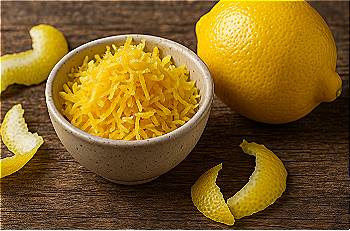
• The outer yellow rind (flavedo) rich in essential oils and the inner white pith (albedo) rich in pectin and fiber. Supplied as fresh zest, dried peel/powder, candied peel, extracts/distillates (peel oil, hydrosol), and pectin raw material.
• Aroma profile: bright citrus–lemon notes (d-limonene, citral), with potential bitterness from limonoids if albedo/seed carryover is high.
Indicative nutrition values (per 100 g raw peel; typical—culinary use is much smaller)
• Energy: ~45–55 kcal
• Carbohydrate: ~15–17 g — sugars ~4–5 g
• Dietary fiber: ~10–12 g (pectins/hemicelluloses)
• Protein: ~1–2 g • Fat: ~0.3–0.5 g — SFA negligible
• Vitamin C: ~90–130 mg • Folate: ~10–20 μg • Potassium: ~160–200 mg • Calcium: ~130–140 mg
• Note: at use levels (zest teaspoons/grams per portion), nutrient contribution is modest; candied peel reflects the recipe’s added sugar.
Key constituents
• Essential oils (flavedo): d-limonene (major), β-pinene, γ-terpinene, citral (neral/geranial), linalool, minor aldehydes.
• Flavonoids: eriocitrin, hesperidin, diosmin; polymethoxylated flavones (PMFs) (e.g., nobiletin, tangeretin) mainly in peel.
• Limonoids (limonin, nomilin) → delayed bitterness if released.
• Pectins (high-methoxyl), hemicelluloses, cellulose (albedo).
• Trace furanocoumarins in cold-pressed peel oil (phototoxicity issue for skin products; food use levels are low).
Production process
• Raw peel/zest: select fruit labeled “edible peel” when surface-treated; wash, optionally dewax, zest/pare, separate from pith as needed.
• Dried peel/powder: controlled drying (low T, airflow) → milling/sieving to particle spec; or freeze-dry for top-note retention.
• Candied peel: blanch (reduce bitterness, soften) → multi-stage sugar infusion → drying and optional coating.
• Peel oil: cold expression of flavedo (more complete aroma; carries furocoumarins) or steam distillation (cleaner, low FCs).
• Pectin: acid extraction from albedo → purification → drying and standardization.
• All under GMP/HACCP with pesticide/wax compliance.
Physical properties
• Appearance: fresh zest bright yellow; dried peel/powder pale-yellow to light brown; candied peel translucent.
• Aroma: high-impact, volatile; oxidation-sensitive (terpenes, aldehydes).
• Bitterness: rises with albedo/seed carryover (limonoids).
• Water activity: low in dried powders (stability), high in fresh/candied (require control).
Sensory & technological properties
• Top-note enhancer at very low dose; withstands short heating but top notes flash off with prolonged heat—add part late.
• Pectin source (albedo) for gelation and viscosity (high-methoxyl pectin gels with sugar + acid).
• Natural flavor “fixative”: peel powders help carry aroma in dry mixes; fiber adds body and reduces syneresis in fillings/jams.
• Can contribute yellow hue slightly; primary function remains flavor/aroma.
Food applications
• Culinary: zest in sauces, marinades, dressings, pastries, leavened goods; candied peel in bakery/confectionery; infusions for syrups, spirits (e.g., limoncello).
• Beverages: peel macerates, cold-brews, flavoring for soft drinks/teas.
• Industrial: bakery inclusions, seasoning blends, dairy desserts, jam/gel systems (pectin), citrus flavor bases.
Nutrition & health
Lemon peel delivers dietary fiber (pectin) and bioactives (flavonoids/PMFs) with negligible fat and SFA. In typical culinary amounts it can support flavor enrichment with minimal calories and contributes small amounts of vitamin C and polyphenols.
Safety/attention points: choose fruit with edible peel declarations when zest is consumed; rinse thoroughly. Cold-pressed peel oil contains furanocoumarins that are phototoxic on skin—relevant to cosmetics and handling; in foods, usage levels are low and typically safe. Allergenic fragrance components (limonene, citral, linalool, geraniol, citronellal) may oxidize to more sensitizing species—store well and avoid stale materials. Bitterness increases if excessive pith/seed is included; blanching/deseeding controls it. No grapefruit-like drug interaction is known for lemon.
Portion note: typical culinary use 1–2 tsp zest (~2–4 g) per serving; candied peel 10–20 g per portion in bakery; peel powder 0.2–1.0% in formulations; food-grade peel oil 0.02–0.10% (or flavor-house guidance).
Quality & specifications (typical topics)
• Identity: botanical, part (flavedo/albedo), origin, “edible peel” compliance for fresh.
• Dried peel/powder: moisture (e.g., ≤10%), volatile oil content, particle size, color (CIELAB), ash, micro (low counts; pathogens absent/25 g).
• Peel oil: assay (limonene %, citral %), optical rotation, refractive index, peroxide value, furocoumarins (if cold-pressed).
• Contaminants: pesticide residues ≤ MRL, heavy metals within limits; absence of foreign matter; EO (ethylene oxide) not permitted.
• Candied peel: °Brix, aw, crystal quality, preservative status.
Storage & shelf-life
• Fresh zest/peel: use promptly or freeze zest; protect from light/air.
• Dried/powder: cool, dry, dark in moisture-barrier packs; 12–24 months typical.
• Peel oil: amber glass, oxygen/light barrier, cool storage; antioxidants as specified; 12–24 months depending on spec.
• Candied peel: ambient sealed; refrigerate after opening and use within stated period.
Safety & regulatory
• Fresh fruit must declare postharvest surface treatments (waxes/authorized fungicides) where applicable; only peels labeled edible should be zested.
• Peel oil is generally recognized as safe at GMP flavoring levels; observe labeling for allergens (flavor compounds) where required.
• Production under GMP/HACCP; pectin per food additive specs when marketed as such.
Labeling
• “Lemon peel/zest,” “dried lemon peel,” “candied lemon peel,” “lemon peel oil,” “lemon hydrosol,” or “pectin” as applicable; declare surface treatment on fresh fruit; list added sugar for candied products.
Troubleshooting
• Flat aroma after baking → over-volatilization/oxidation → add part of zest late, use encapsulated flavors, or raise inclusion slightly.
• Bitter off-taste → excess albedo/seed breakage → trim pith, gentle extraction, seed removal.
• Oxidized/soapy notes in oil → old or poorly stored EO → refresh stock, improve headspace/O₂ control, add permitted antioxidants.
• Sticky candied peel/crystallization → poor syrup control → adjust °Brix/temperature, proper drying, anticrystallization steps.
• Wax interference when zesting → heavy postharvest wax → select edible-peel fruit or lightly abrade/peel surface layer.
Sustainability & supply chain
• By-product valorization: peel from juicing can yield EO, pectin, fiber, and d-limonene (green solvent/fuel).
• Priorities: reduce postharvest waste, efficient water/heat use, wastewater to BOD/COD targets, recyclable packaging, and residue compliance via IPM in orchards.
INCI functions (cosmetics)
• Citrus Limon (Lemon) Peel Oil — fragrance/perfuming, masking; prefer FCF (furocoumarin-free) or respect IFRA limits due to phototoxicity risk of cold-pressed oils.
• Citrus Limon (Lemon) Peel Extract — skin-conditioning, antioxidant (flavonoids/PMFs), mild astringent/toning; used in toners/serums/creams for combination skin.
• Citrus Limon (Lemon) Peel Water / Distillate — fragrance/tonic, low-oil aromatic vehicle.
• Citrus Limon (Lemon) Peel Powder — absorbent/opacifying, gentle mechanical exfoliant; mild deodorizing potential.
• Allergenic fragrance components to declare above thresholds: limonene, citral, linalool, citronellal, geraniol.
• Formulation notes: use distilled or FCF oils for leave-on; in rinse-off risk is lower but manage oxidation (antioxidants) and surfactant/emulsion compatibility.
Conclusion
Lemon peel is a high-impact aromatic and functional ingredient: zest and oils deliver fresh citrus top notes, the albedo provides pectin/fiber for texture, and peel powders enhance body and stability. Quality depends on edible-peel sourcing, freshness/oxidation control, and bitterness management; safety hinges on proper handling of furocoumarins in oils (FCF/IFRA) and compliance with residue limits.
Mini-glossary
• Flavedo/Albedo — colored outer peel rich in essential oil / inner white layer rich in pectin.
• PMFs — polymethoxylated flavones typical of citrus peels with antioxidant/stabilizing roles.
• Limonoids (limonin/nomilin) — compounds behind delayed bitterness.
• FCF — furocoumarin-free lemon oil for improved photostability/safety in leave-on products.
• IFRA — guidelines on safe fragrance ingredient use/limits.
• SFA — saturated fatty acids (negligible in peel).
• MRL — maximum residue limits for pesticides.
Studies
The chemical composition of the lemon includes mainly citric acid and limonene.
It contains flavonoids, which are extremely useful components for the immune defense of the human body and therefore to combat degenerative diseases such as cancer. In particular, Rutin, Quercetin, Neoeriocitrin (1).
It also contains a large amount of vitamin C, one of the most important antioxidants found in nature and an element of contrast to free radicals that are the cause of aging and many diseases related to the oxidation process of cells. However, the fruit that contains the highest amount of vitamin C is the kiwi.
A lemon juice, you know is a remedy against colds and flu and cooling diseases.
It also acts as a protector against rheumatoid arthritis.
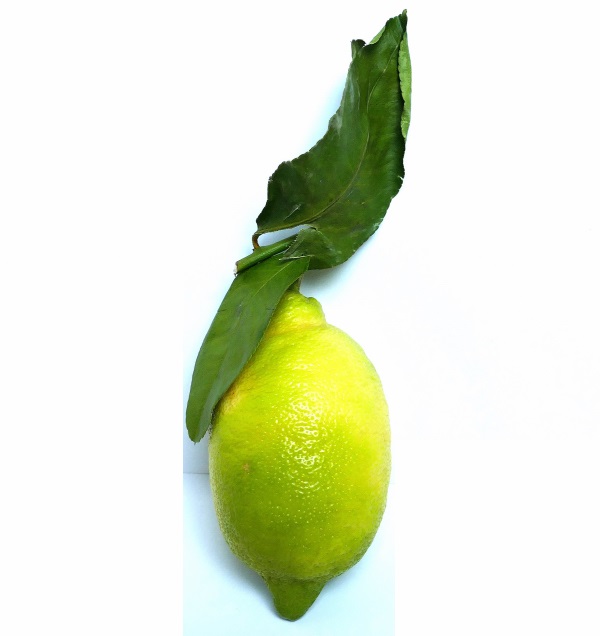
Thin-skinned lemons are preferable as they have more juice.
The lemon have been recognized by scientific studies antimicrobial activity both in the form of nanoemulsions in essential oil and in the form of pure essential oil juice (2).
Among the various phenolic components present in lemon peel, Eriocitrin, for its anti-aging properties, has been the subject of specific studies in rats (3).
Lemon extract has also demonstrated antimicrobial activity against bacteria such as Pseudomonas aeruginosa and Klebsiella pneumoniae (4).

