Agrumi
(Citrus spp.: arancia, mandarino/clementina, limone, pompelmo, lime, bergamotto; famiglia Rutaceae)
Descrizione
• Frutti hesperidi con polpa succosa suddivisa in spicchi, elevata acidità e profilo aromatico dominato dagli oli essenziali della buccia (flavedo). Commercializzati freschi (da tavola, con o senza semi) e come derivati: succhi NFC/concentrati, puree, marmellate/gelatine, scorze candite, oli essenziali ed estratti.
• Ampia stagionalità con cultivar a gradi Brix e acidità titolabile variabili; il rapporto Brix/acidi guida la percezione di dolcezza/equilibrio.
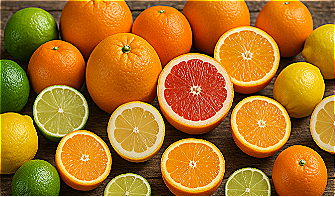
Valori nutrizionali indicativi (per 100 g di parte edibile; range tipici per i principali agrumi)
• Energia: 25–55 kcal
• Carboidrati: 8–13 g — zuccheri 7–10 g
• Fibre: 1,5–3,0 g (prevalenza pectine solubili)
• Proteine: 0,6–1,0 g
• Grassi: 0,1–0,3 g — SFA trascurabili
• Vitamina C: 30–60 mg (mandarino ~26–35; arancia/limone ~45–55)
• Folati: 15–40 µg • Potassio: 140–200 mg • Calcio: 30–40 mg • Magnesio: 8–12 mg
• Sodio: molto basso (↑ solo in conserve/sciroppi)
Principali sostanze contenute
• Acidi organici: citrico predominante (pH succo ~2,2–3,5), malico/minori.
• Flavonoidi: esperidina, eriocitrina, narirutina; in pompelmo naringina (nota amarognola). PMF (flavoni polimetossilati) nelle bucce.
• Carotenoidi: β-criptoxantina (mandarino), β-carotene, luteina/zeaxantina (colore polpa).
• Pectine e emicellulose (albedo); limonoidi (limonina, nomilina) responsabili dell’amara tardiva nei succhi.
• Oli essenziali: d-limonene dominante, più linalolo, citrale, nootkatone (pompelmo).
Processo di produzione
• Frutta fresca: raccolta a maturazione commerciale → cernita, lavaggio, eventuale degreening con etilene a bassa dose (per uniformare il colore), ceratura alimentare e confezionamento.
• Succhi: estrazione (reamer/pressa), chiarifica o mantenimento con pulp, pastorizzazione; per concentrati: evaporazione a T ridotta → FCOJ/FCLJ; recupero di oli essenziali e acque aromatiche.
• Scorze: sbiancatura, canditura, taglio; produzione di pectina da albedo; sottoprodotti a mangime/biogas.
• Controlli secondo GMP/HACCP e specifiche merceologiche.
Proprietà fisiche
• °Brix tipici: arancia 10–13; mandarino/clementina 11–14; limone 7–10; pompelmo 9–12.
• Acidità titolabile (come acido citrico): 0,6–1,2% (arance/mandarini), 5–8% (limoni).
• Rapporto Brix/acidità guida dolcezza/equilibrio; colore influenzato dai carotenoidi e dalla T di stoccaggio.
Proprietà sensoriali e tecnologiche
• Dolcezza–acidità bilanciate determinano accettabilità; amaro da naringina (pompelmo) e limonina (amaro ritardato) da gestire con selezione varietale, chiarifica/adsorbenti e condizioni di processo.
• Pectine conferiscono corpo e stabilità in succhi/marmellate (gel con zucchero/acido).
• Gli oli essenziali apportano note fresche/agrumate; sono sensibili a ossidazione/luce → uso di antiossidanti/shelter da O₂.
Impieghi alimentari
• Fresco da tavola e frutta pronta (spicchi/supremes).
• Bevande: succhi NFC, succhi da concentrato, mix, soft drink, birre radler.
• Cucina/pasticceria: zeste e succo per salse, marinature, dolci, lievitati; marmellate/gelatine.
• Ingredienti: oli essenziali, acque aromatiche, scorze candite, pectina.
Nutrizione e salute
Gli agrumi sono a bassa densità energetica e apportano vitamina C, folati, potassio, carotenoidi e flavonoidi; le pectine contribuiscono a sazietà e modulazione della risposta glicemica. L’apporto di grassi e SFA è trascurabile.
Attenzioni:
• Interazioni farmaci con pompelmo e talvolta bergamotto per furanocumarine (inibizione CYP3A4/P-gp): può aumentare l’esposizione a farmaci sensibili — attenersi a indicazioni mediche.
• Reflusso/ipersensibilità: l’acidità può irritare in soggetti con GERD; modulare porzioni/tempi.
• Erosione dentale: il pH acido richiede risciacquo d’acqua dopo il consumo e evitare spazzolatura immediata.
• Allergie/fitofotodermatiti: rare reazioni al frutto; oli di buccia possono dare fototossicità cutanea (bergaptene) al contatto/sole.
• Succhi: pur ricchi di vitamina C, hanno zuccheri liberi; preferire frutto intero quando possibile e porzioni moderate.
Nota porzione: frutto intero 1 medio (arancia/mandarino) ≈ 120–180 g edibile; limone: succo di ½–1 frutto; succo: 150–200 mL. Per marmellate, 20–30 g come porzione di riferimento.
Qualità e specifiche (temi tipici)
• Classe commerciale/calibro, colore e assenza difetti (ferite, ammaccature, muffe peduncolo).
• °Brix, acidità titolabile, rapporto Brix/acidità, contenuto di succo, olio essenziale superficiale (per zeste).
• Residui: pesticidi ≤ MRL, metalli nei limiti; trattamenti di superficie (cere/fungicidi ammessi) dichiarati.
• Microbiologia: frutto intero a pH basso → rischio ridotto; per succhi controllo spore resistenti all’acido, lieviti e muffe; patogeni assenti/25 g.
• Per succhi: pulp %, viscosità, colore (IU), limonina/naringina (amaro), vitamina C.
Conservazione e shelf-life
• Fresco: 4–10 °C (evitare chilling injury in pompelmo/lime sotto ~7–8 °C), UR alta; 2–8 settimane secondo specie/catena del freddo.
• Evitare etilene per lotti sensibili; separare da prodotti che assorbono odori.
• Succhi: refrigerati ≤4 °C (NFC pastorizzati) con shelf-life tipica 2–4 settimane; UHT/concentrati a T ambiente mesi (integri), refrigerare dopo apertura.
Sicurezza e regolatorio
• Conformità a norme di commercializzazione ortofrutta e requisiti igienici; piani GMP/HACCP per lavorazioni.
• Etichettatura: origine, categoria/calibro, eventuale trattamento superficiale (cere/conservanti) e indicazioni di conservazione; per succhi: denominazione (NFC/da concentrato), % frutta, zuccheri aggiunti se presenti.
Etichettatura
• Denominazioni: “arance/mandarini/clementine/limoni/pompelmi/lime”; per trasformati: “succo di…”, “marmellata di agrumi”, “olio essenziale di…”.
• Evidenziare trattamenti di superficie e modalità d’uso (zeste eduli solo da frutti edibilità buccia).
Troubleshooting
• Amaro tardivo nei succhi → formazione di limonina → ottimizzare estrazione (minimizzare rottura semi/albedo), chiarifica/adsorbenti, gestione T/pH.
• Haze/precipitati → pectine/proteine → uso di pectinasi, chiarifica o microfiltrazione.
• Ossidazione aroma/colore → O₂/luce → de-aerazione, antiossidanti consentiti, pack barriera.
• Muffe al calice → lesioni/umidità → migliorare selezione e ventilazione, trattamenti post-raccolta autorizzati.
• Scorza cerosa difficile da grattugiare → eccesso di cera → preferire frutti con buccia edibile o rimuovere superficialmente la cera.
Sostenibilità e filiera
• Criticità: uso idrico in agrumeti, fitofarmaci, perdite post-raccolta; mitigazioni con irrigazione efficiente, IPM, portinnesti resistenti, coprodotti valorizzati (oli, pectina, mangimi, biogas).
• In stabilimento: recupero calore/acqua, gestione reflui verso target BOD/COD, packaging riciclabile e ottimizzazione logistica.
Conclusione
Gli agrumi offrono freschezza aromatica, vitamina C, flavonoidi e fibre con basso apporto calorico. Selezione della materia prima (rapporto Brix/acidità), processi che preservano aroma/colore e una catena del freddo efficiente sono determinanti per qualità e gradimento.
Mini-glossario
• °Brix: gradi zuccherini del succo.
• Acidità titolabile (TA): % di acido (citrico) nel succo.
• Rapporto Brix/acidità: indice di equilibrio gustativo.
• NFC / FCOJ: not from concentrate / frozen concentrated orange juice.
• PMF: polymethoxylated flavones — flavoni polimetossilati della buccia.
• Limonina: limonoide responsabile di amaro tardivo nei succhi.
• Flavedo/Albedo: strato colorato esterno della buccia / strato bianco ricco di pectina.
• d-Limonene: monoterpene principale degli oli essenziali di agrumi.
• SFA: acidi grassi saturi — trascurabili negli agrumi.
Bibliografia__________________________________________________________________________
Saini RK, Ranjit A, Sharma K, Prasad P, Shang X, Gowda KGM, Keum YS. Bioactive Compounds of Citrus Fruits: A Review of Composition and Health Benefits of Carotenoids, Flavonoids, Limonoids, and Terpenes. Antioxidants (Basel). 2022 Jan 26;11(2):239. doi: 10.3390/antiox11020239.
Abstract. The increased consumption of fruits, vegetables, and whole grains contributes to the reduced risk of many diseases related to metabolic syndrome, including neurodegenerative diseases, cardiovascular disease (CVD), diabetes, and cancer. Citrus, the genus Citrus L., is one of the most important fruit crops, rich in carotenoids, flavonoids, terpenes, limonoids, and many other bioactive compounds of nutritional and nutraceutical value. Moreover, polymethoxylated flavones (PMFs), a unique class of bioactive flavonoids, abundantly occur in citrus fruits. In addition, citrus essential oil, rich in limonoids and terpenes, is an economically important product due to its potent antioxidant, antimicrobial, and flavoring properties. Mechanistic, observational, and intervention studies have demonstrated the health benefits of citrus bioactives in minimizing the risk of metabolic syndrome. This review provides a comprehensive view of the composition of carotenoids, flavonoids, terpenes, and limonoids of citrus fruits and their associated health benefits.
Wdowiak K, Walkowiak J, Pietrzak R, Bazan-Woźniak A, Cielecka-Piontek J. Bioavailability of Hesperidin and Its Aglycone Hesperetin-Compounds Found in Citrus Fruits as a Parameter Conditioning the Pro-Health Potential (Neuroprotective and Antidiabetic Activity)-Mini-Review. Nutrients. 2022 Jun 26;14(13):2647. doi: 10.3390/nu14132647.
Abstract. Hesperidin and hesperetin are polyphenols that can be found predominantly in citrus fruits. They possess a variety of pharmacological properties such as neuroprotective and antidiabetic activity. However, the bioavailability of these compounds is limited due to low solubility and restricts their use as pro-healthy agents. This paper described the limitations resulting from the low bioavailability of the presented compounds and gathered the methods aiming at its improvement. Moreover, this work reviewed studies providing pieces of evidence for neuroprotective and antidiabetic properties of hesperidin and hesperetin as well as providing a detailed look into the significance of reported modes of action in chronic diseases. On account of a well-documented pro-healthy activity, it is important to look for ways to overcome the problem of poor bioavailability.
Lv X, Zhao S, Ning Z, Zeng H, Shu Y, Tao O, Xiao C, Lu C, Liu Y. Citrus fruits as a treasure trove of active natural metabolites that potentially provide benefits for human health. Chem Cent J. 2015 Dec 24;9:68. doi: 10.1186/s13065-015-0145-9.
Abstract. Citrus fruits, which are cultivated worldwide, have been recognized as some of the most high-consumption fruits in terms of energy, nutrients and health supplements. What is more, a number of these fruits have been used as traditional medicinal herbs to cure diseases in several Asian countries. Numerous studies have focused on Citrus secondary metabolites as well as bioactivities and have been intended to develop new chemotherapeutic or complementary medicine in recent decades. Citrus-derived secondary metabolites, including flavonoids, alkaloids, limonoids, coumarins, carotenoids, phenolic acids and essential oils, are of vital importance to human health due to their active properties. These characteristics include anti-oxidative, anti-inflammatory, anti-cancer, as well as cardiovascular protective effects, neuroprotective effects, etc. This review summarizes the global distribution and taxonomy, numerous secondary metabolites and bioactivities of Citrus fruits to provide a reference for further study. Flavonoids as characteristic bioactive metabolites in Citrus fruits are mainly introduced.
Monteiro SS, de Oliveira VM, Pasquali MAB. Probiotics in Citrus Fruits Products: Health Benefits and Future Trends for the Production of Functional Foods-A Bibliometric Review. Foods. 2022 Apr 29;11(9):1299. doi: 10.3390/foods11091299.
Abstract. The relationship between food and human health drives the search for knowledge of food components that are related to these benefits. The scientific community shows a growing interest in the knowledge of the interactions between components of citrus fruits and probiotics to develop ways to improve the quality of the food produced. In this bibliometric review, a study of scientific publications is carried out on the potential of probiotics in citrus fermentation, addressing the importance and future trends of plant-based products in the functional food group as an alternative to the dairy market. The review process of the articles initially took place with a bibliometric analysis and was followed by a literature review. The Scopus database was used in the search for articles, carried out in May 2021. The use of foods as carriers of probiotics is an alternative that has been growing and the surveys evaluated show the desire to diversify the probiotics available on the market. In addition, it was observed that citrus fruits have great potential for the development of functional foods due to their high acceptability and possibilities of development and application in various products.
Zhou Z, Yan Y, Li H, Feng Y, Huang C, Fan S. Nomilin and Its Analogues in Citrus Fruits: A Review of Its Health Promotion Effects and Potential Application in Medicine. Molecules. 2022 Dec 29;28(1):269. doi: 10.3390/molecules28010269.
Abstract. Nomilin is one of the major limonoids, which are plant secondary metabolites also known as tetranortriterpenoids. Nomilin is found mostly in common edible citrus fruits including lemons, limes, oranges, grapefruits, mandarins, along with traditional Chinese medicines derived from citrus fruits, such as tangerine seed, tangerine peel, fructus aurantii immaturus, etc. A number of studies have demonstrated that nomilin and its analogues exhibit a variety of biological and pharmacological activities. These include anti-cancer, immune-modulatory, anti-inflammatory, anti-obesity, anti-viral, anti-osteoclastogenic, anti-oxidant, and neuro-protective effects. Thus, nomilin and its analogues have emerged as a potential therapy for human diseases. The purpose of this review is to chronicle the evolution of nomilin research from examining its history, structure, occurrence, to its pharmacological and disease-preventing properties as well as its potential utilization in medicine and food science.
Zou Z, Xi W, Hu Y, Nie C, Zhou Z. Antioxidant activity of Citrus fruits. Food Chem. 2016 Apr 1;196:885-96. doi: 10.1016/j.foodchem.2015.09.072.
Abstract. Citrus is well-known for its nutrition and health-promotion values. This reputation is derived from the studies on the biological functions of phytochemicals in Citrus fruits and their derived products in the past decades. In recent years, the antioxidant activity of Citrus fruits and their roles in the prevention and treatment of various human chronic and degenerative diseases have attracted more and more attention. Citrus fruits are suggested to be a good source of dietary antioxidants. To have a better understanding of the mechanism underlying the antioxidant activity of Citrus fruits, we reviewed a study on the antioxidant activity of the phytochemicals in Citrus fruits, introduced methods for antioxidant activity evaluation, discussed the factors which influence the antioxidant activity of Citrus fruits, and summarized the underlying mechanism of action. Some suggestions for future study were also presented.
Lu X, Zhao C, Shi H, Liao Y, Xu F, Du H, Xiao H, Zheng J. Nutrients and bioactives in citrus fruits: Different citrus varieties, fruit parts, and growth stages. Crit Rev Food Sci Nutr. 2023;63(14):2018-2041. doi: 10.1080/10408398.2021.1969891.
Abstract. Citrus fruits are consumed in large quantities worldwide due to their attractive aromas and taste, as well as their high nutritional values and various health-promoting effects, which are due to their abundance of nutrients and bioactives. In addition to water, carbohydrates, vitamins, minerals, and dietary fibers are important nutrients in citrus, providing them with high nutritional values. Citrus fruits are also rich in various bioactives such as flavonoids, essential oils, carotenoids, limonoids, and synephrines, which protect from various ailments, including cancer and inflammatory, digestive, and cardiovascular diseases. The composition and content of nutrients and bioactives differ significantly among citrus varieties, fruit parts, and growth stages. To better understand the nutrient and bioactive profiles of citrus fruits and provide guidance for the utilization of high-value citrus resources, this review systematically summarizes the nutrients and bioactives in citrus fruit, including their contents, structural characteristics, and potential health benefits. We also explore the composition variation in different citrus varieties, fruits parts, and growth stages, as well as their health-promoting effects and applications.
Radulović J, Lučić M, Nešić A, Onjia A. Multivariate Assessment and Risk Ranking of Pesticide Residues in Citrus Fruits. Foods. 2023 Jun 22;12(13):2454. doi: 10.3390/foods12132454.
Abstract. Pesticides are extensively used in the cultivation and postharvest protection of citrus fruits, therefore continuous monitoring and health risk assessments of their residues are required. This study aimed to investigate the occurrence of pesticide residues on citrus fruits and to evaluate the acute and chronic risk for adults and children. The risk ranking of twenty-three detected pesticides was carried out according to a matrix ranking scheme. Multiple residues were detected in 83% of 76 analyzed samples. In addition, 28% contained pesticides at or above maximum residue levels (MRLs). The most frequently detected pesticides were imazalil, azoxystrobin, and dimethomorph. According to the risk ranking method, imazalil was classified in the high-risk group, followed by prochloraz, chlorpyrifos, azinphos-methyl, tebufenpyrad, and fenpiroximate, which were considered to pose a medium risk. The majority of detected pesticides (74%) posed a low risk. The health risk assessment indicated that imazalil and thiabendazole contribute to acute (HQa) and chronic (HQc) dietary risk, respectively. The HQc was negligible for the general population, while the HQa of imazalil and thiabendazole exceeded the acceptable level in the worst-case scenario. Cumulative chronic/acute risk (HIc/HIa) assessment showed that chronic risk was acceptable in all samples for children and adults, while the acute risk was unacceptable in 5.3% of citrus fruits for adults and 26% of citrus fruits for children. Sensitivity analyses indicated that the ingestion rate and individual body weight were the most influential risk factors.




