Formaggi
(alimento fermentato e/o coagulato da latte bovino/ovino/caprino/bufalino; famiglia di prodotti freschi, a pasta molle, semidura, dura e filata)
Descrizione
• Prodotto ottenuto per coagulazione del latte (o crema) con caglio e/o acidificazione da colture lattiche, seguito da spurgo del siero e, a seconda del tipo, pressatura, salatura e maturazione.
• Ampio spettro di texture (spalmabile → grattugiabile), umidità e profili aromatici (lattico, burroso, fruttato, fungino, piccante), inclusi formaggi a crosta fiorita (Penicillium camemberti), erborinati (P. roqueforti), a pasta filata (mozzarella), a occhiatura propionica (emmental), a crosta lavata (batteri/lieviti).
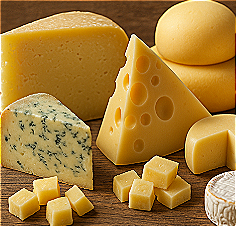
Valori nutrizionali indicativi (per 100 g; valori medi orientativi per categorie)
• Freschi/molli (es. ricotta, crescenza, feta): Energia 150–280 kcal; Proteine 8–18 g; Grassi 8–20 g; Carboidrati (lattosio) 1–4 g; Sale (NaCl) 0,7–3 g; Calcio 200–500 mg
• Semiduri (es. caciotta, asiago, gouda): Energia 300–380 kcal; Proteine 20–27 g; Grassi 24–32 g; Lattosio <1–2 g; Sale 1,5–3,5 g; Calcio 500–900 mg
• Duri/grattugia (es. grana, pecorino stagionato): Energia 380–430 kcal; Proteine 28–36 g; Grassi 26–32 g; Lattosio tracce (<0,1 g); Sale 1,5–4 g; Calcio 900–1200 mg
• Vitamine: A (retinolo), B2, B12; Minerali: Ca, P, Zn, Se
• Gli SFA (acidi grassi saturi) sono prevalenti sulla frazione lipidica; MUFA/PUFA più basse.
Principali sostanze contenute
• Proteine del latte (caseine + sieroproteine; peptidi/liberi in stagionatura), grassi del latte (globuli lipidici; acidi grassi saturi > mono > polinsaturi), lattosio residuo (molto basso nei stagionati), acido lattico e sali (NaCl, Ca, P).
• Composti di maturazione: diacetile, aldeidi/chetoni, acidi grassi liberi, metilchetoni (erborinati), ammine biogene entro limiti di buona pratica.
• Microbiologia utile: lattococchi/lattobacilli/streptococchi; muffe/lieviti caratteristici per tipologia.
Processo di produzione
• Latte: standardizzazione di grasso/proteine; pastorizzazione o uso di latte crudo (tipologia dipendente).
• Inoculo di colture starter e caglio → coagulazione → rottura della cagliata (granulometria target) → eventuale cottura e spurgo.
• Formatura e pressatura → salatura (a secco o in salamoia) → maturazione in ambienti controllati (T/UR) con gestioni specifiche di crosta (spazzolatura/lavaggi/inoculi).
• Eccezioni: ricotta da sieroproteine per riscaldamento/acidificazione; paste filate con filatura in acqua calda.
Proprietà fisiche
• pH post-fabbricazione: tipicamente 5,0–5,8 (forme acido-coagulate anche 4,4–4,8); aw decrescente con la stagionatura.
• Umidità: freschi >55–60%; semiduri 45–54%; duri <45%.
• FDM/MFFB (grasso sulla sostanza secca / umidità sulla base priva di grasso): indicatori chiave per classificazione e funzionalità.
• Colore: avorio–paglierino; consistenza: da spalmabile a friabile/granulosa (cristalli di tirosina nei ben stagionati).
Proprietà sensoriali e tecnologiche
• Fusibilità e filabilità dipendono da pH, umidità, calcio legato e sale-in-moisture; la mozzarella ha stretch elevato, i grana fondono meno e bruniscono.
• Funzionalità in cottura: melt, browning, oil-off variabili; i formaggi fusi impiegano sali emulsionanti per stabilità.
• Sinergie aromatiche** con proteolisi/lipolisi controllate; croste fiorite/lavate ed erborinature apportano note fungine/animali/nocciolate.
Impieghi alimentari
• Tavola e cucina: pizza, paste e risotti mantecati, panini/toast, salse e fondute, gratinature.
• Industria: ready meal, ripieni, snack estrusi ripieni, creme al formaggio, formaggi fusi/processati, grattugiati e cubettati MAP.
Nutrizione e salute
Il formaggio è una fonte concentrata di proteine complete (EAA ricchi di leucina) e di calcio/fosforo, con vitamina B12 e A. La quota lipidica è significativa e prevalentemente satura (SFA); per questo, in un’alimentazione equilibrata è opportuno modulare porzione e frequenza privilegiando varianti a minore tenore di grassi/sale quando indicato.
Il sale contribuisce a sapidità, sicurezza e texture ma alza l’apporto di sodio: utile verificare l’etichetta, soprattutto per regimi ipertesi. Il lattosio si riduce fortemente in stagionatura (fino a tracce nei duri), rendendo molti stagionati tollerabili a parte di chi è intollerante; la sensibilità è individuale. Per gravidanza e soggetti fragili, evitare formaggi molli a crosta fiorita o erborinati da latte crudo non pastorizzato per il rischio Listeria; scegliere prodotti pastorizzati o stagionati a basso aw.
Il profilo macro dipende dal tipo: i freschi apportano più acqua e spesso più sodio (salamoia), i duri più proteine/calcio e grassi.
Nota porzione: linee pratiche — 30–50 g per formaggi semiduri/duri; 60–100 g per freschi/molli; 10–20 g per grattugiati a porzione. Adeguare al piano calorico e al resto del pasto.
Qualità e specifiche (temi tipici)
• Composizione: umidità, grasso su s.s. (FDM), sale, pH, MFFB, proteine, indice di maturazione (NPN/azoto solubile).
• Funzionali: meltability, stretch, oil-off, browning, SHU/forza di taglio, granulometria per grattugiati.
• Microbiologia: criteri per Listeria monocytogenes, Salmonella, E. coli STEC, Staph. aureus; conte lattiche/lieviti/muffe a specifica.
• Contaminanti: aflatossina M1, metalli, residui di farmaci veterinari entro limiti; nitriti/nitrati solo dove permessi.
• Defetti: occhiatura irregolare/soffiature (clostridi), amaro eccessivo (proteolisi/peptidi amari), rancido (lipolisi ossidativa).
Conservazione e shelf-life
• Freschi/molli: 0–4 °C, confezioni barriera/MAP; 7–21 giorni tipici.
• Semiduri/duri: 0–8 °C, rivestimenti o sottovuoto; 30–365+ giorni secondo stagionatura; proteggere da disseccamento e odori.
• Evitare shock termici; una volta aperti, avvolgere in carta microforata/pellicola e consumare in tempi brevi. Congelamento non ideale (sinèresi/sgretolamento).
Sicurezza e regolatorio
• Prodotto alimentare soggetto a GMP/HACCP e requisiti igienico-sanitari per latte/formaggi; uso di latte crudo ammesso per tipologie specifiche con requisiti di maturazione/igiene.
• Allergeni: latte e derivati; indicare in etichetta.
• Per DOP/IGP: disciplinari su latte, processo, area, stagionatura e caratteristiche.
Etichettatura
• Denominazione del tipo (es. “formaggio a pasta dura”, “mozzarella”, “erborinato”); ingredienti: latte, caglio, fermenti, sale (ed eventuali sali emulsionanti nei fusi, agenti antiagglomeranti nei grattugiati).
• Origine del latte dove richiesta; latte pastorizzato/crudo; valori nutrizionali, T di conservazione, data (TMC/scadenza).
• Per grattugiati: indicare agenti antiagglomeranti (es. cellulosa/patate) se usati.
Troubleshooting
• Fusione scarsa/filo debole su pizza → pH troppo basso, sale-in-moisture alto o umidità bassa → usare lotti più giovani/umidi o blend; regolare tempo/temperatura di cottura.
• Oil-off eccessivo → grasso alto, calcio basso o surriscaldo → ridurre T, usare formaggi con calcio legato più alto, miscelare con tipologie meno grasse.
• Amaro in stagionati → proteolisi avanzata/peptidi amari → accorciare stagionatura o selezionare colture.
• Soffiature tardive → contaminazione clostridica → sanificazione, controllo fieno/silomais nel latte, uso di lisozima dove consentito.
• Disseccamento in banco taglio → umidità bassa/esposizione → migliorare pack e rotazione.
Sostenibilità e filiera
• Impatto GHG legato alla zootecnia e alla refrigerazione; mitigazioni con benessere animale, alimentazione sostenibile, gestione deiezioni (biogas), recupero siero (proteine/lattosio/energia).
• In stabilimento: recupero calore dai cicli, pulizie CIP ottimizzate, gestione reflui verso target BOD/COD, packaging riciclabile.
• Tracciabilità latte–stalla, audit fornitori, programmi residui.
Principali funzioni INCI (cosmesi)
• Casein / Hydrolyzed Casein: film-forming, hair conditioning.
• Lactose: umettante/condizionante lieve.
• Hydrolyzed Milk Protein: skin/hair conditioning (con gestione allergeni).
Conclusione
Il formaggio è un ingrediente/ alimento complesso: nutre con proteine complete e calcio, offre funzioni tecnologiche (fusione, filatura, browning) e una grande diversità sensoriale. Qualità e sicurezza dipendono da latte, microbiologia di processo, salatura, stagionatura e catena del freddo, mentre la porzionatura aiuta a bilanciare SFA e sodio nella dieta.
Mini-glossario
• SFA/MUFA/PUFA: acidi grassi sat./mono/polinsaturi.
• FDM: fat on dry matter — % di grasso sulla s.s.
• MFFB: moisture on fat-free basis — umidità sulla base priva di grasso.
• aw: attività dell’acqua — più bassa nei stagionati → maggiore stabilità.
• MAP: modified atmosphere packaging — atmosfera protettiva.
• Starter: colture lattiche che acidificano e guidano la maturazione.
• Salt-in-moisture: sale nella fase acquosa; influenza fusione/microbiologia.
• DOP/IGP: denominazioni di origine protette/indicazioni geografiche protette.
Bibliografia__________________________________________________________________________
Laithier C, Coulon JB, Vuitton DA, Lortal S, Loukiadis E. Bénéfices et risques pour la santé de la consommation de fromage. Health benefits and risks of cheese consumption. Rev Prat. 2025 Sep;75(7):779-786.
Abstract. The positive influence of cheese consumption on the intestinal microbiota and the immune system has received solid scientific support over the last 20 years, from cohort studies concerning protection against the clinical manifestations of atopic allergy and its mechanisms. Some of the benefits of eating cheese go against conventional wisdom. In fact, recent studies show that cheese, as part of a healthy diet and lifestyle, is neutral or even protective against cardiovascular diseases; it does not increase either the risk of obesity, high blood pressure or type 2 diabetes. Complementary research is needed to shed light on the role of cheese in the development of neuro-psychiatric illnesses and cancer. Without losing sight of the infectious risks, which are rare in France but can be a serious cause for concern, cheeses appear to offer several health benefits, notably because of their microbial biodiversity, which is particularly rich in raw milk cheeses. However, further work is needed to clarify the specific benefits of these cheeses.
Tilocca B, Soggiu A, Iavarone F, Greco V, Putignani L, Ristori MV, Macari G, Spina AA, Morittu VM, Ceniti C, Piras C, Bonizzi L, Britti D, Urbani A, Figeys D, Roncada P. The Functional Characteristics of Goat Cheese Microbiota from a One-Health Perspective. Int J Mol Sci. 2022 Nov 16;23(22):14131. doi: 10.3390/ijms232214131.
Abstract. Goat cheese is an important element of the Mediterranean diet, appreciated for its health-promoting features and unique taste. A pivotal role in the development of these characteristics is attributed to the microbiota and its continuous remodeling over space and time. Nevertheless, no thorough study of the cheese-associated microbiota using two metaomics approaches has previously been conducted. Here, we employed 16S rRNA gene sequencing and metaproteomics to explore the microbiota of a typical raw goat milk cheese at various ripening timepoints and depths of the cheese wheel. The 16S rRNA gene-sequencing and metaproteomics results described a stable microbiota ecology across the selected ripening timepoints, providing evidence for the microbiologically driven fermentation of goat milk products. The important features of the microbiota harbored on the surface and in the core of the cheese mass were highlighted in both compositional and functional terms. We observed the rind microbiota struggling to maintain the biosafety of the cheese through competition mechanisms and/or by preventing the colonization of the cheese by pathobionts of animal or environmental origin. The core microbiota was focused on other biochemical processes, supporting its role in the development of both the health benefits and the pleasant gustatory nuances of goat cheese.
Farsi DN, Mathur H, Beresford T, Cotter PD. Cottage cheese, a relatively underexplored cultured dairy product with potential health benefits? Crit Rev Food Sci Nutr. 2025;65(32):7953-7963. doi: 10.1080/10408398.2025.2487682.
Abstract. Cottage cheese (CC) is a member of the "fresh cheese" family of cheeses and is widely consumed due to its culinary versatility and some perceived health benefits. However, the evidence of direct health effects of CC is not well established. This review describes the production and nutritional characteristics of CC, before exploring the evidence of health effects from human intervention, in vitro, and in vivo models. Despite widespread consumption and advocated health benefits, there is a dearth of evidence pertaining to the health effects of CC from high-quality human randomized controlled trials. To date, a limited number of human intervention models with CC have explored nutrient bioavailability, metabolic health, and appetite regulation, in small, niche study populations. Findings with in vitro and in vivo models suggest that CC may be an efficacious vehicle for bioactive compounds. In conclusion, CC is a cultured dairy product that could impose a myriad of benefits across health outcomes including cardiometabolic, gastrointestinal, body composition, appetite regulation, and nutrient status. However, there is a need for high-quality human randomized controlled trials to develop a substantiated evidence base relating to the full potential of CC in human health.
Milani C, Longhi G, Alessandri G, Fontana F, Viglioli M, Tarracchini C, Mancabelli L, Lugli GA, Petraro S, Argentini C, Anzalone R, Viappiani A, Carli E, Vacondio F, van Sinderen D, Turroni F, Mor M, Ventura M. Functional modulation of the human gut microbiome by bacteria vehicled by cheese. Appl Environ Microbiol. 2025 Mar 19;91(3):e0018025. doi: 10.1128/aem.00180-25.
Abstract. Since cheese is one of the most commonly and globally consumed fermented foods, scientific investigations in recent decades have focused on determining the impact of this dairy product on human health and well-being. However, the modulatory effect exerted by the autochthonous cheese microbial community on the taxonomic composition and associated functional potential of the gut microbiota of human is still far from being fully dissected or understood. Here, through the use of an in vitro human gut-simulating cultivation model in combination with multi-omics approaches, we have shown that minor rather than dominant bacterial players of the cheese microbiota are responsible for gut microbiota modulation of cheese consumers. These include taxa from the genera Enterococcus, Bacillus, Clostridium, and Hafnia. Indeed, they contribute to expand the functional potential of the intestinal microbial ecosystem by introducing genes responsible for the production of metabolites with relevant biological activity, including genes involved in the synthesis of vitamins, short-chain fatty acids, and amino acids. Furthermore, tracing of cheese microbiota-associated bacterial strains in fecal samples from cheese consumers provided evidence of horizontal transmission events, enabling the detection of particular bacterial strains transferred from cheese to humans. Moreover, transcriptomic and metabolomic analyses of a horizontally transmitted (cheese-to-consumer) bacterial strain, i.e., Hafnia paralvei T10, cultivated in a human gut environment-simulating medium, confirmed the concept that cheese-derived bacteria may expand the functional arsenal of the consumer's gut microbiota. This highlights the functional and biologically relevant contributions of food microbes acquired through cheese consumption on the human health.IMPORTANCEDiet is universally recognized as the primary factor influencing and modulating the human intestinal microbiota both taxonomically and functionally. In this context, cheese, being a fermented food with its own microbiota, serves not only as a source of nourishment for humans, but also as a source of nutrients for the consumer's gut microbiota. Additionally, it may act as a vehicle for autochthonous food-associated microorganisms which undergo transfer from cheese to the consumer, potentially influencing host gut health. The current study highlights not only that cheese microbiota-associated bacteria can be traced in the human gut microbiota, but also that they may expand the functional repertoire of the human gut microbiota, with potentially significant implications for human health.
Kuhfeld RF, Eshpari H, Atamer Z, Dallas DC. A comprehensive database of cheese-derived bitter peptides and correlation to their physical properties. Crit Rev Food Sci Nutr. 2024;64(27):10105-10119. doi: 10.1080/10408398.2023.2220792.
Abstract. Bitterness is a common flavor attribute of aged cheese associated with the peptide fraction, but excessive levels are a defect leading to consumer rejection. Bitterness in cheese has been primarily associated with peptides that arise from the breakdown of casein. The last review of bitter peptides was published in 1992. This updated review compiled information about the bitter peptides published up to 2022. Our comprehensive search of the literature compiled 226 peptides associated with bitterness and cheese protein origins into a database (Supplemental Materials). The influences of a peptide's physical properties, such as molecular weight, average hydrophobicity, peptide length, number of prolines and the presence of hydrophobic amino acids in the peptide's terminus, were assessed for correlation with bitterness threshold values this assessment found that, among variables considered, higher molecular weight had the strongest correlation with higher bitterness among known peptides. Heatmaps of bitter peptides and their bitterness threshold values highlight β-casein as the primary source of known bitter peptides in cheese. This comprehensive database of cheese protein-derived bitter peptides and this discovery of the correlation of a peptide's physical properties to bitterness will aid future researchers in the identification and discovery of contributors to cheese bitterness.
Nájera AI, Nieto S, Barron LJR, Albisu M. A Review of the Preservation of Hard and Semi-Hard Cheeses: Quality and Safety. Int J Environ Res Public Health. 2021 Sep 17;18(18):9789. doi: 10.3390/ijerph18189789.
Abstract. Cheese is a dairy product with potential health benefits. Cheese consumption has increased due to the significant diversity of varieties, versatility of product presentation, and changes in consumers' lifestyles. Spoilage of hard and semi-hard cheeses can be promoted by their maturation period and/or by their long shelf-life. Therefore, preservation studies play a fundamental role in maintaining and/or increasing their shelf-life, and are of significant importance for the dairy sector. The aim of this review is to discuss the most effective methods to ensure the safety and sensory quality of ripened cheeses. We review traditional methods, such as freezing, and modern and innovative technologies, such as high hydrostatic pressures, chemical and natural vegetable origin preservatives, vacuum and modified atmosphere packaging, edible coatings and films, and other technologies applied at the end of storage and marketing stages, including light pulses and irradiation. For each technology, the main advantages and limitations for industrial application in the dairy sector are discussed. Each type of cheese requires a specific preservation treatment and optimal application conditions to ensure cheese quality and safety during storage. The environmental impact of the preservation technologies and their contribution to the sustainability of the food chain are discussed.
Gaglio R, Todaro M, Settanni L. Improvement of Raw Milk Cheese Hygiene through the Selection of Starter and Non-Starter Lactic Acid Bacteria: The Successful Case of PDO Pecorino Siciliano Cheese. Int J Environ Res Public Health. 2021 Feb 13;18(4):1834. doi: 10.3390/ijerph18041834.
Abstract. This review article focuses on the technological aspects and microbiological critical points of pressed-cooked cheeses processed from raw ewe's milk without the inoculation of starter cultures, in particular "Pecorino" cheese typology produced in Italy. After showing the composition of the biofilms adhering to the surface of the traditional dairy equipment (mainly wooden vat used to collect milk) and the microbiological characteristics of PDO Pecorino Siciliano cheese manufactured throughout Sicily, this cheese is taken as a case study to develop a strategy to improve its hygienic and safety characteristics. Basically, the natural lactic acid bacterial populations of fresh and ripened cheeses were characterized to select an autochthonous starter and non-starter cultures to stabilize the microbial community of PDO Pecorino Siciliano cheese. These bacteria were applied at a small scale level to prove their in situ efficacy, and finally introduced within the consortium for protection and promotion of this cheese to disseminate their performances to all dairy factories. The innovation in PDO Pecorino Siciliano cheese production was proven to be respectful of the traditional protocol, the final cheeses preserved their typicality, and the general cheese safety was improved. An overview of the future research prospects is also reported.




