



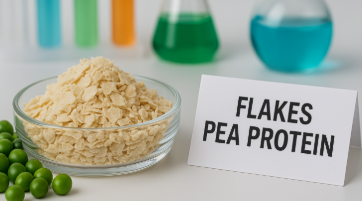
Flakes pea protein
(from seeds of Pisum sativum L.; family Fabaceae — extruded/texturized high-protein flakes)*
Description
• High-protein extruded flakes made primarily from pea protein isolate/concentrate, sometimes with minor carriers (e.g., starch or fiber) to aid expansion and crunch.
• Designed as ready-to-use inclusions for cereals, granola, snack mixes, bars, bakery toppings, and savoury applications; available plain or lightly seasoned/coated.
• Key functions: crunchy texture, protein enrichment, clean-label positioning (legume, gluten-free, non-soy).
Indicative nutrition values (typical ranges; per 100 g, plain uncoated)
• Energy: 360–420 kcal
• Protein: 55–75 g (complete EAA profile; sulphur amino acids comparatively lower)
• Carbohydrate: 10–25 g (sugars ≤2–4 g)
• Dietary fiber: 3–12 g (insoluble predominant; depends on formulation)
• Fat: 3–9 g — SFA (saturated fatty acids; advisable to keep low overall) 0.5–2 g; MUFA 0.5–2 g; PUFA 1–5 g
• Sodium: 150–800 mg (process-dependent; low-sodium grades available)
• Minerals (indicative): potassium 200–1,000 mg; iron 5–20 mg (non-heme); calcium 50–200 mg
Key constituents
• Storage proteins: legumin (11S) and vicilin (7S) fractions driving texturization and crunch.
• Carbohydrates: residual starch/oligosaccharides (raffinose/stachyose may remain at low levels); optional added starch/fiber for expansion.
• Lipids/phospholipids: low; may contribute to off-flavours if oxidised.
• Minor factors: phytates (reduced by processing), minerals, natural flavours; optional seasonings or coatings (sugars, cocoa, fats) in finished inclusions.
Production process
• Blending & hydration: pea protein (isolate/concentrate) blended with water and process aids (salt, starch/fibre as needed).
• Extrusion cooking: high-temperature short-time extrusion shapes and expands the matrix; protein denaturation and texturization create open, crunchy structure.
• Forming: die-cut/laminated then flaked/crumbled to target size; optional toasting/baking for crunch.
• Drying & sizing: to low water activity; classify D10/D50/D90.
• Optional finishing: seasoning, syrup or chocolate coating for bars/cereals.
• Manufactured under GMP/HACCP with allergen and gluten cross-contact controls.
Physical properties
• Appearance: pale cream to light beige flakes; particle size commonly 2–15 mm.
• Texture: crispy/crunchy at aw ≤0.45; softens at higher humidity.
• Bulk density: typically 0.15–0.45 g/mL (grade-dependent).
• Moisture/aw: moisture ≤8%; aw ≤0.45 for crisp retention.
Sensory and technological properties
• Flavour: neutral to mildly “beany/green”; cleaner in deodorised grades or when coated.
• Water/oil interactions: good WHC/OHC supports juiciness in bars and savoury matrices.
• Process tolerance: withstands gentle mixing and short bakes; prolonged high-moisture holds can lead to sogginess.
• Compatibility: pairs well with syrups, chocolate, nut butters; in savoury systems blends with herbs/spices.
Food applications
• Breakfast cereals & granola: protein boost with crunch (5–30%).
• Nutrition & snack bars: inclusions or bases with binders (syrup/sugar alcohols/nut pastes); often chocolate- or yoghurt-coated.
• Bakery: toppings for breads, crackers, high-protein cookies/muffins.
• Savoury: salad toppers, trail mixes, breadcrumbs replacement, crunchy elements in soups and ready meals.
• Plant-based foods: texture element in meat analogues or high-protein bowls.
Nutrition & health
Pea protein flakes provide high biological value plant protein with a favourable PDCAAS/DIAAS for adults when appropriately processed. The amino-acid pattern is strong in lysine and leucine; methionine+cysteine are lower and complement well with cereals (e.g., rice, oats, wheat).
Digestibility is generally high; extrusion reduces antinutritional factors (trypsin inhibitors, lectins) and improves palatability. Some consumers sensitive to FODMAPs may experience GI discomfort at high intakes due to residual oligosaccharides—gradual introduction and adequate hydration help tolerance.
Fat is low, with saturates (sfa) typically minimal; overall lipid impact depends on coatings and recipe fats. Sodium varies by grade—low-sodium versions are available for regulated markets. Naturally gluten-free (verify <20 ppm for claims) and soy-free, which supports “major-allergen-light” positioning; however, legume cross-reactivity is possible in susceptible individuals.
Portion note: Typical inclusion levels are 10–30% in bars/cereals/granola and 5–15% in bakery/snacks, adjusted for texture and nutrition targets. A single 30–40 g serving of flakes as a topper can add 17–28 g of protein (grade-dependent).
Quality and specifications (typical topics)
• Protein: 55–75% (Kjeldahl/Dumas; N×6.25); amino-acid profile/limiting AA.
• Moisture/aw: ≤8% / ≤0.45; crispness by texture analysis (e.g., break force).
• Particle size: D10/D50/D90 and % fines; bulk density to spec.
• Functionals: WHC/OHC, dispersibility, sedimentation in milk/plant beverages, shelf-life crunch retention.
• Sensory: beany notes, astringency, rancidity (peroxide/hexanal trending where fats/coatings used).
• Microbiology: pathogens absent/25 g; APC/yeasts/moulds within spec.
• Contaminants: heavy metals within limits; pesticide residues ≤ MRL; gluten <20 ppm for claims.
Storage and shelf-life
• Store cool, dry, and dark (≤25 °C; RH <60%) in moisture- and oxygen-barrier packaging; avoid odour pick-up.
• Reseal promptly after opening; desiccant sachets recommended.
• Typical shelf-life: 12–18 months unopened; earlier for coated variants depending on fat oxidation and moisture migration.
Safety and regulatory
• Widely accepted as a food ingredient; pea is not a priority allergen in many regions, but manage legume cross-reactivity and cross-contact.
• Protein claims (EU): “source of protein” when ≥12% of energy from protein; “high protein” when ≥20%.
• Gluten-free claims require verification (<20 ppm).
• Manufactured under GMP/HACCP with lot traceability.
Labeling
• Name: “pea protein flakes/extruded pea protein flakes”; declare protein %, added carriers/coatings, and sodium where relevant.
• Call out allergen policy/cross-contact controls and storage instructions; include serving ideas on consumer packs if desired.
Troubleshooting
• Loss of crunch/sogginess → moisture uptake or high aw binders → strengthen moisture barrier, adjust binder solids (higher DE syrup/sugar alcohols), bake/toast lightly, include desiccant.
• Breakage/dust → excessive mechanical handling → reduce drop heights, change conveying, increase flake thickness or agglomerate size.
• Beany/green notes → raw grade choice or oxidation → select deodorised grades, add flavour maskers, manage oxygen and light.
• Poor binding in bars → binder viscosity or solids too low → increase solids, add protein-compatible hydrocolloids, optimise mixing temperature.
• Hard bite → over-toasting/low moisture → reduce bake, increase target aw slightly (while maintaining crispness).
Sustainability and supply chain
• Peas support biological nitrogen fixation, generally lowering fertiliser needs and GHG footprint versus many animal proteins.
• Co-products (starch/fibre) can be valorised in other food/feed streams; target wastewater BOD/COD limits and heat/water recovery.
• Prefer recyclable/lightweight packaging and suppliers with robust agronomic stewardship and traceability.
INCI functions (cosmetics)
• Pisum Sativum (Pea) Protein / Hydrolyzed Pea Protein: film-forming, conditioning, mild humectant; improves hair feel/strength at low %. Usage subject to cosmetic regulations.
Conclusion
Pea protein flakes are a versatile, clean-label way to deliver crunch and high protein across cereals, bars, snacks, and savoury applications. Success depends on grade selection (protein %, flavour), moisture/aw control, binder optimisation, and packaging that preserves crispness and flavour over shelf-life.
Mini-glossary
• SFA: Saturated fatty acids — Excess intakes may raise LDL-cholesterol; keep overall dietary SFA low.
• MUFA: Monounsaturated fatty acids — Generally favourable when replacing saturates.
• PUFA: Polyunsaturated fatty acids — Beneficial when balanced and protected from oxidation.
• PDCAAS/DIAAS: Protein quality indices based on digestibility and indispensable amino acids.
• WHC/OHC: Water/oil-holding capacity — grams of water/oil retained per gram of flakes.
• MRL: Maximum residue limits for pesticides on foods.
• GMP/HACCP: Good manufacturing practice / hazard analysis and critical control points — Preventive hygiene/process-control systems.
• BOD/COD: Biochemical/chemical oxygen demand — Wastewater impact metrics guiding treatment and discharge.
Studies
In a controlled diet, daily consumption of whole and fractionated yellow pea meal at doses equivalent to half a cup of yellow peas reduced insulin resistance in hypercholesterolaemic, while whole pea meal reduced android adiposity in women (1).
Purified peptides extracted from Pisum sativum have demonstrated a broad spectrum of antibacterial activity that can be used as a selective agent against infections and bacteria (2).
This study informs us that as the skin ages, impairment of extracellular matrix protein synthesis and increased action of degradative enzymes manifest as atrophy, wrinkles, and laxity. There is growing evidence for the functional role of exogenous peptides in many areas, including in offsetting the effects of skin aging. Here, using an artificial intelligence approach, RTE62G, a natural and unmodified peptide with extracellular matrix stimulatory properties, was identified. The predicted anti-aging properties of RTE62G peptide were then validated through in vitro, ex vivo, and proof-of-concept clinical trials (3).

