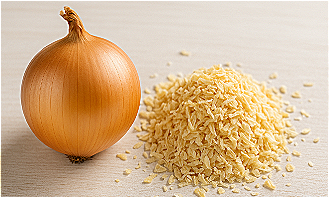
Cipolla essiccata (Allium cepa)
Descrizione
Ingrediente disidratato ottenuto da cipolla fresca pelata, affettata e essiccata; disponibile in lamelle (flakes), granuli (minced/granulated) e polvere (onion powder), anche in versioni tostate o caramellizzate.
Profilo sensoriale: aroma dolce–solforato, note umami e arrostite (se tostata); colore dal bianco–panna al giallo paglierino.
Posizionamento: aromatizzante clean-label, base per condimenti e mix spezie, alternativa pratica alla cipolla fresca.
Valore calorico (per 100 g di prodotto secco)
~320–360 kcal; carboidrati ~70–85 g (di cui zuccheri e fruttani), fibre ~8–15 g, proteine ~8–12 g, grassi <1,5 g, sodio basso. In uso reale le dosi sono modeste (0,2–5% in ricetta).
Principali sostanze contenute
Precursori solforati: S-ossidi di cisteina (es. isoallina). Con alliinasi liberano composti volatili responsabili dell’aroma e il fattore lacrimatorio (sin-propanetial-S-ossido).
Derivati solforati da calore: tiosolfonati, solfuri, tioli; da tostatura pirazine e note caramellate/Maillard.
Carboidrati: fruttani (FOS, FODMAP), glucosio/fruttosio, saccarosio.
Fenolici/flavonoidi: quercetina (soprattutto nelle varietà scure).
Minerali: potassio, manganese; umidità in specifica tipicamente ≤5–7%.
Processo di produzione
Preparazione materia prima: selezione, pelatura, trimming, affettatura/dicing.
Essiccazione: aria calda a bassa T con flussi controllati; opzioni tostatura leggera o caramellizzazione per profili “roasted/sweet”.
Macinazione: calibrazione in flakes/granuli/polvere; possibile criogenico per preservare volatili.
Decontaminazione: vapore o irradiation dove autorizzato; eventuali antiagglomeranti (biossido di silicio, fosfato tricalcico) da dichiarare.
Controlli: umidità/a_w, granulometria (mesh), colore (L*, a*, b*), carica microbica, residui.
Proprietà sensoriali e tecnologiche
Reidratazione: rapido assorbimento; 1 g di secco rende ~5–8 g reidratato (equivalenza fresca ~7–9:1 su base peso).
Potere aromatizzante: elevato e standardizzabile; la polvere si distribuisce in modo omogeneo nelle miscele secche.
Stabilità: buona a bassa a_w; calore prolungato può attenuare i solforati e accentuare note dolci/arrostite.
Colore: tende a scurire per Maillard in matrici zuccheri + amminoacidi (gestire pH/tempo/T).
Impieghi alimentari
Mix spezie/condimenti: rub per snack, carni/plant-based, salse secche.
Zuppe, salse, ready-meal: base aromatica clean-label (fiocchi/granuli per percezione “pezzo”).
Panificazione e bakery salato: pane alla cipolla, cracker, grissini (attenzione a Maillard e colore).
Salumi/plant-based meats: polvere per umami e dolcezza naturale; contributo a legante in blend con proteine/fibre.
Snack & extrusion: seasoning post-cottura; compatibile con latti vegetali e salse cremose.
Nutrizione e salute
Fonte di fibre (in parte fruttani); fornisce flavonoidi (es. quercetina).
FODMAP: i fruttani possono dare gonfiore in soggetti sensibili → gestire dose o preferire aromi naturali “onion-type” low-FODMAP dove necessari.
Sodio: naturalmente basso (controllare miscele con sale).
Profilo dei grassi
Qualità e specifiche (temi tipici)
Umidità ≤5–7%, a_w bassa, granulometria a specifica (es. 40–80 mesh per polvere).
Carica microbica: patogeni assenti/25 g; TAMC/lieviti/muffe controllati (opzioni steam-treated).
Residui: pesticidi/metalli entro limiti; solfiti se usati (raro) da dichiarare.
Sensoriale: assenza di muffa/stantio, odore pulito; colore uniforme senza bruciature.
Conservazione e shelf-life
Conservare al fresco, asciutto, al buio, in pack barriera e ermetico; evitare odori e umidità (caking).
Shelf-life tipica 18–24 mesi chiuso; dopo apertura richiudere e usare entro poche settimane.
Allergeni e sicurezza
Non è un allergene maggiore, ma possibili sensibilità alle Alliaceae.
Verificare e dichiarare solfiti se impiegati come conservanti/antibrunimento.
Senza glutine per natura; gestire cross-contact in impianto.
Funzioni INCI in cosmesi (ove applicabile)
Troubleshooting
Caking/grumi: aumentare barriera umidità, usare antiagglomeranti (es. SiO₂) o agglomerazione della polvere.
Aroma “crudo” in salsa: tostare leggera-mente la polvere in grasso prima dell’acqua, o usare versione tostata.
Scurimento eccessivo in bakery: ridurre tempo/T, modulare pH, usare granuli al posto della polvere fine.
Punti bruciati in snack: abbassare T di frittura, migliorare distribuzione del seasoning, scegliere granulometria più fine.
Sostenibilità e filiera
La disidratazione riduce sprechi e peso/volume trasportato; valorizza surplus stagionali.
In impianto: efficienza energetica nell’essiccazione, recupero calore/aria, reflui verso target BOD/COD, pack riciclabili, GMP/HACCP e tracciabilità.
Etichettatura
Denominazione: “cipolla essiccata” con forma (flakes/granuli/polvere) e eventuale trattamento (tostata, steam-treated).
Additivi: dichiarare antiagglomeranti o solfiti se presenti; per biologico indicare origine.
Allergeni: none specifici, ma segnalare solfiti >10 mg/kg (come SO₂).
Conclusione
La cipolla essiccata offre aroma concentrato, facilità d’uso e stabilità per un ampio spettro di applicazioni, dai condimenti agli shelf-stable meals. La scelta di taglio, tostatura e granulometria, insieme a gestione di umidità e calore, consente di ottenere costanza sensoriale e sicurezza con etichetta pulita.
Mini-glossario
FODMAP — carboidrati fermentabili (oligo-/di-/mono-saccaridi e polioli) che possono causare gonfiore; nella cipolla essiccata il tema principale sono i fruttani.
FOS (frutto-oligosaccaridi) — fruttani a corta catena con effetto prebiotico; utili ma critici per chi segue diete low-FODMAP.
a_w (attività dell’acqua) — misura dell’acqua “libera” disponibile; valori bassi migliorano stabilità e sicurezza del secco.
Reazione di Maillard — reazione tra zuccheri riducenti e amminoacidi che genera colore bruno e note tostate; accelera con calore/pH moderatamente alcalino.
Mesh — indice della granulometria (maglia del setaccio): numero più alto = particelle più fini.
L*, a*, b* — coordinate colore CIELAB: L* (chiarezza), a* (verde↔rosso), b* (blu↔giallo).
TAMC — carica microbica aerobica totale; parametro igienico (insieme a lieviti/muffe e assenza patogeni).
GMP/HACCP — good manufacturing practice / hazard analysis and critical control points: sistemi igienico–preventivi con punti critici (CCP) definiti e controllati.
BOD/COD — domanda biochimica/chimica di ossigeno: indicatori dell’impatto dei reflui e dei requisiti di trattamento.
SiO₂ (biossido di silicio) — antiagglomerante ammesso negli alimenti in polvere; va dichiarato in etichetta se usato.
SO₂ (anidride solforosa) / solfiti — conservanti/antibrunimento; obbligo di dichiarazione >10 mg/kg (come SO₂) nel prodotto finito.
SFA — acidi grassi saturi: da mantenere moderati nella dieta; irrilevanti qui dato il basso tenore lipidico dell’ingrediente.
MUFA — acidi grassi monoinsaturi: spesso neutri/favorevoli; irrilevanti qui.
PUFA — acidi grassi polinsaturi: benefici se bilanciati; irrilevanti qui.
TFA — acidi grassi trans: da evitare; non attesi in questo ingrediente.
MCT — trigliceridi a media catena: non significativi nelle spezie/vegetali disidratati
Studi
Le cipolle hanno proprietà antibatteriche e antiossidanti e possono aiutare a ridurre il rischio di alcune malattie croniche. La quercetina, presente nelle cipolle, è stata associata alla prevenzione di malattie legate all'età come il diabete, il cancro e le malattie neurodegenerative.
Come anti-infiammatorio, un componente della cipolla, l'Onionin A che si trova nel bulbo, ha dimostrato di svolgere un'azione di contrasto all'attività infiammatoria del sangue (1).
Parrebbe anche provata un'azione di miglioramento dell'equilibrio dello zucchero nel sangue.
Viene consigliata, unitamente ad aglio, scalogno ed erba cipollina per prevenire il tumore alla prostata (2).
Le cipolle rosse più conosciute in Italia sono la cipolla rossa di Tropea e quella di Certaldo.
Cipolla rossa studi
Bibliografia______________________________________________________________________
(1) Fujiwara Y, Horlad H, Shiraishi D, Tsuboki J, Kudo R, Ikeda T, Nohara T, Takeya M, Komohara Y. Onionin A, a sulfur-containing compound isolated from onions, impairs tumor development and lung metastasis by inhibiting the protumoral and immunosuppressive functions of myeloid cells. Mol Nutr Food Res. 2016 Nov;60(11):2467-2480. doi: 10.1002/mnfr.201500995.
(2) Colli JL, Amling CL. Chemoprevention of prostate cancer: what can be recommended to patients? Curr Urol Rep. 2009 May;10(3):165-71. Review.
Abstract. Prostate cancer is third to lung and colon cancer as the cause of cancer-related deaths in American men. It is estimated that there will have been more than 28,000 deaths and 186,000 new cases in 2008 that will impose a significant burden on national health care costs. Chemoprevention aims to reduce both incidence and mortality through the use of agents to prevent, reverse, or delay the carcinogenic process. This study provides clinicians with information on some chemoprevention agents that have been considered to reduce prostate cancer risks, including 5-alpha-reductase inhibitors; statins (a class of compounds used to reduce cholesterol); NSAIDs; selenium; vitamins E and D; lycopene; allium vegetables (garlic, scallions, onions, chives, and leeks); soy/isoflavones; and green tea polyphenols. The evidence to support prostate cancer risk reduction benefits for each chemoprevention agent based on a review of the literature is provided.
Tsuboki J, Fujiwara Y, Horlad H, Shiraishi D, Nohara T, Tayama S, Motohara T, Saito Y, Ikeda T, Takaishi K, Tashiro H, Yonemoto Y, Katabuchi H, Takeya M, Komohara Y. Onionin A inhibits ovarian cancer progression by suppressing cancer cell proliferation and the protumour function of macrophages. Sci Rep. 2016 Jul 12;6:29588. doi: 10.1038/srep29588.
Abstract. It is well known that tumour-associated macrophages (TAMs) play an important role in tumour development by modulating the tumour microenvironment, and targeting of protumour activation or the M2 polarization of TAMs is expected to be an effective therapy for cancer patients. We previously demonstrated that onionin A (ONA), a natural low molecular weight compound isolated from onions, has an inhibitory effect on M2 macrophage polarization. In the present study, we investigated whether ONA had a therapeutic anti-ovarian cancer effect using in vitro and in vivo studies. We found that ONA reduced the extent of ovarian cancer cell proliferation induced by co-culture with human macrophages. In addition, we also found that ONA directly suppressed cancer cell proliferation. A combinatorial effect with ONA and anti-cancer drugs was also observed. The activation of signal transducer and activator of transcription 3 (STAT3), which is involved in cell proliferation and chemo-resistance, was significantly abrogated by ONA in ovarian cancer cells. Furthermore, the administration of ONA suppressed cancer progression and prolonged the survival time in a murine ovarian cancer model under single and combined treatment conditions. Thus, ONA is considered useful for the additional treatment of patients with ovarian cancer owing to its suppression of the protumour activation of TAMs and direct cytotoxicity against cancer cells.
Li Q, Wang Y, Mai Y, Li H, Wang Z, Xu J, He X. Health Benefits of the Flavonoids from Onion: Constituents and Their Pronounced Antioxidant and Anti-neuroinflammatory Capacities. J Agric Food Chem. 2020 Jan 22;68(3):799-807. doi: 10.1021/acs.jafc.9b07418.
Abstract. Onion is the most widely cultivated vegetable around the world. In this study, the isolation, concentration, quantification, and bioactivity evaluation of the phenolics in onion peels were investigated. Thirty-four phenolics, including 17 flavonoids and 17 nonflavonoid phenolics, were purified and identified. Among them, there were 2 new unusual epoxyflavanones and a new phenolic constituent, as well as 13 unreported constituents from the genus Allium. The total flavonoids were concentrated, and finally obtained 90.25% of flavonoid content extract. Fifteen main flavonoids were quantified using an ultra-performance liquid chromatography-photodiode array (UPLC-PDA), and quercetin (36.94%) and quercetin 4'-O-β-d-glucopyranoside (15.81%) were the richest contents of flavonoids. The antioxidant and anti-neuroinflammatory capacities were evaluated, and the bioactive results indicated that the flavonoids in onion exhibited pronounced activities. The study suggested that the flavonoids in onion peels could be used in functional food.
Yoo Y, Kim S, Lee W, Kim J, Son B, Lee KJ, Shin H. The prebiotic potential of dietary onion extracts: shaping gut microbial structures and promoting beneficial metabolites. mSystems. 2025 Jan 21;10(1):e0118924. doi: 10.1128/msystems.01189-24.
Abstract. Onions are well-known vegetables that offer various health benefits. This study explores the impact of onion extracts on gut microbiome using an in vitro fecal incubation model and metabolome analysis. Fecal samples were collected from 19 healthy donors and incubated in the presence or absence of onion extracts for 24 h. To reduce inter-individual variability in the gut microbiome, we employed enterotyping based on baseline fecal microbiota: 14 subjects with a Bacteroides-dominant type (enterotype B) and 5 subjects with Prevotella-dominant type (enterotype P). Alpha diversity was significantly reduced in the onion-treated group compared to the non-treated control group in both Bacteroides- and Prevotella-dominant types. However, significant structural differences in bacterial communities were observed based on weighted UniFrac distance. Notably, short-chain fatty acid (SCFA)-producing bacteria, such as Bifidobacterium_388775, Feacalibacterium, and Fusicatenibacter, were overrepresented in response to onion extracts in enterotype B. Furthermore, genes related to butyrate production were significantly overrepresented in the onion-treated group within enterotype B. Consistent with the enriched taxa and the predicted metabolic pathways, SCFAs and their related metabolites were significantly enriched in the onion-treated group. Additionally, tryptophan metabolism-derived metabolites, including indolelactate (ILA) and indolepropionate (IPA), were elevated by 4- and 32-fold, respectively, in the onion-treated group compared to the control group. In vitro growth assays showed an increase in lactobacilli strains in the presence of onion extracts. These results provide evidence that onion extracts could serve as promising prebiotics by altering gut microbial structure and promoting the production of beneficiary metabolites, including SCFAs and indole derivatives, and enhancing the growth of probiotics.IMPORTANCEThis study is significant as it provides compelling evidence that onion extracts have the potential to serve as effective prebiotics. Utilizing an in vitro fecal incubation model and enterotyping to reduce inter-individual variability, the research demonstrates how onion extracts can alter gut microbial structure and promote the production of beneficial metabolites, including SCFAs and indole derivatives like ILA and IPA. Additionally, onion extract treatment enhances the growth of beneficial probiotics. The findings underscore the potential of onion extracts to improve gut health by enriching specific beneficial bacteria and metabolic pathways, thereby supporting the development of functional foods aimed at improving gut microbiota composition and metabolic health.
Dorrigiv M, Zareiyan A, Hosseinzadeh H. Onion (Allium cepa) and its Main Constituents as Antidotes or Protective Agents against Natural or Chemical Toxicities: A Comprehensive Review. Iran J Pharm Res. 2021 Winter;20(1):3-26. doi: 10.22037/ijpr.2020.112773.13940.
Abstract. Onion (Allium cepa) is a member of the family Amaryllidaceae and one of the most widely cultivated species of the genus Allium. Onion has plentiful chemical compounds such as allicin, quercetin, fisetin, other sulphurous compounds: diallyl disulphide and diallyl trisulphide. Onion and its main components in specific doses have shown a lot of benefits including free-radical scavenging and antioxidant properties, anticholesterolemic, anti-heavy metals toxicity, antihyperuricemia, antimicrobial, anti-gastric ulcer, and anticancer. This study summarizes numerous in-vitro and animal studies on the protective effects of onion against natural and chemical toxicities. Onion and its main components can ameliorate the toxicity of chemical agents in kidney, liver, brain, blood, heart, reproductive system, embryo, pancreas through reducing lipid peroxidation, antioxidant effect, radical-scavenging, anti-inflammatory, chelating agent, cytoprotective activities, increasing protein synthesis in damaged tissues, suppressing apoptosis, as well as modulation of PKC-




