Refined coconut oil (RBD)
Description
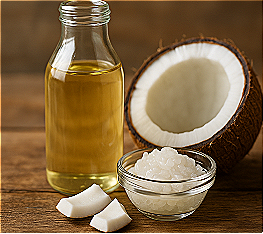
Neutral-flavor edible oil obtained from copra (dried coconut kernel) and processed to be refined, bleached, and deodorized (RBD).
Appearance & sensory: water-white to pale yellow, neutral aroma/taste; melting point ~24–26 °C (solid below, liquid above).
Positioning: stable frying/baking fat, suitable for clean-label, vegan, and gluten-free products; distinct from virgin coconut oil (unrefined).
Caloric value (per 100 g)
Key constituents
Triacylglycerols dominated by lauric (C12:0) with myristic (C14:0) and palmitic (C16:0); minor oleic (C18:1) and linoleic (C18:2).
Unsaponifiables (tocopherols, sterols) low.
Typical chemistry: **IV** (iodine value) ~6–10, **SV** (saponification value) ~248–265 mg KOH/g.
Production process
Dry milling: coconuts dehusked → shelled → copra dried (hot air/sun).
Oil extraction: expeller and/or solvent; desolventize–toast where applicable.
Refining: degumming, neutralization (reduce **FFA**), bleaching (adsorbents), deodorization (steam under vacuum).
Optional steps: winterization/fractionation (e.g., to make lauric shortenings or **MCT**-rich fractions by further processing); interesterification for specific melting curves.
Quality controls: peroxide/anisidine, color, moisture/volatiles, 3-MCPD/glycidyl esters kept within regulatory limits.
Sensory and technological properties
Thermal behavior: smoke point ≈ 200–230 °C (spec- and equipment-dependent).
Oxidative stability: high, thanks to predominance of **SFA**; low **IV** slows autoxidation.
Crystallization: sharp melt–set around room temperature → can grain; manage with tempering or blends.
Compatibility: lauric fat—not compatible with cocoa butter (risk of fat bloom) unless using non-lauric systems or barriers.
Foam tendency: low when properly refined; increases with moisture/contaminants.
Food applications
Frying & sautéing: stable at high heat; low flavor carry-over.
Bakery & confectionery: shortenings, coatings, cream fillings, laminated doughs; quick melt release in-mouth.
Non-dairy & plant-based: creamers, cheese analogs, spreads (structure via blend/interesterification).
Snacks & extrusion: frying medium and lipid systems for seasonings and inclusions.
Nutrition and health
Predominantly **SFA** (especially lauric) → raises HDL but also raises LDL; use in moderation within total dietary fat targets.
Trans fat absent in non-hydrogenated refined oil; **TFA** appear only if hydrogenated (should be declared).
**MCT** (C8–C10) are minor in standard refined oil; dedicated fractionation is required for MCT oil.
Fat profile
**SFA** ~85–92% (lauric-rich): stable but to moderate for cardiovascular health.
**MUFA** ~5–8% (mainly oleic): often neutral/beneficial.
**PUFA** ~1–3% (linoleic): beneficial when balanced, but minimal here.
**TFA**: negligible unless hydrogenated.
**MCT**: present only in part (C8/C10 low; C12 lauric is borderline in metabolism).
Quality and specifications (typical topics)
RBD specs: moisture/volatiles ≤0.1%, **FFA** (as lauric) ≤0.1–0.2%, peroxide value ≤1–3 meq O₂/kg, Lovibond color low, odor/taste neutral.
Cold/hot tests: cloud/melt consistent with COC profile; IV/SV within range.
Contaminants: 3-MCPD/glycidyl esters, polycyclics, metals, and pesticides within limits; allergens/foreign matter absent.
Microbiology: not supportive of growth; pathogens absent/25 g.
Storage and shelf life
Store cool, dark, airtight; avoid light/air/heat.
Shelf life: typically 18–24 months unopened; once opened, close tightly and use within months.
Avoid repeated deep-fry cycles (polymer buildup).
Allergens and safety
Gluten-free and vegan.
Labeling note: coconut may be treated as a tree nut for allergen labeling in some jurisdictions (e.g., U.S.); follow local rules.
No added trans fats unless hydrogenated is declared.
INCI functions in cosmetics (where applicable)
INCI: Cocos Nucifera (Coconut) Oil, Hydrogenated Coconut Oil, Caprylic/Capric Triglyceride (from fractionation).
Roles: emollient, skin-conditioning, cleansing/surfactant aid; common in soaps, balms, hair care.
Troubleshooting
Soapy/harsh flavor: elevated **FFA** → check refining/neutralization; avoid hydrolysis (moisture control).
Rancid/oxidized notes: high peroxide/anisidine → improve bleaching/deodorization, reduce oxygen/light exposure.
Grainy set in spreads: uncontrolled crystallization → temper or use interesterified blends/crystal modifiers.
Foaming in fryer: residual moisture/impurities → filter regularly, dry food surfaces, manage fry turnover.
Sustainability and supply chain
Main origins: Philippines, Indonesia, India, Sri Lanka (mostly smallholder).
Prefer traceable, deforestation-free, and fair-labor supply; consider Sustainable Coconut Charter/fair-trade programs.
In-plant: maximize solvent/steam recovery, treat effluents toward **BOD/COD** targets, use recyclable packaging, and maintain **GMP/HACCP** and robust traceability.
Labelling
Name: “refined, bleached and deodorized coconut oil” (or “refined coconut oil”); declare “hydrogenated” or “interesterified” when applicable.
Optional claims: non-hydrogenated, no trans fat (subject to local rules); make allergen declarations per jurisdiction.
Conclusion
Refined coconut oil is a highly stable lauric fat with neutral flavor, clean melt, and excellent frying/baking performance. Sound refining, controlled crystallization, and clear labeling (hydrogenation, allergen, sustainability) deliver consistent functionality across snacks, bakery, confectionery, and plant-based systems.
Mini-glossary
**SFA** — saturated fatty acids: heat-stable; excessive intake raises LDL—keep moderate overall.
**MUFA** — monounsaturated fatty acids: often neutral/beneficial for lipids; minor in coconut oil.
**PUFA** — polyunsaturated fatty acids: beneficial when balanced; very low in coconut oil.
**TFA** — trans fatty acids: form with hydrogenation; avoid unless required and declared.
**MCT** — medium-chain triglycerides: C8–C10; rapid oxidation for energy; significant levels require fractionation.
**IV** — iodine value: measure of unsaturation (lower = more saturated/stable).
**SV** — saponification value: indicates average fatty-acid chain length.
**FFA** — free fatty acids: high values signal hydrolysis/degradation (off-flavors, smoke).
**GMP/HACCP** — good manufacturing practice / hazard analysis and critical control points: preventive food-safety systems.
**BOD/COD** — biochemical/chemical oxygen demand: wastewater impact metrics guiding treatment and compliance.
The studies carried out in the medical field, take as a parameter the coconut virgin oil, for which some interesting properties have been found, while for the other types that have undergone processing procedures (such as refining), they infer a reduced antioxidant potential (1 ).
A first and more widespread therapeutic indication, is the antioxidant and antistress capacity (2), therefore an ability to generate protective effects on the cardiovascular system (3).
Overall, the weight of the evidence from intervention studies to date suggests that replacing coconut oil with cis unsaturated fats would alter blood lipid profiles in a manner consistent with a reduction in risk factors for cardiovascular disease (4).
Coconut oil studies
References_______________________________________________________
(1) Marina AM, Man YB, Nazimah SA, Amin I. Antioxidant capacity and phenolic acids of virgin coconut oil. Int J Food Sci Nutr. 2009;60 Suppl 2:114-23. doi: 10.1080/09637480802549127.
Abstract. The antioxidant properties of virgin coconut oil produced through chilling and fermentation were investigated and compared with refined, bleached and deodorized coconut oil. Virgin coconut oil showed better antioxidant capacity than refined, bleached and deodorized coconut oil. The virgin coconut oil produced through the fermentation method had the strongest scavenging effect on 1,1-diphenyl-2-picrylhydrazyl and the highest antioxidant activity based on the beta-carotene-linoleate bleaching method. However, virgin coconut oil obtained through the chilling method had the highest reducing power. The major phenolic acids detected were ferulic acid and p-coumaric acid. Very high correlations were found between the total phenolic content and scavenging activity (r=0.91), and between the total phenolic content and reducing power (r=0.96). There was also a high correlation between total phenolic acids and beta-carotene bleaching activity. The study indicated that the contribution of antioxidant capacity in virgin coconut oil could be due to phenolic compounds.
(2) Yeap SK, Beh BK, Ali NM, Yusof HM, Ho WY, Koh SP, Alitheen NB, Long K. Antistress and antioxidant effects of virgin coconut oil in vivo. Exp Ther Med. 2015 Jan;9(1):39-42. doi: 10.3892/etm.2014.2045.
Abstract. Virgin coconut oil (VCO) has been consumed worldwide for various health-related reasons and some of its benefits have been scientifically evaluated. Medium-chain fatty acids were found to be a potential antidepressant functional food; however, this effect had not been evaluated in VCO, which is rich in polyphenols and medium-chain fatty acids. The aim of this study was to evaluate the antistress and antioxidant effects of VCO in vivo, using mice with stress-induced injury. The antistress effect of VCO (administered per os, at a dose of 10 ml/kg body weight) was evaluated using the forced swim test and chronic cold restraint stress models. VCO was able to reduce immobility time and restore oxidative stress in mice post-swim test. Furthermore, mice treated with VCO were found to exhibit higher levels of brain antioxidants, lower levels of brain 5-hydroxytryptamine and reduced weight of the adrenal glands. Consequently, the serum cholesterol, triglyceride, glucose and corticosterone levels were also lower in VCO-treated mice. These results suggest the potential value of VCO as an antistress functional oil.
(2) Babu AS, Veluswamy SK, Arena R, Guazzi M, Lavie CJ. Virgin coconut oil and its potential cardioprotective effects. Postgrad Med. 2014 Nov;126(7):76-83. doi: 10.3810/pgm.2014.11.2835.
Abstract. Emphasis on diet to improve the cardiovascular (CV) risk profile has been the focus of many studies. Recently, virgin coconut oil (VCO) has been growing in popularity due to its potential CV benefits. The chemical properties and the manufacturing process of VCO make this oil healthier than its copra-derived counterpart. This review highlights the mechanism through which saturated fatty acids contribute to CV disease (CVD), how oils and fats contribute to the risk of CVD, and the existing views on VCO and how its cardioprotective effects may make this a possible dietary intervention in isolation or in combination with exercise to help reduce the burden of CVDs.
(4) Eyres L, Eyres MF, Chisholm A, Brown RC. Coconut oil consumption and cardiovascular risk factors in humans. Nutr Rev. 2016 Apr;74(4):267-80. doi: 10.1093/nutrit/nuw002. Epub 2016 Mar 5. PMID: 26946252; PMCID: PMC4892314.
Maki KC, Hasse W, Dicklin MR, Bell M, Buggia MA, Cassens ME, Eren F. Corn Oil Lowers Plasma Cholesterol Compared with Coconut Oil in Adults with Above-Desirable Levels of Cholesterol in a Randomized Crossover Trial. J Nutr. 2018 Oct 1;148(10):1556-1563. doi: 10.1093/jn/nxy156.
Abstract. Background: Few trials have examined the effects of coconut oil consumption in comparison with polyunsaturated fatty acid-rich oils such as corn oil. Objective: This trial assessed the effects of consuming foods made with corn oil compared with coconut oil on lipids, glucose homeostasis, and inflammation. Methods: This was a preliminary randomized crossover study of men (n = 12) and women (n = 13) with a mean age of 45.2 y, mean body mass index (in kg/m2) of 27.7, fasting LDL cholesterol ≥115 mg/dL and <190 mg/dL, and triglycerides (TGs) ≤375 mg/dL. Subjects consumed muffins and rolls providing 4 tablespoons (∼54 g) per day of corn oil or coconut oil as part of their habitual diets for 4 wk, with a 3-wk washout between conditions. Fasting plasma lipids and high-sensitivity C-reactive protein (hs-CRP) and glucose metabolism were assessed via an intravenous glucose tolerance test at baseline and 15 and 29 d of treatment. Responses were compared between treatments by ANCOVA. Results: Median baseline concentrations of LDL cholesterol, non-HDL cholesterol, total cholesterol (total-C), HDL cholesterol, total-C:HDL cholesterol, and TGs were 123, 144, 188, 46.0, 4.21, and 92.5 mg/dL, respectively. Changes from baseline for corn oil and coconut oil conditions, respectively, were: LDL cholesterol (primary outcome; -2.7% compared with +4.6%), non-HDL cholesterol (-3.0% compared with +5.8%), total-C (-0.5% compared with +7.1%), HDL cholesterol (+5.4% compared with +6.5%), total-C:HDL cholesterol (-4.3% compared with -3.3%), and TGs (-2.1% compared with +6.0%). Non-HDL cholesterol responses were significantly different between corn and coconut oil conditions (P = 0.034); differences between conditions in total-C and LDL cholesterol approached significance (both P = 0.06). Responses for hs-CRP and carbohydrate homeostasis parameters did not differ significantly between diet conditions. Conclusions: When incorporated into the habitual diet, consumption of foods providing ∼54 g of corn oil/d produced a more favorable plasma lipid profile than did coconut oil in adults with elevated cholesterol. This trial was registered at clinicaltrials.gov as NCT03202654.
Cox C, Sutherland W, Mann J, de Jong S, Chisholm A, Skeaff M. Effects of dietary coconut oil, butter and safflower oil on plasma lipids, lipoproteins and lathosterol levels. Eur J Clin Nutr. 1998 Sep;52(9):650-4. doi: 10.1038/sj.ejcn.1600621.
Abstract. Objective: The aim of this present study was to determine plasma levels of lathosterol, lipids, lipoproteins and apolipoproteins during diets rich in butter, coconut fat and safflower oil. Design: The study consisted of sequential six week periods of diets rich in butter, coconut fat then safflower oil and measurements were made at baseline and at week 4 in each diet period. Subjects: Forty-one healthy Pacific island polynesians living in New Zealand participated in the trial. Interventions: Subjects were supplied with some foods rich in the test fats and were given detailed dietary advice which was reinforced regularly. Results: Plasma lathosterol concentration (P < 0.001), the ratio plasma lathosterol/cholesterol (P=0.04), low density lipoprotein (LDL) cholesterol (P<0.001) and apoB (P<0.001) levels were significantly different among the diets and were significantly lower during coconut and safflower oil diets compared with butter diets. Plasma total cholesterol, HDL cholesterol and apoA-levels were also significantly (P< or =0.001) different among the diets and were not significantly different between buffer and coconut diets. Conclusions: These data suggest that cholesterol synthesis is lower during diets rich in coconut fat and safflower oil compared with diets rich in butter and might be associated with lower production rates of apoB-containing lipoproteins.




