Konjac flour (glucomannan)
Description
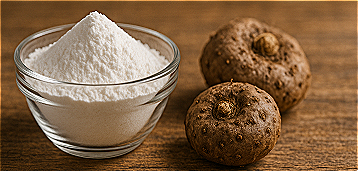
Food-grade powder from the corm of Amorphophallus konjac, rich in glucomannan (a soluble polysaccharide).
Sensory profile: neutral taste, white–off-white color, faint odor. In water it forms highly viscous solutions and, in the presence of alkali and/or calcium ions, elastic, heat-stable gels (basis of konnyaku/shirataki).
Positioning: clean-label thickener/gel former, gluten-free, suitable for plant-based and low-calorie formulations.
Caloric value (per 100 g powder)
~160–220 kcal (predominantly soluble fiber). Total carbohydrates ~80–90 g (mostly fiber), protein <1 g, fat <1 g, sodium low. Typical use is much lower (≈ 0.2–2%).
Key constituents
Glucomannan (β-1,4 glucose–mannose copolymer; often ≥70–85% d.b.), with partial acetylation that affects gelling.
Moisture low (spec ≤10–12%), ash low; protein/lipids trace.
Micronutrients negligible; FODMAPs low.
Production process
Raw material prep: A. konjac corms peeled, sliced, dried.
Milling & sieving: production of konjac flour; for konjac gum the glucomannan is extracted/refined (water → alcohol precipitation → drying).
Controls: heavy metals, microbial load, solution viscosity (e.g., at 1%), particle size.
For gelling foods: deacetylation/crosslinking occurs in-recipe using Ca(OH)₂ or Na₂CO₃ during cooking.
Sensory and technological properties
Hydration/viscosity: extremely high water binding (many times its weight) and viscosity at 0.5–1.0%.
Gelling: with alkali/Ca²⁺ forms thermostable, elastic gels (konnyaku); synergy with κ-carrageenan and xanthan.
Process stability: good from pH ~4–10; at low pH + high heat it can hydrolyze (viscosity loss).
Freeze–thaw: well-deacetylated gels are generally stable; solutions may synerese—manage with sugars/salts or blends.
Food applications
Noodles/konnyaku/shirataki: provides structure and elastic bite (konnyaku: flour + Ca(OH)₂).
Sauces, soups, beverages: low-dose thickener; good shear tolerance under moderate processing.
Bakery & gluten-free: improves water retention, softness, and fresh-keeping; in pasta supports cooking firmness.
Meats & plant analogs: binder and water/fat stabilizer; in emulsion gels increases sliceability.
Fat replacer/functional fiber: adds body at low calories.
Confectionery/gelled systems: opaque, firm gels, also synergistic with carrageenan.
Nutrition and health
Soluble, highly viscous fiber that can increase satiety and modulate post-prandial glycemia at the recipe level.
In the EU, approved claims allow glucomannan to contribute to weight loss with 3 g/day in an energy-restricted diet (in three doses of 1 g with 1–2 glasses of water each), and to maintain normal blood cholesterol at 4 g/day, when label conditions are met.
Possible GI discomfort (bloating) at high intakes: introduce gradually and ensure adequate hydration.
Fat profile
Quality and specifications (typical topics)
Identity/purity: glucomannan ≥70–85% d.b., moisture ≤10–12%, ash ≤3%, metals (Pb, As, Cd, Hg) within limits.
Functionality: solution viscosity (e.g., 1% at 25 °C), gelling index with Ca(OH)₂, particle size (mesh), color L*.
Microbiology: pathogens absent/25 g, low TPC/yeasts/molds; Salmonella negative.
Additive status: where applicable listed as E425 (E425(i) konjac gum / glucomannan) per food category.
Storage and shelf life
Store cool, dry, dark, in moisture-barrier, airtight packaging (avoid odors).
Typical shelf life ~24 months unopened; once opened, reseal and use within weeks.
Allergens and safety
Not a major allergen; gluten-free by nature.
Choking risk if consumed dry or in firm mini-gels that are not properly chewed (e.g., mini-cup jelly): always use with sufficient water and appropriate formats; mini-cup konjac gels are restricted/banned in some jurisdictions.
Declare any health claims per regulation; manage **GMO**/identity-preserved status as required.
INCI functions in cosmetics (where applicable)
INCI: Amorphophallus Konjac Root Powder, Glucomannan, Hydrolyzed Konjac Mannan.
Roles: film-forming, thickening, texturizing, absorbent in gels/lotions; konjac sponges for gentle cleansing.
Troubleshooting
Lumping on hydration: premix with sugar/oil or use agglomerated grades; rain-in under high shear.
Viscosity loss in acid/heat: reduce time/temperature, buffer pH, or blend (e.g., with xanthan).
Gel too rigid/rubbery: reduce Ca(OH)₂, lower dose, limit deacetylation, or blend with hydrocolloids/carrageenan.
Syneresis in gels: increase solids/sugars, optimize pH/ions, leverage κ-carrageenan synergy.
Sustainability and supply chain
Cultivated in East/Southeast Asia (China, Japan, Indonesia); low field inputs with high corm yield.
In-plant: recover water/alcohol from extraction cycles, manage effluents toward **BOD/COD** targets, optimize energy; use recyclable packaging; maintain **GMP/HACCP** and robust traceability.
Labelling
Names: “konjac flour”, “glucomannan”, or “konjac gum (E425)” as appropriate.
State technological function (thickener/gelling agent/fiber), origin, lot; for health claims (weight/cholesterol) specify dose, intake method, and required warnings (e.g., take with plenty of water).
Conclusion
Konjac flour is a high-function soluble fiber delivering very high viscosity and elastic, heat-stable gels at low calorie cost, making it versatile for konnyaku/shirataki, sauces, gluten-free bakery, and plant analogs. Correct grade selection, pH/ion/temperature control, and proper hydration are key to achieving target textures and stable performance safely.
Mini-glossary
Glucomannan: Glucose–mannose polysaccharide responsible for viscosity and gelation in konjac flour.
Deacetylation: removal of acetyl groups enabling Ca²⁺ crosslinking → elastic konnyaku gels.
**PUFA** — polyunsaturated fatty acids: Potentially beneficial when balanced; irrelevant here (fat trace).
**MUFA** — monounsaturated fatty acids: Often neutral/beneficial; irrelevant here.
**SFA** — saturated fatty acids: Best kept moderate overall; negligible in this ingredient.
**TFA** — trans fatty acids: Negligible in konjac flour.
**MCT** — medium-chain triglycerides: Not significant in konjac flour.
**GMO** — genetically modified organism: Status/claims may require disclosure.
**GMP/HACCP** — good manufacturing practice / hazard analysis and critical control points: Preventive food-safety systems with validated CCPs.
**BOD/COD** — biochemical/chemical oxygen demand: Wastewater metrics guiding treatment and environmental compliance.
References__________________________________________________________________________
Laignier F, Akutsu RCA, Lima BR, Zandonadi RP, Raposo A, Saraiva A, Botelho RBA. Amorphophallus konjac: Sensory Profile of This Novel Alternative Flour on Gluten-Free Bread. Foods. 2022 May 10;11(10):1379. doi: 10.3390/foods11101379.
Abstract. This study aimed to evaluate the sensory profile of gluten-free bread with Amorphophallus konjac (AK) flour in different concentrations. This experimental study is divided into three steps: preparation of the gluten-free bread formulations, sensory analysis, and statistical analysis. The addition of Konjac flour in a gluten-free bread formulation was tested in different proportions, 12.5%, 25%, 37.5%, and 50% of the flour content. The checking all-that-apply (CATA) was conducted with 110 panelists; among these, 43 were consumers of gluten-free bread. Sensory analysis was conducted using a 9-point hedonic scale for color, aroma, texture, flavor, appearance, and overall acceptability. The AK flour influenced the sensory characteristics of gluten-free bread. Bread with characteristics closer to those found in bread with gluten was the one with 12.5% of konjac flour for both the acceptability analysis as the attributes raised through a detailed CATA map. The control sample is located next to features like dry appearance, dry texture and grainy, dark color, and salty. Therefore, 12.5% AK gluten-free bread is closer to the characteristics of the control sample, such as light crust color, light crumb color, soft and moist texture, cohesion, and brightness. The bread with the highest percentage of overall consumer acceptance was 12.5% konjac with 93% and 96% acceptance among consumers and non-consumers of gluten-free bread, respectively.
Drugs and Lactation Database (LactMed®) [Internet]. Bethesda (MD): National Institute of Child Health and Human Development; 2006–. Glucomannan. 2024 Dec 15.
Abstract. Glucomannan is a soluble, highly viscous fiber commonly derived from Amorphophallus konjac root. Glucomannan has no specific lactation-related uses. It is most often used to lower cholesterol, to treat constipation and diabetes, and is contained in products to promote weight loss. No data exist on the safety and efficacy of glucomannan in nursing mothers or infants. However, because glucomannan is not absorbable, it will not reach the breastmilk and is very unlikely to affect the nursing infant. Dietary supplements do not require extensive pre-marketing approval from the U.S. Food and Drug Administration. Manufacturers are responsible to ensure the safety, but do not need to prove the safety and effectiveness of dietary supplements before they are marketed. Dietary supplements may contain multiple ingredients, and differences are often found between labeled and actual ingredients or their amounts. A manufacturer may contract with an independent organization to verify the quality of a product or its ingredients, but that does not certify the safety or effectiveness of a product. Because of the above issues, clinical testing results on one product may not be applicable to other products. More detailed information about dietary supplements is available elsewhere on the LactMed Web site.
Laignier F, Akutsu RCCA, Maldonade IR, Bertoldo Pacheco MT, Silva VSN, Mendonça MA, Zandonadi RP, Raposo A, Botelho RBA. Amorphophallus konjac: A Novel Alternative Flour on Gluten-Free Bread. Foods. 2021 May 27;10(6):1206. doi: 10.3390/foods10061206.
Abstract. The demand for gluten-free products is rising, but their production with similar quality as their gluten counterparts is challenging. This study aimed to develop gluten-free bread samples using different concentrations of Amorphophallus konjac flour (0%, 12.5%, 25%, 37.5%, and 50% of the total flour content) and to evaluate their nutritional and physicochemical properties. Proteins, lipids, carbohydrates, moisture, ash content, fibers, resistant starch, firmness, specific volume, and color were evaluated using official methods. Protein varied from 2.95% to 4.94%, the energy value from 347.93 to 133.55 kcal/100 g, dietary fiber from 8.19 to 17.90%, and resistant starch from 0.67% to 0.75% on wet basis. The addition of konjac flour positively influenced the specific volume. Higher concentrations of konjac flour in the formulations led to lower calories of the bread due to the significant addition of water to the dough. The bread samples with konjac showed high fiber content due to the composition of the flour. They had lower levels of carbohydrates, which can positively influence the glycemic index. Konjac flour provided dough mold, growth, and better texture for gluten-free bread. The best formulations were prepared in concentrations up to 37.5% konjac. The 50% konjac bread showed slightly reduced specific volume and pale color.
Islam F, Labib RK, Zehravi M, Lami MS, Das R, Singh LP, Mandhadi JR, Balan P, Khan J, Khan SL, Nainu F, Nafady MH, Rab SO, Emran TB, Wilairatana P. Genus Amorphophallus: A Comprehensive Overview on Phytochemistry, Ethnomedicinal Uses, and Pharmacological Activities. Plants (Basel). 2023 Nov 23;12(23):3945. doi: 10.3390/plants12233945.
Abstract. The genus Amorphophallus belongs to the family Araceae. Plants belonging to this genus are available worldwide and have been used in traditional medicines since ancient times, mainly in Ayurveda and Unani medical practices. Amorphophallus species are an abundant source of polyphenolic compounds; these are accountable for their pharmacological properties, such as their analgesic, neuroprotective, hepatoprotective, anti-inflammatory, anticonvulsant, antibacterial, antioxidant, anticancer, antiobesity, and immunomodulatory effects, as well as their ability to prevent gastrointestinal disturbance and reduce blood glucose. Moreover, Amorphophallus species contain numerous other classes of chemical compounds, such as alkaloids, steroids, fats and fixed oils, tannins, proteins, and carbohydrates, each of which contributes to the pharmacological effects for the treatment of acute rheumatism, tumors, lung swelling, asthma, vomiting, abdominal pain, and so on. Additionally, Amorphophallus species have been employed in numerous herbal formulations and pharmaceutical applications. There has been no extensive review conducted on the Amorphophallus genus as of yet, despite the fact that several experimental studies are being published regularly discussing these plants' pharmacological properties. So, this review discusses in detail the pharmacological properties of Amorphophallus species. We also discuss phytochemical constituents in the Amorphophallus species and their ethnomedicinal uses and toxicological profiles.
Jiang M, Li H, Shi JS, Xu ZH. Depolymerized konjac glucomannan: preparation and application in health care. J Zhejiang Univ Sci B. 2018 Jul;19(7):505-514. doi: 10.1631/jzus.B1700310.
Abstract. Konjac glucomannan (KGM) is a water-soluble polysaccharide obtained from the roots and tubers of konjac plants. Recently, a degraded product of KGM, depolymerized KGM (DKGM), has attracted attention because of its low viscosity, improved hydrophily, and favorable physiological functions. In this review, we describe the preparation of DKGM and its prebiotic effects. Other health benefits of DKGM, covering antioxidant and immune activity, are also discussed, as well as its safety. DKGM could be a candidate for use as a tool for the treatment of various diseases, including intestinal flora imbalance, and oxidative- and immune-related disorders.




