



Mace (Myristica fragrans aril)
Common name: Mace
(Dried aril surrounding the nutmeg seed)
Source plant (nutmeg tree)
Kingdom: Plantae
Clade: Angiosperms
Clade: Eudicots
Order: Magnoliales
Family: Myristicaceae
Genus: Myristica
Species: Myristica fragrans Houtt.
Note: Mace is the membranous aril that surrounds the seed of nutmeg (Myristica fragrans). After drying, it is sold in blades or ground, with a more delicate, floral aroma compared to nutmeg.
Cultivation and growing conditions of the nutmeg tree
Climate:
Prefers warm, humid tropical climates.
Needs well-distributed rainfall throughout the year and does not tolerate frost.
Exposure:
Grows best in full sun slightly moderated or light partial shade, especially when young.
Often grown in agroforestry systems with other shading trees.
Soil:
Prefers deep, well-drained soils rich in organic matter.
Develops well in slightly acidic to neutral soils.
Sensitive to prolonged waterlogging.
Watering:
In areas with regular rainfall, natural precipitation can be sufficient.
In drier conditions, supplemental irrigation is needed, especially for young trees.
Temperature:
Optimal growth roughly between 20 and 30 °C.
Low temperatures and cold winds can damage leaves and flowers.
Fertilization:
Benefits from regular applications of compost or well-rotted manure.
Balanced fertilizers (nitrogen, phosphorus, potassium) help support vegetative growth and fruiting.
Crop management:
Light pruning to maintain an open, balanced canopy.
Weed control around the base of the trees, especially in the first years.
Harvest:
Ripe fruits are harvested when they split open naturally, revealing the seed and the red aril.
Mace is separated from the seed, spread out and dried until it becomes brittle and orange-reddish to brown in color.
Description
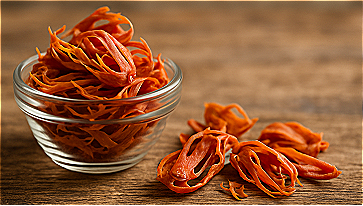
Aromatic spice obtained from the lacy aril that surrounds the nutmeg seed; dried into “blades” or ground into a fine powder.
Sensory profile: warm, sweet–spicy with citrus–floral top notes and a gentle peppery finish; more delicate and brighter than nutmeg.
Culinary role: classic in baked goods, creamy sauces, soups, sausages/charcuterie, pickling, spice blends (e.g., garam masala). Typical use 0.05–0.30% of formula.
Caloric value (per 100 g, spice)
~450–520 kcal; carbohydrates ~40–55 g (including fiber), fat ~30–36 g (mostly fixed oil), protein ~5–8 g, sodium low. Actual intake per serving is very small.
Chemical composition and structure
Volatile oil (essential oil): typically 7–15%, rich in terpenes (e.g., sabinene, α-/β-pinene, limonene, terpinene) and phenylpropanoids (myristicin, elemicin, safrole traces, eugenol).
Fixed oil (triacylglycerols): variable 20–35% containing myristic, palmitic, oleic, linoleic fatty acids.
Lignans/neolignans: e.g., macelignan and related compounds linked to aroma stability and antioxidant properties.
Minerals/vitamins: manganese, copper, potassium; B vitamins present at low levels.
Physical properties
Form: whole blades (thin, brittle arils) or ground powder.
Color: orange–amber to deep red-gold; ground mace is yellow–orange.
Moisture: typically ≤10–12% for quality; water activity controlled to prevent mould.
Solubility: essential oil soluble in ethanol and fats; insoluble in water (except for flavor dispersion).
Particle size (ground): commonly 20–60 mesh, tailored to application.
Production process
Harvest & separation: ripe nutmeg fruits split; aril (mace) removed from the seed, washed/trimmed.
Flattening & drying: arils spread and pressed into blades; sun- or hot-air–dried to target moisture with airflow control.
Grading & cleaning: size/color grading; removal of extraneous matter; optional steam sterilization to reduce microbial load.
Milling & packing: cryogenic or cooled milling for volatile retention; oxygen- and light-barrier packaging.
Essential oil/CO₂ extract (optional): steam distillation or supercritical CO₂ for concentrated flavor.
Sensory and technological properties
Flavor release: fast top-note due to monoterpenes, with a warm, lingering tail from phenylpropanoids.
Coloring effect: imparts golden hue at typical dosages.
Processing sensitivity: heat, light, oxygen drive oil loss and oxidation → use late addition, tight lids, cool storage.
Food applications
Bakery/desserts: cakes, doughnuts, custards, rice pudding, fruit preserves.
Savory: béchamel/cream sauces, soups (potato, pumpkin), seafood, pâtés, white sausages.
Beverage & confectionery: cordials, liqueurs, syrups, chocolate and pralines.
Seasonings: spice blends, pickling spice, rub mixes with cinnamon, coriander, white pepper.
Nutrition and health
Antioxidant constituents (e.g., lignans, eugenol) may contribute to aroma stability and flavor impact; physiological effects at culinary doses are limited.
Excess consumption can cause nausea, dizziness, and neurotoxic symptoms linked mainly to myristicin/elemicin; culinary use is well below such levels.
Sodium-free by nature; supports salt reduction via aromatic intensity.
Fat profile
Fixed oil contains **SFA** (saturated fatty acids, notably myristic and palmitic), **MUFA** (monounsaturated fatty acids, mainly oleic) and **PUFA** (polyunsaturated fatty acids, linoleic).
Health note: **SFA** are best kept moderate overall, while **MUFA** are often neutral/beneficial and **PUFA** beneficial when balanced; in mace, serving sizes are tiny, so lipid impact is nutritionally minimal. **TFA**/**MCT** are negligible.
Quality and specifications (typical topics)
Identity & purity: whole blades or ground, free of extraneous matter, uniform color.
Moisture: ≤10–12%; volatile oil content within spec (higher = stronger aroma).
Chemical: peroxide/anisidine (oxidation) low, ash, acid-insoluble ash within limits; pesticides/metals compliant.
Microbiology: pathogens absent/25 g (e.g., Salmonella negative); total plate count, yeasts/moulds controlled; steam-treated options available.
Adulteration checks: microscopy, GC–MS essential-oil fingerprint, color and fiber profile.
Storage and shelf life
Store cool (≤20 °C), dry, dark, in airtight, oxygen-barrier packs; avoid heat/light.
Shelf life: whole blades 18–24 months; ground 12–18 months (aroma fades faster).
Keep away from moisture to prevent caking/mould.
Allergens and safety
Not a major allergen in most jurisdictions; spice allergies can occur.
Toxicity at high doses: compounds such as myristicin/safrole warrant moderation; comply with regional limits for safrole/methyleugenol in foods.
Pregnancy/medications: avoid excess; potential interactions at pharmacological doses.
Gluten-free by nature; manage cross-contact under good practices.
INCI functions in cosmetics (where applicable)
INCI: Myristica Fragrans (Mace) Extract, Myristica Fragrans (Mace) Oil.
Roles: fragrance, antioxidant/skin-conditioning support in oils, balms, soaps; assess sensitization and photosafety; follow IFRA guidance for leave-on products.
Troubleshooting
Musty/mouldy notes: indicates poor drying or storage → check moisture/a_w, switch to steam-sterilized supply.
Weak aroma: old crop/over-milled or oxidized → specify volatile oil minimum, request fresh-pack dates, use cryogenic milling.
Caking: humidity ingress → upgrade barrier and desiccants, reduce headspace.
Specking in light sauces: use finer grind or infuse in fat then strain.
Sustainability and supply chain
Major origins include Indonesia, Sri Lanka, India, Grenada; prefer traceable, deforestation-free, and fair-labor sources.
In-plant: adopt energy-efficient drying, steam sterilization, and waste valorization (e.g., spent husk/meal) with wastewater managed toward **BOD/COD** targets; maintain **GMP/HACCP** and robust traceability.
Labelling
Ingredient name: “mace” (distinct from “nutmeg”).
Declare country of origin, form (whole/ground), and processing (steam-sterilized) where relevant; ensure compliance with any regional limits on safrole/methyleugenol.
Conclusion
Mace is a refined, warm–aromatic spice that lends bright, sweet–spicy complexity at low dosages. Specifying volatile oil, ensuring clean, dry processing, and protecting against oxidation and microbial risks preserve its signature flavor and clean-label quality across bakery, savory, and beverage applications.
Mini-glossary
**SFA** — saturated fatty acids: Fats best kept moderate overall; present in mace’s fixed oil.
**MUFA** — monounsaturated fatty acids: Often neutral/beneficial (e.g., oleic); minor in mace.
**PUFA** — polyunsaturated fatty acids: Beneficial when balanced (e.g., linoleic); oxidation-prone; minor here.
**TFA** — trans fatty acids: Negligible in spices.
**MCT** — medium-chain triglycerides: Not significant in mace.
IFRA — International Fragrance Association: Provides safety standards for fragrance use in cosmetics.
**GMP/HACCP** — good manufacturing practice / hazard analysis and critical control points: Preventive food-safety systems with validated CCPs.
**BOD/COD** — biochemical/chemical oxygen demand: Wastewater impact metrics guiding treatment and compliance.

