



Seaweed protein (macroalgae)
Description
Protein ingredients derived from edible seaweeds (macroalgae) across brown (Phaeophyceae: Laminaria/Kombu, Ascophyllum, Fucus), red (Rhodophyta: Porphyra/Nori, Palmaria palmata/Dulse), and green (Chlorophyta: Ulva/sea lettuce) lineages.
Typical protein (dry basis): red/green seaweeds ~20–40% (species- and season-dependent; Porphyra among the highest), brown seaweeds ~7–20%. Commercial concentrates/isolates standardize to ≥50–80% protein via processing.
Sensory profile: marine–umami, sometimes briny/phenolic; color from emerald to deep brown–red depending on species and process.
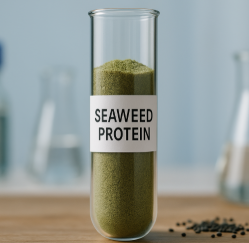
Caloric value (per 100 g, powder)
Protein concentrate (50–65%): ~320–380 kcal; protein 50–65 g, carbohydrates 15–30 g (notably soluble fiber/polysaccharides), fat 1–5 g, sodium variable (desalting reduces it).
Protein isolate (≥80%): ~330–410 kcal; protein 80–90 g, carbohydrates 1–10 g, fat 1–4 g.
Key constituents
Proteins/peptides: structural proteins and, in reds, phycobiliproteins (e.g., phycoerythrin) contributing color and antioxidant activity.
Free amino acids: notably glutamate/aspartate → umami impact.
Polysaccharides (co-extracted): alginates/fucoidans (brown), agar/carrageenans (red), ulvans (green) — affect viscosity/gelation.
Minerals/micronutrients: iodine (especially in kelps), potassium, calcium, iron; B-vitamins vary by species and processing.
Production process
Harvesting & pretreatment: sorting, washing, optional blanching/desalting to reduce sand/salts/iodine.
Drying & milling: air/sun/drum/spray drying, then milling to target particle size.
Protein concentration/isolation:
Cell-wall disruption (mechanical, enzymatic, ultrasound/PEF) to improve extractability/digestibility.
Alkaline solubilization → isoelectric precipitation or membrane filtration to yield concentrates/isolates.
Enzymatic hydrolysis/fermentation to reduce beany/marine notes, increase solubility and bioaccessibility.
Finishing: decolorization/deodorization as needed, spray-drying, sieving, standardization.
Sensory and technological properties
Solubility: pH-dependent; hydrolysates show broader solubility and lower turbidity.
Emulsifying/foaming: seaweed proteins and co-extracted polysaccharides synergize to stabilize emulsions/foams.
Gelling/viscosity: interactions with alginates/carrageenans/ulvans provide body and gel strength in sauces and fillings.
Flavor: intrinsic umami supports salt reduction; off-notes mitigated by desalting, activated carbon, or fermentation.
Food applications
Plant-based meats/seafood analogs: binder, emulsifier, and texture aid; supports extrusion with cereals/legumes.
Soups, sauces, dressings: natural thickening/emulsifying with umami lift.
Bakery/snacks: protein enrichment in crackers, chips, savory bars; color and flavor managed by blends.
Beverages & nutrition: hydrolysates in RTD drinks or broths (clarity and taste optimized).
Nutrition and health
Protein quality: good lysine levels; sulfur amino acids may be limiting → complement with cereals/seeds. PDCAAS/DIAAS improve after cell-wall disruption/enzymatic hydrolysis.
Fiber & minerals: co-deliver soluble fibers and minerals; iodine can be high in kelp-derived materials—manage dose.
Bioactives: phycobiliproteins/peptides may contribute antioxidant/ACE-inhibitory activities (matrix-/process-dependent).
Fat profile
Total fat low; lipids mainly membrane phospholipids with some **PUFA** (e.g., long-chain n-3 traces). For most food uses, fat contribution is negligible relative to proteins/polysaccharides. **MUFA** and **SFA** fractions are minor; **TFA**/**MCT** are not relevant.
Quality and specifications (typical topics)
Protein (N×factor): report nitrogen-to-protein factor suitable for seaweeds (often ~5.0–5.13 rather than 6.25) due to non-protein nitrogen.
Moisture/aw, ash (marine salts), sodium/iodine (declared/controlled), metals (As, Cd, Pb, Hg) within limits, with inorganic arsenic specifically low (avoid hijiki sources).
Microbiology: pathogens absent/25 g; low yeasts/molds; verify biogenic amines if fermented.
Functionality: solubility vs pH, emulsifying/foaming indices, gel strength/viscosity, color (L, a, b*)**, particle size.
Sensory: marine/phenolic off-notes minimized; grit/sand absent.
Storage and shelf life
Store cool, dry, dark, airtight; protect from moisture (caking) and odors.
Shelf life: typically 12–24 months for powders in oxygen/moisture-barrier packs; shorter for liquid hydrolysates (refrigerated).
Allergens and safety
Not a major allergen, but cross-contact with crustaceans/fish possible in shared facilities.
Iodine sensitivity/thyroid: kelp-rich proteins may exceed daily iodine if overdosed → formulate and label responsibly.
Inorganic arsenic: ensure compliant sourcing and routine analytics; some jurisdictions advise against hijiki consumption.
Gluten-free by nature; manage cross-contact under **GMP/HACCP**.
INCI functions in cosmetics (where applicable)
INCI: Hydrolyzed Algae Protein, Algae Extract, or species-specific (e.g., Laminaria Digitata Extract, Ascophyllum Nodosum Extract, Ulva Lactuca Extract).
Roles: film-forming, skin/hair conditioning, moisture retention, and antioxidant support in serums, shampoos, masks.
Troubleshooting
Marine/off odors or bitterness: apply desalting, activated carbon, or fermentation; select low-phenolic species/cuts.
Too dark/green color: decolorize (ethanol washes/adsorbents) or blend with light proteins.
Low solubility or graininess: increase hydrolysis, adjust pH/ionic strength, reduce particle size, add chelators to manage divalent ions.
High sodium/iodine: use desalting, species selection, and spec caps; declare iodine per serving where appropriate.
Weak gel/emulsion: leverage synergy with alginates/carrageenans/ulvans or add starches/hydrocolloids.
Sustainability and supply chain
Seaweed aquaculture requires no arable land, freshwater, or fertilizers, supports habitat and nutrient uptake.
Ensure responsible harvesting, biosecurity, and traceability; optimize processing water/energy, treat effluents toward **BOD/COD** targets; use recyclable packaging and maintain **GMP/HACCP**.
Labelling
Names: “seaweed protein concentrate/isolate” with species (e.g., from Porphyra/Ulva/Laminaria).
Declare protein % (N×factor used), sodium/iodine where relevant, country of origin/lot; apply vegan/gluten-free claims only when compliant.
Conclusion
Seaweed protein offers a low-impact, umami-forward protein platform with useful functionality (solubility, emulsification, gelling synergy) and valuable minerals/fibers. Success hinges on species selection, extractability/digestibility enhancement (cell-wall disruption, enzymatic hydrolysis/fermentation), and careful control of iodine/metals/off-notes to deliver clean flavor, stable texture, and regulatory compliance.
Mini-glossary
PDCAAS/DIAAS: Indices of protein quality based on digestibility/indispensable amino acids; improve with hydrolysis/fermentation.
N-to-protein factor: Multiplier converting nitrogen to protein; for seaweeds often ~5.0–5.13 (lower than 6.25) due to non-protein nitrogen.
Phycobiliproteins: Water-soluble chromoproteins (e.g., phycoerythrin) from red algae contributing color and antioxidant effects.
**PUFA** — polyunsaturated fatty acids: Potentially beneficial when balanced; minor in macroalgae protein powders.
**MUFA** — monounsaturated fatty acids: Typically neutral/beneficial; minor fraction here.
**SFA** — saturated fatty acids: Best kept moderate overall; minor here.
**TFA** — trans fatty acids: Negligible in seaweed ingredients.
**MCT** — medium-chain triglycerides: Not relevant for macroalgae.
**GMP/HACCP** — good manufacturing practice / hazard analysis and critical control points: Preventive food-safety systems with validated CCPs.
**BOD/COD** — biochemical/chemical oxygen demand: Wastewater metrics guiding treatment and environmental impact.

