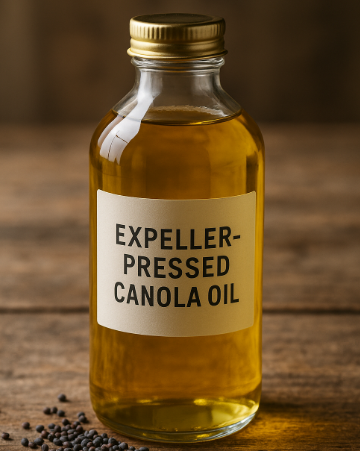
Expeller-pressed canola oil
Canola oil is an oil made from a particular species of rapeseed and canola stands for 'CANadian Oil Low Acid'. It is a modified rapeseed from which the erucic acid, a problematic component for human health that I will write about later, has been removed.
Canola is also the common term used for oil obtained from specially bred low-erucic-acid, low-glucosinolate rapeseed varieties of Brassica napus (and sometimes Brassica rapa), developed mainly in Canada from the 1970s onwards to provide an oil with a more favourable and safer nutritional profile than traditional rapeseed oil. It is a clear, pale yellow to golden liquid oil with a mild flavour and light aroma, used both cold (as a dressing) and in cooking and frying thanks to its good fatty-acid profile and reasonable oxidative stability. Nutritionally it is characterised by a very low content of saturated fatty acids and a high proportion of monounsaturated and polyunsaturated fatty acids, with a useful balance between omega-6 (linoleic acid) and omega-3 (alpha-linolenic acid). Beyond edible oil, canola yields meals and cakes for animal feeding and specific fractions (such as lecithins and unsaponifiable matter) used in foods, supplements and cosmetics.
Vegetable oil obtained from low–erucic, low–glucosinolate rapeseed cultivars (canola) using mechanical expellers (screw presses) that separate oil from flakes without chemical solvent.
Sensory profile: pale straw to golden color, neutral to lightly nutty aroma; typically fuller flavor than highly refined solvent-extracted oils.
Grades: Unrefined (expeller) for robust flavor; lightly/refined expeller for cleaner taste and higher heat tolerance; high-oleic variants for extra stability.
Caloric value (per 100 g)
About 884 kcal (≈ 9 kcal/g); fat ~100 g, protein 0 g, carbohydrates 0 g.
Naturally provides vitamin E (tocopherols) (often 15–30 mg/100 g, grade-dependent).
Key constituents
Triacylglycerols rich in oleic acid (**MUFA**), plus linoleic (n-6) and α-linolenic, ALA (n-3) (**PUFA**).
Minor unsaponifiables: phytosterols (e.g., campesterol, β-sitosterol, brassicasterol), tocopherols (α/γ); traces of phenolics retained more in unrefined lots.
Erucic acid controlled (<2% by canola standard; typically trace).
Production process
Seed prep: cleaning → conditioning/cooking → flaking.
Expeller extraction: single or two-stage screw pressing to express oil (often 70–85% of oil in the seed if press-only). Some facilities pre-press then solvent-extract the presscake (not “expeller-only”).
Finishing: settling/centrifugation and filtration; optional winterization for cold stability.
Refining options: from unrefined (minimal) to RBD (degum → neutralize → bleach → deodorize); expeller lines may use physical refining to preserve micronutrients and limit by-products.
Co-product: canola meal (higher residual oil than solvent meal), used in feed/protein streams.
Sensory and technological properties
Smoke point: depends on refining/FFA—typically ~190–205 °C (unrefined expeller) and ~210–230 °C (refined expeller); high-oleic grades trend higher.
Oxidative stability: good due to high **MUFA**; the **PUFA** fraction necessitates protection from light/oxygen/heat. High-oleic improves fry life.
Rheology: low viscosity for easy pouring; may haze in chill due to waxes if not winterized (clears at ambient).
Food applications
Sautéing and shallow/deep frying (prefer refined expeller; replace when polar compounds exceed limits).
Emulsions (mayonnaise/dressings), sauces, marinades (clean flavor).
Bakery/pastry: tender crumb/shortening effect; blends for spreads/margarines.
Plant-based products: contributes juiciness/lubricity in meat analogs; spray/coating for snacks.
Nutrition and health
Typical fatty-acid distribution: **SFA** low (~6–8%), **MUFA** high (~58–65%, mainly oleic), **PUFA** (~28–32%, linoleic n-6 ~18–24%, **ALA** n-3 ~8–12%; n-6:n-3 ≈ 2:1–3:1).
Tocopherols and phytosterols support a favorable lipid profile.
Because **PUFA** are more oxidation-prone, prefer shorter high-heat exposures or high-oleic expeller oil for prolonged frying.
Fat profile
**MUFA** (monounsaturated fatty acids, chiefly oleic) → typically neutral/beneficial for blood lipids and more heat-stable than PUFA.
**PUFA** (polyunsaturated fatty acids: linoleic n-6, **ALA** n-3) → potentially beneficial when balanced, but less heat-stable.
**SFA** (saturated fatty acids, mainly palmitic) → low; keep moderate overall.
**TFA** (trans fatty acids) → negligible in non-hydrogenated oils.
**MCT** (medium-chain triglycerides) → not significant.
Quality and specifications (typical topics)
Identity/purity: acid value/FFA low (e.g., ≤0.3% as oleic for refined), peroxide value ≤10 meq O₂/kg, anisidine controlled, TOTOX low; moisture/impurities ≤0.1% (refined).
Micronutrients: tocopherols and phytosterols higher in unrefined/lightly refined expeller oils.
Process contaminants: minimize 3-MCPD/glycidyl esters via optimized deodorization; PAH negligible with good seed/thermal control.
Frying control: track polar compounds, FFA, viscosity, color to define end-of-life.
Storage and shelf life
Store cool, dark, airtight (prefer nitrogen-flushed for bulk). Avoid copper/iron contact.
Shelf life: 12–18 months (refined expeller); 6–12 months (unrefined), shorter once opened.
Allergens and safety
Not a major allergen; residual proteins are minimal in refined grades.
GMO status: canola may be GM in some regions; non-GMO expeller lines are available—label per regulation.
Erucic acid compliant for canola; verify lot conformity.
INCI functions in cosmetics (when applicable)
INCI: Canola Oil, Brassica Campestris (Rapeseed) Seed Oil.
Roles: emollient, skin-conditioning, light occlusive, hair-conditioning in oils, balms, creams, color cosmetics.
Troubleshooting
Early smoking/foaming: elevated FFA/water/crumbs or spent oil → filter, keep stable temperature, refresh above polar-compound limits.
Rancid/fishy notes: oxidation → verify age/storage, limit light/heat/air; use fresh lots.
Cold haze/crystals: waxes/high-melting TAGs → use winterized oil or warm to ambient.
Sustainability and supply chain
Solvent-free extraction lowers solvent emissions; mechanical pressing may increase energy per tonne but simplifies effluent control.
Crop rotation-friendly with high yields; valorize expeller meal; adopt recyclable packaging and robust **GMP/HACCP** and traceability; manage effluents toward **BOD/COD** targets.
Labelling
Declare “expeller-pressed canola oil”; specify refined/unrefined, high-oleic if applicable, country of origin, and lot.
Nutrition claims (e.g., source of vitamin E) only when compliant; non-GMO/organic per jurisdiction.
Conclusion
Expeller-pressed canola oil offers a clean-label, solvent-free extraction pathway with a favorable lipid profile (high **MUFA**, low **SFA**, meaningful **PUFA** including **ALA**), neutral-to-nutty flavor, and broad culinary utility. Selecting the appropriate refining level and grade (standard vs high-oleic), managing heat, and ensuring good storage maximize stability, safety, and sensory quality.
Mini-glossary
**MUFA** — monounsaturated fatty acids: Typically neutral/beneficial for blood lipids; more oxidation-stable than PUFA.
**PUFA** — polyunsaturated fatty acids: Include linoleic (n-6) and **ALA** (α-linolenic, n-3); beneficial when balanced, but heat-sensitive.
**SFA** — saturated fatty acids: E.g., palmitic; best kept moderate overall.
**ALA** — α-linolenic acid (n-3): Essential omega-3 present in canola; supports fatty-acid balance.
**TFA** — trans fatty acids: Negligible in non-hydrogenated canola oil.
**MCT** — medium-chain triglycerides: Not significant in canola oil.
TOTOX — total oxidation value: 2× peroxide + anisidine; composite index of oil oxidation state.
Winterization: Removal of waxes/high-melting TAGs to improve cold stability.
**GMP/HACCP** — good manufacturing practice / hazard analysis and critical control points: Preventive food-safety systems with validated CCPs.
**BOD/COD** — biochemical/chemical oxygen demand: Effluent metrics guiding wastewater treatment and environmental impact.
References__________________________________________________________________________
Pourrajab B, Sharifi-Zahabi E, Soltani S, Shahinfar H, Shidfar F. Comparison of canola oil and olive oil consumption on the serum lipid profile in adults: a systematic review and meta-analysis of randomized controlled trials. Crit Rev Food Sci Nutr. 2023 Nov;63(33):12270-12284. doi: 10.1080/10408398.2022.2100314.
Abstract. Background and aims: Several randomized clinical trials have investigated the effects of canola oil (CO) compared to olive oil (OO) on the serum lipid profiles in adults. However, the results of these studies are inconsistent. Thus, this study aimed to assess the comparison of CO and OO consumption on the serum lipid components in adults. Methods and results: The following online databases were searched until February 4th, 2022: PubMed/Medline, Scopus, Clarivate Analytics Web of Science, Cochrane Central Register of Controlled Trials, and Google Scholar. The effect sizes were stated as the weighted mean difference (WMD) with 95% confidence intervals (CI). A total of 13 eligible trials were included in this meta-analysis. The results showed that the CO consumption, significantly reduced serum LDL-c (WMD: -6.13 mg/dl, 95%CI: -9.79, -2.46, p = 0.001), TC (WMD: -8.92 mg/dl, 95% CI: -13.52, -4.33, P < 0.001) and LDL-c/HDL-c ratio (WMD: -0.30; 95% CI, -0.53, -0.06, p = 0.01) levels compared to OO. There were no significant changes in the other components of the blood lipids. Conclusion: The results of this review suggest that CO consumptionhas beneficial effects on LDL-c, TC, and LDL-c/HDL-c ratio compared to OO. Therefore, its replacement with OO can have cardioprotective impacts.
Davis KM, Petersen KS, Bowen KJ, Jones PJH, Taylor CG, Zahradka P, Letourneau K, Perera D, Wilson A, Wagner PR, Kris-Etherton PM, West SG. Effects of Diets Enriched with Conventional or High-Oleic Canola Oils on Vascular Endothelial Function: A Sub-Study of the Canola Oil Multi-Centre Intervention Trial 2 (COMIT-2), a Randomized Crossover Controlled Feeding Study. Nutrients. 2022 Aug 18;14(16):3404. doi: 10.3390/nu14163404.
Abstract. Partial replacement of saturated fatty acids (SFA) with unsaturated fatty acids is recommended to reduce cardiovascular disease (CVD) risk. Monounsaturated fatty acids (MUFA), including oleic acid, are associated with lower CVD risk. Measurement of flow-mediated dilation of the brachial artery (FMD) is the gold standard for measuring endothelial function and predicts CVD risk. This study examined the effect of partially replacing SFA with MUFA from conventional canola oil and high-oleic acid canola oil on FMD. Participants (n = 31) with an elevated waist circumference plus ≥1 additional metabolic syndrome criterion completed FMD measures as part of the Canola Oil Multi-Centre Intervention Trial 2 (COMIT-2), a multi-center, double-blind, three-period crossover, controlled feeding randomized trial. Diet periods were 6 weeks, separated by ≥4-week washouts. Experimental diets were provided during all feeding periods. Diets only differed by the fatty acid profile of the oils: canola oil (CO; 17.5% energy from MUFA, 9.2% polyunsaturated fatty acids (PUFA), 6.6% SFA), high-oleic acid canola oil (HOCO; 19.1% MUFA, 7.0% PUFA, 6.4% SFA), and a control oil blend (CON; 11% MUFA, 10% PUFA, 12% SFA). Multilevel models were used to examine the effect of the diets on FMD. No significant between-diet differences were observed for average brachial artery diameter (CO: 6.70 ± 0.15 mm, HOCO: 6.57 ± 0.15 mm, CON: 6.73 ± 0.14 mm; p = 0.72), peak brachial artery diameter (CO: 7.11 ± 0.15 mm, HOCO: 7.02 ± 0.15 mm, CON: 6.41 ± 0.48 mm; p = 0.80), or FMD (CO: 6.32 ± 0.51%, HOCO: 6.96 ± 0.49%, CON: 6.41 ± 0.48%; p = 0.81). Partial replacement of SFA with MUFA from CO and HOCO had no effect on FMD in participants with or at risk of metabolic syndrome.
Yahay M, Heidari Z, Allameh Z, Amani R. The effects of canola and olive oils consumption compared to sunflower oil, on lipid profile and hepatic steatosis in women with polycystic ovarian syndrome: a randomized controlled trial. Lipids Health Dis. 2021 Jan 29;20(1):7. doi: 10.1186/s12944-021-01433-9.
Abstract. Background: Polycystic Ovarian Syndrome (PCOS) is one of the most common endocrinopathies and metabolic disorders in women during their reproductive years. It is often associated with dyslipidemia and other risk factors of cardiovascular diseases (CVD). This study was aimed to evaluate dietary intervention effects with canola and olive oils compared to sunflower oil on lipid profile and fatty liver severity among women with PCOS. Method: This study was a 10-week intervention including 72 women with PCOS. Patients were randomly assigned to three groups for receiving 25 g/day canola, olive, or sunflower oils for 10 weeks. The primary and secondary outcomes were to assess changes in lipid profile and in fatty liver severity, respectively. Result: At the end of the study, 72 patients with a mean age of 29.31 were analysed. Canola oil consumption resulted in a significant reduction in serum levels of TG (P = 0.002) and TC/HDL (P = 0.021), LDL/HDL (P = 0.047), and TG/HDL (P = 0.001) ratios, however, there was no significant reduction in lipid profile following olive oil consumption. Canola (P < 0.001) and olive oils (P = 0.005) could significantly reduce the fatty liver grade. Moreover, HOMA-IR in both canola (P < 0.001) and olive (P = 0.004) groups was significantly decreased. Conclusion: In total, compared to olive and sunflower oils, significant improvements in lipid profile, liver function, and HOMA-IR were observed following canola oil consumption in women with PCOS.
Khandouzi N, Zahedmehr A, Nasrollahzadeh J. Effects of canola or olive oil on plasma lipids, lipoprotein-associated phospholipase A2 and inflammatory cytokines in patients referred for coronary angiography. Lipids Health Dis. 2020 Aug 14;19(1):183. doi: 10.1186/s12944-020-01362-z.
Abstract. Background: The potential cardioprotective benefits of olive oil (OO) and canola oil (CO) consumption have been shown in some studies. The present study compared the effects of CO and OO on plasma lipids, some inflammatory cytokines, and lipoprotein-associated phospholipase A2 (Lp-PLA2) mass and activity in patients undergoing coronary angiography. Methods: The current randomized, controlled, parallel-arm, clinical trial involved 48 patients (44 men and 4 women, aged 57.63 ± 6.34 years) with at least one classic cardiovascular risk factor (hypertension, dyslipidemia, or diabetes) who referred for coronary angiography. Patients were randomly divided into two groups and received 25 mL/day refined olive oil (n = 24) or canola oil (n = 24) for 6 weeks. Plasma lipids, some selected inflammatory markers, and Lp-PLA2 levels were measured at baseline and after the intervention. Results: CO consumption produced a significant reduction in plasma Lp-PLA2 mass (- 0.97 ± 1.84 vs. 0.34 ± 1.57 ng/mL, p = 0.008 for CO and OO, respectively), whereas the mean changes in interleukine-6 concentration were significantly lower after OO consumption compared with CO (- 9.46 ± 9.46 vs. -0.90 ± 6.80 pg/mL, p = 0.008 for OO and CO, respectively). After 6 weeks of intervention, no significant changes were observed in plasma Lp-PLA2 activity, complement C3, C4, or lipid profiles in the two intervention groups. Conclusions: Comparing the two vegetable oils in subjects with cardiovascular risk factors showed that the consumption of olive oil is more effective in reducing the level of inflammatory cytokine interleukine-6, whereas canola oil was more effective in lowering Lp-PLA2 levels; however, this finding should be interpreted with caution, because Lp-PLA2 activity did not change significantly.
Ruyter B, Sissener NH, Østbye TK, Simon CJ, Krasnov A, Bou M, Sanden M, Nichols PD, Lutfi E, Berge GM. n-3 Canola oil effectively replaces fish oil as a new safe dietary source of DHA in feed for juvenile Atlantic salmon. Br J Nutr. 2019 Dec 28;122(12):1329-1345. doi: 10.1017/S0007114519002356.
Abstract. Limited availability of fish oils (FO), rich in n-3 long-chain (≥C20) PUFA, is a major constraint for further growth of the aquaculture industry. Long-chain n-3 rich oils from crops GM with algal genes are promising new sources for the industry. This project studied the use of a newly developed n-3 canola oil (DHA-CA) in diets of Atlantic salmon fingerlings in freshwater. The DHA-CA oil has high proportions of the n-3 fatty acids (FA) 18 : 3n-3 and DHA and lower proportions of n-6 FA than conventional plant oils. Levels of phytosterols, vitamin E and minerals in the DHA-CA were within the natural variation of commercial canola oils. Pesticides, mycotoxins, polyaromatic hydrocarbons and heavy metals were below lowest qualifiable concentration. Two feeding trials were conducted to evaluate effects of two dietary levels of DHA-CA compared with two dietary levels of FO at two water temperatures. Fish increased their weight approximately 20-fold at 16°C and 12-fold at 12°C during the experimental periods, with equal growth in salmon fed the FO diets compared with DHA-CA diets. Salmon fed DHA-CA diets had approximately the same EPA+DHA content in whole body as salmon fed FO diets. Gene expression, lipid composition and oxidative stress-related enzyme activities showed only minor differences between the dietary groups, and the effects were mostly a result of dietary oil level, rather than the oil source. The results demonstrated that DHA-CA is a safe and effective replacement for FO in diets of Atlantic salmon during the sensitive fingerling life-stage.




