



Garbanzo beans (chickpeas) (Cicer arietinum)
Description
Edible pulses with creamy, nutty flavor and a tender–meaty bite when cooked; common types are kabuli (large, beige) and desi (smaller, darker; often dehulled/split as chana dal).
Culinary versatility: excellent for purées (e.g., hummus), frying/roasting (snacks), stews/curries (e.g., chana masala), salads, and as flour (besan/gram) for batters, flatbreads (socca), and gluten-free baking.
Aquafaba: the cooking liquor is a notable foaming/emulsifying medium for meringues and mousses.
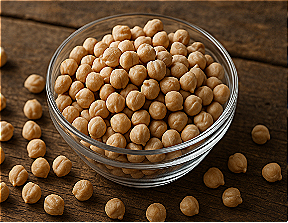
Caloric value (per 100 g)
Dry (as sold): ~360–380 kcal.
Cooked in water, no salt: ~155–170 kcal, protein 8–9 g, carbohydrates 26–30 g (of which fiber 7–9 g), fat 2–3 g.
Canned (drained): broadly similar to cooked; sodium varies widely (rinsing reduces sodium).
Key constituents
Carbohydrates: mainly starch (with RS3 — retrograded resistant starch increasing on cooling).
Proteins (~20–22% dry basis): storage proteins vicilin/7S, legumin/11S (convicilin), with sulfur amino acids (methionine/cysteine) limiting → complement with cereals.
Dietary fiber: soluble (pectic/gum) and insoluble (cellulosic) fractions; oligosaccharides (raffinose/stachyose; FODMAP).
Phytochemicals: saponins, phytosterols, phenolics; phytate (mineral chelation; reduced by processing).
Minerals/vitamins: good folate, manganese, magnesium, phosphorus, potassium, iron (bioavailability improves with vitamin C and proper cooking).
Production process
Dry product: cleaning → grading → dehulling (optional) → drying to spec → packaging (barrier).
Canned/ready-to-eat: soaking (or rapid hydration) → boiling/pressure cooking to tenderness → filling with brine, optional CaCl₂ (firmness) → seaming → retort sterilisation → cooling.
Flour/semolina: milling (stone/roller/pin) of dehulled seeds; optional heat treatment to reduce beany notes and antinutrients.
Sensory and technological properties
Creamy texture with thin seed coat (kabuli) aiding pureability; desi varieties yield earthier flavor and firmer texture.
High water absorption and starch gelation provide body in soups and sauces.
Aquafaba functionality stems from soluble proteins, polysaccharides, and saponins, enabling foam stability and emulsification.
Food applications
Mediterranean/Middle Eastern: hummus, falafel, stews.
South Asian: chana masala, chole, besan for pakora, ladoos, socca/farinata variants.
Modern uses: roasted snacks, pasta and extruded foods, plant-based burgers, dairy alternatives (with chickpea protein isolates).
Aquafaba: egg-free foams, mayonnaise, ganache, cakes.
Nutrition and health
High fiber supports satiety and glycaemic control; protein complements cereals for amino-acid balance.
Glycaemic impact: typically low–moderate GI; cooling and reheating can increase RS3 and further attenuate GI.
Sodium management: choose low-salt canned options or rinse thoroughly.
Antinutrients (phytate, trypsin inhibitors, tannins) are reduced by soaking, cooking/pressure cooking, sprouting, and fermentation.
FODMAP: oligosaccharides may cause bloating; canned, rinsed portions and gradual titration improve tolerance.
Fat profile
Total fat is modest (cooked beans ~2–3 g/100 g), composed predominantly of PUFA — polyunsaturated fatty acids (notably linoleic n-6; potentially beneficial if balanced) and MUFA — monounsaturated fatty acids (oleic n-9; often neutral/beneficial), with small SFA — saturated fatty acids (palmitic; best kept moderate overall). TFA — trans fatty acids are negligible; MCT — medium-chain triglycerides not relevant.
Quality and specifications (typical topics)
Dry beans: moisture ≤14–16%, uniform size, low defects (splits, insect damage), purity (foreign matter minimal), absence of live pests.
Canned: drained weight in spec, firm but tender texture, low cooking water turbidity, pH/salt within target; CaCl₂ declared if used.
Microbiology: for canned, commercial sterility; for dry, pathogens absent/25 g.
Residues/contaminants: pesticides/metals within limits; no foreign bodies.
Storage and shelf life
Dry: store cool, dry, dark; avoid heat/humidity (prevents hard-to-cook phenomenon).
Cooked/refrigerated: ≤4 °C, 3–4 days; freezable after draining.
Canned: ambient until date; once opened, refrigerate in liquid and use within a few days.
Allergens and safety
Not among top EU/US major allergens, but legume allergies (including chickpea) occur; possible cross-reactivity with peanut, lentil, pea, soy.
Gluten-free by nature; verify cross-contact in mixed facilities.
Lectins are inactivated by proper boiling/retort; avoid undercooking.
INCI functions in cosmetics (when applicable)
Possible INCI: Cicer Arietinum Seed Extract / Seed Powder / Protein / Oil.
Roles: gentle abrasive/adsorbent (flour), light skin-conditioning/antioxidant claims (extracts); ensure safety/claim substantiation.
Troubleshooting
Tough/lengthy cooking (HTC): beans old or stored warm/humid → soak 8–12 h with fresh water, pressure cook; a pinch of baking soda (0.1–0.2%) can shorten time (may soften skins).
Skins separating: thermal shock/alkalinity → keep a gentle simmer, salt during/after cooking; small CaCl₂ can improve firmness.
Gas/bloating: discard soak water, rinse canned, build up portions gradually; use carminative herbs (bay, cumin, fennel).
Flat flavor: increase salt/acid balance and add good oils (e.g., olive oil) and aromatics.
Sustainability and supply chain
Nitrogen-fixing legume: lowers need for synthetic fertilizers and improves rotations; GHG footprint far lower than animal proteins.
Improve by efficient water/energy in soaking/cooking, effluent management toward BOD/COD targets, and recyclable packaging; ensure traceability under GMP/HACCP.
Labelling
Names: “garbanzo beans/chickpeas” (dry or cooked/canned).
Declare drained weight, salt content, and firming agents for canned; list country of origin/lot; “gluten-free” as appropriate.
Conclusion
Garbanzo beans are a nutrient-dense, versatile pulse delivering fiber, plant protein, and minerals with a creamy, nutty profile. Proper soaking/cooking (or selecting quality canned, rinsed beans) and thoughtful pairings with grains and healthy fats optimize digestibility, nutrient availability, and sensory quality across traditional and modern dishes.
Mini-glossary
RS3 — retrograded resistant starch: Starch fraction formed on cooling; may moderate glycaemic response.
GI — glycaemic index: Relative blood-glucose impact; lowered by fiber, fat/protein pairing, and cook–cool cycles.
FODMAP — fermentable oligo-, di-, mono-saccharides and polyols: Can cause GI discomfort; lower with rinsing and portion control.
PUFA — polyunsaturated fatty acids: Include linoleic (n-6); beneficial when balanced but more oxidation-prone.
MUFA — monounsaturated fatty acids: Include oleic (n-9); often neutral/beneficial.
SFA — saturated fatty acids: E.g., palmitic; advisable to keep moderate overall.
TFA — trans fatty acids: Negligible in pulses.
MCT — medium-chain triglycerides: Not relevant in chickpeas.
GMP/HACCP — good manufacturing practice / hazard analysis and critical control points: Preventive food-safety systems with validated CCPs.
BOD/COD — biochemical/chemical oxygen demand: Wastewater metrics guiding effluent treatment and environmental impact.
Studies
Unsaturated fatty acids such as linoleic acid and oleic acid are found in chickpeas
Sterols present are beta-sitosterol, stigmasterol and campesterol.
Among the most interesting vitamins riboflavin, niacin, thiamine, beta-carorene
The health benefits of CP consumption have received recent attention from researchers. Phytic acid, lectins, sterols, saponins, dietary fiber, resistant starch, oligosaccharides, unsaturated fatty acids, amylase inhibitors, and some bioactive compounds such as carotenoids and isoflavones have demonstrated the ability to lower clinical complications associated with various human diseases (1).
Chickpeas have several potential health benefits and, in combination with other legumes and grains, could beneficial effects on some of the important human diseases such as those affecting the cardiovascular system, type 2 diabetes, digestive diseases and some cancers (2).
Chickpeas. Studies on properties, intake and effects

