

Hello, Guest!


  Objects Tiiips Categories
Vital wheat gluten
"Descrizione"
by Al222 (23438 pt)
2025-Nov-05 09:56

Vital wheat gluten

Description

  • Concentrated wheat protein obtained by hydrating wheat flour, washing out starch/solubles, and drying the remaining gluten network to preserve its vital (functional) elasticity.

  • Sensory/functional profile: Neutral taste, high elasticity and extensibility, strong gas retention and water absorption; forms a viscoelastic network on hydration/kneading.

  • Formats: Powder (standard or fine), agglomerated/instant for better dispersion; often standardized for protein %.
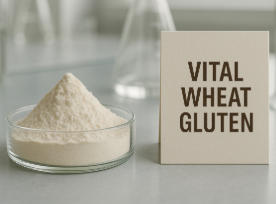
Caloric value (per 100 g, dry powder)

  • About 360–380 kcal; protein 70–82 g (N×5.7), carbohydrates 8–15 g (residual starch), fat 1–3 g, fiber ~1–2 g, sodium low unless salted blends.

Key constituents

  • Storage proteins (gluten): gliadins (confer extensibility) and glutenins (confer elasticity); rich in glutamine/glutamic acid, limited lysine, threonine, methionine.

  • Minor components: residual starch, lipids, minerals (low ash), enzymes (largely inactivated on drying).

  • Moisture (spec): typically ≤8–10%.

Production process

  • Dough making & washing: Wheat flour + water → develop gluten → wash to remove starch/solubles (continuous or batch).

  • Separation: Screens/centrifuges for starch milk; gluten mass is dewatered.

  • Drying: Low-temperature air or belt/fluid-bed drying to retain vital functionality; then milling, sieving, agglomeration if required.

  • Finishing/QC: Protein %, moisture, ash, particle size, microbiology (pathogens absent/25 g), metal detection, packaging (moisture/oxygen barrier).

Sensory and technological properties

  • Hydration & binding: High water absorption (often 1.5–2.0× its weight); improves dough strength, tolerance, and gas retention.

  • Structure building: Enhances loaf volume, chew, and sliceability; in pasta/noodles improves bite and lowers cooking loss.

  • Texturisation: Under high-moisture extrusion creates fibrous structures for meat analogues; in seitan forms an elastic matrix with simple hydration/kneading.

  • Synergies: Blends well with soy/pea proteins and hydrocolloids to tune bite and juiciness.

Food applications

  • Bakery: Pan breads, artisanal breads, rolls, bagels, flatbreads; typical use 1–5% on flour (higher for weak flours).

  • Pasta/noodles: Strengthens durum/soft-wheat formulas; improves firmness and tolerance.

  • Plant-based meats & seitan: Main structuring protein; with spices/oils delivers meaty chew.

  • Snacks & batters: Acts as binder and film former; reduces breakage.

  • Processed meats: In some regions used as binder/water-retainer (check local regulations).

Nutrition and health

  • High-protein ingredient with incomplete amino-acid profile (low lysine)—combine with legumes/seeds to improve EAA balance.

  • Glycaemic impact is low at typical inclusion because starch is reduced.

  • Not suitable for individuals with celiac disease, non-celiac gluten sensitivity, or wheat allergy.

Fat profile

  • Total fat very low. Any residual lipids are traces of PUFA — polyunsaturated fatty acids (potentially beneficial when balanced; more oxidation-prone), MUFA — monounsaturated fatty acids (often neutral/beneficial), and minimal SFA — saturated fatty acids (best kept moderate overall). TFA — trans fatty acids are negligible; MCT — medium-chain triglycerides not significant.

Quality and specifications (typical topics)

  • Protein (N×5.7): commonly ≥75% (vital); premium grades ≥80%.

  • Moisture: ≤8–10%; ash: ≤1.0–1.5%; starch: ≤10–12% (as is).

  • Functionality: Water absorption, extensibility/elasticity tests, gluten index (where applicable), dough stability (Farinograph/Extensograph).

  • Microbiology: Pathogens absent; TAMC/yeasts/moulds within spec; mycotoxins/metals/pesticides compliant.

  • Physicals: Color (light cream), particle size (flowability), bulk density.

Storage and shelf life

  • Store cool, dry, airtight, away from odors; protect from humidity (caking/lumping) and pests.

  • Shelf life: typically 12–24 months unopened; after opening reseal tightly and use promptly.

Allergens and safety

  • Contains wheat and gluten (major allergens).

  • Risk of dust inhalation during handling—apply dust control/PPE.

  • Manage cross-contact under GMP/HACCP; for gluten-free lines, strict segregation is required.

INCI functions in cosmetics (contextual)

  • While vital wheat gluten itself is uncommon in cosmetics, related INCI such as Hydrolyzed Wheat Protein and Wheat Amino Acids are used for film-forming/conditioning; note wheat allergen labeling policies where applicable.

Troubleshooting

  • Tough/over-elastic dough: Reduce gluten dosage, increase hydration, add fat/sugars, or extend rest/autolyse.

  • Weak loaf volume: Increase gluten level or mixing development; verify enzyme activity and yeast levels.

  • Crumbly GF doughs: Combine vital gluten alternatives (if gluten-free is required) with hydrocolloids/proteins; if gluten is allowed, small gluten additions improve cohesion.

  • Seitan too spongy: Lower leavening/steam, add oil/legume protein; knead to develop gluten strands before cooking.

Sustainability and supply chain

  • Source from traceable wheat and mills with efficient water/energy use; valorize starch byproduct streams.

  • Manage effluents toward BOD/COD targets; use recyclable packaging; maintain supplier GAP and full traceability.

Labelling

  • Declare as “vital wheat gluten” or “wheat gluten.”

  • Include allergen statements (contains wheat, gluten); for meat analogs/bakery mixes, state percent use if required by local law.

  • Note country of origin, lot/traceability, and any fortification claims only if applicable.

Conclusion

Vital wheat gluten is a powerful functional protein that strengthens doughs, builds structure, and enables fibrous textures in plant-based systems. Correct hydration, mixing, and dosage—aligned to flour strength and process—deliver consistent volume, chew, and sliceability from bakery to alternative proteins.

Mini-glossary

  • EAA — essential amino acids: Amino acids the body cannot synthesize; wheat gluten is low in lysine, so pair with legumes.

  • PDCAAS/DIAAS — protein quality scores: Indices of digestible amino-acid adequacy; gluten scores lower alone, higher with complements.

  • WHC/WAC — water-holding/absorption capacity: Ability to bind water; governs dough yield and handling.

  • GMP/HACCP — good manufacturing practice / hazard analysis and critical control points: Preventive systems with validated CCPs.

  • BOD/COD — biochemical/chemical oxygen demand: Metrics guiding wastewater treatment impact.

  • PUFA — polyunsaturated fatty acids; MUFA — monounsaturated fatty acids; SFA — saturated fatty acids; TFA — trans fatty acids; MCT — medium-chain triglycerides: Lipid classes present only in trace amounts in vital wheat gluten.

References__________________________________________________________________________

Pycia K, Kaszuba J, Posadzka Z, Juszczak L. Influence of the Addition of Vital Wheat Gluten on Thermal and Rheological Properties of Triticale Flour. Polymers (Basel). 2023 Apr 13;15(8):1870. doi: 10.3390/polym15081870. 

Abstract. The aim of this study was to evaluate the effect of the addition of vital wheat gluten to triticale flour on its thermal and rheological properties. In the tested systems (TG), triticale flour from Belcanto grain was replaced with vital wheat gluten in the amounts of 1%, 2%, 3%, 4% and 5%. Wheat flour (WF) and triticale flour (TF) were also tested. For the tested flours and mixtures with gluten, the falling number, gluten content, as well as the parameters of gelatinization and retrogradation characteristics using differential scanning calorimetry (DSC) and characteristics of pasting using a viscosity analyzer (RVA) were determined. In addition, viscosity curves were plotted, and viscoelastic properties of the obtained gels were also assessed. It was observed that there were no statistically significant differences between the TF and TG samples in terms of falling number. The average value of this parameter in TG samples was 317 s. It was found that the replacement of TF with vital gluten reduced the gelatinization enthalpy and increased the retrogradation enthalpy, as well as the degree of retrogradation. The highest viscosity was characterized by the WF paste (1784 mPa·s) and the lowest by the TG5% mixture (1536 mPa·s). Replacing TF with gluten resulted in a very visible decrease in the apparent viscosity of the systems. In addition, the gels based on the tested flours and TG systems had the character of weak gels (tan δ = G″/G' > 0.1), while the values of the parameters G' and G″ decreased as the share of gluten in the systems increased.

Apper-Bossard E, Feneuil A, Wagner A, Respondek F. Use of vital wheat gluten in aquaculture feeds. Aquat Biosyst. 2013 Nov 16;9(1):21. doi: 10.1186/2046-9063-9-21.

Abstract. In aquaculture, when alternative protein sources of Fish Meal (FM) in diets are investigated, Plant Proteins (PP) can be used. Among them, Vital Wheat Gluten (VWG) is a proteinaceous material obtained from wheat after starch extraction. "It is mainly composed of two types of proteins, gliadins and glutenins, which confer specific visco-elasticity that's to say ability to form a network providing suitable binding. This will lead to specific technological properties that are notably relevant to extruded feeds". Besides these properties, VWG is a high-protein ingredient with an interesting amino-acid profile. Whereas it is rather low in lysine, it contains more sulfur amino acids than other PP sources and it is high in glutamine, which is known to improve gut health and modulate immunity. VWG is a protein source with one of the highest nitrogen digestibility due to a lack of protease inhibitor activity and to the lenient process used to make the product. By this way, addition of VWG in diet does not adversely affect growth performance in many fish species, even at a high level, and may secure high PP level diets that can induce health damages.

Giannou V, Tzia C. Addition of Vital Wheat Gluten to Enhance the Quality Characteristics of Frozen Dough Products. Foods. 2016 Jan 6;5(1):6. doi: 10.3390/foods5010006. 

Abstract. The aim of this study was to enhance the quality and sensory characteristics of bread made from frozen dough. Both white and whole-wheat flour were used. In order to improve dough strength and stability during frozen storage, samples were supplemented with vital wheat gluten at the levels of 2%, 4%, 5%, and 6% of flour weight. The characteristics of baked samples were determined through weight loss, specific volume, crust, and crumb color, texture, and sensory evaluation. Dough behavior at sub-zero temperatures was further examined for control samples and samples with 6% gluten using Differential Scanning Calorimetry (DSC), while their low molecular sugar content (fructose, glucose, sucrose) was measured using High Pressure Liquid Chromatography (HPLC), as it can be associated with yeast viability and dough freezing point depression. The most stable samples were those with 4% and 6% gluten (for white flour) and those with 4% and 5% gluten (for whole-wheat flour). Gluten addition raised the freezing point of dough samples and preserved low molecular sugar generation after prolonged storage.

Luo D, Li X, Geng M, Zhang Y, Lan H, Li J, Qi C, Bai Z, Huang J. Effect of Arabinoxylan from Wastewater Generated during Vital Wheat Gluten Production on Liver Metabolism in Type 2 Diabetic Mice. Foods. 2023 Jul 8;12(14):2640. doi: 10.3390/foods12142640.

Abstract. Arabinoxylan (AX) is a dietary fiber that has been proven to have a significant antidiabetic effect. Liver metabolic disorders frequently coincide with the development of type 2 diabetes, but research on the hepatoprotective effects of AX in type 2 diabetic mice is lacking. As AX is abundant in the wastewater produced during vital wheat gluten protein production, this study used it as a raw material to evaluate its protective effect on liver function. The study employed an AX intervention in type 2 diabetic mice induced by a high-fat diet combined with streptozotocin and collected serum and liver tissue samples after 4 weeks. Serum and liver function indicators were measured using an automatic biochemistry analysis apparatus, and liver fat accumulation was observed using oil red O staining. Nontargeted metabolomics analysis of liver tissues was conducted using UHPLC-MS/MS. The results showed that AX significantly improved liver function indicators and histopathological damage, and regulated liver metabolic disorders by improving the differential metabolites of pantothenate and CoA biosynthesis, as well as purine metabolism. This study demonstrated that AX may exert a significant hepatoprotective effect by regulating metabolic disorders.

Olabarrieta I, Cho SW, Gällstedt M, Sarasua JR, Johansson E, Hedenqvist MS. Aging properties of films of plasticized vital wheat gluten cast from acidic and basic solutions. Biomacromolecules. 2006 May;7(5):1657-64. doi: 10.1021/bm0600973. 

Abstract. In order to understand the mechanisms behind the undesired aging of films based on vital wheat gluten plasticized with glycerol, films cast from water/ethanol solutions were investigated. The effect of pH was studied by casting from solutions at pH 4 and pH 11. The films were aged for 120 days at 50% relative humidity and 23 degrees C, and the tensile properties and oxygen and water vapor permeabilities were measured as a function of aging time. The changes in the protein structure were determined by infrared spectroscopy and size-exclusion and reverse-phase high-performance liquid chromatography, and the film structure was revealed by optical and scanning electron microscopy. The pH 11 film was mechanically more stable with time than the pH 4 film, the latter being initially very ductile but turning brittle toward the end of the aging period. The protein solubility and infrared spectroscopy measurements indicated that the protein structure of the pH 4 film was initially significantly less polymerized/aggregated than that of the pH 11 film. The polymerization of the pH 4 film increased during storage but it did not reach the degree of aggregation of the pH 11 film. Reverse-phase chromatography indicated that the pH 11 films were to some extent deamidated and that this increased with aging. At the same time a large fraction of the aged pH 11 film was unaffected by reducing agents, suggesting that a time-induced isopeptide cross-linking had occurred. This isopeptide formation did not, however, change the overall degree of aggregation and consequently the mechanical properties of the film. During aging, the pH 4 films lost more mass than the pH 11 films mainly due to migration of glycerol but also due to some loss of volatile mass. Scanning electron and optical microscopy showed that the pH 11 film was more uniform in thickness and that the film structure was more homogeneous than that of the pH 4 film. The oxygen permeability was also lower for the pH 11 film. The fact that the pH 4 film experienced a larger and more rapid change in its mechanical properties with time than the pH 11 film, as a consequence of a greater loss of plasticizer, was presumably due to its initial lower degree of protein aggregation/polymerization. Consequently, the cross-link density achieved at pH 4 was too low to effectively retain volatiles and glycerol within the matrix.

Taghvaei M, Smith B, Yazar G, Bean S, Tilley M, Ioerger B. Identification of gluten-like proteins in selected pod bearing leguminous tree seeds. PLoS One. 2021 Apr 5;16(4):e0249427. doi: 10.1371/journal.pone.0249427.

Abstract. The protein composition, molecular weight distribution, and rheological properties of honey locust, mesquite, Kentucky coffee tree, and carob seed germs were compared against wheat gluten. Polymeric and Osborne fractionation protocols were used to assess biochemical properties. Dynamic oscillatory shear tests were performed to evaluate protein functionality. All samples had similar ratios of protein fractions as well as high molecular weight disulfide linked proteins except for the Kentucky coffee tree germ proteins, which were found to have lower molecular weight proteins with little disulfide polymerization. Samples were rich in acidic and polar amino acids (glutamic acid and arginine,). Rheological analyses showed that vital wheat gluten had the most stable network, while Kentucky coffee seed proteins had the weakest. High molecular weight disulfide linked glutenous proteins are a common, but not universal feature of pod bearing leguminous trees.


Evaluate