



Modified vegetable gum
Description
Umbrella term for plant- or seaweed-derived hydrocolloids that have been physically and/or chemically modified to tune hydration, viscosity, gelation, freeze–thaw stability, acid/salt tolerance, and processing robustness.
Common bases: guar (galactomannan), locust bean/carob (galactomannan), pectin (fruit cell walls), alginate (brown seaweeds), carrageenan (red seaweeds), gum arabic (acacia); occasionally cellulose gum (CMC) is grouped with “vegetable gums” on labels.
Typical modifications: hydroxypropylation, carboxymethylation, amidation (pectin), propylene-glycol esterification (alginate), controlled depolymerisation/oxidation, enzyme tailoring, pregelatinisation/instantisation (physical), and blends.
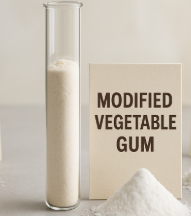
Caloric value (per 100 g; dry powder)
About 180–240 kcal (mostly non-digestible soluble fiber); fat/protein ≤1 g; sodium low unless present as a salt (e.g., sodium alginate).
Use levels: typically 0.05–1% in beverages and sauces, 0.2–2% in dressings, dairy/plant-based, fillings, and gels.
Key constituents
Polysaccharides (e.g., galactomannans, pectins, alginates, carrageenans, arabinogalactans) with process-specific substituents/cross-links that reshape rheology (shear-thinning, thixotropy) and gel interaction (often ion-responsive, e.g., Ca²⁺ for alginate, K⁺ for κ-carrageenan).
Functional metrics: molecular weight, degree of substitution (DS)/molar substitution (MS), ash/ion profile, particle size, moisture.
Production process
Extraction/purification: water extraction from seed/peel/seaweed, filtration, precipitation (alcohol/acid) or membrane steps, then drying (spray/drum/air) and milling.
Modification:
Chemical (food-grade): hydroxypropylation, carboxymethylation, amidation (pectin), propylene-glycol esterification (for propylene glycol alginate), mild oxidation/acid hydrolysis to adjust MW.
Physical/enzymatic: pregel/instant, enzyme trimming, co-processing with sugars/fibers.
Finishing: standardisation to target viscosity/gel strength, sieving, metal detection, barrier packaging.
QC focus: moisture/aw, pH/ash, Brookfield/rotational viscosity, gel strength/elasticity (G′/G″) where relevant, DS/MS, ion content, microbiology (pathogens absent/25 g), metals/pesticides within limits.
Sensory and technological properties
Neutral to mild taste, low flavour masking (varies by gum).
Rheology design: from thin, high-shear stable fluids to short/creamy spoonables or elastic gels; many systems are shear-thinning and thixotropic (good pumpability, stand-up body).
Process tolerance: modifications improve acid/salt/heat/shear resistance; freeze–thaw stability enhanced by substitution and blends.
Synergies: classic pairs (locust bean + κ-carrageenan, LBG + xanthan, pectin + Ca²⁺) allow texture tuning at lower dosages.
Food applications
Beverages: suspension (pulp/spice), mouthfeel, cloud stability.
Dairy/plant-based: viscosity, creaminess, serum control in yogurt/spoonables, RTD.
Sauces/dressings: emulsion stabilisation, pour control, cling.
Bakery & gluten-free: water binding, crumb softness, staling delay.
Confectionery/gels: gel setting (alginate/pectin/carrageenan), shine and bite control.
Frozen desserts: ice-crystal control, melt-resistance (with blends).
Meat/plant analogues: bind, juiciness, sliceability; brines/injections for yield.
Nutrition and health
Low energy impact at use levels; contribute soluble fiber that can aid texture and satiety.
Large bolus intakes may cause GI discomfort in sensitive individuals; typical food levels are well tolerated.
Sodium mainly from ionic forms (e.g., sodium alginate) but low per serving.
Fat profile
Total fat negligible; therefore PUFA — polyunsaturated fatty acids, MUFA — monounsaturated fatty acids, and SFA — saturated fatty acids are nutritionally insignificant here. TFA — trans fatty acids absent; MCT — medium-chain triglycerides not relevant.
Quality and specifications (typical topics)
Identity/purity: moisture (often ≤12–13%), ash, pH, colour, particle size, foreign-matter free.
Functionality: viscosity at stated %, shear rate and temperature; gel strength/set time where applicable; syneresis/freeze–thaw tests; clarity/turbidity.
Chemistry: DS/MS, ion profile (Na⁺/K⁺/Ca²⁺/Mg²⁺), sulphate content for carrageenans, degree of amidation for pectin.
Micro/safety: pathogens absent, yeasts/moulds low; metals, pesticides compliant.
Storage and shelf life
Store cool, dry, airtight, away from odours/light; protect from humidity (caking, hydration loss).
Shelf life: typically 24–36 months unopened; reseal and use promptly after opening.
Allergens and safety
Vegan/vegetarian and gluten-free by nature; low intrinsic allergenicity.
Manage cross-contact in mixed facilities under GMP/HACCP; some gels are ion-sensitive—validate process pH/salt.
High-dose laxation/bloating possible in sensitive individuals; formulate within guideline levels.
INCI functions in cosmetics (when applicable)
Typical INCI names: Hydroxypropyl Guar, Sodium Alginate, Propylene Glycol Alginate, Pectin, Amidated Pectin, Cellulose Gum.
Roles: viscosity-increasing, film-forming, stabilising, emulsion stabiliser, skin-conditioning (light), anti-caking/absorbent in powders.
Troubleshooting
Lumping (“fish-eyes”) on addition: pre-mix with sugar/oil, dry blend with other powders, or use instantised grades; ensure vigorous vortex.
Phase separation/thin body: increase dosage, choose higher DS/cross-linked grade, or add synergist gum.
Acid/salt cooking breakdown: select acid-stable or amidated types; adjust ion profile (e.g., K⁺/Ca²⁺ for gelation).
Grainy gels/syneresis: reduce ions, adjust pH, cooling rate, or switch gum system/blend ratio.
Air entrapment/foam: de-aerate (vacuum, inline), lower shear, or include antifoam where permitted.
Sustainability and supply chain
Prefer traceable sourcing (e.g., responsibly harvested seaweeds, certified guar), support smallholders, and ensure ecosystem stewardship.
Processing effluents (rich in organics/salts) should meet BOD/COD targets; optimise water/energy and choose recyclable packaging.
Labelling
Declarations vary by market: “modified vegetable gum (thickener/stabiliser)”, or specific names/codes (e.g., guar gum, amidated pectin (E440ii), propylene glycol alginate (E405), sodium alginate (E401), CMC (E466)).
Some jurisdictions require the specific additive name or number rather than the generic phrase “modified vegetable gum.”
Conclusion
Modified vegetable gum offers a versatile, clean-tasting toolkit to build body, stability, and gel structure across beverages, sauces, dairy/plant-based, confectionery, frozen desserts, bakery, and savoury systems. By matching the base gum, modification chemistry, ion/pH environment, and process conditions, developers achieve consistent viscosity, controlled gelation, and shelf-stable textures at low dosages.
Mini-glossary
DS/MS — degree/molar substitution: Average functional groups per sugar unit; governs solubility, stability, gelation.
Shear-thinning: Viscosity decreases as shear rate increases; improves pumpability and coating.
Thixotropy: Time-dependent recovery of viscosity after shear; useful for stand-up sauces.
G′/G″ — storage/loss moduli: Elastic vs viscous response; higher G′ indicates more solid-like gels.
Syneresis: Water release from gels over time; reduced by appropriate gum choice, DS, and blends.
GMP/HACCP — good manufacturing practice / hazard analysis and critical control points: Preventive systems with validated CCPs.
BOD/COD — biochemical/chemical oxygen demand: Effluent metrics guiding wastewater treatment.
aw — water activity: Governs micro stability and caking in powders and finished foods.

