Cumino (Cuminum cyminum, famiglia Apiaceae)
Descrizione
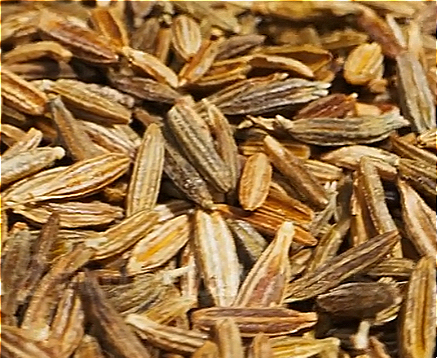
Spezia ottenuta dai semi essiccati dell’ombrellifera Cuminum cyminum; disponibili interi o macinati.
Profilo sensoriale: aroma caldo, terroso, lievemente nocciolato con note verdi e pepate; amaro delicato sul finire.
Origine e coltivazione: tradizionale di Asia meridionale e Mediterraneo; principali produttori moderni India, Medio Oriente e Nord Africa.
Valore calorico (per 100 g di spezia secca)
~370–400 kcal; carboidrati 40–50 g (di cui fibre 10–12 g), proteine 17–19 g, grassi 20–23 g, sodio basso (salvo miscele salate).
Porzione tipica (1 cucchiaino, ~2 g): 7–8 kcal.
Principali sostanze contenute
Olio essenziale (~2–5% sul secco): cuminaldeide (aldeide aromatica caratteristica), p-cimene, γ-terpinene, β-pinene, tracce di fenoli e esteri.
Olio fisso (lipidi non volatili): prevalenza di acidi grassi linoleico (n-6), oleico e palmitico.
Polifenoli e flavonoidi (es. apigenina, luteolina), saponine, tannini; minerali: ferro, manganese, magnesio, potassio; vitamine del gruppo B in tracce.
Processo di produzione
Raccolta e post-raccolta: taglio delle ombrelle mature, essiccazione all’aria o in essiccatoi, trebbiatura.
Pulizia e selezione: setacciatura, aspirazione, selezione ottica per rimuovere impurità/semi estranei.
Toasting (opzionale): tostatura leggera per amplificare le note nocciolate.
Macinazione: criogenica o a perni con controllo della temperatura (protezione dell’olio essenziale); setacciatura alla granulometria richiesta.
Decontaminazione (ove necessario): vapore saturo, ossido di etilene o trattamenti alternativi conformi; confezionamento barriera (sacchi multistrato, atmosfera inerte).
Controlli qualità: umidità/aw, carica microbica (Salmonella assente/25 g), olio essenziale (resa e cuminaldeide), metalli pesanti, micotossine, residui di pesticidi, corpi estranei.
Proprietà sensoriali e tecnologiche
Aromatica termostabile relativa: le note di base resistono; le note di testa si attenuano con cotture prolungate → utile una dose di rifinitura a fine cottura.
Solubilità parziale nei grassi: l’olio o il temper in ghee/olio (“blooming”) estrae i composti volatili e li distribuisce nella matrice.
Attività antiossidante/antimicrobica: contributo coadiuvante alla stabilità in miscele speziate e insaccati (dose-dipendente).
Impieghi alimentari
Cucine tradizionali: indiana (tadka, garam masala), mediorientale (baharat, za’atar varianti), messicana/tex-mex (taco/chili), mediterranea (legumi, verdure).
Applicazioni tipiche: tempering in olio, rub a secco, marinate, salse e curry, insaccati, snack salati, pane/piadine speziate, burger plant-based (come top note calda).
Abbinamenti: corindolo, paprika/peperoncino, aglio, cipolla, cumino nero (Nigella), semi di finocchio, limone/aceti.
Nutrizione e salute
Porzioni d’uso ridotte → impatto calorico minimo; apporta fibre, minerali (spec. ferro) e fitocomposti aromatici.
Digestione: tradizionalmente impiegato come carminativo; tollerabilità buona nelle quantità culinarie.
Sodio intrinsecamente basso; attenzione solo a mix con sale.
Profilo dei grassi
Tenore lipidico moderato nella spezia tal quale (ma bassa assunzione in porzione). La frazione lipidica contiene prevalentemente PUFA — grassi polinsaturi (soprattutto linoleico n-6: potenzialmente benefici se bilanciati, più suscettibili a ossidazione), MUFA — grassi monoinsaturi (es. oleico n-9: spesso neutri/favorevoli) e quota minore di SFA — grassi saturi (es. palmitico; da moderare nel quadro dietetico complessivo). TFA — acidi grassi trans trascurabili; MCT — trigliceridi a media catena non significativi.
Qualità e specifiche (temi tipici)
Umidità ≤ 10–12%, aw bassa (≈0,6), olio essenziale e cuminaldeide in range specifica; ceneri, granulometria, assenza di corpi estranei.
Microbiologia: patogeni assenti/25 g; piani di sanificazione con CCP definiti.
Contaminanti/adulterazioni: controllo micotossine (es. ocratossina A), metalli, pesticidi; sorvegliare adulterazioni (semi affini, coloranti non conformi).
Packaging: barriera a luce/ossigeno/umidità; eventuale flushing con azoto.
Conservazione e shelf-life
Conservare al buio, fresco e asciutto, in contenitori ermetici; evitare calore/luce.
Shelf-life: 12–24 mesi chiuso; dopo apertura usare rapidamente per preservare l’aroma.
Allergeni e sicurezza
In UE il cumino non è un allergene maggiore; possibili ipersensibilità a Apiaceae (es. sedano, carota, finocchio) per cross-reattività.
Olio essenziale: a uso aromatico/cosmetico può essere sensibilizzante (aldeidi); attenersi a limiti IFRA e a test di stabilità/sicurezza.
Attenzione a cross-contamination con glutine/sesamo/senape in impianti misti.
Funzioni INCI in cosmesi
INCI possibili: Cuminum Cyminum Seed Oil, Cuminum Cyminum Seed Extract, Cuminum Cyminum Fruit Oil.
Ruoli: fragrance, masking, antioxidant leggero, skin conditioning in prodotti leave-on/rinse-off (uso conservativo secondo IFRA).
Troubleshooting
Aroma piatto dopo cottura lunga: aggiungere una spolverata finale o usare parte del cumino tostato a secco.
Note “verdi” eccessive: passare i semi in tostatura leggera prima della macinazione/uso.
Perdita di aroma in stoccaggio: migliorare barriera del pack, ridurre ossigeno (sacchetti a bassa OTR/scavenger O₂).
Residui sabbiosi/impurezze: richiedere selezione ottica e analisi filth al fornitore.
Sostenibilità e filiera
Coltura annuale a basso input relativa; preferire fornitori con tracciabilità e pratiche GAP.
In stabilimento: gestione reflui verso target BOD/COD, riduzione polveri, energia per essiccazione; operare sotto GMP/HACCP; pack riciclabile.
Etichettatura
Denominazioni: “cumino in semi”, “cumino macinato”; per miscele indicare ingredienti e eventuali allergeni.
Facoltativi claim: “senza sale aggiunto”, “da fonti naturali” (aroma/colore) se conformi.
Conclusione
Il cumino è una spezie cardine con firma aromatica calda e terrosa, capace di strutturare profili sensoriali in numerose cucine. La tostatura mirata, il blooming in grassi, la granulometria e il pack barriera sono decisivi per massimizzare intensità, persistenza e stabilità dell’aroma.
Mini-glossario
PUFA — grassi polinsaturi: es. linoleico (n-6); potenzialmente benefici se bilanciati, più sensibili all’ossidazione.
MUFA — grassi monoinsaturi: es. oleico (n-9); spesso neutri/favorevoli per il profilo lipidico.
SFA — grassi saturi: da moderare nel complesso della dieta; quota minore nel cumino.
TFA — acidi grassi trans: trascurabili nelle spezie non idrogenate.
MCT — trigliceridi a media catena: non significativi nel cumino.
GMP/HACCP — good manufacturing practice / hazard analysis and critical control points: sistemi preventivi con punti critici controllati per qualità/sicurezza.
BOD/COD — domanda biochimica/chimica di ossigeno: indicatori dell’impatto dei reflui e dell’efficienza di trattamento.
Bibliografia__________________________________________________________________________
Drugs and Lactation Database (LactMed®) [Internet]. Bethesda (MD): National Institute of Child Health and Human Development; 2006–. Cumin. 2025 Jun 15.
Abstract. Cumin (Cuminum cyminum) seed contains a volatile oil that contains cuminaldehyde and other aldehydes; the seeds also contain numerous flavonoids and terpenes. Cumin has been used as a galactogogue in India and Türkiye with some literature support, including as part of an herbal mixture.[1–5] Galactogogues should never replace evaluation and counseling on modifiable factors that affect milk production.[6,7] No data exist on the excretion of any components of cumin into breastmilk or on the safety and efficacy of cumin in nursing mothers or infants. Cumin is “generally recognized as safe” (GRAS) as a spice and flavoring by the U.S. Food and Drug Administration. Cumin is generally well tolerated, but occasional phototoxic skin reactions have been reported after contact with the oil. Those allergic to cumin or related herbs should avoid cumin. Dietary supplements do not require extensive pre-marketing approval from the U.S. Food and Drug Administration. Manufacturers are responsible to ensure the safety, but do not need to prove the safety and effectiveness of dietary supplements before they are marketed. Dietary supplements may contain multiple ingredients, and differences are often found between labeled and actual ingredients or their amounts. A manufacturer may contract with an independent organization to verify the quality of a product or its ingredients, but that does not certify the safety or effectiveness of a product. Because of the above issues, clinical testing results on one product may not be applicable to other products. More detailed information about dietary supplements is available elsewhere on the LactMed Web site.
Yabalak E, Ibrahim F, Erdoğan Eliuz EA. Natural sanitizer potential of Cuminum cyminum and applicable approach for calculation of Kováts retention index of its compounds. Int J Environ Health Res. 2023 Feb;33(2):158-169. doi: 10.1080/09603123.2021.2011159.
Abstract. The demand for natural agents instead of chemicals in terms of food and health safety is increasing day by day. This study aimed to investigate the potential of the methanolic extract of Cuminum cyminum (C. cyminum) in the fight against Escherichia coli (E. coli), Staphylococcus aureus (S. aureus)and Candida (C. albicans). The chemical composition of the methanolic extract of C. cyminum was analyzed using GS-MS. Also, Kováts retention indices were calculated for the detected compounds using an applicable formula. The most basic substance was cuminic aldehyde (27.86%) and p-(Dimethoxymethyl)-isopropylbenze (18.32%). The Minimum Inhibitory Concentration (MIC) of the extract was 0.1 g/mL for S. aureus and C. albicans while it was > 0.1 for E. coli. Although the methanol extract of C. cyminum acts against all three microorganisms, the most lasting effect was on S. aureus, indicating that it can be recommended as a strong antibacterial disinfectant for S. aureus.
Sowbhagya HB. Chemistry, technology, and nutraceutical functions of cumin (Cuminum cyminum L): an overview. Crit Rev Food Sci Nutr. 2013;53(1):1-10. doi: 10.1080/10408398.2010.500223.
Abstract. Cumin is a seed spice belonging to the family umbelliferae. Cumin and value added products from cumin are used in food flavoring and perfumery. Cumin contains volatile oil (3-4%), cuminaldehyde, the major active principle, which is present to an extent of 45-50%. Cumin and value added products from cumin, viz., cumin oil and oleoresin are exported. Cumin powder forms the main component of many spice mixes and curry powders. Cuminaldehyde is an important phytochemical and possesses many health benefits. Alcohol and water extract of cumin are reported to possess many nutraceutical properties like antiallergic, antioxidant, anti-platelet aggregation, and hypoglycemic. Cumin and value added products from cumin can be a good source of nutraceuticals with many biological activities. Incorporation of cumin into food products will have the benefits of a flavorant and nutraceutical at the same time. In the present review, the chemistry, processing, and biological activities of cumin and its components are discussed.
Ishida M, Miyagawa F, Nishi K, Sugahara T. Aqueous Extract from Cuminum cyminum L. Seed Alleviates Ovalbumin-Induced Allergic Rhinitis in Mouse via Balancing of Helper T Cells. Foods. 2022 Oct 15;11(20):3224. doi: 10.3390/foods11203224.
Abstract. Cuminum cyminum L. (cumin) seeds are widely used as a spice. Although we previously reported that the aqueous extract of cumin seeds suppresses the degranulation of rat basophilic RBL-2H3 cells, it has not been clarified whether the extract alleviates actual allergy symptoms in vivo. Therefore, in this study, we investigated the effect of oral administration of cumin seed aqueous extract (CAE) in ovalbumin (OVA)-induced allergic rhinitis. BALB/c mice were randomly divided into the following three groups: control group (five mice), OVA group (five mice), and OVA + CAE group (five mice). Allergic rhinitis was induced by sensitization (intraperitoneal, 25 μg OVA and 1.98 mg aluminum hydroxide gel) followed by challenge (intranasal, 400 μg OVA). The oral administration of CAE (25 mg/kg) reduced the sneezing frequency of OVA-induced allergic rhinitis model mice. In addition to reducing the serum immunoglobulin E and IL-4 levels, the oral administration of CAE reduced the production of T-helper type-2 (Th2) cytokines (IL-4, IL-5, IL-10, and IL-13) in the splenocytes of the model mice. Furthermore, a significant increase in the ratio of Th1 to Th2 cells was observed in the CAE-administered group. Our findings suggest that the ingestion of CAE improves T cell balance, the dominant state of Th2, and alleviates allergic rhinitis symptoms.
Koppula S, Choi DK. Cuminum cyminum extract attenuates scopolamine-induced memory loss and stress-induced urinary biochemical changes in rats: a noninvasive biochemical approach. Pharm Biol. 2011 Jul;49(7):702-8. doi: 10.3109/13880209.2010.541923.
Abstract. Context: Cuminum cyminum Linn. (Apiaceae), cumin, is a popular spice with a long history of medicinal use to treat various symptoms such as diarrhea, flatulence, gynecological, and respiratory diseases. Objective: To date, no scientific investigation was reported regarding memory-enhancing and antistress activity of cumin fruits. The present study deals with the memory-enhancing and antistress activities and further the antioxidant status via lipid peroxidation inhibition. Materials and methods: Antistress activity was evaluated by inducing stress via forced swimming and the urinary vanillylmandelic acid (VMA) and ascorbic acid were estimated as biomarkers. Memory-enhancing activity was studied by conditioned avoidance response using Cook's pole climbing apparatus in normal and scopolamine-induced amnestic rats. Thiobarbituric acid reactive substances (TBARS) assay was used to evaluate the lipid peroxidation. Results: Daily administration of cumin at doses of 100, 200, and 300 mg/kg body weight 1 h prior to induction of stress inhibited the stress-induced urinary biochemical changes in a dose-dependent manner without altering the levels in normal control groups. The cognition, as determined by the acquisition, retention, and recovery in rats, was observed to be dose-dependent. The extract also produced significant lipid peroxidation inhibition in comparison with known antioxidant ascorbic acid in both rat liver and brain. Discussion and conclusion: This study provides scientific support for the antistress, antioxidant, and memory-enhancing activities of cumin extract and substantiates that its traditional use as a culinary spice in foods is beneficial and scientific in combating stress and related disorders.




