



Sodium phosphates (mono-, hexameta-, and tripoly-; E339/E452)
Description
Family of food-grade sodium salts of phosphoric acid spanning orthophosphates and condensed phosphates:
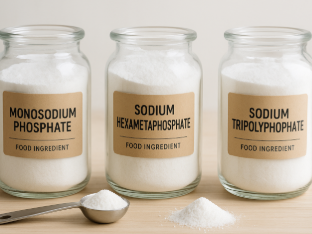
Monosodium phosphate (MSP; sodium dihydrogen phosphate, NaH₂PO₄) → primarily a buffer/acid regulator.
Sodium hexametaphosphate (SHMP; (NaPO₃)ₙ) → linear polyphosphate, strong sequestrant/chelant (Ca²⁺/Mg²⁺).
Sodium tripolyphosphate (STPP; Na₅P₃O₁₀) → water-binding, protein-function enhancer, sequestrant.
Primary functions: pH control (buffering), ion sequestration, water retention/yield, texture and protein extraction, emulsifying salt (processed cheese), and process stability in thermal foods and beverages.
Caloric value & contribution (in finished foods)
Energy: negligible at typical use levels.
Mineral contribution: phosphorus and sodium; formulation should consider overall Na targets.
Key constituents & markers
MSP (orthophosphate), STPP (triphosphate), SHMP (average chain length specified).
Typical specifications: assay (often as % P₂O₅), pH of solution, insolubles, loss on drying, fluoride/heavy metals within limits, orthophosphate content in polyphosphates.
Production process
Neutralisation of food-grade phosphoric acid with sodium hydroxide/carbonate → MSP; filtration, drying, milling.
Controlled thermal condensation of orthophosphates → STPP and SHMP; screening, anti-caking as needed; moisture-barrier packaging.
QC: identity, assay (P₂O₅), sequestration index, particle size/flow, micro (low counts), residual metals/fluoride.
Sensory and technological properties
Buffering (MSP): stabilises pH in meat, dairy, beverages, protecting protein functionality.
Sequestration (SHMP/STPP): binds Ca²⁺/Mg²⁺/Fe³⁺ → improved heat stability, clarity, reduced scale/haze.
Water-binding & protein extraction (STPP): increases ionic strength, solubilises myofibrillar proteins → higher cook yield, juiciness, better sliceability.
Emulsifying salt (STPP/SHMP/TSPP blends): disperses casein in processed cheese; tunes melt/stretch.
Dough/ batter effects: tailors viscosity, gluten network, and gas release when paired with bicarbonate (note: MSP is mildly acidic; many leavening systems rely on SAPP/MCP, not covered here).
Food applications & typical use levels (always follow local regulations)
Meat/poultry/seafood brines & marinades (STPP ± SHMP): finished-product ~0.2–0.5% STPP equivalent for yield, purge reduction, tenderness.
Processed cheese (STPP/SHMP blends): 0.5–3% of cheese mix as emulsifying salts (product-specific).
Evaporated/UHT dairy, coffee whiteners (SHMP/MSP): chelating/buffering for heat stability.
Beverages/syrups (SHMP/MSP): clarity, anti-scale, pH set.
Canned/retorted foods: colour/texture protection via chelation; pH buffering.
Nutrition and health
Phosphorus is essential (bone/teeth, ATP, phospholipids).
Manage total phosphorus and sodium exposure, especially for renal impairment or low-sodium diets; keep Ca:P balance in mind.
Align with use limits and any applicable ADI guidance.
Quality and specifications (typical topics)
Assay (as salt or % P₂O₅), pH, insolubles, LOD, fluoride/heavy metals; for SHMP: average chain length and orthophosphate fraction.
Functional tests: sequestration index, buffer capacity, emulsifying performance (cheese model), reactivity and particle size (for targeted dissolution).
Storage and shelf life
Store cool, dry, sealed; many grades are hygroscopic and can cake on moisture uptake.
Keep away from strong acids/oxidisers. Typical shelf life 12–36 months depending on grade/pack.
Allergens and safety
Not major allergens; mineral salts with negligible calories.
Consider sodium load and phosphorus contribution in labelling and nutrition design.
INCI functions in cosmetics (extra-food)
INCI examples: Sodium Phosphate, Disodium/Trisodium Phosphate, Sodium Tripolyphosphate, Sodium Polyphosphate/Hexametaphosphate.
Roles: buffering, chelating, viscosity control, emulsion stabilising.
Troubleshooting
Soapy/metallic notes or aftertaste: potential overdose or too-reactive grade → reduce level or change grade/particle size.
Grainy processed cheese/poor melt: calcium balance off or emulsifying-salt ratio suboptimal → adjust STPP/SHMP/TSPP blend.
Grey meat colour/excess purge: pH/ionic strength not optimised or insufficient mixing/tumble → tune phosphate + salt system and process.
Haze/scale in beverages: insufficient sequestration → increase SHMP or switch to more soluble K-phosphates if sodium is constrained.
Sustainability and supply chain
Originates from phosphate rock → purified phosphoric acid; monitor impurities (e.g., fluoride, metals) via refining.
Manage plant effluents to limit nutrient discharge; target BOD/COD compliance and nutrient removal where required.
Operate under GMP/HACCP with traceability; use dust-controlled, recyclable packaging.
Labelling
Declare by specific salt name (e.g., sodium tripolyphosphate, sodium hexametaphosphate, monosodium phosphate) and/or E-number (E339 orthophosphates, E452 polyphosphates).
Indicate function (e.g., acidity regulator, stabiliser, emulsifying salt).
Conclusion
Sodium phosphates—MSP, SHMP, and STPP—are workhorse functional ingredients that provide precise pH control, strong chelation, and robust water-binding/protein functionality, enabling stable texture, clean flavour, and process tolerance across meat, dairy/cheese, beverage, and thermal-processed foods. Careful grade selection, dosage, and ion balance ensure regulatory compliance and sensory quality.
Mini-glossary
MSP — Monosodium phosphate: orthophosphate; buffer/acid regulator.
STPP — Sodium tripolyphosphate: triphosphate; water-binding, protein extraction, sequestrant.
SHMP — Sodium hexametaphosphate: polyphosphate; strong chelant, anti-scale, clarifier.
P₂O₅ — Conventional expression of phosphate content in specifications.
ADI — Acceptable daily intake: regulatory exposure benchmark for additives.
GMP/HACCP — Good manufacturing practice / hazard analysis and critical control points: preventive hygiene/quality systems with validated CCPs.
BOD/COD — Biochemical/chemical oxygen demand: wastewater impact indicators tied to treatment performance.

