



Prepared beans (Ready-to-eat, canned/jarred/pouched)
Description
Cooked legumes (e.g., white, kidney, pinto, chickpeas) packed plain in brine, in sauce (e.g., baked beans), or as refried beans/purees; shelf-stable by retort sterilisation or sold chilled/pasteurised.
Sensory profile: mild to earthy–nutty flavour; creamy to soft-firm texture depending on variety, calcium firming, and cook.
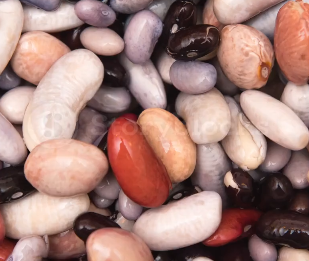
Caloric value (per 100 g)
Plain beans in brine (drained): ~90–150 kcal, protein 6–9 g, carbohydrates 14–24 g (of which fiber 4–8 g), fat 0.3–2 g.
Baked beans in tomato sauce: typically ~80–110 kcal; sugars higher from sauce.
Refried beans/purees: ~110–180 kcal depending on added fats (oil/lard) and dry solids.
Sodium: low in no-salt options; variable in brine/sauced products (rinsing lowers Na in plain beans).
Key constituents
Complex carbohydrates (starch, incl. RS3 after cooling), dietary fiber (soluble/insoluble), proteins 18–24% d.b. (sulfur AAs limiting → complement with cereals).
Phytochemicals: polyphenols, phytates, saponins; minerals (K, Mg, Fe, P) and B-vitamins (e.g., folate, thiamin).
Lipids: low overall; predominantly PUFA and MUFA with minimal SFA.
Production process
Raw material prep: cleaning, grading, soaking (or quick-soak), optional blanching.
Cooking: boiling or pressure cooking to target texture; addition of brine and optional CaCl₂ (firming).
Filling & closing: into cans, glass jars, or retort pouches; vacuum/steam-flow for headspace control.
Thermal processing: retort sterilisation to commercial sterility (ambient shelf-stable) or pasteurisation for chilled lines.
Quality controls: drained weight, pH (brine vs sauce), salt/°Bé, texture (TPA/Instron), colour, seam integrity/vacuum, microbiology (post-process), residues (metals/pesticides).
Sensory and technological properties
Body/viscosity: starch and soluble fiber add thickness to broths and sauces.
Purée-ability: high—ideal for soups, spreads, and refried styles.
Texture tuning: via cook time, calcium level, bean variety, and cooling (↑ RS3 gives a firmer set).
Colour: seed-coat pigments may bleed into the medium (expected).
Food applications
Ready-to-eat sides, chili & stews, salads, rice & beans, burritos/tacos, baked beans, soups, purees/refried beans.
Formulation ingredient in ready meals, plant-based fillings, extruded snacks (from bean flours/pastes).
Nutrition and health
Source of plant protein, fiber, and folate; GI typically low–medium, further reduced by cooling (↑ RS) and pairing with fat/protein.
Other components: Salicylic acid (1), iron and zinc (2), The flavonol glycosides phenolic compounds found in common beans possess antimicrobial, anti-inflammatory and ultraviolet radiation (UVR) protective properties (3),
High fiber supports satiety and regularity; glycaemic impact generally low–moderate, further tempered by cooling (↑ RS3) and combining with fat/protein.
Antinutrients (phytates, lectins) are substantially reduced by proper cooking/retorting, improving mineral bioavailability.
FODMAP: oligosaccharides may cause bloating in sensitive individuals; rinsing plain canned beans and gradual intake help.
Fat profile
Low total fat; residual lipids mainly PUFA — polyunsaturated fatty acids (e.g., linoleic n-6) and MUFA — monounsaturated fatty acids (e.g., oleic n-9), with minimal SFA — saturated fatty acids. TFA — trans fatty acids negligible; MCT — medium-chain triglycerides not significant.
Quality and specifications (typical topics)
Drained weight (meets spec), texture (few split/burst seeds), uniformity and defect count, sodium declared; pH and Brix for sauces.
Microbiology: commercial sterility for retorted goods; pathogens absent/25 g.
Packaging integrity: double seam specs (cans), vacuum/closure torque (jars), seal strength (pouches).
Can/jar linings: modern BPA-NI coatings commonly used; monitor for sensory neutrality.
Storage and shelf life
Ambient shelf-stable (retorted): typically 18–36 months unopened; once opened refrigerate ≤4 °C and consume in 2–3 days.
Chilled/pasteurised: 0–4 °C, shelf life days–weeks per label.
Allergens and safety
Naturally gluten-free; manage cross-contact in mixed facilities.
Not major allergens in the EU, but legume cross-reactivity (e.g., soy/peanut) can occur.
Lectin (PHA) risk pertains to undercooked raw red kidney beans; properly retorted beans are safe.
Troubleshooting
Hard/tough beans (HTC): raw stock too old/hard-to-cook → extend soak/cook, use pressure, and ensure adequate calcium balance.
Burst skins/mushiness: overcook, alkaline brines, or thermal shocks → gentler cook, adjust salt/calcium, manage cooling.
Metallic/“can” notes: check lining integrity, retort chemistry, and storage (avoid heat).
Excess sodium/sweetness: choose reduced-salt/sugar variants or rinse plain beans; adjust sauce acidity and Brix.
Sustainability and supply chain
Nitrogen-fixing crops with lower GHG footprint than animal proteins; encourage crop rotations and water/energy efficiency in soak/cook steps.
Packaging: steel cans and glass are highly recyclable; manage processing effluents toward BOD/COD targets; full traceability under GMP/HACCP.
Labelling
Declare bean variety where relevant (e.g., chickpeas, kidney beans), drained weight, ingredients (e.g., beans, water, salt, calcium chloride; sauce components), and nutrition facts.
Claims like “source/high in fiber” or “low sodium” only when regulatory thresholds are met.
Conclusion
Prepared beans provide convenience, nutrient density (fiber, plant protein, micronutrients), and culinary versatility. Thoughtful control of raw material, cook/retort, calcium/salt, and packaging integrity ensures safe, tasty, consistent products with a long shelf life.
Mini-glossary
GI — Glycaemic index: Blood-glucose response; lowered by fiber, fat, and cooling (↑ RS3).
RS3 — Retrograded resistant starch: Less digestible starch formed upon cooling; helps blunt glucose spikes.
FODMAP — Fermentable oligo-, di-, mono-saccharides and polyols: Fermentable carbs that may cause bloating; rinsing/gradual intake can help.
SFA — Saturated fatty acids: Low share in beans; keep moderated in overall diet.
MUFA — Monounsaturated fatty acids: Often neutral/beneficial (e.g., oleic n-9).
PUFA — Polyunsaturated fatty acids: Potentially beneficial when balanced; more oxidation-prone.
TFA — Trans fatty acids: Negligible in non-hydrogenated bean products.
MCT — Medium-chain triglycerides: Not significant in legumes.
GMP/HACCP — Good manufacturing practice / hazard analysis and critical control points: Preventive hygiene systems with validated CCPs.
BOD/COD — Biochemical/chemical oxygen demand: Indicators of wastewater impact from processing.

