



Pink beans (Phaseolus vulgaris)
Description
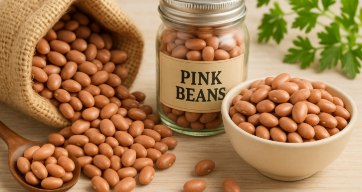
Dried legume seeds with a light pink seed coat, sometimes mottled with faint rosy-brown streaks; on cooking they turn uniform pink and become creamy.
Sensory profile: sweet–earthy, lightly nutty; creamy flesh with medium-to-good shape retention (great for purées/refried beans and stews).
Cultivation and growing conditions
Climate:
Prefers warm, temperate climates.
Sensitive to cold: damaged by late frosts and low temperatures at germination.
Typically grown as a spring–summer crop, once the soil has warmed adequately.
Exposure:
Requires full sun for good vegetative growth, flowering and pod set.
Soil:
Thrives in medium-textured, well-drained, deep soils with good organic matter.
Prefers slightly acidic to neutral pH.
Sensitive to waterlogging, which favors root rot and fungal diseases.
Watering:
Needs a regular water supply, especially during flowering and seed filling.
Avoid strong alternation between drought and excess water, which can cause pod splitting and increase disease incidence.
Temperature:
Optimal germination when soil temperature is around 15–20 °C.
Optimal growth roughly between 18 and 28 °C.
Excessive heat combined with drought during flowering can reduce yield.
Fertilization:
As a legume, it can fix atmospheric nitrogen via root rhizobia; heavy applications of mineral nitrogen are usually unnecessary.
Phosphorus, potassium and micronutrients are more important to support flowering, pod development and seed filling.
Incorporation of compost or well-rotted manure before sowing is beneficial.
Crop management:
Early weed control is essential while plants are still small and non-competitive.
Climbing or semi-climbing types require stakes or other supports (canes, nets, wires).
Avoid excessive soil compaction so as not to limit root development.
Crop rotation:
Fits very well into rotations with cereals and other non-legume crops.
Helps improve soil fertility through nitrogen fixation and crop residues.
Propagation:
By seed, with direct sowing in the field once frost risk has passed and soil temperature is suitable.
Caloric value (per 100 g)
Dry (as sold): ~335–360 kcal.
Cooked in water, unsalted: ~130–150 kcal, protein 8–9.5 g, carbohydrates 23–27 g (of which fiber 7–9 g), fat 0.5–1.0 g.
Canned (drained): similar to cooked; sodium varies (rinsing lowers Na).
Key constituents
Complex carbohydrates: starch with a share of resistant starch that increases after cooling (RS3).
Proteins ~20–23% d.b. (globulins phaseolin/legumin); sulfur amino acids are limiting → complement with cereals.
Dietary fiber (soluble/insoluble: pectins, hemicelluloses).
Oligosaccharides (raffinose, stachyose; FODMAP).
Phytochemicals: polyphenols (phenolic acids, proanthocyanidins) and phytates; minerals (potassium, magnesium, iron, phosphorus) and B-vitamins (e.g., folate, thiamin).
Production process
Selection, cleaning, sizing, and controlled drying → barrier packaging for the dry product.
Ready-to-eat: soaking (or quick hydration), boiling/pressure cooking to tenderness; for canned: brining, filling, retort sterilisation.
Milled/semiprocessed forms: milling (optionally cryogenic) with heat treatments to inactivate inhibitors.
Sensory and technological properties
High purée-ability (creams, refried), contributes body/viscosity to soups and sauces.
Post-cook cooling → ↑ RS3 for a firmer set and more moderated glycaemic response.
Seed coat lightens and can lightly tint the broth during cooking.
Food applications
Mexican/Southwestern cuisines: frijoles de la olla, refried beans, burritos/tacos, chili.
Soups/stews/warm salads, rice & beans, purées/spreads; veg burgers and fillings.
Flour for pasta/extruded snacks to increase protein/fiber.
Nutrition and health
High fiber supports satiety and regularity; notable folate and minerals.
Glycaemic index low–moderate, further reduced by cooling (↑ RS3) and eating with fat/protein.
Antinutrients (phytates, lectins, enzyme inhibitors) are reduced by soaking + cooking (preferably pressure cooking) and by fermentation/sprouting, improving mineral bioavailability.
FODMAP: oligosaccharides may cause bloating → discard soak water and rinse canned beans.
Fat profile
Low total fat; residual lipids are mainly PUFA — polyunsaturated fatty acids (e.g., linoleic n-6; potentially beneficial when balanced but more oxidation-prone) and MUFA — monounsaturated fatty acids (e.g., oleic n-9; often neutral/beneficial), with minimal SFA — saturated fatty acids (best moderated in the overall diet). TFA — trans fatty acids negligible; MCT — medium-chain triglycerides not significant.
Quality and specifications (typical topics)
Dry beans: moisture ≤ 14–16%, pest-free, uniform size, low breaks/foreign matter.
Canned: drained weight on spec, uniform texture (avoid overcook), declared sodium; optional CaCl₂ as firming agent.
Microbiology: category-appropriate (commercial sterility for canned; pathogens absent/25 g).
Residues: pesticides/heavy metals within limits; no foreign bodies.
Storage and shelf life
Dry: store cool/dry/dark; avoid high temperature/humidity to prevent the hard-to-cook phenomenon.
Cooked/refrigerated: ≤4 °C, 3–4 days; freezable after cooking and draining.
Allergens and safety
Gluten-free naturally; verify cross-contact in mixed facilities.
Lectins: as with other Phaseolus, require adequate boiling; avoid undercooking and low-temp slow cookers without pre-boil.
Possible cross-reactivity in individuals allergic to soy/peanut.
INCI functions in cosmetics
Possible INCI: Phaseolus Vulgaris (Bean) Extract / Seed Extract / Seed Flour.
Roles: skin conditioning, antioxidant, absorbent/texturiser in niche applications (use limited; review safety/claims).
Troubleshooting
Excessive cook time/firm texture: aged/HTC lots → soak 8–12 h (optionally lightly salted), pressure cook; a small baking soda 0.1–0.2% can help.
Skins peeling: thermal shocks/alkalinity → keep a gentle boil, salt during/after; minimal CaCl₂ for extra firmness.
Bloating/flatulence: discard soak water, rinse well, increase portions gradually; use carminative herbs (bay, fennel).
Flat flavour: balance with salt, acidity (lime/vinegar), and good fats (olive oil).
Sustainability and supply chain
Nitrogen-fixing legume: lowers synthetic fertiliser needs; GHG footprint is lower than animal proteins.
Improve via crop rotations, efficient water/energy use in soaking/cooking, effluent management toward BOD/COD targets; recyclable packaging; full traceability under GMP/HACCP.
Labelling
Names: “pink beans” (distinct from borlotti/cranberry or pinto beans).
For canned: declare drained weight, salt, and any CaCl₂. Possible claims (e.g., source of fiber) when thresholds are met.
Conclusion
Pink beans combine creaminess, versatility, and nutritional value (fiber, protein, folate), making them ideal for soups, stews, refried beans, and fillings. Proper preparation (soaking and vigorous boiling/pressure cooking) maximises safety, digestibility, and sensory appeal.
Mini-glossary
GI — glycaemic index: measure of blood-glucose response; lowered by fiber, fat, and cooling (↑ RS3).
RS3 — retrograded resistant starch: less digestible starch formed on cooling that can blunt glucose spikes.
FODMAP — fermentable oligo-, di-, mono-saccharides and polyols: may cause bloating; soaking/rinsing reduces them.
SFA — saturated fatty acids: low share here; moderate in overall diet.
MUFA — monounsaturated fatty acids: e.g., oleic n-9; often neutral/beneficial.
PUFA — polyunsaturated fatty acids: e.g., linoleic n-6; beneficial when balanced, more oxidation-prone.
TFA — trans fatty acids: negligible in non-hydrogenated products.
MCT — medium-chain triglycerides: not significant in legumes.
GMP/HACCP — good manufacturing practice / hazard analysis and critical control points: preventive hygiene systems with validated CCPs.
BOD/COD — biochemical/chemical oxygen demand: indicators of wastewater impact along the supply chain.

