Semi di canapa (Hemp seeds)
Descrizione
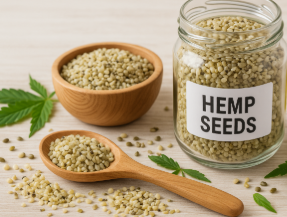
Semi oleaginosi della specie Cannabis sativa L. (varietà alimentari a basso THC), disponibili interi, decorticati (“hemp hearts”), tostati o come ingredienti (farina, proteine, olio).
Profilo sensoriale: sapore nocciolato e leggermente tostato, croccanti; la decorticazione rende la texture più burrosa e la nota vegetale più morbida.
Valore calorico (per 100 g di prodotto)
~550–560 kcal; grassi ~48–50 g, proteine ~30–33 g, carboidrati ~8–10 g (di cui fibre 4–6 g).
Per 1 cucchiaio (~10–12 g): ~55–65 kcal.
Principali sostanze contenute
Proteine ad elevata qualità (soprattutto edestina e albumine), ricche di arginina; amminoacidi solforati medi; PDCAAS/DIAAS buoni per i semi.
Lipidi: prevalenza PUFA (linoleico n-6, ALA n-3) con rapporto n-6:n-3 tipico ~3:1; presenti GLA (γ-linolenico) e SDA (stearidonico) in tracce utili.
Vitamina E (tocoferoli), fitosteroli, polifenoli; minerali (magnesio, fosforo, potassio, ferro, zinco).
Carboidrati: quota di fibre solubili/insolubili; amido basso nei decorticati.
Processo di produzione
Raccolta delle piante a maturazione → essiccazione e selezione dei semi → pulizia/deferrizzazione.
Opzionale decorticazione meccanica; tostatura leggera per profilo aromatico.
Per derivati: spremitura a freddo per olio di semi di canapa (panello → farina/proteine), oppure molitura controllata per farine alimentari.
Controlli: umidità, THC superficiale tracce (rimozione polveri resinoso-vegetali), metalli/micotossine.
Proprietà sensoriali e tecnologiche
Croccantezza e untuosità naturale nei decorticati; ottima disperdibilità in creme/spread.
In ricetta conferiscono corpo, succosità e ritenzione di acqua/olio; le proteine favoriscono legame/emulsione.
L’alta quota di PUFA rende i semi sensibili all’ossidazione: preferire processi delicati e pack barriera.
Impieghi alimentari
Topping per insalate, yogurt, zuppe, poke, muesli; granole e barrette.
Pesti/creme spalmabili (anche in sostituzione di frutta a guscio), burger plant-based, pane e cracker.
Latte e bevande di canapa, tofu/gel proteici da semi, pasta e snack estrusi con farina di canapa.
Nutrizione e salute
Proteine e fibre contribuiscono a sazietà e controllo della risposta glicemica post-prandiale.
Lipidi con PUFA n-6 e ALA n-3: favorevoli se bilanciati; ALA può convertire parzialmente in EPA/DHA (resa limitata).
Vitamina E/fitosteroli: supporto antiossidante e possibile effetto ipocolesterolemizzante.
Sodio assente (salvo ricetta).
Aspetti legali: varietà alimentari con THC non psicoattivo ai livelli consentiti; CBD naturalmente basso nei semi.
Profilo dei grassi
PUFA (grassi polinsaturi: linoleico n-6, ALA n-3; potenzialmente benefici per profilo cardiometabolico ma più ossidabili; evitare alte T prolungate).
MUFA (grassi monoinsaturi, es. oleico n-9; spesso neutri/favorevoli e migliorano la stabilità).
Qualità e specifiche (temi tipici)
Umidità ≤ 8–10% (semi), corpi estranei/pietrisco assenti, assenza parassiti.
Conta semi decorticati integri, granulometria della granella/farina; acidità/perossidi per l’olio.
THC superficiale tracce entro limiti; metalli pesanti/micotossine/pesticidi conformi; microbiologia: cariche basse (semi secchi).
Conservazione e shelf-life
Conservare al buio, al fresco (idealmente ≤20 °C), ermeticamente; evitare ossigeno e luce.
Shelf-life: 12–18 mesi (semi interi), 9–12 mesi (decorticati); più breve se tostati o macinati. Per l’olio: frigo dopo apertura.
Allergeni e sicurezza
I semi di canapa non sono allergeni maggiori; rare ipersensibilità possibili.
Glutine assente naturalmente; verificare cross-contact in impianti misti.
THC/CBD: nei semi edibili i livelli sono trascurabili; evitare contaminazioni da parti resinose.
Funzioni INCI in cosmesi
Voci INCI: Cannabis Sativa (Hemp) Seed Oil, Cannabis Sativa Seed Extract/Powder.
Ruoli: emolliente (olio), antiossidante secondario (tocoferoli), condizionante/texturizer in scrub e maschere.
Troubleshooting
Note rancide/ossidate: eccesso di luce/aria/calore → usare pack barriera, antiossidanti naturali, FIFO.
Amaro/erbaceo marcato: lotti ossidati o toste eccessive → scegliere freschi, tostare leggero.
Perdita di croccantezza in bakery: aumentare secco o temperare l’umidità dell’impasto.
Separazione in creme/pesti: aumentare shear, aggiungere emulsionanti compatibili o parte proteica dei semi.
Sostenibilità e filiera
Coltura a ciclo breve, rustica, con buona soppressione infestanti e input ridotti; utile in rotazioni (migliora suolo).
Co-prodotti valorizzabili (olio, panello, farina); impianti sotto GMP/HACCP, gestione reflui verso target BOD/COD; pack riciclabili/opachi.
Etichettatura
Dichiarazioni: “semi di canapa”, “semi di canapa decorticati”; per derivati: “olio di semi di canapa”, “farina di semi di canapa”.
Eventuali claim su omega-3/omega-6 conformi a linee guida e tenori reali.
Conclusione
I semi di canapa offrono un profilo nutrizionale completo con proteine di buona qualità, grassi insaturi (n-6/n-3 ben calibrati) e micronutrienti protettivi, insieme a versatilità tecnologica in dolce e salato. Una gestione attenta di freschezza, ossigeno e temperatura garantisce stabilità, sicurezza e piacere sensoriale.
Mini-glossario
MUFA — Grassi monoinsaturi (es. oleico n-9): spesso neutri/favorevoli per il profilo lipidico e la stabilità termica.
PUFA — Grassi polinsaturi (es. linoleico n-6, ALA n-3): benefici se bilanciati; più suscettibili all’ossidazione.
SFA — Grassi saturi (es. palmitico/stearico): utili alla robustezza di processo; da moderare nella dieta.
ALA — Acido α-linolenico (n-3): precursore di EPA/DHA; conversione limitata nell’adulto.
EPA/DHA — Eicosapentaenoico/Docosaesaenoico (n-3): acidi grassi marini con evidenze cardiovascolari; non presenti in quantità significative nei semi.
GLA — Acido γ-linolenico (n-6): derivato del linoleico; potenziale supporto infiammatorio-cutaneo.
SDA — Acido stearidonico (n-3): intermedio che può facilitare la via verso EPA.
TFA — Acidi grassi trans: minimi/assenti nei semi non idrogenati; da limitare quando presenti altrove.
MCT — Trigliceridi a media catena: non significativi nei semi di canapa.
GMP/HACCP — Good manufacturing practice / hazard analysis and critical control points: sistemi igienico-preventivi con CCP convalidati.
BOD/COD — Domanda biochimica/chimica di ossigeno: indicatori dell’impatto dei reflui lungo la filiera.
Bibliografia__________________________________________________________________________
Sirangelo TM, Diretto G, Fiore A, Felletti S, Chenet T, Catani M, Spadafora ND. Nutrients and Bioactive Compounds from Cannabis sativa Seeds: A Review Focused on Omics-Based Investigations. Int J Mol Sci. 2025 May 29;26(11):5219. doi: 10.3390/ijms26115219.
Abstract. Hemp (Cannabis sativa L.) is a versatile crop that can be processed to obtain different products with multiple applications. Its seeds are a well-documented ancient source of proteins, fibers and fats, all of which possess high nutritional value. Additionally, metabolites such as flavones and phenols are present in the seeds, contributing to their antioxidant properties. Due to hemp seeds' distinctive nutritional profile, the interest in exploring the potential use in food and nutraceuticals is growing, and they can be considered an interesting and promising alternative resource for human and animal feeding. Omics studies on hemp seeds and their by-products are also being developed, and they contribute to improving our knowledge about the genome, transcriptome, proteome, metabolome/lipidome, and ionome of these sustainable food resources. This review illustrates the main nutrients and bioactive compounds of hemp seeds and explores the most relevant omics techniques and investigations related to them. It also addresses the various products derived from processing the whole seed, such as oil, dehulled seeds, hulls, flour, cakes, meals, and proteins. Moreover, this work discusses research aimed at elucidating the molecular mechanisms underlying their protein, lipid, fiber, and metabolic profile. The advantages of using omics and multi-omics approaches to highlight the nutritional values of hemp seed by-products are also discussed. In our opinion, this work represents an excellent starting point for researchers interested in studying hemp seeds as source of nutrients and bioactive compounds from a multi-level molecular perspective.
Banskota AH, Jones A, Hui JPM, Stefanova R. Triacylglycerols and Other Lipids Profiling of Hemp By-Products. Molecules. 2022 Apr 5;27(7):2339. doi: 10.3390/molecules27072339.
Abstract. Hemp seed by-products, namely hemp cake (hemp meal) and hemp hulls were studied for their lipid content and composition. Total lipid content of hemp cake and hemp hulls was 13.1% and 17.5%, respectively. Oil extraction yields using hexane, on the other hand, were much lower in hemp cake (7.4%) and hemp hulls (12.1%). Oil derived from both hemp seeds and by-products were primarily composed of neutral lipids (>97.1%), mainly triacylglycerols (TAGs), determined by SPE and confirmed by NMR study. Linoleic acid was the major fatty acid present in oils derived from hemp by-products, covering almost 55%, followed by α-linolenic acid, covering around 18% of the total fatty acids. For the first time, 47 intact TAGs were identified in the hemp oils using UPLC-HRMS. Among them, TAGs with fatty acid acyl chain 18:3/18:2/18:2 and 18:3/18:2/18:1 were the major ones, followed by TAGs with fatty acid acyl chain of 18:3/18:3/18:2, 18:2/18:2/16:0, 18:2/18:2/18:1, 18:3/18:2.18:0, 18:2/18:2/18:0, 18:2/18:1/18:1 and 18:3/18:2:16:0. Besides TAGs, low levels of terpenes, carotenoids and cannabidiolic acid were also detected in the oils. Moreover, the oils extracted from hemp by-products possessed a dose-dependent DPPH radical scavenging property and their potencies were in a similar range compared to other vegetable oils.
Bárta J, Roudnický P, Jarošová M, Zdráhal Z, Stupková A, Bártová V, Krejčová Z, Kyselka J, Filip V, Říha V, Lorenc F, Bedrníček J, Smetana P. Proteomic Profiles of Whole Seeds, Hulls, and Dehulled Seeds of Two Industrial Hemp (Cannabis sativa L.) Cultivars. Plants (Basel). 2023 Dec 30;13(1):111. doi: 10.3390/plants13010111.
Abstract. As a source of nutritionally important components, hemp seeds are often dehulled for consumption and food applications by removing the hard hulls, which increases their nutritional value. The hulls thus become waste, although they may contain valuable protein items, about which there is a lack of information. The present work is therefore aimed at evaluating the proteome of hemp (Cannabis sativa L.) at the whole-seed, dehulled seed, and hull levels. The evaluation was performed on two cultivars, Santhica 27 and Uso-31, using LC-MS/MS analysis. In total, 2833 protein groups (PGs) were identified, and their relative abundances were determined. A set of 88 PGs whose abundance exceeded 1000 ppm (MP88 set) was considered for further evaluation. The PGs of the MP88 set were divided into ten protein classes. Seed storage proteins were found to be the most abundant protein class: the averages of the cultivars were 65.5%, 71.3%, and 57.5% for whole seeds, dehulled seeds, and hulls, respectively. In particular, 11S globulins representing edestin (three PGs) were found, followed by 7S vicilin-like proteins (four PGs) and 2S albumins (two PGs). The storage 11S globulins in Santhica 27 and Uso-31 were found to have a higher relative abundance in the dehulled seed proteome (summing to 58.6 and 63.2%) than in the hull proteome (50.5 and 54%), respectively. The second most abundant class of proteins was oleosins, which are part of oil-body membranes. PGs belonging to metabolic proteins (e.g., energy metabolism, nucleic acid metabolism, and protein synthesis) and proteins related to the defence and stress responses were more abundant in the hulls than in the dehulled seeds. The hulls can, therefore, be an essential source of proteins, especially for medical and biotechnological applications. Proteomic analysis has proven to be a valuable tool for studying differences in the relative abundance of proteins between dehulled hemp seeds and their hulls among different cultivars.
van Klinken BJ, Stewart ML, Kalgaonkar S, Chae L. Health-Promoting Opportunities of Hemp Hull: The Potential of Bioactive Compounds. J Diet Suppl. 2024;21(4):543-557. doi: 10.1080/19390211.2024.2308264.
Abstract. Hemp hull is the outer coat of the hemp seed, derived from the plant Cannabis sativa L., Cannabaceae. While much attention has been paid to hemp seed for its oil, protein and micronutrient content, far less attention has been given to hemp hull, a side stream of hemp processing. Hemp hull is a source of bioactive compounds, dietary fiber, minerals as well as protein, lipids and carbohydrates. Of note, two bioactive compounds, n-trans-caffeoyltyramine and n-trans-feruloyltyramine have been identified in hemp hull as key bioactive compounds that support gut health, liver function and other physiological processes. Both of these compounds were identified as agonists of the transcription factor, hepatic nuclear factor-4 alpha which has been implicated in gene expression that governs gut permeability, factors associated with inflammatory bowel diseases, and hepatic lipid homeostasis. Additionally, the dietary fibers in hemp hull have been demonstrated to be novel prebiotics, which may further amplify hemp hull's effect on gut health and metabolic health. This review article summarizes the nutritional content of hemp hull, explores the physiological effects of bioactive compounds found in hemp hull, and identifies opportunities for further research on hemp hull for human health benefit.
House JD, Neufeld J, Leson G. Evaluating the quality of protein from hemp seed (Cannabis sativa L.) products through the use of the protein digestibility-corrected amino acid score method. J Agric Food Chem. 2010 Nov 24;58(22):11801-7. doi: 10.1021/jf102636b.
Abstract. The macronutrient composition and the quality of protein of hemp seed and products derived from hemp seed grown in Western Canada were determined. Thirty samples of hemp products (minimum 500 g), including whole hemp seed, hemp seed meal from cold-press expelling, dehulled, or shelled, hemp seed and hemp seed hulls, were obtained from commercial sources. Proximate analysis, including crude protein (% CP), crude fat (% fat) and fiber, as well as full amino acid profiles, were determined for all samples. Protein digestibility-corrected amino acid score (PDCAAS) measurements, using a rat bioassay for protein digestibility and the FAO/WHO amino acid requirement of children (2-5 years of age) as reference, were conducted on subsets of hemp products. Mean (±SD) percentage CP and fat were 24.0(2.1) and 30.4(2.7) for whole hemp seed, 40.7(8.8) and 10.2(2.1) for hemp seed meal, and 35.9(3.6) and 46.7(5.0) for dehulled hemp seed. The percentage protein digestibility and PDCAAS values were 84.1-86.2 and 49-53% for whole hemp seed, 90.8-97.5 and 46-51% for hemp seed meal, and 83.5-92.1 and 63-66% for dehulled hemp seed. Lysine was the first limiting amino acid in all products. Removal of the hull fraction improved protein digestibility and the resultant PDCAAS value. The current results provide reference data in support of protein claims for hemp seed products and provide evidence that hemp proteins have a PDCAAS equal to or greater than certain grains, nuts, and some pulses.
Banskota AH, Tibbetts SM, Jones A, Stefanova R, Behnke J. Biochemical Characterization and In Vitro Digestibility of Protein Isolates from Hemp (Cannabis sativa L.) By-Products for Salmonid Feed Applications. Molecules. 2022 Jul 27;27(15):4794. doi: 10.3390/molecules27154794.
Abstract. Hemp (Cannabis sativa L.) processing by-products (hemp cake and hemp seed hulls) were studied for their protein content, extraction of protein isolates (PIs), and their in vitro protein digestibility (IVPD). Crude protein contents of hemp cake and hemp seed hulls were 30.4% and 8.6%, respectively, calculated based on generalized N-to-P conversion factor (N × 5.37). Extraction efficiency of PIs from defatted biomass ranged from 56.0 to 67.7% with alkaline extraction (0.1 M NaOH) followed by isoelectric precipitation (1.0 M HCl). Nitrogen analysis suggested that the total protein contents of PIs extracted using three different alkaline conditions (0.5 M, 0.1 M, and pH 10.0 with NaOH) were >69.7%. The hemp by-product PIs contained all essential amino acids (EAAs) required for fish with leucine, valine, and phenylalanine belonging to the five dominant amino acids. Overall, glutamate was the dominant non-EAA followed by aspartate. Coomassie staining of an SDS-PAGE gel revealed strong presence of the storage protein edestin. High IVPD of >88% was observed for PIs extracted from hemp seeds and by-products when evaluated using a two-phase in vitro gastric/pancreatic protein digestibility assay. PIs extracted from by-products were further tested for their antioxidant activities. The tested PIs showed dose-dependent DPPH radical scavenging activity and possessed strong ORAC values > 650 μM TE/g.




