



Paprika seed oil
Description
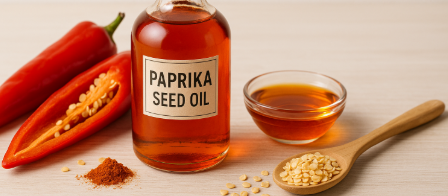
Vegetable oil obtained from the seeds of Capsicum annuum (a by-product of the paprika supply chain), produced by pressing (cold or hot) and/or solvent extraction followed by refining.
Sensory profile: golden-yellow with possible orange/red highlights (trace carotenoids), light fruity/nutty aroma, very low pungency (seeds contain few capsaicinoids; small traces may migrate from placenta).
Caloric value (per 100 g)
~884 kcal/100 g (fat ~100 g).
Smoke point (indicative): ~160–180 °C for cold-pressed, ~220–230 °C for refined (RBD); practical heat tolerance is limited by the high PUFA content.
Key constituents
Triacylglycerols with typical fatty acids: linoleic (n-6) ~60–75% (PUFA), oleic (n-9) ~10–20% (MUFA), palmitic ~8–15% and stearic ~2–5% (SFA).
Minor components: tocopherols (mostly γ-tocopherol), phytosterols (e.g., β-sitosterol), squalene; residual carotenoids (e.g., capsanthin/capsorubin).
Capsaicinoids: generally trace (sometimes de-capsaicinized during refining).
Production process
Seed separation from paprika powder, cleaning, and controlled drying.
Mechanical pressing (preferably cold-pressed for premium edible/cosmetic use) or solvent extraction; then refining (degumming, neutralization, bleaching, deodorization) for RBD grades.
Optional polishing/filtration and standardization for stability and color; deeper deodorization for cosmetic specs.
Sensory and technological properties
Provides a warm hue at low addition; flavor is delicate with a faint paprika note.
Oxidation risk is high due to elevated PUFA → use antioxidants (e.g., tocopherols/rosemary extract), barrier packaging, and lower process temperatures.
Best for cold uses, light sautés, and short cooks; not ideal for extended frying.
Food applications
Dressings/condiments, marinades, mayonnaise/dressings (as a PUFA fraction), finishing soups/sauces for a gentle color-aroma touch.
Snacks/coatings applied cool, spreadable cheeses/spreads (small percentages for color/aroma).
Often blended with more stable oils (palm olein, high-oleic olive, high-oleic sunflower) to balance lipid profile and stability.
Nutrition and health
High n-6 PUFA (linoleic) with natural tocopherols; advisable to balance overall diet with n-3 sources (ALA/EPA/DHA).
Cholesterol-free; sodium-free (recipe dependent).
Capsaicin usually minimal, but unrefined oils can give a slight tingle in sensitive consumers.
Fat profile
Predominantly PUFA (polyunsaturated fatty acids, e.g., linoleic n-6): potentially beneficial for cardiometabolic markers when balanced with n-3, but more oxidation-prone and less suited to high-heat.
Some MUFA (monounsaturated, e.g., oleic n-9): often neutral/beneficial; improves stability in blends.
Moderate SFA (saturated, e.g., palmitic/stearic): aids structure, should be moderated in the overall diet.
TFA negligible in non-hydrogenated oils; no meaningful MCT.
Quality and specifications (typical topics)
Free fatty acids (FFA) low (e.g., ≤0.3% as oleic for refined), peroxide value ≤2 meq O₂/kg at release, p-anisidine/TOTOX low.
Iodine value (IV) high (consistent with PUFA-rich oils), color (Lovibond/ASTA) on spec.
Total tocopherols, phytosterols, and (if required) residual capsaicinoids.
Metals/pesticides compliant, residual solvents within limits; microbiology not limiting (oil matrix).
Storage and shelf life
Store cool (10–20 °C), dark, airtight; minimize oxygen (e.g., nitrogen headspace).
Typical shelf life 12–18 months (often shorter for cold-pressed). Avoid light/heat; use FIFO.
Allergens and safety
Not a major allergen; gluten-free.
Potential eye/skin irritation with non-de-capsaicinized oils—apply good handling practices.
In shared facilities, manage cross-contact per site risks.
INCI functions in cosmetics
INCI: Capsicum Annuum (Seed) Oil or Capsicum Annuum Seed Extract (if extractive).
Roles: light emollient, conditioning, potential secondary antioxidant (tocopherols); subtle color. Check staining and photostability.
Troubleshooting
Early rancidity/oxidized odor: excess oxygen/light → improve packaging, add antioxidants, reduce hold temp/time.
Color fade: carotenoid degradation → dose late, protect from light, avoid overheating.
Foaming on heat: moisture/impurities → filter, dry ingredients, avoid prolonged high T.
Unexpected pungency: residual capsaicinoids → switch to refined/de-capsaicinized grade or tighter filtration.
Sustainability and supply chain
Upcycling of paprika seed by-product reduces waste and adds value.
Favor traceable agriculture, energy-efficient processing, solvent recovery, effluent control toward BOD/COD targets; opaque/recyclable packs.
Operate under GMP/HACCP with CCPs on oxidation, residual solvents, and metals.
Labeling
Ingredient list: “paprika seed oil” or “Capsicum annuum seed oil”; declare antioxidants and refining status when relevant (RBD).
Conclusion
Paprika seed oil offers a PUFA-rich profile, delicate signature flavor, and a natural warm tint—well suited to cold and moderate-heat applications or as part of stability-oriented blends. Sound process design (antioxidants, packaging, temperature) and thoughtful grade selection (refined vs. cold-pressed) ensure stability, safety, and sensory consistency.
Mini-glossary
PUFA — Polyunsaturated fatty acids (e.g., linoleic n-6): can support cardiometabolic health; more prone to oxidation and less heat-stable.
MUFA — Monounsaturated fatty acids (e.g., oleic n-9): often neutral/beneficial; improve stability in blends.
SFA — Saturated fatty acids (e.g., palmitic/stearic): aid process stability; moderate in total diet.
ALA — Alpha-linolenic acid (n-3): typically trace here; balance diet with n-3 sources.
GMP/HACCP — Good manufacturing practice / hazard analysis and critical control points: preventive hygiene systems with validated CCPs.
BOD/COD — Biochemical/chemical oxygen demand: indicators of effluent impact.
FIFO — First in, first out: stock rotation to maintain freshness and low oxidation.
Studies
Paprika is rich in antioxidants (1), vitamins and minerals, especially vitamin C (2). It also has anti-inflammatory properties and can help promote heart health. It is used in traditional medicine to treat acne, joint inflammation and indigestion (3).
It should be enjoyed in moderation!

