



Palm olein
Description
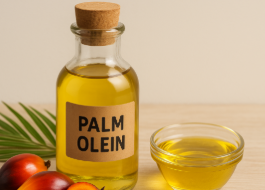
Liquid fraction of palm oil obtained by fractionation (controlled crystallization and filtration) of crude/refined palm oil; at ambient temperature it stays fluid thanks to a higher share of unsaturated fats.
Commercial grades: standard olein, super olein (stays clearer in cooler climates), soft olein; widely available as RBD (refined–bleached–deodorized) for food use.
Sensory profile: pale golden color, neutral/slightly fruity aroma and taste (RBD grades); excellent frying stability.
Caloric value (per 100 g)
~884 kcal/100 g; fat ~100 g.
Per tablespoon (~10–15 ml): ~90–120 kcal.
Key constituents
Triacylglycerols with typical fatty acids: oleic (n-9) ~43–48% (MUFA, monounsaturated), palmitic ~37–41% (SFA, saturated), linoleic (n-6) ~9–13% (PUFA, polyunsaturated), stearic ~4–5%; others in traces (e.g., myristic).
Minor components: tocopherols/tocotrienols (vitamin E), phytosterols; in RBD fractions, native carotenoids are largely removed.
TFA (trans fatty acids) negligible in non-hydrogenated oils.
Production process
Extraction of palm oil from the mesocarp of Elaeis guineensis fruits, clarification and refining (degumming, neutralization, bleaching, deodorization).
Fractionation: controlled cooling → crystallization of stearin; filtration separates olein (liquid) from stearin (solid).
Final polishing/filtration and quality checks; optional blending to meet specifications (e.g., cloud point).
Sensory and technological properties
Smoke point (RBD): ~225–235 °C → suitable for prolonged/repeated frying.
Oxidative stability: high (balanced MUFA/SFA, low PUFA; natural vitamin E).
Cloud point: typically 10–15 °C; super olein ~5–8 °C → less prone to chill haze.
Low foaming when well refined; good resistance to polymerization and darkening with proper fryer management.
Food applications
Deep-frying and stir-frying (foodservice and home), snacks (extruded/fried), tempura, chips.
Soft margarines, mayonnaise/dressings, sauces; co-formulant in bakery and spreads.
Performs reliably in hot climates and high-throughput kitchens.
Nutrition and health
100% fat: nutritional impact depends on portion and overall diet.
The unsaturated share (MUFA/PUFA) is often neutral/beneficial for some lipid markers; the SFA share warrants moderation in total diet.
Sodium absent; vitamin E traces contribute to stability.
Fat profile
MUFA (monounsaturated fatty acids, e.g., oleic n-9): often neutral/beneficial for lipid profile and thermal stability.
PUFA (polyunsaturated fatty acids, e.g., linoleic n-6): beneficial when balanced with n-3 but more oxidation-prone.
SFA (saturated fatty acids, e.g., palmitic/stearic): support process stability; moderate in the overall diet.
TFA: minimal/absent in non-hydrogenated grades. No meaningful MCT.
Quality and specifications (typical topics)
Free fatty acids (FFA) ≤ 0.10–0.25% (as palmitic), peroxide value ≤ 2 meq O₂/kg, p-anisidine/TOTOX low.
Moisture/impurities ≤ 0.1%; iodine value (IV) ~56–60; slip melting point ~19–24 °C.
Color (Lovibond) low for RBD; metals/contaminants (e.g., 3-MCPD esters/glycidyl esters) within legal limits.
In frying, monitor TPC (total polar compounds) and acidity per regulations.
Storage and shelf life
Store dark, well-closed, cool (15–20 °C); avoid air, light, and heat.
Typical shelf life 12–24 months (depends on quality, antioxidants, and packaging).
At low temperature it may haze/crystallize: reversible with gentle warming.
Allergens and safety
Not a major allergen; naturally gluten-free.
In frying, avoid excess moisture/residues (foaming, off-notes); respect time/temperature to limit degradation.
Comply with GMP/HACCP; control process contaminants (e.g., 3-MCPD/GE) and potential migration from equipment.
INCI functions in cosmetics
INCI: Elaeis Guineensis (Palm) Oil; the liquid fraction may be labeled Palm Olein.
Roles: emollient, solvent for lipophilic actives, texture contributor (sticks/ointments); base for saponification (hard soaps with good lather).
Troubleshooting
Chill haze/solidification: switch to super olein or temper gently.
Foaming in fryers: excess water/batter fines, detergent residues, or degraded oil → filter, manage turnover, dry raw materials.
Darkening/rancid odor: oxidation/polymerization → lower temperature, renew oil, filter particulates, protect from air/light.
Soggy fries/coating: overload or too low temperature → reduce batch size, restore set-point.
Sustainability and supply chain
Palm cultivation raises deforestation, biodiversity, and GHG concerns: prefer RSPO/deforestation-free supply, traceability to mill/plantation, and inclusion of smallholders.
Treat POME effluents toward BOD/COD targets; valorize biogas and residues (EFB, shells).
Improve energy efficiency in refining/fractionation, heat recovery, recyclable packaging; regular audits under GMP/HACCP.
Labeling
Ingredient list: “palm oil (olein)” or “palm olein” per local practice; in foodservice, declare frying oil when required.
Conclusion
Palm olein combines high thermal stability, sensory neutrality, and robust process performance, making it a reliable frying and formulation oil. Responsible sourcing, correct operating conditions, and proper storage ensure safety, quality, and sensory consistency.
Mini-glossary
MUFA — Monounsaturated fatty acids (e.g., oleic n-9): often neutral/beneficial; good thermal stability.
PUFA — Polyunsaturated fatty acids (e.g., linoleic n-6): potentially beneficial; more prone to oxidation.
SFA — Saturated fatty acids (e.g., palmitic/stearic): support stability; moderate in diet.
TFA — Trans fatty acids: negligible in non-hydrogenated palm olein; limit when present.
MCT — Medium-chain triglycerides: not significant in palm olein.
RBD — Refined, bleached, deodorized: purification grade for edible oils.
TPC — Total polar compounds: frying oil degradation index (regulated limits).
IV — Iodine value: degree of unsaturation.
GMP/HACCP — Good manufacturing practice / hazard analysis and critical control points: preventive hygiene systems with validated CCPs.
BOD/COD — Biochemical/chemical oxygen demand: effluent impact indicators.
RSPO — Roundtable on Sustainable Palm Oil: voluntary certification scheme for palm supply sustainability.
Studies
However, recent studies have shown that a connection has been established between this oil and certain cardiovascular disorders (1) especially when this oil is heated (2).
Since its inception in food, this oil was first challenged for the deforestation it produces as farmers and companies producing it tend to clear forests and woodlands to extract it, given the high demand. Later, however, as early as 1991, attention was paid to the health issue with studies finding it difficult to interpret the evidence for this oil unambiguously with respect to coronary heart disease and cancer (3).
Studies from 2004 drew attention to the risk that this oil could create, if oxidized and that is, not fresh, with the creation of a negative lipid profile, toxicity to kidney, lung, liver and heart, while red palm oil, by virtue of its beta carotene content could protect against vitamin A deficiency and some forms of cancer (4).
There is a strong component of saturated fatty acids in palm oil, particularly palmitic acid, and these ldel 2014 studies confirm this (5).
Another 2015 study reiterates the high saturated fat content and provides not encouraging findings on the increase in harmful LDL cholesterol (6).
At the level of comparison, between palm oil and sunflower oil, it is confirmed that palm oil as a highly saturated vegetable oil can induce dysfunction of liver lipid metabolism before touching serum lipid levels. Sunflower oil, on the other hand, a highly unsaturated vegetable oil, has been shown to be well metabolized in the liver (7).
All these studies agree in attributing to palm oil a high saturated fat content and, in a long and articulate examination of the biological and nutritional properties of this oil by a group of researchers at the University of Naples, controversial results from a health perspective (8).
A study aimed at detecting the mutations produced in palm oil, used as frying oil for potato chips, found that, at temperatures of 150, 165 and 180° thermo-oxidative alterations, changes in fatty acid composition and color alteration are produced. In summary, the higher the temperature, the more the oxidation of palm oil increases (9).
Another problem related to palm oil is the increasing deforestation carried out to plant huge quantities of palm trees.
There is also a "red" palm oil on the market with slightly better physical characteristics and taste.

