

Ciao, Visitatore!


🔍
RECENSIONE

Recensione

Al222
Al222 (25707 pt) 03-Nov-2025 11:00

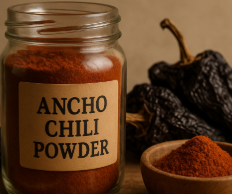
Peperoncino ancho in polvere

Descrizione

  • Polvere di peperoncino ottenuta dalla macinazione dei baccelli essiccati e maturi (rossi) di poblano (Capsicum annuum, fam. Solanaceae), noti commercialmente come ancho.

  • Profilo sensoriale: colore bruno-rubino, aroma dolce e fruttato (uva passa, prugna secca), note tostate/cacao con lieve affumicato; pungenza bassa.

  • Piccantezza (indicativa): ~1.000–2.000 SHU (Scoville Heat Units), variabile per cultivar, terroir e quota di placenta/semi.
Valore calorico (per 100 g di prodotto)

  • Polvere secca: ~280–320 kcal; carboidrati ~50–60 g (di cui fibre ~30–35 g), proteine ~12–15 g, grassi ~10–15 g.

  • Per porzione d’uso (0,5–5 g): apporto energetico modesto; il contributo nutrizionale è soprattutto fitocomposti e fibre (su base secca).

Principali sostanze contenute

  • Carotenoidi: capsantina, capsorubina, zeaxantina, β-carotene (responsabili del colore).

  • Capsaicinoidi: bassi (prodotto tendenzialmente poco piccante).

  • Polifenoli e composti volatili (pirazine, note tostate); zuccheri naturali e acidi organici.

  • Minerali in tracce; modesta quota di lipidi intrinseci (da semi/oleoresine).

Processo di produzione

  • Materia prima: baccelli ancho interi, puliti, tipicamente destellati e parzialmente deseedati per ridurre amaro e variabilità di pungenza.

  • Trattamenti preliminari: eventuale tostatura leggera per esaltare aromi; sanificazione (vapore, raggi ionizzanti ove ammesso) per abbattere la carica microbica.

  • Macinazione: a bassa temperatura con setacciatura per la granulometria desiderata; blending per standardizzare colore (ASTA) e profilo.

  • Controlli qualità: umidità8–12%, ASTA, corpi estranei, micotossine (es. aflatossine), pesticidi/metalli, microbiologia (bassa aw).

Proprietà sensoriali e tecnologiche

  • Colorante naturale caldo e profondo con buona resa a dosi basse.

  • Disperdibilità: ottima in matrici grasse; nei sistemi acquosi aiuta la pre-dispersione in olio o l’uso di emulsionanti.

  • Stabilità colore/aroma: sensibile a luce, ossigeno e calore prolungato → preferire pack barriera e dosaggio a fine cottura.

  • Compatibilità aromatica: sinergie con acidi (aceto, agrumi), umami (soia, miso) e grassi (olio d’oliva).

Impieghi alimentari

  • Cucina messicana/sud-occidentale: mole, enchiladas, salse rosse, chili a bassa pungenza, rub per carni e verdure.

  • Applicazioni moderne: hummus/salse affumicate-dolci, marinature, patate al forno, uova e legumi; base per blend (es. ancho-cacao-caffè).

Nutrizione e salute

  • Porzioni d’uso piccole con apporto di carotenoidi e polifenoli a potenziale antiossidante.

  • Sodio intrinsecamente basso (dipende dalla ricetta).

  • Tollerabilità: pungenza lieve; in soggetti con GERD o sensibilità alle spezie modulare la dose.

Profilo dei grassi

  • Tenore lipidico basso-moderato per una spezia; composizione orientata a PUFA (grassi polinsaturi, prevalentemente linoleico; utili se bilanciati ma più ossidabili), presenza di MUFA (grassi monoinsaturi, es. oleico; spesso neutri/favorevoli), minima SFA (grassi saturi; da moderare nella dieta complessiva).

Qualità e specifiche (temi tipici)

  • ASTA, umidità, granulometria, ceneri, pungenza/SHU (se dichiarata).

  • Micotossine conformi; pesticidi/metalli entro limiti; PAH sotto controllo se è stata fatta tostatura.

  • Microbiologia: assenza di patogeni; cariche totali basse (bassa aw).

  • Uniformità di colore/aroma e assenza di corpi estranei.

Conservazione e shelf-life

  • Conservare al buio, asciutto, fresco (≈5–20 °C) in contenitori barriera ben chiusi; evitare luce, aria e calore.

  • Shelf-life tipica 12–24 mesi (in funzione di ASTA, protezione antiossidante e pack); richiudere prontamente dopo l’uso.

Allergeni e sicurezza

  • Naturalmente senza glutine; non tra gli allergeni maggiori. Possibile cross-contaminazione in impianto (verificare fornitore).

  • Capsaicina irritante per cute/mucose: usare guanti in lavorazioni prolungate; tenere lontano dai bambini.

Funzioni INCI in cosmesi

  • Denominazioni: Capsicum Annuum Fruit Powder, Capsicum Annuum Extract.

  • Ruoli: colorante naturale (toni rosso-bruni), lieve antiossidante secondario, skin conditioning blando. Verificare staining cutaneo e stabilità; impiego a basse dosi con test di compatibilità.

Troubleshooting

  • Sapore piatto/vecchio: materia prima ossidata → scegliere lotti freschi (ASTA adeguato), migliorare pack e stoccaggio.

  • Amaro/acre: eccesso di semi/placenta o tostatura troppo spinta → aumentare deseeding, ridurre T/tempo.

  • Colore non uniforme: granulometria eterogenea o scarsa disperdibilitàsetacciare e pre-disperdere in olio.

  • Grumi in miscele secche: umidità elevata → essiccare gentilmente, setacciare, usare anti-caking consentiti.

Sostenibilità e filiera

  • Essiccazione corretta in origine riduce rischio micotossine; preferire fornitori con tracciabilità e pratiche agricole responsabili.

  • Efficienza di processo: recupero scarti, pack riciclabili, gestione reflui verso target BOD/COD; audit sotto GMP/HACCP con CCP su sanificazione, corpi estranei e screening micotossine.

Conclusione

Il peperoncino ancho in polvere offre calore moderato, dolcezza fruttata e profondità aromatica che arricchiscono salse, rub e piatti a bassa pungenza. La selezione della materia prima, il controllo di tostatura/macinazione e una corretta disperdibilità consentono stabilità, uniformità e coerenza sensoriale nelle applicazioni professionali e domestiche.

Mini-glossario

  • SHUscoville heat units: indice della pungenza percepita (più alto = più piccante).

  • ASTAamerican spice trade association (unità colore): misura standard della potenza colorante.

  • awattività dell’acqua: disponibilità d’acqua per i microrganismi; nelle spezie è bassa.

  • PUFAgrassi polinsaturi (es. linoleico): possibili benefici cardiometabolici; più suscettibili all’ossidazione.

  • MUFAgrassi monoinsaturi (es. oleico): in genere neutri/favorevoli sul profilo lipidico.

  • SFAgrassi saturi: da moderare nella dieta complessiva.

  • GMP/HACCPgood manufacturing practice / hazard analysis and critical control points: sistemi igienico-preventivi con punti critici (CCP) convalidati.

  • CCPcritical control point: fase di processo da presidiare (es. sanificazione, micotossine).

  • BOD/CODdomanda biochimica/chimica di ossigeno: indicatori dell’impatto dei reflui nel trattamento acque.

Bibliografia__________________________________________________________________________

Hernández, L. J., Montejo, N. C., Rangel, A. S., Torres, V. R., Rico, J. S. G. J. A., & Naveda, A. F. (2024). Agronomic and morphological evaluation of six genotypes and two hybrids of Poblano peppers in field conditions. Agro Productividad.

Abstract. Objective: to evaluate agronomic and morphological traits of six Poblano-type pepper genotypes, compared to a commercial hybrid and an experimental hybrid, in order to select genotypes with potential to continue with a plant breeding program. Design/ Methodology/ Approach: treatments and statistical model were arranged in randomized complete blocks, with eight treatments (six F2 genotypes, and two hybrids Carranza (commercial F1) and F402 (experimental F1). Treatments were analyzed with analysis of variance (p ≤ 0.05); then tested with Multiple Mean Comparison (Tukey, p ≤ 0.05) and Pearson Correlation Analysis. Results: no statistical differences were found in yield per plant (RPP), number of fruits per plant (NFP), average weight per fruit (PPF), plant height (AP), stem thickness (GT), leaf length (AL) and leaf width (AH). Regarding width at the base of the fruit (ABF) the hybrids were superior; in average width of the fruit the genotypes G4, G6 and the hybrids were better; in fruit length G2, G5 and G6 stood out; in calyx depth G1, G3 and G4; in length of the peduncle G4 was different from the others; and in thickness of the mesocarp (GM) the genotypes G2, G4, G6 and hybrids were superior. According to Pearson's correlation, the yield depended on NFP (0.66), MG (0.46), ABF (0.38), as it is shown by their coefficients.

Toledo-Aguilar, R., López-Sánchez, H., López, P. A., Guerrero-Rodríguez, J. D. D., Santacruz-Varela, A., & Huerta-de la Peña, A. (2016). Morphological diversity of native population’s poblano pepper. Revista mexicana de ciencias agrícolas7(5), 1005-1015.

Abstract. The genetic diversity in different types of pepper in Mexico has been little studied. The poblano pepper (Capsicum annuum L.) has great culinary importance as an ingredient in traditional dishes from Puebla; also constitutes a source of income for rural families in the region of the Sierra Nevada de Puebla; however, there is no study to determine the morphological diversity of native populations of this type of pepper found in this ecological niche. The aim of this study was to analyze the morphological diversity of native population’s poblano peppers de la Sierra Nevada de Puebla. By using descriptors were analyzed 41 populations of pepper poblano, four of ancho pepper, two of “Loco” pepper, one of “Miahuateco” and hybrid pepper ancho pepper “Doroteo” (Ahern Seeds®). An experimental design was used in three randomized complete block assessment in two locations. In the combined analysis of variance statistically significant difference in 60% of the variables found. With the selection of 30 morphological was performed variables principal component analysis, where populations of pepper poblano formed a group, away from the rest of populations evaluated and the hybrid. The cluster analysis was also performed, in which four subgroups were defined. The native populations that shaped each subgroup were not related to the geographical location of seed collection, suggesting the exchange of germplasm among farmers. In the native populations of pepper poblano morphological diversity found mainly in fruit variables, plant habit and earliness.

Santiago López, U., Ramírez Meraz, M., & Méndez Aguilar, R. (2018). HAP14F: hybrid of ancho poblano pepper for the Altiplano de México. Revista mexicana de ciencias agrícolas, 9(2), 481-485.

Abstract. In Mexico, the poblano pepper has great gastronomic, economic and social importance because it is a basic ingredient of traditional dishes. Obtaining low yields in the producing areas, mainly in the Altiplano de México, is due to the high use of creole seeds. To mitigate the aforementioned problem, INIFAP developed the HAP14F wide pepper poblano hybrid, which is an early cycle because it presents flowering and ripening at 39 and 118 days after transplantation (DDT), respectively. It produces fruits of intermediate green color in an immature state that turn a dark red color with a strong brilliance in a mature state. In open-pit evaluations, this hybrid had an average yield of 3.7 t ha-1 of dried or dehydrated chili and in green fruit it reached 23.1 t ha-1. For the aforementioned, HAP14F is considered a good alternative for the Altiplano de México.

Hernández Hernández, B. N., Tornero Campante, M. A., Sandoval Castro, E., Rodríguez Mendoza, M. D. L. N., Taboada Gaytán, O. R., & Peña Olvera, B. V. (2021). Growth, yield and quality of poblano chili pepper grown in hydroponics under greenhouse. Revista mexicana de ciencias agrícolas, 12(6), 1043-1056.

Abstract. The poblano chili pepper crop sown in soil in the Alto Atoyac in Puebla has been affected by the presence of diseases caused by fungi, bacteria and nematodes, generating losses in yield and reduction of the sowing area. The production under greenhouse and hydroponics is an alternative solution to this problem, since it allows the development of crops in a controlled environment using inert substrates, ensuring a greater percentage of production. The objective was to evaluate the growth, yield and fruit quality of two local varieties of poblano chili pepper (Tlacotepec and Tlalancaleca) and a commercial variety (San Luis), supplied nutritionally by three concentrations of the Steiner nutrient solution under greenhouse and hydroponics in order to know their agronomic and productive behavior. A 3x3 factorial treatment design in a completely randomized experimental design was considered. The variables evaluated were: plant height, stem thickness, number of leaves, number of bifurcations, number of flowers, yield and fruit quality. The results showed that the San Luis variety reached the highest yield and fruit quality. As for the three concentrations of nutrient solution, there was no significant effect on the yield and the agronomic behavior of creole varieties in the substrate, greenhouse and hydroponics system may be an option for the production of poblano chili pepper in the Alto Atoyac region