



Natural flavorings (Natural flavors)
Description
Ingredients intended to impart aroma and/or taste to foods, obtained from natural sources (botanical, animal, or microbiological) using physical, enzymatic, or microbiological (fermentation) processes.
In the EU, the term “natural flavoring substance/flavoring” and “natural X flavoring” have defined use; “natural X flavoring” generally implies ≥95% of the flavoring component originates from X. In the US, “natural flavor” covers extracts, essential oils, distillates, enzymatic/thermal reaction products, and isolated substances of natural origin.
Commercial forms include essential oils, extracts (hydroalcoholic/glycolic), oleoresins, distillates, fermentation-derived flavors, heat-treated flavors, emulsions (cloudy/clear), and spray-dried powders on a carrier.
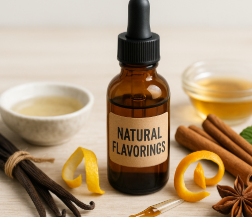
Caloric value (per 100 g)
Carrier-dependent:
Oil-based: ~800–900 kcal/100 g.
Hydroalcoholic: ~200–300 kcal/100 g (varies with ethanol/propylene glycol).
Spray-dried powders (e.g., on maltodextrin/OSA starch): ~300–400 kcal/100 g.
Per serving in foods: typical use is ppm–0.3%, so energy contribution is negligible.
Key constituents
Volatiles: terpenes/terpenoids (e.g., limonene, linalool), aldehydes (e.g., natural vanillin), ketones, alcohols, lactones (creamy/fruity notes), pyrazines (toasted), Maillard compounds.
Non-volatiles (in extracts/oleoresins): capsaicinoids, curcuminoids, polyphenols.
Approved solvents/carriers: ethanol, water, propylene glycol, triacetin, vegetable oil, glycerol; for powders: maltodextrin, gum arabic, OSA-starch.
Optional processing aids (emulsifiers, antioxidants like tocopherols) within good-practice limits.
Production process
Raw material selection: source identity (species, botanical part, chemotype), supplier qualification, traceability.
Physical extraction: cold pressing (citrus), steam distillation, supercritical CO₂ (high purity, minimal residues).
Solvent extraction: food-grade solvents (e.g., ethanol, ethyl acetate) with vacuum solvent removal.
Fermentations/bioconversions: generate fruity/lactonic notes or complex umami nuances.
Heat-treated flavors: controlled Maillard reactions from natural precursors.
Standardization: adjust strength (e.g., fold), balance the profile, filter/decolorize as needed.
Formulation: beverage emulsions, spray-dried powders (1–25% load), and encapsulations to protect from oxidation and volatilization.
Sensory and technological properties
Potency and finesse depend on source, process, and vehicle.
Stability is sensitive to light, oxygen, pH, temperature, ions (e.g., Fe³⁺), and thermal processes (retort/pasteurization).
Matrix compatibility:
Essential oils → fatty or emulsified systems.
Emulsions → aqueous/acidic beverages.
Powders → dry mixes and bakery.
Typical issues: fading (intensity loss), scalping (absorption into packaging), phase separation in emulsions.
Food applications
Beverages (citrus emulsions, botanical extracts), dairy and analogs, confectionery/bakery, snacks (savory/smoke), meat and plant-based (reaction/smoke flavors), sauces/condiments.
Roles: characterizing flavor (e.g., natural lemon), top-note/base building, rounding, masking off-notes, and umami enhancement.
Nutrition and health
Energy and nutrients are minimal at use levels.
Sodium is absent unless added in the finished recipe; trace antioxidants (e.g., tocopherols) may be present.
Consider individual tolerance to potential sensitizers (e.g., citrus terpenes).
Fat profile
Relevant only for oil-based flavors/oleoresins: the vehicle contributes fat (often MUFA/PUFA). Nutritional impact remains trivial at typical dosages.
Quality and specifications (typical topics)
Identity & strength: GC-MS/HS-GC markers (e.g., vanillin, menthol), declared fold.
Physical parameters: density, refractive index, optical rotation (essential oils), pH (aqueous extracts), color.
Purity: residual solvents within limits, compliant metals/pesticides, tracked allergens.
Stability: peroxide value/TBA for fatty systems; retort/pasteurization stability where required.
Microbiology: usually not limiting for oils/alcoholic systems; low-aw powders must meet low counts and pathogen-free status.
Storage and shelf life
Store dark, well closed, preferably nitrogen-flushed, at controlled temperature (often 5–20 °C).
Avoid air, light, and heat; reclose promptly after use.
Typical shelf life 12–24 months (varies with matrix, antioxidants, and barrier packaging; shorter for terpene-rich citrus).
Allergens and safety
Regulated allergens (e.g., soy, milk, gluten, tree nuts) must be declared when present as ingredients/derivatives.
Some flavor components can be sensitizers (e.g., limonene, linalool in cosmetics).
Manage flash point for alcoholic extracts; avoid over-dosage (solventy/ bitter notes).
Operate under GMP/HACCP, with CCP on residual solvents, microbial load (powders), traceability, and equipment hygiene.
INCI functions in cosmetics
Common entries: Aroma, Flavor, Parfum; specific botanicals, e.g., Citrus Limon (Lemon) Peel Oil, Mentha Piperita (Peppermint) Oil, Vanilla Planifolia Fruit Extract.
Roles: fragrance/flavor, masking, sensory modifier. For leave-on/lip products, verify allergens and stability.
Troubleshooting
Fading: increase load, use encapsulation, dose late, reduce time/temperature.
Emulsion instability: optimize oil phase, emulsifier ratio, and homogenization; consider OSA-starch or gum arabic.
Solventy/bitter notes: excessive terpenes/solvents → switch to terpene-reduced, change vehicle.
Scalping in PET/PE: upgrade barrier (glass/cans), control headspace, use suitable liners.
Lot variability: tighten standardization via GC-MS markers and sensory panels.
Sustainability and supply chain
Natural origin implies agricultural variability → require strong traceability and supplier qualification.
Favor supercritical CO₂/ethanol where feasible, implement solvent/energy recovery, and manage effluents toward BOD/COD targets.
Upcycling (e.g., citrus peels), recyclable packaging, and LCA help minimize footprint.
Maintain GMP/HACCP with defined CCP, and audit suppliers and cold chain for sensitive materials.
Conclusion
Natural flavorings are versatile, clean-label tools to craft complex sensory profiles with minimal nutritional impact. Thoughtful choices of source, process (extraction/fermentation), and form (oil, emulsion, powder) optimize stability, dispersibility, and consistency, while meeting safety, regulatory, and sustainability requirements.
Mini-glossary
GMP/HACCP — Good manufacturing practice / hazard analysis and critical control points: preventive hygiene systems with validated CCPs.
CCP — Critical control point: process step requiring control (e.g., residual solvents, emulsion stability, microbiology).
BOD/COD — Biochemical/chemical oxygen demand: indicators of effluent impact on wastewater.
GC-MS / HS-GC — Gas chromatography–mass spectrometry / headspace GC: techniques to identify/quantify volatiles.
Supercritical CO₂ — high-pressure fluid for clean extractions with minimal residues.
OSA-starch — Octenyl succinic anhydride-modified starch: carrier/emulsifier for spray-dried flavors.
Fold — Relative concentration of a flavor versus its native source (e.g., lemon oil 5-fold).
Scalping — Absorption of volatiles by packaging plastics, reducing flavor intensity.

