



Green chiles
Description
Immature fruits of Capsicum spp. (mainly C. annuum; sometimes C. frutescens, family Solanaceae). Common types: Anaheim/Hatch (mild), jalapeño, serrano, and long frying peppers.
Sensory profile: green/verdant notes (methoxypyrazines), light acidity, moderate sweetness; heat ranges from mild to medium-high. Roasting develops smoky and caramelized aromas.
Pungency: ~500 SHU (Scoville Heat Units) for Anaheim to >20,000 SHU for green serrano; varies by cultivar, maturity, climate, and part used (placenta/seeds are hottest).
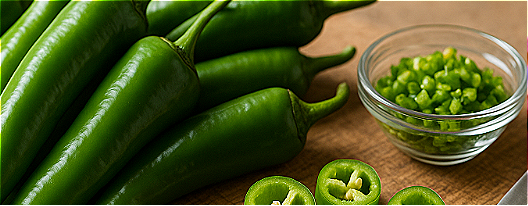
Common name: Green chili peppers
(Immature fruits of Capsicum spp.)
Source plant: Capsicum spp. (mainly Capsicum annuum, Capsicum frutescens, Capsicum chinense)
Kingdom: Plantae
Clade: Angiosperms
Clade: Eudicots
Order: Solanales
Family: Solanaceae
Genus: Capsicum
Main species involved: C. annuum, C. frutescens, C. chinense
Note: Green chili peppers are not a separate species, but simply fruits harvested at the immature stage, before turning red, yellow or orange. At this stage they usually have a somewhat milder pungency and a fresher, more “green/herbaceous” aroma compared with fully ripe fruits.
Cultivation and growing conditions of green chili peppers (Capsicum spp.)
Climate:
Prefer warm, temperate climates with a long growing season.
Sensitive to cold and frost; require mild temperatures from germination onward.
Perform best in summer with temperatures between about 20 and 30 °C.
Exposure:
Require full sun (at least 6–8 hours per day) for vigorous growth, flowering and fruit set.
Excessive shade reduces yield and pungency.
Soil:
Thrive in fertile, well-drained, medium-textured soils.
Prefer slightly acidic to neutral pH (around 6–7).
Do not tolerate waterlogging, which favors root rot and fungal diseases.
Watering:
Need regular irrigation, keeping the soil moist but not saturated.
Avoid strong alternation between drought and excess water, as this can cause flower drop, fruit cracking and higher disease incidence.
Temperature:
Optimal germination at 20–28 °C.
Ideal vegetative growth between about 18 and 30 °C.
Temperatures below roughly 12–14 °C slow development significantly.
Fertilization:
Benefit from a good initial supply of organic matter (compost or well-rotted manure).
Phosphorus and potassium support flowering, fruit set and fruit quality.
Nitrogen should be applied in moderation to avoid excessive vegetative growth at the expense of fruit production.
Crop management:
Early weed control is important during the initial growth stages.
Organic mulching can help conserve soil moisture and reduce competition from weeds.
Taller or high-yielding varieties may need staking or other supports.
Harvest:
Green chili peppers are harvested when the fruits are fully developed in size but still immature, usually deep green.
Early and repeated picking encourages continuous fruit production.
Propagation:
By seed, usually sown in protected seedbeds or trays and later transplanted to the open field or pots once outdoor temperatures are reliably mild.
Caloric value (per 100 g)
Fresh, raw: ~20–35 kcal; water ~88–92 g; available carbohydrates ~4–7 g; fiber ~1.5–3 g; protein ~1 g; fat ~0.3 g.
Roasted/cooked without added fat: similar to raw (losses in heat-sensitive vitamins).
Canned or pickled (drained): calories similar; sodium can be high depending on brine/acidification (rinsing lowers sodium).
Key constituents
Capsaicinoids: capsaicin and dihydrocapsaicin (heat; thermostable; soluble in fats/alcohol).
Vitamins: vitamin C high in fresh; provitamin A carotenoids (less than in red-ripe), B6; K1 in trace–moderate amounts.
Pigments: chlorophylls (green; shift to pheophytins with heat/acids → olive tone).
Polyphenols/flavonoids: quercetin, phenolic acids (ferulic, p-coumaric).
Dietary fiber (pectins/hemicelluloses); minerals with potassium prevalent, magnesium in traces.
Aroma compounds: 3-isobutyl-2-methoxypyrazine and other “green” volatiles; Maillard notes after roasting.
Production process
Fresh: field selection at green stage, harvest, sorting, washing, refrigeration (7–10 °C, RH 90–95%).
Fire-roasted/peeled: flame or drum roast, cool/steam-peel, remove skin/placenta/seeds, cut (strips/dice).
Shelf-stable RTE: fill with acidified brine (target acidic pH), optional CaCl₂ for firmness, seal and pasteurize/retort.
Pickled: vinegar + salt, bottling, pasteurization.
Frozen/IQF: optional peeling, cutting, rapid freezing, barrier packaging.
Sensory and technological properties
Modulating heat: remove placenta and seeds; fats and dairy soften burn (capsaicin solubilization).
Roasting: softens texture, concentrates sweetness, adds smoke; slight loss of vitamin C and chlorophylls.
Texture: pectin-based crispness; CaCl₂ helps maintain firmness in brines.
Color stability: near-neutral pH preserves green; acidity and long cooking shift to olive.
Culinary uses
Southwestern/Mexican-influenced: chile verde, green salsas, enchiladas, chiles rellenos, fire-roasted dice in tacos and omelets.
Indian/Middle Eastern: fresh mince in tadka/sautés, chutneys, pickles.
Southeast Asian: curry pastes/nam prik, quick stir-fries.
Everyday cooking: soffritto-style aromatics, marinades, aioli/mayo and sauces, controlled fermentations, pizza/sandwich toppings.
Nutrition and health
Low energy density and good amounts of vitamin C and antioxidant phytochemicals.
Thermogenesis/appetite: capsaicinoids may slightly raise energy expenditure and modulate appetite, within individual tolerance.
GI: extremely low glycemic impact at typical serving sizes.
GI sensitivity/GERD: high doses may irritate; prefer gentle cooking and soothing pairings.
Sodium: monitor in pickled/canned forms; choose low-salt or rinse before use.
Fat profile
Very low total fat. Seeds/placenta contribute micro-fractions, mostly PUFA (polyunsaturated fatty acids; can support heart health when balanced), MUFA (monounsaturated; often neutral/beneficial), and minimal SFA (saturated; limit in overall diet). Values depend on cultivar and seed content.
Quality and specifications (typical topics)
Fresh: high turgor, smooth intact skin, uniform green, minimal browning; green stem; free of decay/pests; size and length consistent.
Roasted/peeled: clean peel, minimal residual seeds/char, uniform cut.
Canned/pickled: drained weight in spec; compliant acidic pH; firm but not mushy; declared salt; optional CaCl₂ at technical doses.
Microbiology: commercial sterility for retorted goods; for acidified/pasteurized, pH ≤ 4.6 with validated processes.
Residues: pesticides/metals within limits; free of foreign matter.
Storage and shelf life
Fresh: 7–10 °C, RH 90–95% (avoid <7 °C to prevent chilling injury); 1–2 weeks depending on cultivar and cold chain.
Roasted/peeled, refrigerated: ≤4 °C, 3–4 days; suitable for freezing.
Shelf-stable: 18–24 months (retort) if the pack is intact; pickles/pastes depend on pH and process.
Protect from light/oxygen to preserve color/aroma; seal well after opening and consume promptly.
Allergens and safety
Gluten-free by nature; rare cross-reactions in sensitive individuals to other Solanaceae.
Capsaicin is irritant: use gloves for intensive handling; avoid contact with eyes/skin; keep away from children.
Physical hazards: seeds/skins may persist in homemade products; strain if needed.
INCI functions in cosmetics
Possible entries: Capsicum Annuum Fruit Extract, Capsicum Frutescens Fruit Extract, Capsicum Frutescens Resin, Capsaicin.
Roles: warming/rubefacient, skin-conditioning, toning, masking in targeted products (muscle balms/scalp lotions). Use at very low doses with safety evaluation, compliant claims, and intended-use controls.
Troubleshooting
Too hot: remove placenta/seeds, blend with milder varieties, add fat/dairy or a touch of sugar; dilute during cooking.
Green turns olive: excessive acidity/overcooking → cook briefly; add acids at the end.
Bitter/over-green: pass over flame or griddle to light char; peel.
Mushy in cans: overprocessing or pectin loss → optimize time/temperature; consider CaCl₂.
Overly smoky: balance with acidic/fresh elements (lime, yogurt, herbs).
Sustainability and supply chain
Moderate inputs versus many crops; good yields in open field and protected cultivation.
Process efficiency: valorize by-products (seeds/placenta for oleoresins), cut waste; manage brines/effluents toward BOD/COD targets.
Cold-chain logistics, recyclable packs; traceability and hygiene prerequisites under GMP/HACCP.
Conclusion
Green chiles deliver fresh aroma and adjustable heat with a light nutritional profile and notable vitamin C and phytochemicals. Choice of cultivar and processing (roasting, acidification, retort, freezing) lets you tune intensity, texture, and shelf life. Careful control of pH, salt, and process validation preserves safety and sensory quality, while smart pairings enhance digestibility and flavor balance.
Mini-glossary
SHU — Scoville Heat Units: measure of perceived heat; rises with capsaicinoids.
GI — Glycemic Index: low impact here due to minimal available carbs.
SFA — Saturated Fatty Acids: limit in overall diet; minimal in green chiles.
MUFA — Monounsaturated Fatty Acids: often neutral/beneficial for lipids.
PUFA — Polyunsaturated Fatty Acids: can support heart health; more prone to oxidation.
GMP/HACCP — Good Manufacturing Practice / Hazard Analysis and Critical Control Points: preventive hygiene systems with validated CCPs.
BOD/COD — Biochemical/Chemical Oxygen Demand: indicators of process-effluent impact on wastewater.
Studies
Fresh pepper contains phenols, flavonoids, capsaicinoids, ascorbic acid, all components that exert an antioxidant activity. In the treated pepper there are fewer phytochemical components and the antioxidant activity is lower (1). Cooking the pepper subtracts at least 60% of vitamin C.
Capsaicin is the alkaloid that gives the pepper its spicy taste, it is a component with antioxidant properties.
An extract from the leaves of pepper significantly inhibited inflammatory cytokine production, inhibited cell proliferation without producing cytotoxicity, and suppressed the expression of inflammatory proteins (2).
Among the polyphenols present, caffeic acid, quercetin and kaempferol have the highest amounts and have shown antimicrobial activity (3).
From green bell pepper, an extract of pectic polysaccharides showed antineoplastic activity in breast cancer, in vitro and in vivo (4).

