Olio di limone (ingrediente alimentare)
Descrizione
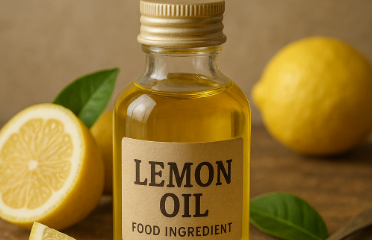
Olio essenziale ottenuto principalmente dalla spremitura a freddo delle bucce di Citrus limon (L.) Osbeck, impiegato come aroma naturale in alimenti e bevande.
Profilo: note agrumate fresche, limonose e vivaci con sfumature verdi; colore giallo paglierino; liquido mobile altamente volatile.
Disponibile come olio espresso, olio de-terpenato (folded 2×, 5×, 10×) o come emulsione pronta per bevande.
Valore calorico (per 100 g di prodotto)
Principali sostanze contenute
Monoterpeni: d-limonene (prevalente), β-pinene, γ-terpinene.
Componenti ossigenati (chiave per l’aroma): citral (miscela geraniale/nerale), linalool, cis-/trans-citral derivati, α-terpineolo.
Furocumarine (tracce variabili nell’olio espresso): bergaptene, oxypeucedanin; assenti o molto ridotte nelle versioni FCF (furanocoumarin-free) o distillate.
Marcatori analitici tipici: GC–MS fingerprint, limonene %, citral %, rotazione ottica, indice di rifrazione, densità, perossidi.
Processo di produzione
Materia prima: bucce fresche da filiera del succo; separazione meccanica delle vescicole oleifere.
Estrazione: spremitura a freddo con acqua → separazione per centrifugazione.
Purificazione/standardizzazione: filtrazione, eventuale deterpenazione/folding per concentrare i componenti ossigenati e migliorare stabilità e solubilità.
Formulazione per bevande: emulsioni O/W con gomma arabica/amidi modificati e, se necessario, agenti di peso (es. esteri della colofonia, SAIB).
Controlli sotto GMP/HACCP con CCP su residui pesticidi, metalli, carica microbica del veicolo, adulterazioni e integrità del sigillo.
Proprietà sensoriali e tecnologiche
Intensità aromatica elevata; le versioni folded offrono nota di citral più marcata e maggiore resistenza in processo.
Volatilità/ossidazione: sensibile a luce, ossigeno e calore; l’ossidazione del limonene genera note resinose/vernice.
Solubilità: l’olio è lipofilo; per usi in acqua/bevande richiede emulsione o premiscela idroalcolica; rischio di oiling-out senza corretta emulsione/HLB.
Impieghi alimentari
Bevande (bibite, tè freddi, hard seltzer) tramite emulsioni o aromatizzanti solubili.
Prodotti da forno, creme, gelati/sorbetti, confetteria, sciroppi e salse dessert.
Prodotti salati: maionesi/salse, marinature per pesce/pollo, condimenti.
Dosaggi orientativi (da validare in prova): 5–60 ppm in bevande pronte, 20–300 ppm in bakery/confetteria; usare pre-diluizioni per dosaggi accurati.
Nutrizione e salute
Ai livelli d’uso è una sostanza aromatizzante; non si attribuiscono claim salutistici senza specifica autorizzazione.
Possibili ipersensibilità individuali a componenti (es. limonene, linalool, citral); non è un allergene maggiore UE in ambito alimentare.
Le furocumarine sono rilevanti soprattutto nell’uso cosmetico (fototossicità cutanea); in alimenti le quantità sono molto basse.
Qualità e specifiche (temi tipici)
Identità: profilo GC–MS coerente (limonene dominante, citral e terpeni secondari).
Parametri fisici: densità e indice di rifrazione in range, rotazione ottica positiva tipica.
Purezza: limiti per perossidi, aldeidi di ossidazione, adulteranti (terpeni esogeni, ftalati, solventi).
Contaminanti: pesticidi conformi; metalli bassi; furocumarine sotto target per l’uso previsto.
Stabilità: test di luce/calore/ossigeno; assenza di torbidità/sedimenti in emulsione.
Etichetta: indicare origine botanica (Citrus limon), eventuale fold/FCF, supporti/emulsionanti se presenti.
Conservazione e shelf-life
Conservare in vetro ambrato o latta barriera, colmo d’azoto, al buio, a T bassa (preferibilmente ≤10 °C).
Minimizzare ossigeno nello spazio di testa; evitare contenitori permeabili.
Shelf-life tipica 12–24 mesi (grado e pack dipendono); richiudere subito dopo l’uso.
Allergeni e sicurezza
Non contiene allergeni maggiori ai sensi UE in food; attenzione a ipersensibilità ai singoli componenti aromatici.
Fototossicità: rilevante per uso topico non alimentare; per alimenti privilegiare gradi FCF quando opportuno.
Rigoroso rispetto di GMP/HACCP; CCP su residui, ossidazione, stabilità emulsioni e corpi estranei.
Funzioni INCI in cosmesi
Voci tipiche: Citrus Limon (Lemon) Peel Oil, varianti FCF (furanocoumarin-free).
Ruoli: fragrance, masking, skin conditioning. Per leave-on rispettare limiti d’uso e preferire FCF.
Troubleshooting
Oiling-out / ring di olio in bevande: emulsione inadeguata/HLB errato → usare emulsioni stabilizzate (gomma arabica/amidi modificati) e, se necessario, agenti di peso; controllare dimensione gocce.
Off-note resinosa/vernice: ossidazione del limonene → aggiungere antiossidanti idonei (es. tocoferoli/estratto di rosmarino), migliorare pack e headspace inerte.
Perdita di intensità: volatilizzazione in cottura → usare folded o encapsulation/inclusioni; dosare a freddo quando possibile.
Torbidità/instabilità in bevande: coalescenza → ottimizzare emulsione, pH, forza ionica; evitare etanolo insufficiente nelle soluzioni idroalcoliche.
Sostenibilità e filiera
Upcycling di bucce dalla filiera del succo; riduzione sprechi.
Migliorare l’impatto con recupero solvente/energia, gestione reflui verso BOD/COD target, imballaggi riciclabili e logistica a freddo.
Tracciabilità completa in GMP/HACCP; preferire fornitori con residui bassi e certificazioni di qualità.
Conclusione
L’olio di limone è un aroma naturale potente e versatile. La selezione del grado (espresso, folded, FCF), la protezione da luce/ossigeno/calore e una formulazione corretta (emulsioni o pre-diluizioni) determinano stabilità, sicurezza e coerenza sensoriale in applicazione.
Mini-glossario
GC–MS — gascromatografia–spettrometria di massa: impronta analitica per identificare e quantificare i componenti volatili.
FCF — furanocoumarin-free: grado privo di furocumarine per ridurre rischi di fototossicità (rilevante in cosmesi).
HLB — hydrophilic–lipophilic balance: indice per scegliere l’emulsionante adeguato all’olio essenziale.
SAIB — sucrose acetate isobutyrate: agente di pesatura per emulsioni di bevande.
Folding (2×/5×/10×) — concentrazione frazionata dell’olio (riduzione terpeni, ↑ componenti ossigenati) per migliorare stabilità/impatto.
GMP/HACCP — good manufacturing practice / hazard analysis and critical control points: sistemi igienico-preventivi con CCP definiti.
CCP — critical control point: fase in cui un controllo previene/riduce un pericolo (es. residui, ossidazione, sigillo).
BOD/COD — domanda biochimica/chimica di ossigeno: indicatori dell’impatto dei reflui di processo.
Bibliografia__________________________________________________________________________
Manjunath C, Mahurkar N. In vitro cytotoxicity of cardamom oil, lemon oil, and jasmine oil on human skin, gastric, and brain cancer cell line. J Cancer Res Ther. 2021 Jan-Mar;17(1):62-68. doi: 10.4103/jcrt.JCRT_915_17.
Abstract. Objective: The main objective of the study was to evaluate the cytotoxicity of selected essential oils on human skin, gastric, and brain cancer cell lines using microculture tetrazolium test. Materials and methods: Phytochemical analysis, as well as acute oral toxicity tests, was carried out in female albino mice with cardamom oil, lemon oil, and jasmine oil according to the Organization for Economic Co-operation and Development guidelines 425. Anticancer activities of the above test drugs were performed using human cancer cell lines. The studies were carried out at Skanda Life Sciences Pvt. Ltd., Bengaluru. Results: Phytochemical analysis has shown the presence of carbohydrates and flavonoids in cardamom oil. While lemon oil has shown the presence of carbohydrates, flavonoids, steroids, terpenoids, and tannins, jasmine oil has shown the presence of carbohydrates, alkaloids, flavonoids, steroids, terpenoids, and glycosides. Toxicity studies showed that cardamom oil, lemon oil, and jasmine oil were all found to be safe up to 2000 mg/kg body weight. Results have shown that lemon oil exhibited the strongest cytotoxicity toward three human cancer cell lines, namely skin cancer (A431), gastric cancer (MKN-45), and brain cancer (U-87 MG) cell lines, with higher IC50 values of 62.82 μg/ml, 220.9 μg/ml, and 440.1 μg/ml compared to standard. Jasmine oil exhibited the strongest cytotoxicity toward skin cancer and brain cancer cell lines, whereas cardamom oil has shown stronger cytotoxicity only toward skin cancer cell line but did not show any level of inhibition of growth of brain and gastric cancer cells. Conclusion: Our study reveals that lemon oil, jasmine oil, and cardamom oil possess potent antitumor activity compared to standard. At different concentrations, lemon oil has shown statistically significant (***P < 0.0001) anticancer activity toward all the three human cancer cell lines. While jasmine oil has shown statistically significant (***P < 0.0001) anticancer activity toward skin and brain cancer cell line, cardamom oil has also shown statistically significant (***P < 0.0001) anticancer activity but only toward skin cancer cell line.
Naganuma M, Hirose S, Nakayama Y, Nakajima K, Someya T. A study of the phototoxicity of lemon oil. Arch Dermatol Res. 1985;278(1):31-6. doi: 10.1007/BF00412492.
Abstract. Lemon oil contains furocoumarin derivatives and is known to cause phototoxicity. In this study, lemon oil was fractionated, and its phototoxic activity was measured by means of a biological assay. The substances producing phototoxicity were identified by high-performance liquid chromatography as being oxypeucedanin and bergapten. The phototoxic potency of oxypeucedanin was only one-quarter of that of bergapten. However, the amounts of these two phototoxic compounds present in lemon oils produced in different regions of the world varied by a factor of more than 20 (bergapten, 4-87 ppm; oxypeucedanin, 26-728 ppm), and their ratio was not constant. The two compounds accounted for essentially all of the phototoxic activity of all lemon-oil samples. Among various other citrus-essential oils investigated, lime oil and bitter-orange oil also contained large amounts of oxypeucedanin. Oxypeucedanin was found to elicit photopigmentation on colored-guinea-pig skin without preceding visible erythema.
Ibrahium SM, Wahba AA, Farghali AA, Abdel-Baki AS, Mohamed SAA, Al-Quraishy S, Hassan AO, Aboelhadid SM. Acaricidal Activity of Tea Tree and Lemon Oil Nanoemulsions against Rhipicephalus annulatus. Pathogens. 2022 Dec 9;11(12):1506. doi: 10.3390/pathogens11121506.
Abstract. Tick infestation is a serious problem in many countries since it has an impact on the health of animals used for food production and pets, and frequently affects humans. Therefore, the present study aimed to investigate the acaricidal effects of nanoemulsions of essential oils of Melaleuca alternifolia (tea tree, TT) and Citrus limon (lemon oil, CL) against the different stages (adult, eggs, and larvae) of deltamethrin-resistant Rhipicephalus annulatus ticks. Three forms of these oils were tested: pure oils, nanoemulsions, and a binary combination. Tea tree and lemon oil nanoemulsions were prepared, and their properties were assessed using a zeta droplet size measurement and a UV-Vis spectrophotometer. The results showed that TT and CL exhibited higher adulticidal effects in their pure forms than in their nanoemulsion forms, as demonstrated by the lower concentrations required to achieve LC50 (2.05 and 1.26%, vs. 12.8 and 11.4%, respectively) and LC90 (4.01% and 2.62%, vs. 20.8 and 19.9%, respectively). Significant larvicidal activity was induced by the TTCL combination, and LC50 was reached at a lower concentration (0.79%) than that required for the pure and nanoemulsion forms. The use of pure CL oil was found to have the most effective ovicidal effects. In conclusion, pure TT and CL have potent acaricidal effects against phenotypically resistant R. annulatus isolates. It is interesting that the activity levels of TT and CL EOs' binary and nanoemulsion forms were lower than those of their individual pure forms.
Komiya M, Takeuchi T, Harada E. Lemon oil vapor causes an anti-stress effect via modulating the 5-HT and DA activities in mice. Behav Brain Res. 2006 Sep 25;172(2):240-9. doi: 10.1016/j.bbr.2006.05.006.
Abstract. We examined the anti-stress action of the essential oils of lavender, rose, and lemon using an elevated plus-maze task (EPM), a forced swimming task (FST), and an open field task (OFT) in mice. Lemon oil had the strongest anti-stress effect in all three behavioral tasks. We further investigated a regulatory mechanism of the lemon oil by pre-treatments with agonists or antagonists to benzodiazepine, 5-HT, DA, and adrenaline receptors by the EPM and the FST. The anti-stress effect of lemon oil was significantly blocked by pre-treatment with frumazenil, benzodiazepine receptor antagonist, or apomorphine, a nonselective DA receptor agonist. In contrast, agonists or antagonists to the 5-HT receptor and the alpha-2 adrenaline receptor did not affect the anti-stress effect of lemon oil. Buspirone, DOI, and mianserine blocked the antidepressant-like effect of lemon oil in the FST, but WAY100,635 did not. These findings suggest that the antidepressant-like effect of lemon oil is closely related with the 5-HTnergic pathway, especially via 5-HT(1A) receptor. Moreover, the lemon oil significantly accelerated the metabolic turnover of DA in the hippocampus and of 5-HT in the prefrontal cortex and striatum. These results suggest that lemon oil possesses anxiolytic, antidepressant-like effects via the suppression of DA activity related to enhanced 5-HTnergic neurons.
Kreye G, Wasl M, Dietz A, Klaffel D, Groselji-Strele A, Eberhard K, Glechner A. Aromatherapy in Palliative Care: A Single-Institute Retrospective Analysis Evaluating the Effect of Lemon Oil Pads against Nausea and Vomiting in Advanced Cancer Patients. Cancers (Basel). 2022 Apr 24;14(9):2131. doi: 10.3390/cancers14092131.
Abstract. Aromatherapy is regularly used in the University Hospital Krems's palliative care unit. In a retrospective analysis, we investigated whether there were improvements in nausea and vomiting in patients with advanced cancers over a time span of 24 months. Data collection used the medical records of patients who were institutionally approved to receive routine aroma applications for alleviating nausea and vomiting. The efficacy of using lemon oil pads was tested with one-dimensional chi-squared tests. Sixty-six patients received 222 applications of lemon oil on cotton pads; no data were available for 17 applications. The adequate relief of nausea and vomiting was reported for 149 (73%) applications, whereas no symptom control was seen for 56 (27%) applications. For the 56 applications without symptom control, first- and second-line rescue medications were successful in 53 and 3 cases, respectively. The use of aromatherapy with lemon oil pads against nausea and vomiting was feasible for 73% of all applications. All patients who did not benefit from aromatherapy had effective symptom control with a rescue medication. Large randomized prospective trials are necessary to evaluate the benefit of the use of lemon oil pads against nausea and vomiting in patients with advanced cancer.
EFSA Panel on Additives and Products or Substances used in Animal Feed (FEEDAP); Bampidis V, Azimonti G, Bastos ML, Christensen H, Kouba M, Fašmon Durjava M, López-Alonso M, López Puente S, Marcon F, Mayo B, Pechová A, Petkova M, Ramos F, Sanz Y, Villa RE, Woutersen R, Brantom P, Chesson A, Westendorf J, Galobart J, Manini P, Pizzo F, Dusemund B. Safety and efficacy of feed additives consisting of expressed lemon oil and its fractions from Citrus limon (L.) Osbeck and of lime oil from Citrus aurantiifolia (Christm.) Swingle for use in all animal species (FEFANA asbl). EFSA J. 2021 Apr 30;19(4):e06548. doi: 10.2903/j.efsa.2021.6548. PMID: 33968248; PMCID: PMC8085978.




