Funghi (mushrooms) — ingredienti per alimenti
Descrizione
Ingredienti ottenuti da corpi fruttiferi di specie edibili coltivate o spontanee (es. Agaricus bisporus — champignon, Pleurotus ostreatus — pleurotus, Lentinula edodes — shiitake, Boletus edulis — porcino, Cantharellus cibarius — finferlo).
Forme commerciali: freschi, refrigerati/ATM, surgelati IQF, essiccati (interi/fette), liofilizzati, in salamoia o sott’olio (acidificati), macinati/polvere ed estratti (brodi/seasoning).
Profilo sensoriale: umami spiccato (glutammato + 5’-nucleotidi), note terrose/nocciolate; consistenza da tenero (champignon) a carnoso (porcini/pleurotus).
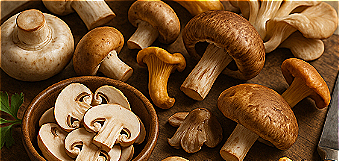
Valore calorico (per 100 g di prodotto)
Freschi: ~20–30 kcal; proteine ~2–4 g, carboidrati ~2–4 g (prevalenza di fibre), grassi ~0,2–0,6 g, fibre ~1–3 g.
Surgelati: simile ai freschi.
Essiccati: ~230–320 kcal (concentrazione solidi); proteine ~20–30 g, fibre ~20–35 g, grassi ~2–6 g.
Funghi in salamoia/sott’olio: energia variabile; sodio elevato (salamoia), grassi elevati se in olio.
Principali sostanze contenute
Aminoacidi liberi (spec. glutammato, aspartato) e 5’-nucleotidi (5’-GMP, 5’-IMP, 5’-XMP) → umami sinergico.
Fibre: β-glucani, chitina, emicellulose (sazietà/texture).
Antiossidanti: ergotioneina, polifenoli, ergosterolo (precursore vitamina D₂ se esposti a UV).
Minerali: potassio elevato; selenio variabile (specie/terreno).
Enzimi: PPO (polifenolossidasi) responsabile dell’imbrunimento enzimatico.
Marcatori: °Brix (solidi nel mezzo di governo), pH (acidificati <4,5), aw, resa di reidratazione (essiccati), metalli entro limiti.
Processo di produzione
Freschi: coltivazione su substrati controllati → raccolta → selezione/calibratura → lavaggio delicato o spazzolatura → taglio → ATM/sottovuoto → catena del freddo.
Surgelati IQF: sbianchitura/precottura breve → congelamento rapido → confezionamento barriera.
Essiccati/liofilizzati: affettatura → essiccazione ad aria o liofilizzazione → setacciatura → pack barriera all’umidità.
Conserve: scottatura, invasamento in salamoia/olio con acidificazione (es. acido acetico/citrico) → pastorizzazione → raffreddamento rapido.
Polveri/estratti: essiccazione → macinazione fine → eventuale estrazione acquosa e concentrazione (brodi/umami booster).
Qualità sotto **GMP/HACCP** con CCP su igiene, pH (acidificati), parametri termici, sigillo/integrità.
Proprietà sensoriali e tecnologiche
Umami e rotondità del gusto; synergy glutammato–5’-nucleotidi potenzia altre note sapide.
Texture: da succosa a “meaty”; gli essiccati reidratati mantengono aromi intensi.
Browning: PPO causa imbrunimento su taglio/aria → limitare con pH acido/antiossidanti e bassa O₂.
Legante/ispessente: le polveri aumentano corpo e viscosità in salse/zuppe.
Rilascio d’acqua in cottura: gestire con saltatura breve e calore alto.
Impieghi alimentari
Primi piatti (risotti, paste), salse e ragù (anche vegetariani), zuppe/consommé, ripieni, contorni e grigliate.
Condimenti: polvere di funghi/porcini come esaltatore naturale; estratti per brodi/insaporitori.
Plant-based: base per burger/polpette vegetali e falsi “shredded” (pleurotus).
Snack: chips di funghi essiccati/forno.
Nutrizione e salute
Basso tenore calorico nei freschi; fibre e composti bioattivi (es. ergotioneina).
Vitamina D₂ aumentabile con trattamento UV post-raccolta.
FODMAP: alcune specie sono ricche di mannitolo → attenzione in soggetti sensibili.
Sodio: alto nelle versioni in salamoia; preferire riscacquo o varianti a basso sale.
Profilo dei grassi
Tenore di grassi molto basso; composizione tipica: prevalenza di acidi grassi **PUFA** (grassi polinsaturi, soprattutto linoleico), quota di **MUFA** (grassi monoinsaturi) e minima **SFA** (grassi saturi). Impatto lipidico modesto alle porzioni d’uso.
Qualità e specifiche (temi tipici)
Freschi: assenza di vischio/mucose, turgore, imbiancatura minima, calibri omogenei, terra/sabbia assente.
Essiccati: umidità ≤12%, assenza di infestanti e corpi estranei, purezza di specie dichiarata.
Conserve: pH <4,5, peso sgocciolato in specifica, sale dichiarato, mezzo di governo limpido.
Microbiologia: patogeni assenti/25 g, lieviti/muffe contenuti; spore gestite da processo.
Residui/metalli entro limiti; attenzione ai metalli pesanti nei selvatici.
Conservazione e shelf-life
Freschi: 0–4 °C, 5–7 giorni (ATM prolunga); evitare lavaggi anticipati.
Surgelati: ≤−18 °C, 8–12 mesi.
Essiccati/liofilizzati: luogo asciutto e buio, 12–24 mesi; richiudere subito.
Conserve: ambiente se integre; dopo apertura ≤4 °C e consumo in 3–5 giorni (olio) o 3–4 giorni (salamoia).
Allergeni e sicurezza
Non sono tra gli allergeni maggiori UE, ma possibili ipersensibilità individuali.
Identificazione specie: essenziale per i selvatici (rischio specie tossiche).
C. botulinum: rischio nei prodotti in olio se non acidificati → rispettare pH/ricette ufficiali.
Contaminanti naturali: agaritina (in Agaricus; termolabile); evitare specie note per tossine (es. Gyromitra).
Possibili solfiti in conserve: etichettare.
Funzioni INCI in cosmesi
Voci tipiche: Mushroom Extract, Ganoderma Lucidum (Mushroom) Extract, Lentinus Edodes (Shiitake) Extract, Tremella Fuciformis Polysaccharide.
Ruoli: antioxidant, skin conditioning, film forming/umettante (polisaccaridi).
Troubleshooting
Imbrunimento post-taglio: attività PPO → acidificare leggermente (es. succo di limone), ridurre O₂, raffreddare.
Testura molle/acquosa in padella: eccesso d’acqua → saltare a fuoco vivo, porzioni ridotte, salare a fine cottura.
Sapore terroso/muschio: materia prima vecchia → usare lotti freschi, pulizia accurata.
Essiccati gommosi: reidratazione insufficiente → ammollo in acqua tiepida 20–30 min; filtrare e riusare l’acqua d’ammollo.
Conserve troppo salate: riscacquare o bilanciare in ricetta; scegliere low-salt.
Sostenibilità e filiera
Coltivazione su substrati agricoli di scarto (paglia/segatura) con alta efficienza d’uso risorse; bassa impronta GHG rispetto ad altre proteine.
Substrato esausto valorizzabile come ammendante/compost; gestione reflui verso target **BOD/COD**.
Imballaggi riciclabili; catena del freddo efficiente; tracciabilità completa sotto **GMP/HACCP**.
Conclusione
I funghi sono ingredienti versatili e naturali che apportano umami, struttura e aromi complessi con basso impatto calorico nei prodotti freschi. Scelta della specie, forma (fresco/essiccato/conserva) e controllo di pH/umidità/ossigeno sono i driver chiave per stabilità, sicurezza e coerenza sensoriale.
Mini-glossario
aw — attività dell’acqua: quota di acqua “libera”; aw più bassa → migliore stabilità microbiologica.
PPO — polifenolossidasi: enzima responsabile dell’imbrunimento dei tessuti tagliati.
FODMAP — fermentable oligo-, di-, mono-saccharides and polyols: carboidrati fermentabili che possono dare disturbi gastrointestinali in soggetti sensibili.
HPP — high pressure processing: pastorizzazione ad alta pressione che preserva aroma/colore.
GMP/HACCP — good manufacturing practice / hazard analysis and critical control points: sistemi igienico–preventivi con CCP definiti.
CCP — critical control point: fase in cui un controllo previene/riduce un pericolo (es. pH, parametri termici, sigillo).
BOD/COD — domanda biochimica/chimica di ossigeno: indicatori dell’impatto dei reflui.
IQF — individual quick freezing: surgelazione rapida porzionata.
MAP/ATM — modified atmosphere packaging/atmosfera modificata: confezionamento con gas protettivi (N₂/CO₂) per prolungare la shelf-life.
5’-GMP / 5’-IMP / 5’-XMP — 5’-guanosina/inosina/xantosina monofosfato: nucleotidi che potenziano l’umami.
**SFA** — grassi saturi: in eccesso possono aumentare LDL; nei funghi sono minimi.
**MUFA** — grassi monoinsaturi (es. oleico): quota minore, effetto neutro/favorevole sui lipidi ematici.
**PUFA** — grassi polinsaturi (es. linoleico): quota prevalente nei pochi grassi totali dei funghi.
Bibliografia__________________________________________________________________________
Cerletti C, Esposito S, Iacoviello L. Edible Mushrooms and Beta-Glucans: Impact on Human Health. Nutrients. 2021 Jun 25;13(7):2195. doi: 10.3390/nu13072195.
Abstract. Mushroom cell walls are rich in β-glucans, long or short-chain polymers of glucose subunits with β-1,3 and β-1,6 linkages, that are responsible for the linear and branching structures, respectively. β-glucans from cereals, at variance, have no 1,6 linkages nor branching structures. Both immunomodulatory and anti-inflammatory effects of mushrooms have been described using purified β-glucans or fungi extracts on cellular and experimental models; their potential clinical use has been tested in different conditions, such as recurrent infections of the respiratory tract or complications of major surgery. Another promising application of β-glucans is on cancer, as adjuvant of conventional chemotherapy. β-glucans may protect the cardiovascular system, ameliorating glucose, lipid metabolism, and blood pressure: these activities, observed for oat and barley β-glucans, require confirmation in human studies with mushroom β-glucans. On the other hand, mushrooms may also protect the cardiovascular system via a number of other components, such as bioactive phenolic compounds, vitamins, and mineral elements. The growing knowledge on the mechanism(s) and health benefits of mushrooms is encouraging the development of a potential clinical use of β-glucans, and also to further document their role in preserving health and prevent disease in the context of healthy lifestyles.
González A, Cruz M, Losoya C, Nobre C, Loredo A, Rodríguez R, Contreras J, Belmares R. Edible mushrooms as a novel protein source for functional foods. Food Funct. 2020 Sep 23;11(9):7400-7414. doi: 10.1039/d0fo01746a. P
Abstract. Fast demographic growth has led to increasing interest in low-cost alternative protein sources to meet population needs. Consequently, scientific researchers have been focused on finding under-exploited sources of protein, alternative to those of animal origin. Usually plant proteins have been used for this purpose; however, most of them are not considered to be high quality due to their lack of some essential amino acids. Mushroom proteins usually have a complete essential amino acid profile, which may cover the dietetic requirements, as well as may have certain economic advantages as compared to animal and plant sources. Many mushrooms also have the ability to grow in agro-industrial waste, as submerged cultures, reaching high yields in a short period of time. Edible mushrooms can be processed to obtain a wide variety of food products enriched with high quality protein, which may have as well improved functional properties, giving them an added value. This review discusses the use of mushrooms as sustainable functional food.
Shamim MZ, Mishra AK, Kausar T, Mahanta S, Sarma B, Kumar V, Mishra PK, Panda J, Baek KH, Mohanta YK. Exploring Edible Mushrooms for Diabetes: Unveiling Their Role in Prevention and Treatment. Molecules. 2023 Mar 21;28(6):2837. doi: 10.3390/molecules28062837.
Abstract. Diabetes mellitus is a complex illness in which the body does not create enough insulin to control blood glucose levels. Worldwide, this disease is life-threatening and requires low-cost, side-effect-free medicine. Due to adverse effects, many synthetic hypoglycemic medications for diabetes fail. Mushrooms are known to contain natural bioactive components that may be anti-diabetic; thus, scientists are now targeting them. Mushroom extracts, which improve immune function and fight cancer, are becoming more popular. Mushroom-derived functional foods and dietary supplements can delay the onset of potentially fatal diseases and help treat pre-existing conditions, which leads to the successful prevention and treatment of type 2 diabetes, which is restricted to the breakdown of complex polysaccharides by pancreatic-amylase and the suppression of intestinal-glucosidase. Many mushroom species are particularly helpful in lowering blood glucose levels and alleviating diabetes symptoms. Hypoglycaemic effects have been observed in investigations on Agaricussu brufescens, Agaricus bisporus, Cordyceps sinensis, Inonotus obliqus, Coprinus comatus, Ganoderma lucidum, Phellinus linteus, Pleurotus spp., Poria cocos, and Sparassis crispa. For diabetics, edible mushrooms are high in protein, vitamins, and minerals and low in fat and cholesterol. The study found that bioactive metabolites isolated from mushrooms, such as polysaccharides, proteins, dietary fibers, and many pharmacologically active compounds, as well as solvent extracts of mushrooms with unknown metabolites, have anti-diabetic potential in vivo and in vitro, though few are in clinical trials.
Thu ZM, Myo KK, Aung HT, Clericuzio M, Armijos C, Vidari G. Bioactive Phytochemical Constituents of Wild Edible Mushrooms from Southeast Asia. Molecules. 2020 Apr 23;25(8):1972. doi: 10.3390/molecules25081972.
Abstract. Mushrooms have a long history of uses for their medicinal and nutritional properties. They have been consumed by people for thousands of years. Edible mushrooms are collected in the wild or cultivated worldwide. Recently, mushroom extracts and their secondary metabolites have acquired considerable attention due to their biological effects, which include antioxidant, antimicrobial, anti-cancer, anti-inflammatory, anti-obesity, and immunomodulatory activities. Thus, in addition to phytochemists, nutritionists and consumers are now deeply interested in the phytochemical constituents of mushrooms, which provide beneficial effects to humans in terms of health promotion and reduction of disease-related risks. In recent years, scientific reports on the nutritional, phytochemical and pharmacological properties of mushroom have been overwhelming. However, the bioactive compounds and biological properties of wild edible mushrooms growing in Southeast Asian countries have been rarely described. In this review, the bioactive compounds isolated from 25 selected wild edible mushrooms growing in Southeast Asia have been reviewed, together with their biological activities. Phytoconstituents with antioxidant and antimicrobial activities have been highlighted. Several evidences indicate that mushrooms are good sources for natural antioxidants and antimicrobial agents.
Phan CW, David P, Sabaratnam V. Edible and Medicinal Mushrooms: Emerging Brain Food for the Mitigation of Neurodegenerative Diseases. J Med Food. 2017 Jan;20(1):1-10. doi: 10.1089/jmf.2016.3740.
Abstract. There is an exponential increase in dementia in old age at a global level because of increasing life expectancy. The prevalence of neurodegenerative diseases such as dementia and Alzheimer's disease (AD) will continue to rise steadily, and is expected to reach 42 million cases worldwide in 2020. Despite the advancement of medication, the management of these diseases remains largely ineffective. Therefore, it is vital to explore novel nature-based nutraceuticals to mitigate AD and other age-related neurodegenerative disorders. Mushrooms and their extracts appear to hold many health benefits, including immune-modulating effects. A number of edible mushrooms have been shown to contain rare and exotic compounds that exhibit positive effects on brain cells both in vitro and in vivo. In this review, we summarize the scientific information on edible and culinary mushrooms with regard to their antidementia/AD active compounds and/or pharmacological test results. The bioactive components in these mushrooms and the underlying mechanism of their activities are discussed. In short, these mushrooms may be regarded as functional foods for the mitigation of neurodegenerative diseases.
Yan Z, Liu H, Li J, Wang Y. Application of Identification and Evaluation Techniques for Edible Mushrooms: A Review. Crit Rev Anal Chem. 2023;53(3):634-654. doi: 10.1080/10408347.2021.1969886.
Abstract. Edible mushrooms are healthy food with high nutritional value, which is popular with consumers. With the increase of the problem of mushrooms being confused with the real and pollution in the market, people pay more and more attention to food safety. More than 167 articles of edible mushroom published in the past 20 years were reviewed in this paper. The analysis tools and data analysis methods of identification and quality evaluation of edible mushroom species, origin, mineral elements were reviewed. Five techniques for identification and evaluation of edible mushrooms were introduced and summarized. The macroscopic, microscopic and molecular identification techniques can be used to identify species. Chromatography, spectroscopy technology combined with chemometrics can be used for qualitative and quantitative study of mushroom and evaluation of mushroom quality. In addition, multiple supervised pattern-recognition techniques have good classification ability. Deep learning is more and more widely used in edible mushroom, which shows its advantages in image recognition and prediction. These techniques and analytical methods can provide strong support and guarantee for the identification and evaluation of mushroom, which is of great significance to the development and utilization of edible mushroom.
Falandysz J. Selenium in edible mushrooms. J Environ Sci Health C Environ Carcinog Ecotoxicol Rev. 2008 Jul-Sep;26(3):256-99. doi: 10.1080/10590500802350086.
Abstract. Selenium is vital to human health. This article is a compendium of virtually all the published data on total selenium concentrations, its distribution in fruitbody, bioconcentration factors, and chemical forms in wild-grown, cultivated, and selenium-enriched mushrooms worldwide. Of the 190 species reviewed (belonging to 21 families and 56 genera), most are considered edible, and a few selected data relate to inedible mushrooms. Most of edible mushroom species examined until now are selenium-poor (< 1 microg Se/g dry weight). The fruitbody of some species of wild-grown edible mushrooms is naturally rich in selenium; their occurrence data are reviewed, along with information on their suitability as a dietary source of selenium for humans, the impact of cooking and possible leaching out, the significance of traditional mushroom dishes, and the element's absorption rates and co-occurrence with some potentially problematic elements. The Goat's Foot (Albatrellus pes-caprae) with approximately 200 microg Se/g dw on average (maximum up to 370 microg/g dw) is the richest one in this element among the species surveyed. Several other representatives of the genus Albatrellus are also abundant in selenium. Of the most popular edible wild-grown mushrooms, the King Bolete (Boletus edulis) is considered abundant in selenium as well; on average, it contains approximately 20 microg Se/g dw (maximum up to 70 microg/g dw). Some species of the genus Boletus, such as B. pinicola, B. aereus, B. aestivalis, B. erythropus, and B. appendiculus, can also accumulate considerable amounts of selenium. Some other relatively rich sources of selenium include the European Pine Cone Lepidella (Amanita strobiliformis), which contains, on average, approximately 20 microg Se/g dw (up to 37 microg/g dw); the Macrolepiota spp., with an average range of approximately 5 to < 10 microg/g dw (an exception is M. rhacodes with < 10 microg/g dw); and the Lycoperdon spp., with an average of approximately 5 microg Se/g dw. For several wild-grown species of the genus Agaricus, the selenium content ( approximately 5 microg/g dw) is much greater than that from cultivated Champignon Mushroom; these include A. bisporus, A. bitorquis, A. campestris, A. cesarea, A. campestris, A. edulis, A. macrosporus, and A. silvaticus. A particularly rich source of selenium could be obtained from selenium-enriched mushrooms that are cultivated on a substrate fortified with selenium (as inorganic salt or selenized-yeast). The Se-enriched Champignon Mushroom could contain up to 30 or 110 microg Se/g dw, while the Varnished Polypore (Ganoderma lucidum) could contain up to 72 microg Se/g dw. An increasingly growing database on chemical forms of selenium of mushrooms indicates that the seleno-compounds identified in carpophore include selenocysteine, selenomethionine, Se-methylselenocysteine, selenite, and several unidentified seleno-compounds; their proportions vary widely. Some aspects of environmental selenium occurrence and human body pharmacokinetics and nutritional needs will also be briefly discussed in this review.




