Asiago, formaggio (latte vaccino; pasta semicotta/filata, stagionatura breve–lunga)
Descrizione
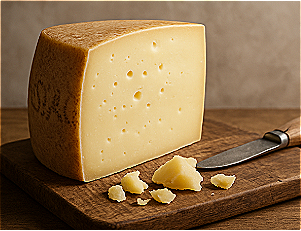
Formaggio a pasta semicotta da latte vaccino con uso di Fermenti Lattici, disponibile in due grandi tipologie DOP: asiago pressato (fresco/dolce), a breve maturazione, e asiago d’allevo (mezzano/vecchio/stravecchio) con maturazioni più lunghe.
Area tradizionale: zone alpine e pedemontane del Veneto e del Trentino, con produzioni DOP regolamentate dal disciplinare.
Pressato: pasta elastica e morbida, occhiatura fine e diffusa, sapore latteo–butterato, lievemente dolce.
D’allevo: pasta più compatta e via via granulare con l’età; occhiatura minuta/irregolare; profilo nocciolato–sapido, tendenza piccante nelle stagionature lunghe.
Valore calorico (per 100 g di prodotto)
Asiago pressato: ~330–380 kcal; grassi ~26–30 g, proteine ~23–25 g, carboidrati ~0–2 g (lattosio molto basso), sale ~1,6–2,2 g, umidità ~40–44%.
Asiago d’allevo: ~370–420 kcal; grassi ~28–33 g, proteine ~25–28 g, carboidrati ~0–1 g, sale ~1,8–2,5 g, umidità ~34–40%.
Principali sostanze contenute
Proteine: caseine in rete calcio–fosfato; tracce di sieroproteine.
Grassi del latte (triacilgliceroli) con vitamine A, D, E, K liposolubili.
Minerali: calcio e fosforo elevati; sodio da salamoia.
Composti d’aroma da proteolisi e lipolisi (più marcati nel d’allevo).
Marker tipici: pH ~5,1–5,4, % umidità, % sale, grasso su s.s. ≥~48–50%, aw controllata.
Processo di produzione
Latte crudo o pastorizzato (secondo disciplinare) → aggiunta di Fermenti Lattici → caglio (prevalente vitello) → coagulazione e rottura fine della cagliata.
Cottura/semi-cottura della cagliata e spurgo del siero → messa in forma e pressatura (più accentuata nel pressato).
Salamoia → eventuale trattamento di crosta (oli/cere ammesse) → stagionatura:
Produzione sotto GMP/HACCP con CCP su trajettoria pH, tempo/assorbimento di sale, igiene, integrità imballi.
Proprietà sensoriali e tecnologiche
Texture: da elastica e fondente (pressato) a più asciutta/leggermente granulare (alle stagionature).
Fusione: buona meltability e filatura moderata; l’allevo stagionato fonde “pulito” ma è meno filante.
Aroma/sapore: latte–panna, burroso e nocciolato; progressivo umami/sapidità e lieve piccante con l’età.
Impieghi alimentari
Tavola/affettato, panini/burger, gratin e forno, risotti/gnocchi/paste (mantecature), pizza in blend, piatti di polenta e antipasti (il d’allevo con miele/mostarde).
In salse/zuppe aggiungere fuori bollore per ridurre la granulosità.
Nutrizione e salute
Ricco di proteine e calcio; energetico con sodio e grassi saturi significativi → moderazione della porzione.
Lattosio basso (<~0,5 g/100 g, variabile); possibili tracce.
Versioni affumicate (ove presenti): controllare livelli di PAH entro i limiti normativi.
Profilo dei grassi
Andamento tipico dei formaggi vaccini: ~60–70% **SFA** (grassi saturi), ~25–33% **MUFA** (grassi monoinsaturi, prevalentemente oleico), ~2–5% **PUFA** (grassi polinsaturi, linoleico/ALA).
Piccole quote naturali di **TFA** ruminanti (es. CLA); **MCT** presenti come frazione minore del grasso del latte.
Nota salute: favorire nella dieta **MUFA**/**PUFA** rispetto a **SFA** e curare la porzionatura.
Qualità e specifiche (temi tipici)
pH 5,1–5,4, umidità/sale nello spettro di stile, grasso su s.s. ≥~48–50%.
Struttura: pasta compatta, occhiatura minuta/meccanica; assenza di amaro e odori difettosi.
Microbiologia: cariche contenute; Listeria/Salmonella assenti/25 g; controllo lieviti/muffe.
Confezione: film barriera, cere/paraffine idonee; sigillo integro; tracciabilità DOP.
Conservazione e shelf-life
0–4 °C. Non aperto: 1–3 mesi (pressato) fino a 6–12+ mesi (d’allevo, a seconda del pack).
Dopo apertura: 7–14 giorni ben avvolto e asciutto; limitare ossigeno/umidità per prevenire muffe ed essudazione.
Congelamento possibile per porzioni/grattugiato (leggere variazioni di texture all’uso).
Allergeni e sicurezza
Funzioni INCI in cosmesi
Troubleshooting
Oiling-off in cottura: T eccessiva o formaggio troppo secco → ridurre T/tempo; blend con formaggi più umidi; ottimizzare sale/calcio.
Salsa granulosa: pH troppo basso o ebollizione → aggiungere fuori bollore, impiegare amidi/emulsionanti idonei.
Amaro in stagionatura: proteolisi/lipolisi eccessive → rivedere caglio, tempi/temperature di maturazione, sale.
Muffe superficiali: barriera/scambio gassoso inadeguati → migliorare pack e trattamenti di crosta consentiti.
Sostenibilità e filiera
La filiera lattiero-casearia ha impronta GHG e idrica rilevante; mitigazioni: efficienza di alimentazione/energia, cattura del metano dei reflui, pack riciclabili, cold chain ottimizzata.
Stabilimenti: reflui a target **BOD/COD**; piena tracciabilità sotto **GMP/HACCP**.
Conclusione
L’asiago unisce versatilità culinaria, buona fusione e ricchezza aromatica. Un attento controllo di pH/sale/umidità, stagionatura e condizioni di cottura garantisce prodotti sicuri, stabili e coerenti sensorialmente, dal pressato dolce allo stravecchio più complesso.
Mini-glossario
**SFA** — grassi saturi: eccessi possono aumentare LDL; utile limitarli e sostituirli parzialmente con insaturi.
**MUFA** — grassi monoinsaturi (es. oleico): in genere favorevoli/neutralmente associati ai lipidi ematici.
**PUFA** — grassi polinsaturi (es. linoleico/ALA): benefici se bilanciati; più suscettibili a ossidazione.
**TFA** — grassi trans: piccole quote naturali nei latticini (CLA); evitare i TFA industriali.
**MCT** — trigliceridi a media catena (C6–C12): frazione minore del grasso del latte.
Fermenti Lattici — dicitura in etichetta italiana per lactic starter cultures impiegate nella caseificazione.
GMP/HACCP — good manufacturing practice / hazard analysis and critical control points: sistemi igienico–preventivi con CCP.
CCP — critical control point: fase in cui un controllo previene/riduce un pericolo (es. pH, salamoia, sigillo).
BOD/COD — domanda biochimica/chimica di ossigeno: indicatori dell’impatto dei reflui.
aw — attività dell’acqua: quota di acqua “libera”; aw bassa migliora la stabilità.
Bibliografia__________________________________________________________________________
Lora I, Zidi A, Magrin L, Prevedello P, Cozzi G. An insight into the dairy chain of a Protected Designation of Origin cheese: The case study of Asiago cheese. J Dairy Sci. 2020 Oct;103(10):9116-9123. doi: 10.3168/jds.2019-17484.
Abstract. The Protected Designation of Origin (PDO) label of the European Union safeguards and guarantees top-quality traditional agri-food products that must be manufactured in a specific region according to traditional production methods. Production specifications of PDO cheeses are often focused on the cheese-making process and lack information on the dairy farming system that is upstream of the chain. This case study aimed to analyze and cluster the dairy farms that supply milk to the chain of Asiago, an internationally known PDO cheese of northeastern Italy. A large survey involving all of the cheese factories of the Asiago PDO chain was made in 2017. Each cheese factory submitted a questionnaire to its supplying dairy farmers concerning (1) farm facilities and herd management and (2) feeding program of lactating cows. Results from 517 farms were processed; there were 67 ± 27% (mean ± standard deviation) respondents per cheese factory. Four clusters of dairy farms were identified by hierarchical clustering analysis. Cluster 1 (8% of the surveyed farms) and cluster 2 (22%) are small in size and low in yield, representing the traditional milk production system; farms are mainly located on mountains or hills and have autochthonous dual-purpose breeds mostly housed in tiestall barns. By rearing cattle of endangered breeds and feeding cows primarily with forages produced on-farm together with the use of pasture, these clusters, and especially cluster 1, have shown to provide essential ecosystem services for landscape and biodiversity preservation in the alpine areas. Clusters 3 and 4 (34 and 36% of the surveyed farms, respectively) gather medium-scale farms mainly located in the lowland that operate according to modern management and housing systems and rear high-producing dairy cows. These cows are mainly fed total mixed rations based on corn silage, but the dietary forage:concentrate ratio is kept relatively high, as farmers are more interested in producing high-quality milk for cheese-making than pushing for yield. Regardless of the cluster allocation, a considerable cow longevity, which is a recognized "iceberg indicator" of cattle well-being, was highlighted. This study showed that different farming systems may lay behind a single PDO cheese. The knowledge of their characteristics is important to reinforce the PDO production specifications as well as to distinguish and protect niche products that come from specific groups of farms that provide essential ecosystem services. The Authors. Published by Elsevier Inc. and Fass Inc. on behalf of the American Dairy Science Association®.
Segato S, Galaverna G, Contiero B, Berzaghi P, Caligiani A, Marseglia A, Cozzi G. Identification of Lipid Biomarkers To Discriminate between the Different Production Systems for Asiago PDO Cheese. J Agric Food Chem. 2017 Nov 15;65(45):9887-9892. doi: 10.1021/acs.jafc.7b03629.
Abstract. The lipid fraction of Asiago Protected Designation of Origin (PDO) cheese was analyzed to identify specific biomarkers of its main production systems through a canonical discriminant analysis. The three main production systems of the cheese were considered. Two were located in the upland (UL): pasture-based (P-UL) vs hay-based total mixed rations (H-UL). The third was located in the lowland (LL) and processed milk from cows fed maize silage-based rations (maize silage lowland: MS-LL). The discriminant analysis selected nine fatty acids and vitamin A as lipid biomarkers useful to separate the three production systems. High contents of conjugated linoleic acids, anteiso-C15:0, and vitamin A were discriminant factors for P-UL cheese. The separation between H-UL and MS-LL cheese was less marked with the former having the higher content of conjugated linoleic acids and some polyunsaturated n-6 fatty acids and with the latter being identified by cyclopropane fatty acid and C9:0.
Segato S, Caligiani A, Contiero B, Galaverna G, Bisutti V, Cozzi G. 1H NMR Metabolic Profile to Discriminate Pasture Based Alpine Asiago PDO Cheeses. Animals (Basel). 2019 Sep 25;9(10):722. doi: 10.3390/ani9100722.
Abstract. The study was carried out in an alpine area of North-Eastern Italy to assess the reliability of proton nuclear magnetic resonance 1H NMR to fingerprint and discriminate Asiago PDO cheeses processed in the same dairy plant from upland pasture-based milk or from upland hay-based milk. Six experimental types of Asiago cheese were made from raw milk considering 2 cows' feeding systems (pasture- vs. hay-based milk) and 3 ripening times (2 months, Pressato vs. 4 months, Allevo_4 vs. 6 months, Allevo_6). Samples (n = 55) were submitted to chemical analysis and to 1H NMR coupled with multivariate canonical discriminant analysis. Choline, 2,3-butanediol, lysine, tyrosine, and some signals of sugar-like compounds were suggested as the main water-soluble metabolites useful to discriminate cheese according to cows' feeding system. A wider pool of polar biomarkers explained the variation due to ripening time. The validation procedure based on a predictive set suggested that 1H NMR based metabolomics was an effective fingerprinting tool to identify pasture-based cheese samples with the shortest ripening period (Pressato). The classification to the actual feeding system of more aged cheese samples was less accurate likely due to their chemical and biochemical changes induced by a prolonged maturation process.
Segato, Severino, et al. "Effect of period of milk production and ripening on quality traits of Asiago cheese." Italian Journal of Animal Science 6.sup1 (2007): 469-471.
Abstract. After 6 and 12 months of ripening, samples of Asiago d’Allevo were analyzed for quality traits. Cheeses were produced during 3 periods using milk from cows fed a total mixed ration (TMR, May) or grazing on alpine pasture (AG) in early (July) and late (Sept.) summer. Data were submitted to ANOVA considering ripening, milk production period and farm as main effects, and whole cheese weight as covariate. During ripening, pH of AG-cheese was significantly lower than that of TMR-cheese; crude fat and protein significantly increased. According to period, July-samples showed the significantly lowest value of dry matter (DM), maybe due to a lower crude fat con-tent; however, variability in skimming method could have altered proximate composition. No texture differences were found, although increasing weight of whole cheese significantly reduced max shear force as result of a lower DM content. Lightness (L*) and yellowness (b*) significantly decreased during ripening. AG feeding system caused a lower L* and higher b* than TMR one, probably as a consequence of a different amount of milk pigments. Cheese varied also within AG season: Sept.-samples showed the lowest L* value and the highest b*.
Lignitto, Laura, et al. "Angiotensin-converting enzyme inhibitory activity of water-soluble extracts of Asiago d'allevo cheese." International dairy journal 20.1 (2010): 11-17.
Abstract. The angiotensin-converting enzyme (ACE) inhibitory activity of water-soluble extracts (WSE) from Asiago cheeses was assayed in two cheese production systems and with different ripening times. The WSE were ultrafiltered through 10 kDa and 3 kDa cut-off membranes to evaluate the ACE inhibitory activity of long and short peptides, respectively. The cheese production systems had no significant effect on the ACE inhibitory activity, whereas 6-month-old cheeses had higher inhibitory potency than the more ripened ones. Moreover, the fraction containing peptides smaller than 3 kDa made a more considerable contribution to ACE inhibitory activity than the fraction smaller than 10 kDa, suggesting an inhibitory effect due to short peptides. The peptidic fraction was characterized using RP-HPLC coupled to mass spectrometric detection. Simulated gastrointestinal digestion was carried out to evaluate the effects of digestive enzymes on the generation of bioactive peptides, but this did not significantly affect the inhibitory activity.




