Provolone (latte vaccino; pasta filata, stagionatura breve–lunga)
Descrizione
Formaggio pasta filata ottenuto da latte vaccino con acidificazione controllata e filatura in acqua calda; stagionatura da settimane (dolce) a mesi/oltre (piccante).
Tipi principali: provolone dolce (caglio di vitello, gusto mite, pasta più elastica) e provolone piccante (cagli di capretto/agnello, maggiore lipolisi → sapore più deciso).
Forme tradizionali: salame (cilindrica), pera/fiaschetta, melone/mandarino; possibili versioni affumicate. Colore paglierino; occhiatura assente o minuta.
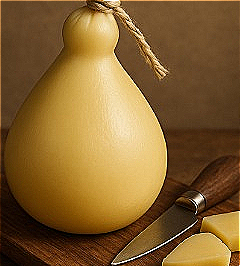
Valore calorico (per 100 g di prodotto)
~350–400 kcal; grassi ~27–32 g, proteine ~24–27 g, carboidrati ~0–2 g (lattosio molto basso), sale ~1,8–2,8 g, umidità ~36–42% (varia con stagionatura).
Principali sostanze contenute
Proteine: caseine in rete calcio–fosfato; tracce di sieroproteine.
Grassi del latte (triacilgliceroli) con vitamine A, D, E, K liposolubili.
Minerali: calcio e fosforo elevati; sodio dalla salamoia.
Composti d’aroma da proteolisi/lipolisi (più marcati nel piccante).
Marcatori analitici: pH ~5,1–5,4, % umidità, % grasso (s.s. ≥~48–50%), % sale, attività dell’acqua (aw).
Processo di produzione
Latte (crudo o pastorizzato) standardizzato → Fermenti Lattici mesofili/termofili → caglio (vitello per dolce; miste capretto/agnello per piccante) → coagulazione e rottura fine → maturazione della cagliata fino a pH di filatura → filatura in acqua calda e formatura.
Raffreddamento e salamoia → eventuale affumicatura → legature/reti per le forme tipiche → stagionatura in ambienti controllati (T/UR) con trattamenti di crosta (oli, cere, paraffina) secondo stile.
Controlli sotto GMP/HACCP con CCP su trajettoria pH, tempo/sale in salamoia, igiene e integrità delle legature/confezioni.
Proprietà sensoriali e tecnologiche
Texture: elastica e morbida nel dolce; più compatta/friabile e talora pungente nel piccante.
Fusione: buona meltability, con oil-off moderato se umidità e calcio sono bilanciati; gli stagionati fondono “pulito” ma sono meno filanti.
Aroma: lattico–butterato, nocciolato; affumicato aggiunge note fenoliche dolci.
Impieghi alimentari
Tavola/affettato, toast/burger/sandwich, gratin e cucina al forno, pizza in blend, spiedi e griglia, antipasti (provolone piccante con miele/mostarde).
In salse e zuppe, aggiungere fuori bollore per limitare la granulosità.
Nutrizione e salute
Ricco di proteine e calcio; energetico con quota significativa di sodio e grassi saturi → porzionare con moderazione.
Lattosio in genere basso (<0,5 g/100 g) ma non sempre nullo.
Versioni affumicate: controllare l’esposizione per mantenere IPA/PAH entro limiti.
Profilo dei grassi
Andamento tipico dei formaggi vaccini: ~60–70% **SFA**, ~25–33% **MUFA** (prevalente oleico), ~2–5% **PUFA** (linoleico/ALA).
Piccole quote naturali di **TFA** ruminanti (es. CLA); **MCT** presenti come frazione minore del grasso del latte.
Nota salute: sostituire parte dei **SFA** con **MUFA**/**PUFA** nella dieta aiuta il profilo lipidico.
Qualità e specifiche (temi tipici)
pH 5,1–5,4, umidità e sale nei range di stile; grasso sulla s.s. ≥~48–50%.
Struttura: pasta compatta senza occhi evidenti; assenza di amaro e odori difettosi.
Microbiologia: cariche basse; Listeria/Salmonella assenti/25 g; controllo lieviti/muffe e coliformi.
Confezioni: film barriera, cere/paraffine idonee; sigillo integro.
Conservazione e shelf-life
0–4 °C; non aperto: 1–4 mesi (breve stagionatura) fino a >6 mesi (lunghe).
Dopo apertura: 7–14 giorni ben avvolto e asciutto; limitare ossigeno/umidità per prevenire muffe e essudazione.
Congelamento possibile per porzioni/grattugiato (lievi variazioni di texture).
Allergeni e sicurezza
Contiene latte (allergene maggiore).
Versioni da latte crudo: ove ammesse, gestione rigorosa di igiene e stagionatura; per prodotti ready-to-eat monitoraggi ambientali contro Listeria.
Funzioni INCI in cosmesi
Troubleshooting
Fusione grassa (oiling-off): T eccessiva o formaggio troppo secco → ridurre T/tempo; usare blend con formaggi più umidi; ottimizzare sale/calcio.
Granulosità in salsa: pH troppo basso o ebollizione → aggiungere fuori bollore, impiegare amidi/emulsionanti idonei.
Amaro in stagionatura: proteolisi/lipasi eccessive → rivedere caglio, tempi/T di stagionatura, e sale.
Muffe superficiali: barriera/scambio gassoso inadeguati → migliorare pack e controlli; dove consentito, trattamenti di crosta idonei.
Sostenibilità e filiera
La filiera lattiero-casearia ha impronta GHG e idrica rilevante; mitigazioni: efficienza di alimentazione/energia, gestione metano dei reflui, pack riciclabili, cold chain ottimizzata.
Stabilimenti: reflui a target BOD/COD; tracciabilità completa sotto GMP/HACCP.
Conclusione
Il provolone unisce versatilità culinaria, buona fusione e ricchezza aromatica. Il controllo di pH/sale/umidità, della stagionatura e delle condizioni di cottura assicura prodotti sicuri, stabili e coerenti sensorialmente.
Mini-glossario
**SFA** — grassi saturi: eccessi possono aumentare LDL; utile limitarli e bilanciare con insaturi.
**MUFA** — grassi monoinsaturi (es. oleico): in genere favorevoli/neutralmente associati ai lipidi ematici.
**PUFA** — grassi polinsaturi (es. linoleico/ALA): benefici se bilanciati; più suscettibili a ossidazione.
**TFA** — grassi trans: piccole quote naturali nei latticini (CLA); evitare TFA industriali.
**MCT** — trigliceridi a media catena (C6–C12): frazione minore del grasso del latte.
Fermenti Lattici — dizione in etichetta italiana per colture starter: consorzi di batteri lattici che acidificano e sviluppano aroma.
GMP/HACCP — good manufacturing practice / hazard analysis and critical control points: sistemi igienico–preventivi con CCP definiti.
CCP — critical control point: fase in cui un controllo previene/riduce un pericolo (es. pH, sale, sigillatura).
BOD/COD — domanda biochimica/chimica di ossigeno: indicatori dell’impatto dei reflui caseari.
aw — attività dell’acqua: acqua “libera” disponibile; aw più bassa → migliore stabilità.
Bibliografia__________________________________________________________________________
Paggio F, Ritota M, Di Costanzo MG, Barzaghi S, Monti L, Ulrici A, Manzi P. Effects of time and temperature of storage on chemical and nutritional characteristics of raw milk for Provolone Valpadana PDO cheesemaking: a multivariate approach. J Dairy Res. 2023 May;90(2):191-199. doi: 10.1017/S0022029923000341.
Abstract. We evaluated the possibility of increasing the storage temperature of raw milk for Provolone Valpadana cheesemaking, to identify the most suitable conditions of time and temperature for a pre-maturation process. We used Principal Component Analysis (PCA) to analyze the overall effects of different storage conditions on chemical, nutritional and technological characteristics of the raw milk. Four different thermal storage cycles, two at fixed temperature/time (6 and 12°C for 60 h) and two with two-phase thermal cycle (10 and 12°C for 15 h, followed by refrigeration at 4°C for 45 h) were studied. Although a moderate heterogeneity among raw milks from the 11 producers of Provolone Valpadana cheese was observed, PCA revealed the critical aspects of the extreme storage conditions (60 h of refrigeration). Some samples resulted in anomalous behaviors, probably related to unexpected fermentation phenomena occurring with increasing storage temperature. The acidification and the increase in the contents of lactic acid, soluble calcium, and degree of retinol isomerization observed in the anomalous samples can compromise the technological functionality of milk. Conversely, the storage with a two-phase thermal cycle did not lead to variations in any measured characteristic, suggesting that mild refrigeration conditions (10 or 12°C for 15 h followed by 4°C for 45 h) could be a good compromise in favoring milk pre-maturation without altering its quality characteristics.
Giraffa G, Gatti M, Rossetti L, Senini L, Neviani E. Molecular diversity within Lactobacillus helveticus as revealed by genotypic characterization. Appl Environ Microbiol. 2000 Apr;66(4):1259-65. doi: 10.1128/AEM.66.4.1259-1265.2000.
Abstract. Lactobacillus helveticus is a homofermentative thermophilic lactic acid bacterium that is used in the manufacture of Swiss type and long-ripened Italian cheeses, such as Emmental, Grana, and Provolone cheeses. Substantial differences in several technologically important characteristics are found among L. helveticus strains isolated from natural dairy starter cultures. In the present study we investigated the genotypic diversity of 74 strains isolated from different dairy cultures used for manufacturing Grana and Provolone cheeses and six collection strains. A restriction fragment length polymorphism analysis of both total genomic DNA and the 16S rRNA gene (ribotyping) was used as genotypic fingerprinting. A multivariate statistical analysis of the data enabled us to identify significant genotypic heterogeneity in L. helveticus. We found that genotypic fingerprinting could be used to distinguish strains; in particular, it was possible to associate the presence of specific strain genotypes with dairy ecosystem sources (e.g., Grana or Provolone cheese). Our data contribute to the description of microbial heterogeneity in L. helveticus and provide a more solid basis for understanding the functional and ecological significance of the presence of different L. helveticus biotypes in natural dairy starter cultures.
Gatti M, Trivisano C, Fabrizi E, Neviani E, Gardini F. Biodiversity among Lactobacillus helveticus strains isolated from different natural whey starter cultures as revealed by classification trees. Appl Environ Microbiol. 2004 Jan;70(1):182-90. doi: 10.1128/AEM.70.1.182-190.2004. PMID: 14711641;
Abstract. Lactobacillus helveticus is a homofermentative thermophilic lactic acid bacterium used extensively for manufacturing Swiss type and aged Italian cheese. In this study, the phenotypic and genotypic diversity of strains isolated from different natural dairy starter cultures used for Grana Padano, Parmigiano Reggiano, and Provolone cheeses was investigated by a classification tree technique. A data set was used that consists of 119 L. helveticus strains, each of which was studied for its physiological characters, as well as surface protein profiles and hybridization with a species-specific DNA probe. The methodology employed in this work allowed the strains to be grouped into terminal nodes without difficult and subjective interpretation. In particular, good discrimination was obtained between L. helveticus strains isolated, respectively, from Grana Padano and from Provolone natural whey starter cultures. The method used in this work allowed identification of the main characteristics that permit discrimination of biotypes. In order to understand what kind of genes could code for phenotypes of technological relevance, evidence that specific DNA sequences are present only in particular biotypes may be of great interest.
Sampalean NI, de-Magistris T, Rama D. Investigating Italian Consumer Preferences for Different Characteristics of Provolone Valpadana Using the Conjoint Analysis Approach. Foods. 2020 Nov 25;9(12):1730. doi: 10.3390/foods9121730. PMID: 33255550;
Abstract. The objective of this paper was twofold. First, we estimated consumer preferences for an Italian cheese (Provolone Valpadana) with respect to several attributes and levels, such as price, origin certification, production system, 'free from' labelling, and brand. Second, we identified consumer clusters with similar preferences for various cheese characteristics. Preferences were estimated using the conjoint analysis method. Then, a cluster analysis was used to classify consumers into different (three) clusters followed by a market simulation. In all three clusters, the attribute most preferred by Italian consumers was the brand of the cheese: consumers preferred to purchase Provolone cheese having the lowest price, produced by Auricchio, bearing a European Union (EU) quality certification, produced organically, and non-lactose-free. The results of our study provide helpful information to food companies for better segmenting their market and targeting their consumers, as well as effectively promoting their products using brands, certifications as organic and lactose-free. This study contributes to the literature on consumer preference for the EU labelling scheme (voluntary and mandatory). To our knowledge, this is the first study to investigate this combination of multiple labels displayed on the front of Italian cheese packaging.




