



Dried ancho chili pepper (dried ripe poblano; Capsicum annuum L., family Solanaceae)
Description
The ancho is the fully ripe, dried poblano chile: large, heart-shaped, wrinkled pod, deep maroon–mahogany color, mild heat (~1,000–2,000 SHU).
Sensory profile: sweet, raisin/prune, hints of cocoa, coffee, tobacco, light earthiness; minimal bitterness if seeds/placenta are removed.
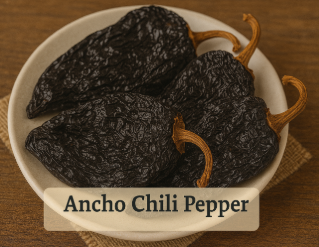
Common name: Ancho dried chili
(Dried ripe poblano chili)
Botanical origin: Capsicum annuum L. (family Solanaceae)
Kingdom: Plantae
Clade: Angiosperms
Clade: Eudicots
Order: Solanales
Family: Solanaceae
Genus: Capsicum
Species: Capsicum annuum L.
Note: Ancho is the fully ripe red poblano chili that has been dried. It has a sweet, aromatic flavour with notes reminiscent of dried plum, raisin and cocoa. It is one of the most important chilies in traditional Mexican cuisine.
Cultivation and growing conditions
(Referring to the poblano pepper from which ancho is obtained)
Climate:
Prefers warm, temperate climates.
Sensitive to frost and low temperatures, especially at early stages.
A long, warm season is needed so fruits can fully ripen from green to deep red.
Exposure:
Requires full sun to maximize yield and fruit quality.
Shade reduces production and slows ripening.
Soil:
Thrives in fertile, well-drained, medium-textured soils.
Ideal pH: slightly acidic to neutral (6–7).
Waterlogged conditions promote root diseases and rot.
Watering:
Needs steady irrigation, keeping the soil moist but not saturated.
Strong alternation between drought and heavy watering can cause:
flower drop
fruit cracking
uneven ripening
Slightly reduced irrigation in the final weeks supports more uniform ripening.
Temperature:
Optimal seed germination: 20–25 °C.
Optimal growth: 20–30 °C.
Below about 12–14 °C, growth slows significantly.
Fertilization:
Requires good soil organic matter.
Phosphorus and potassium support flowering, fruit set and fruit quality.
Nitrogen must be balanced: excess nitrogen leads to lush foliage but fewer fruits.
Crop management:
Early weed control is important.
Mulching helps retain soil moisture and reduce weed pressure.
Vigorous plants may benefit from light staking.
Light pinching can be used to encourage branching.
Harvest (for ancho production):
Fruits must be harvested fully ripe, deep red.
Only red poblano fruits can become true ancho (green poblano is not suitable).
Ancho drying process
Harvest of fully ripe red poblano chiles at peak aroma.
Slow drying, in the sun or in low-temperature dryers.
Storage of the dried fruits, which turn dark red to brown, with a flexible skin and intense aroma.
(Unlike chipotle, ancho is dried but not smoked.)
Flavour profile
Low to medium pungency
Sweet, fruity notes (raisin, dried plum)
Hints of cocoa and tobacco
Deep, mellow aroma suitable for slow-cooked dishes
Main culinary uses
Key ingredient in mole sauces
Base for many traditional Mexican sauces
Stews and soups
Stuffed (after soaking and rehydrating)
Ground into powder for rubs, marinades and general seasoning
Caloric value (per 100 g)
~250–350 kcal (varies with moisture and seed content). At typical use levels (grams per recipe), energy contribution is modest.
Key constituents
Capsaicinoids at low levels (mainly capsaicin/dihydrocapsaicin).
Carotenoids (capsanthin, capsorubin, β-carotene), sugars (glucose/fructose), organic acids (malic/citric), fiber/pectins, minor polyphenols; vitamin C largely reduced by drying.
Analytical markers: SHU, capsaicinoids by HPLC, color (CIE L*a*b*; red products often report ASTA color), moisture/aw, mesh/particle size, defects/foreign matter.
Production process
Raw material: sound, field-ripened red poblanos.
Preparation: washing → destemming, deseeding (as required) → splitting/cutting.
Drying: sun/solar or hot-air dehydration with controlled time–temperature to targets moisture ≤10–12% and aw ≤0.60–0.65.
Sizing/screening, metal detection, and high-barrier packaging (often nitrogen-flushed).
Managed under GMP/HACCP with CCP on drying profile, foreign bodies, and pack integrity.
Sensory and technological properties
Blooming/toasting (brief, low heat) enhances volatiles; over-toasting yields bitterness.
Rehydration: soak in hot water/stock (∼60–80 °C, 15–30 min); blend to paste; strain to remove tough skins if desired.
Acid (vinegar/tomato) brightens fruit notes; fat (oil/nuts/seeds) rounds bitterness and carries aroma.
Food uses
Core chile in moles (e.g., mole poblano), adobos, enchilada/enchilamole sauces, salsas rojas, stews/chili con carne, dry rubs, sausages, marinades.
Typical dosages: powder 0.2–1.0% in blends; paste 1–5% of sauce weight; whole rehydrated 1–3% of finished product. Validate in pilot trials.
Nutrition and health
Low sodium, low fat at culinary portions; provides carotenoids and fiber (vs fresh).
Capsaicin may irritate in sensitive individuals; avoid unauthorized health claims.
Lipid profile
Very low total fat; traces from seeds/placenta only. Pattern is trace PUFA ≥ MUFA > SFA with no material impact at use levels.
Health note: diets favoring MUFA (monounsaturated fatty acids) and PUFA (polyunsaturated fatty acids) over SFA (saturated fatty acids) are generally favorable/neutral for blood lipids; here the effect is minimal. TFA (industrial trans fatty acids) absent; MCT (medium-chain triglycerides) not characteristic.
Quality and specifications (typical topics)
Moisture ≤10–12%, aw ≤0.60–0.65, uniform color (deep red-brown), low defects/foreign matter, absence of infestation.
Microbiology: APC within spec; yeasts/molds low; Salmonella absent/25 g.
Contaminants: pesticides/metals compliant; monitor mycotoxins (e.g., aflatoxins/ochratoxin A) and lead in imported powders.
Capsaicinoids/HPLC, ASTA color, mesh size for powders.
Storage and shelf-life
Store cool/dry/dark in oxygen/light-barrier packs; 12–24 months sealed.
Reseal after opening; after rehydration, treat as perishable (refrigerate; short hold).
Allergens and safety
Capsicum is not a major EU allergen; rare individual sensitivities exist.
Manage cross-contact on seasoning lines (sesame, celery, mustard, gluten/soy carriers). Use PPE when milling/powder handling.
INCI functions in cosmetics
Listings: Capsicum Annuum Fruit Extract/Powder (non-pungent to mildly pungent).
Roles: fragrance, mild warming/rubefacient; assess irritancy and color stability.
Troubleshooting
Bitter/ashy notes: over-toasting → reduce time/temp; remove seeds/placenta; balance with acid/fat.
Tough skins/gritty sauces: extend soak or lightly simmer, then blend and strain.
Dull color: oxidation/light → use amber/high-barrier packs; add chile late in cooking.
Caking in powders: high RH → add desiccant, improve barrier, consider anticaking.
Weak flavor: toast briefly, increase dose, or blend with guajillo/pasilla for complexity.
Sustainability and supply chain
Favor IPM cultivation and efficient irrigation; use solar drying where feasible.
Optimize dryer heat recovery; use recyclable/mono-material packs; treat plant effluents to BOD/COD targets; full traceability under GMP/HACCP.
Conclusion
Dried ancho delivers mild heat, lush dried-fruit sweetness, and signature color that define many Mexican sauces. Controlled drying/toasting/rehydration, good packaging, and spec standardization ensure safe, stable, and sensory-consistent results across applications.
Mini-glossary
SHU — Scoville heat units: pungency scale (ancho ≈ 1,000–2,000).
HPLC — High-performance liquid chromatography: quantifies capsaicinoids and identity markers.
ASTA (color) — American Spice Trade Association color index for red spice products.
aw — Water activity: low aw (≤0.60–0.65) limits microbial growth in dried goods.
SFA — Saturated fatty acids: excessive intakes may raise LDL; trace here.
MUFA — Monounsaturated fatty acids (e.g., oleic): generally favorable/neutral for blood lipids; trace here.
PUFA — Polyunsaturated fatty acids (e.g., linoleic): beneficial when balanced; trace here.
TFA — Trans fatty acids (industrial): avoid; absent in non-hydrogenated spices.
MCT — Medium-chain triglycerides: characteristic of coconut fat; not present in ancho.
GMP/HACCP — Good Manufacturing Practice / Hazard Analysis and Critical Control Points: hygiene/preventive-safety systems with defined CCP.
CCP — Critical control point: step where a control prevents/reduces a hazard.
BOD/COD — Biochemical/Chemical oxygen demand: indicators of effluent impact from processing.

