



Cooked white rice
Description
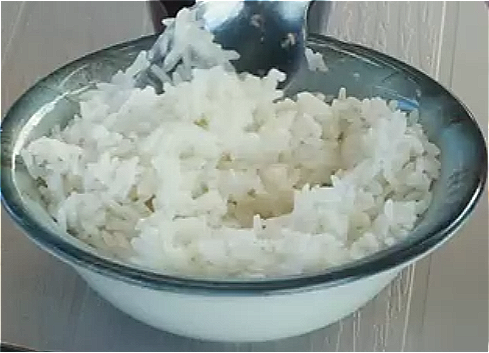
Polished white rice cooked by absorption, steaming, boiling/drain, or pressure rice-cooker methods. Texture ranges from fluffy/separate (long-grain, higher amylose) to tender/cohesive (medium–short grain, lower amylose). Aromatic types (e.g., jasmine, basmati) contribute varietal aroma; parboiled rice yields firmer, less sticky grains. Enriched rice may carry added iron and B vitamins (market-dependent).
Caloric value (per 100 g)
~120–150 kcal (depends on variety and water uptake).
Typical composition: carbohydrate ~26–32 g, protein ~2–3 g, fat ~0.2–0.5 g, fiber ~0.2–0.6 g, water ~65–72%; sodium naturally very low unless salted/seasoned.
Key constituents
Starch (ratio amylose/amylopectin governs stickiness and retrogradation), rice proteins (glutelins/albumins), trace lipids, small amounts of minerals (K, Mg) and B vitamins (reduced by polishing; partly restored in enriched rice).
Resistant starch (RS) increases after cooling (retrogradation).
Typical pH of plain cooked rice: ~6.0–7.0; aw >0.95 (microbiologically permissive).
Optional fortificants (thiamin, niacin, iron) per local standards.
Production process
Rinsing (to remove surface starch and excess enrichment dust) → optional soaking (10–30 min; shortens cook time; evens hydration).
Cooking: absorption water ratios by weight typically 1.2–1.7:1 (water:rice) depending on grain/type; or boil/drain to desired tenderness.
Resting/steaming-off (5–10 min) → fluffing for separation.
Food service: hold >60 °C hot, or rapid-chill to ≤5 °C (within safe time) for cold storage.
RTE/retort pouches: fill cooked (or cook-in-pouch), seal, thermal sterilization to validated Fo, cool, dry, pack.
Chilled/MAP: cook → season/oil (if used) → rapid chill → pack under MAP.
HACCP with CCP on thermal process, cooling, metal detection, and, for acidified styles (e.g., sushi rice), pH control.
Sensory and technological properties
Texture: higher amylose → drier, separate grains; lower amylose → softer/adhesive. Oil rinses and proper resting improve separation; over-stirring breaks grains and raises stickiness.
Retrogradation on cooling firms grains; reheating with steam restores tenderness but some RS persists.
Rinsing yields cleaner flavor and less clumping; soaking improves center hydration.
Aromatics (jasmine/basmati) are volatile; minimize lid-off holding.
Food uses
Side dish for meats/vegetables; base for bowls, stir-fries, fried rice, stuffings, casseroles, congee (with higher water ratio).
Component in ready meals, sushi (when acidified/seasoned), rice salads, and rice noodles production (from rice flour).
Nutrition and health
Carbohydrate-dense, low fat, low fiber (vs brown rice). Pair with vegetables/legumes to raise fiber and micronutrients.
GI typically medium–high; cooling (↑ RS) and adding fat/protein can moderate glycemic response.
Sodium minimal unless salted/seasoned.
Arsenic: rinsing and excess-water methods can reduce total arsenic; variety/origin dependent.
Gluten-free; rice allergy is uncommon but reported.
Lipid profile
Intrinsic fat is very low; pattern is traces of PUFA (linoleic) ≥ MUFA (oleic) > SFA.
Health note: choosing added fats rich in MUFA (monounsaturated fatty acids) and PUFA (polyunsaturated fatty acids) over SFA (saturated fatty acids) is generally favorable/neutral for blood lipids; effect is minor at typical additions.
TFA (industrial trans) absent; MCT not characteristic unless coconut fat is added.
Quality and specifications (typical topics)
Grain integrity (% broken after cook), firmness/TPA or shear force, stickiness/adhesion, moisture, aw, pH, color/whiteness, aroma retention.
For RTE: commercial sterility (validated Fo), seal integrity, fill weight, oxygen in headspace, micro limits per standard.
Raw rice inputs: varietal identity, amylose %, length/width ratio, moisture ≤14%, defects/foreign matter.
Storage and shelf-life
Freshly cooked (home/food service): hold >60 °C hot; or cool quickly and refrigerate ≤5 °C; use within 3–4 days; reheat thoroughly.
RTE retort pouches: ambient 6–12 months unopened; after opening, refrigerate and use in 2–3 days.
Chilled MAP: 0–4 °C, typically 5–10 days.
IQF/frozen: –18 °C, 12–18 months; reheat steam/microwave.
Allergens and safety
Rice is gluten-free and not a major EU allergen; manage cross-contact from seasonings and shared lines.
Bacillus cereus risk: control cooling, holding, and reheating; avoid room-temperature storage.
Sushi rice is acidified (typ. pH ~4.1–4.6) to enhance safety at ambient service.
INCI functions in cosmetics
Related rice derivatives: Oryza Sativa (Rice) Starch, Oryza Sativa (Rice) Bran Oil, Oryza Sativa (Rice) Extract (absorbent, skin conditioning, antioxidant). “Cooked white rice” itself is not a cosmetic ingredient.
Troubleshooting
Gummy/clumped: too much water, insufficient rinsing/resting, or low-amylose variety → rinse, adjust water ratio, rest, fluff; consider parboiled or higher-amylose rice.
Hard/undercooked centers: increase soak or cook time; verify water absorption; avoid lifting lid early.
Dry/firm after holding: hold with humidified heat; add a small steam burst before service.
Burned bottom: lower heat, heavier-bottom pot, correct water; avoid over-reduction.
Off-aroma/stale: minimize oxygen/light exposure for aromatics; use tight lids and timely service.
Sustainability and supply chain
Prefer farms using AWD irrigation and IPM; consider parboiled to reduce cooking losses/waste.
Optimize steam/thermal energy (insulation, heat recovery); use recyclable or mono-material pouches where feasible.
Treat effluents to BOD/COD targets; maintain full traceability under GMP/HACCP.
Conclusion
Cooked white rice is a neutral, adaptable carrier of texture and energy. Selecting the right variety/amylose, applying controlled cooking and resting, and enforcing time–temperature safety deliver a product that is tender, safe, and consistent across cuisines and formats.
Mini-glossary
RS — Resistant starch: starch fraction not digested; increases after cooling/retrogradation, can moderate glycemic response.
GI — Glycemic index: post-meal blood-glucose response; lowered by RS, fiber, and pairing with fat/protein.
SFA — Saturated fatty acids: excessive intakes may raise LDL; choose modest levels in added fats.
MUFA — Monounsaturated fatty acids (e.g., oleic): generally favorable/neutral for blood lipids.
PUFA — Polyunsaturated fatty acids (n-6/n-3): beneficial when balanced; typical of seed oils.
TFA — Trans fatty acids: avoid industrial TFA; absent if non-hydrogenated oils are used.
MCT — Medium-chain triglycerides: characteristic of coconut fat; increase SFA share.
GMP/HACCP — Good Manufacturing Practice / Hazard Analysis and Critical Control Points: hygiene and preventive-safety systems with defined CCP.
CCP — Critical control point: step where a control prevents/reduces a hazard (e.g., Fo, cooling).
Fo — Sterilization value (minutes at 121.1 °C equivalent) ensuring commercial sterility in retort packs.
MAP — Modified-atmosphere packaging: tailored headspace gases to extend chilled shelf-life.
IQF — Individually quick frozen: process that freezes grains separately for easy portioning.
aw — Water activity: free-water measure; high aw in cooked rice necessitates strict time–temperature control.
AWD — Alternate wetting and drying: irrigation practice reducing water use and methane emissions.
IPM — Integrated pest management: reduces pesticide load via biological and cultural controls.
BOD/COD — Biochemical/Chemical oxygen demand: indicators of wastewater impact.
Studies
In general, rice contains more than 100 bioactive substances mainly in its bran layer including phytic acid, isovitexin, gamma-oryzanol, phytosterols, octacosanol, squalene, gamma-aminobutyric acid, tocopherol and derived from tocotrienol (1), antioxidants.
It does not contain beta carotene (provitamin A) and has a very low iron and zinc content (2).
In rice bran there are bioactive phytochemicals that exert protective actions against cancer that involve the metabolism of the host and the intestinal microbiome. A diet based on rice bran has shown positive effects in reducing the risk of colon cancer (3).
Allergies: Be careful, rice contains a certain amount of lactose.
The most common types of rice used are :
- Arborio : large grains, the most common in Italy
- Ribe : elongated grains.
- Thaibonnet : medium, elongated and fine grains
- Rome : large grains
- Basmati : thin and elongated grains. Grown in Pakistan and India
- Carnaroli : large grains
- Vialone nano : large, round grains
- Original or Balilla : small round grains
- Jasmine : fine grains of Asian origin
- Red : red, small and narrow grains
- Wild : Zizania palustris
- Baldo : large, shiny grains
- Ganges : from India
- Footboard : releases a lot of starch
- Venus : from China and the Po Valley
- Patna : from Thailand. Long and narrow grains
- Sant'Andrea : Thick and long grains. Releases a lot of starch
Rice viruses and pests: Pseudomonas aeruginosa, Rice yellow mottle virus, Magnaporthe oryzae , Rice Tungro Bacilliform Virus , Lissorhoptrus oryzophilus Kuschel, Oebalus pugnax, Xanthomonas oryzae

