



Chipotle (smoked and dried jalapeño; Capsicum annuum L., family Solanaceae)
Description
Chipotle is the fully ripe (red) jalapeño that has been slowly smoked and dehydrated until a dry chile with a smoky–sweet–hot profile is obtained.
Forms: whole dried (types morita = sweeter; meco = drier/woodier), flakes/powder, reconstituted, or in adobo sauce (vinegar/tomato and spices).
Typical heat: ~3,000–10,000 SHU (varies by cultivar and process).
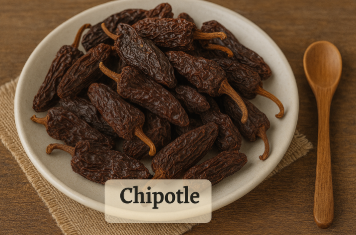
Common name: Chipotle
(Smoked and dried jalapeño chili)
Botanical origin: Capsicum annuum L. (family Solanaceae)
Kingdom: Plantae
Clade: Angiosperms
Clade: Eudicots
Order: Solanales
Family: Solanaceae
Genus: Capsicum
Species: Capsicum annuum L.
Note: Chipotle is not a separate species, but a fully ripe red jalapeño that is slowly smoked – traditionally over pecan or oak wood – and then dried. The result is a chili with a smoky, sweet, aromatic and moderately hot flavour, widely used in Mexican cuisine.
Cultivation and growing conditions
(Referring to the jalapeño plant from which chipotle is obtained)
Climate:
Prefers warm, temperate climates.
Sensitive to cold and frost.
A long, warm growing season is ideal to allow fruits to turn fully red before smoking.
Exposure:
Requires full sun (at least 6–8 hours per day).
Excess shade reduces yield and capsaicin content.
Soil:
Prefers fertile, well-drained, medium-textured soils.
Grows best at slightly acidic to neutral pH.
Waterlogged conditions favour root rot and fungal diseases.
Watering:
Needs regular irrigation, keeping the soil moist but not saturated.
Strong alternation between drought and excess water can cause flower drop and fruit cracking.
Reducing irrigation in the final stages helps ripening and flavour concentration.
Temperature:
Optimal seed germination at 20–25 °C.
Best vegetative growth between 20 and 30 °C.
Growth slows markedly below about 12–14 °C.
Fertilization:
Requires a good supply of organic matter.
Phosphorus and potassium support flowering, fruit set and fruit quality.
Nitrogen must be carefully balanced to avoid excessive foliage at the expense of fruits.
Crop management:
Early weed control is important.
Mulching helps maintain more constant soil moisture and reduce weed pressure.
Light pruning or pinching can promote branching and more uniform production.
Harvest (for chipotle production):
Fruits must be harvested fully ripe, deep red.
Green jalapeños cannot be turned into true chipotle.
Chipotle production process
Harvest of fully ripe red jalapeños.
Slow smoking (for several days up to about a week) over aromatic wood at low temperature.
Drying until the fruits become dark, wrinkled and very fragrant.
Optional processing into powder, sauce or canned “chipotle in adobo”.
Main uses
Seasoning for sauces, spice rubs and marinades
Ingredient in chili, tacos, burritos, fajitas and stews
Base flavour for soups and slow-cooked dishes
Production of chipotle in adobo, very popular in Mexican and Tex-Mex cooking
Caloric value (per 100 g)
Dried/powder: ~250–350 kcal/100 g (solids concentrated).
In adobo sauce: ~70–120 kcal/100 g (depends on added sugars/oil).
At culinary portions (grams), the energy contribution is modest.
Key constituents
Capsaicinoids: capsaicin and dihydrocapsaicin (pungency/rubefacient effect).
Smoke volatiles: guaiacol, syringol and related phenolics (characteristic smoke notes).
Carotenoids (red stage): capsanthin, capsorubin, β-carotene; chlorophylls negligible.
Minor polyphenols, fiber, potassium; sodium low except in adobo products.
Markers: capsaicinoids by HPLC, color (ASTA/CIE L*a*b*), moisture/aw for dried goods, SHU on label, PAH within limits.
Production process
Raw material: sound, fully ripe red jalapeño.
Smoking–drying: extended exposure to hot smoke (e.g., mesquite/oak) with controlled temperature/humidity to ≤10–12% moisture.
Cooling/cleaning → sorting/grading (morita/meco) → optional milling → barrier packaging.
Variant: reconstitution and adobo preparation (vinegar/tomato, salt, spices) → pasteurization/hot-fill.
Controls under GMP/HACCP with CCP on time–temperature, PAH, and foreign bodies.
Sensory and technological properties
Rounded smoke aroma, residual fruit sweetness, medium heat; light toasting develops Maillard/caramel notes.
Smoke volatiles are oxygen/light sensitive (tend to fade over time).
Dispersibility: powder integrates well in rubs/sauces; whole chiles should be reconstituted (hot water/stock) before use.
Food uses
Sauces (chipotle salsa, smoky mayos/BBQ), marinades and glazes for meats, stews/chili, dry rubs, snack seasonings.
Typical dosages: powder 0.1–0.8% in seasonings/sauces; reconstituted whole 1–3% of finished weight; adobo 5–20% in compound sauces. Validate by pilot trials.
Nutrition and health
Low caloric impact at use levels; vitamin C is degraded by smoking/drying; carotenoids are relatively stable in fatty matrices.
Capsaicin may irritate skin/mucosa in sensitive individuals.
For smoked materials, source from suppliers controlling PAH; in adobo versions monitor sodium.
Lipid profile
Very low total fat; only trace SFA (saturated fatty acids), MUFA (monounsaturated fatty acids), PUFA (polyunsaturated fatty acids).
Health note: emphasizing MUFA/PUFA over SFA is generally favorable/neutral for blood lipids; here the effect is not material at culinary portions. TFA (industrial trans fatty acids) absent; MCT (medium-chain triglycerides) not characteristic.
Quality and specifications (typical topics)
Dried/powder: moisture ≤10–12%, aw ≤0.60–0.65, freedom from pests/foreign matter; ASTA color, particle size (d50/d90), capsaicinoids by HPLC.
PAH within limits; metals/pesticides compliant.
Adobo: pH 3.2–4.1, declared salt, drained weight, commercial sterility, closure integrity.
Storage and shelf-life
Dried/powder: store cool/dry/dark in oxygen-barrier packs; 12–24 months; reseal to limit oxidation.
Adobo (shelf-stable): cool/dry/dark, 12–24 months unopened; after opening refrigerate and use within 5–7 days.
Apply FIFO; avoid thermal cycling and direct light.
Allergens and safety
Capsicum is not a major EU allergen; individual cross-reactivity may occur.
In plants: use PPE with hot powders; prevent cross-contact with other allergens on seasoning lines; label heat level.
INCI functions in cosmetics
Listings: Capsicum Annuum Fruit Extract / Capsicum Annuum (Pepper) Extract.
Roles: rubefacient/warming and fragrance; manage pH and dose to limit irritancy.
Troubleshooting
Weak smoke over time: reduce oxygen in headspace, use dark glass/high-barrier films, add a portion of chipotle post-cook.
Harsh smoke/bitterness: switch to morita or lower dose; rebalance with acidity and slight sweetness.
Phase separation in sauce: raise °Bx, improve homogenization, and, if needed, use xanthan/pectin at low levels.
Inconsistent heat: standardize blend and assay capsaicinoids; remove placenta/seeds to reduce burn.
Sustainability and supply chain
Farm with IPM and efficient water use; smoke with traceable woods and PAH control.
In-plant: treat effluents to BOD/COD targets, improve thermal energy efficiency, use recyclable packaging; full traceability under GMP/HACCP.
Conclusion
Chipotle brings a distinctive smoky character with medium heat and broad application versatility. Quality raw material, tight control of pH/°Brix (for sauces), pungency standardization, and protection from oxygen/light deliver safe, stable, and sensory-consistent products.
Mini-glossary
SHU — Scoville heat units: chile pungency scale.
HPLC — High-performance liquid chromatography: quantifies capsaicinoids and quality markers.
ASTA — American Spice Trade Association (color): standardized color intensity index for spices/chiles.
aw — Water activity: lower aw improves stability against molds/microbial growth in dried goods.
SFA — Saturated fatty acids: excess may raise LDL; only trace in chipotle.
MUFA — Monounsaturated fatty acids (e.g., oleic): generally favorable/neutral for blood lipids; trace here.
PUFA — Polyunsaturated fatty acids (n-6/n-3): beneficial when balanced; trace here.
TFA — Trans fatty acids: avoid industrial TFA; absent in non-hydrogenated spices.
MCT — Medium-chain triglycerides: not characteristic of chipotle.
PAH — Polycyclic aromatic hydrocarbons: smoke-derived contaminants to keep within limits.
GMP/HACCP — Good Manufacturing Practice / Hazard Analysis and Critical Control Points: hygiene/preventive-safety systems with defined CCP.
CCP — Critical control point: step where a control prevents/reduces a hazard.
BOD/COD — Biochemical/Chemical oxygen demand: indicators of processing effluent impact.
FIFO — First in, first out: inventory rotation using older lots first.

