

| "Descrizione" by Al222 (23403 pt) | 2025-Oct-31 12:15 |
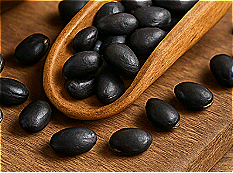
Black beans (black turtle bean; Phaseolus vulgaris L., family Fabaceae)
Description
Legume with black seed coat, creamy flesh, and a thin skin; flavor is earthy–nutty.
Sold dry, canned (retorted), or ready-cooked chilled; staple in Latin American, Caribbean, and Mediterranean dishes.
Caloric value (per 100 g)
Dry: ~330–350 kcal; carbs ~58–63 g, protein ~21–24 g, fat ~1–2 g, fiber ~15–16 g.
Boiled, unsalted: ~120–150 kcal; carbs ~20–27 g, protein ~8–10 g, fat ~0.3–0.8 g, fiber ~6–9 g.
Sodium naturally low; higher in brined/canned products (rinsing helps).
Key constituents
Proteins of good legume quality (rich in lysine, limited in methionine/cysteine).
Starch (varietal amylose/amylopectin), dietary fiber (insoluble/soluble), and resistant starch (RS), which increases upon cooling.
Polyphenols in the black seed coat: anthocyanins (e.g., cyanidin-3-glucoside), proanthocyanidins/flavonols.
Minerals (Fe, Mg, K), folate, and B vitamins.
Anti-nutritional factors reduced by processing: phytates, trypsin inhibitors, lectins (PHA), α-galactosides (raffinose/stachyose).
Technical markers: hydration capacity (mL/g), cooking time, color L*a*b*, uniformity/defects.
Production process
Dry commodity: cleaning, optical sorting, grading, destoning/metal removal, barrier packaging.
Ready-cooked/canned: soaking (sometimes light brine), blanching, fill with cover liquid, retort sterilization, cooling, inspections (drained weight, vacuum, seam integrity).
Variants: sprouting or pressure cooking to improve digestibility and reduce anti-nutrients.
Sensory and technological properties
Soaking 6–12 h or hot-soak shortens cook time; acids and hard water (Ca²⁺/Mg²⁺) slow softening.
Small amounts of baking soda or brining may cut time, but excess can fragilize skins and affect flavor.
Hard-to-cook phenomenon in old/warm-stored lots is mitigated by pressure cooking.
Food uses
Soups/stews (feijoada, black bean soup), chili, burritos/tacos, rice & beans, salads, plant-based burgers, purees/spreads.
Typical inclusions: as main protein 20–40% of finished dish; in mixes/sides 10–30%.
Aquafaba (cook liquor) can serve as emulsifier/foaming agent.
Nutrition and health
Source of plant protein, fiber, and folate; GI generally low–medium, further reduced by cooling (↑ RS) and by adding fat/protein to the meal.
Other components: Salicylic acid (1), iron and zinc (2), The flavonol glycosides phenolic compounds found in common beans possess antimicrobial, anti-inflammatory and ultraviolet radiation (UVR) protective properties (3),
Rinsing canned beans can lower sodium.
Lectins/inhibitors: thorough cooking (boil/retort) inactivates them—avoid undercooking.
Phytates may reduce Fe/Zn/Ca bioavailability; soaking, sprouting, and fermentation lower them.
α-galactosides can cause gas; soak & refresh water, use α-galactosidase enzymes, or pressure cook.
Lipid profile
Very low total fat; typical pattern PUFA (linoleic) ≥ MUFA (oleic) > SFA.
Health note: favoring MUFA (monounsaturated fatty acids) and PUFA (polyunsaturated fatty acids) over SFA (saturated fatty acids) is generally favorable/neutral for blood lipids; impact here is limited due to low fat.
TFA industrial absent; MCT not characteristic.
Quality and specifications (typical topics)
Moisture (dry beans) ≤14–16%; size grade and uniformity; defects (breaks, spots, damaged seeds) within limits.
Water absorption (mL/g), standardized cooking time, texture (shear/rupture force), color and color loss during cooking.
Freedom from pests (bruchids), foreign matter, stones/metals; pesticides/metals within limits; mycotoxins typically not critical but monitored.
For canned: drained weight, declared salt, pH, commercial sterility, vacuum and container integrity.
Storage and shelf-life
Dry: store cool/dry/dark; avoid high temperatures to reduce hard-to-cook. Typical shelf-life 12–24 months; apply FIFO.
Canned/ready-cooked: 24–36 months unopened; once opened, refrigerate and consume within 3–4 days.
Allergens and safety
Legumes are not major EU allergens, but allergies/cross-reactivity exist (e.g., peanut/soy).
Ensure adequate cooking to inactivate lectins; avoid raw or undercooked consumption.
Manage CCP for foreign bodies, commercial sterility (for canned), and hygiene.
INCI functions in cosmetics
Listings: Phaseolus Vulgaris Extract / Seed Extract (limited use).
Potential roles: mild skin conditioning/antioxidant; verify safety and formula stability.
Troubleshooting
Excessive cook time/hard cores: longer soak, use soft water, light brine or pressure cook; avoid acids early.
Burst skins: excess agitation or too little sodium during soak; try gentle brining.
Flat flavor: finish with acid (lime/vinegar) and umami (onion, bay, kombu); salt toward the end.
Gas/bloating: soak + change water, rinse canned beans, use α-galactosidase, cool after cooking to raise RS.
Sustainability and supply chain
Nitrogen-fixing crop reduces need for N fertilizers; lower carbon footprint than animal proteins.
Processing: reuse aquafaba; treat effluents to BOD/COD targets; recyclable packaging; full traceability under GMP/HACCP.
Conclusion
Black beans combine protein, fiber, and polyphenols with broad culinary versatility. Fresh raw material, proper soak/cook, and tight quality control deliver tender, safe, and flavorful products.
Mini-glossary
RS — Resistant starch: starch fraction not digested; increases after cooling, may temper glycemic response.
GI — Glycemic index: post-meal glucose response; low–medium for black beans, influenced by recipe and cooling.
SFA — Saturated fatty acids: excess may raise LDL; low in beans.
MUFA — Monounsaturated fatty acids (e.g., oleic): generally favorable/neutral for blood lipids; low in beans.
PUFA — Polyunsaturated fatty acids (n-6/n-3): beneficial when balanced; low in beans.
TFA — Trans fatty acids: avoid industrial TFA; absent in non-hydrogenated legumes.
ALA — Alpha-linolenic acid (n-3): present only in traces in legumes; limited overall impact.
EPA/DHA — Long-chain n-3 fatty acids typical of fish; absent in legumes.
MCT — Medium-chain triglycerides: not characteristic of legumes.
GMP/HACCP — Good Manufacturing Practice / Hazard Analysis and Critical Control Points: hygiene and preventive-safety systems with defined CCP.
CCP — Critical control point: step where a control prevents/reduces a hazard.
BOD/COD — Biochemical/Chemical oxygen demand: indicators of wastewater impact.
FIFO — First in, first out: inventory rotation using older lots first.
References__________________________________________________________________________
(1) Mecha E, Erny GL, Guerreiro ACL, Feliciano RP, Barbosa I, Bento da Silva A, Leitão ST, Veloso MM, Rubiales D, Rodriguez-Mateos A, Figueira ME, Vaz Patto MC, Bronze MR. Metabolomics profile responses to changing environments in a common bean (Phaseolus vulgaris L.) germplasm collection. Food Chem. 2022 Feb 15;370:131003. doi: 10.1016/j.foodchem.2021.131003.
(2) Huertas R, William Allwood J, Hancock RD, Stewart D. Iron and zinc bioavailability in common bean (Phaseolus vulgaris) is dependent on chemical composition and cooking method. Food Chem. 2022 Sep 1;387:132900. doi: 10.1016/j.foodchem.2022.132900. Epub 2022 Apr 5. PMID: 35398678.
(3) Fonseca-Hernández D, Lugo-Cervantes EDC, Escobedo-Reyes A, Mojica L. Black Bean (Phaseolus vulgaris L.) Polyphenolic Extract Exerts Antioxidant and Antiaging Potential. Molecules. 2021 Nov 6;26(21):6716. doi: 10.3390/molecules26216716.
Abstract. Phenolic compounds present in common beans (Phaseolus vulgaris L.) have been reported to possess antimicrobial, anti-inflammatory and ultraviolet radiation (UVR) protective properties. UVR from sunlight, which consists of UV-B and UV-A radiations, induces reactive oxygen species (ROS) and free radical formation, consequently activating proteinases and enzymes such as elastase and tyrosinase, leading to premature skin aging. The objective of this work was to extract, characterize and evaluate the antioxidant and antiaging potential of polyphenols from a black bean endemic variety. The polyphenolic extract was obtained from black beans by supercritical fluid extraction (SFE) using CO2 with a mixture of water-ethanol as a cosolvent and conventional leaching with a mixture of water-ethanol as solvent. The polyphenolic extracts were purified and characterized, and antioxidant potential, tyrosinase and elastase inhibitory potentials were measured. The extract obtained using the SFE method using CO2 and H2O-Ethanol (50:50 v/v) as a cosolvent showed the highest total phenolic compounds yield, with 66.60 ± 7.41 mg GAE/g coat (p > 0.05) and 7.30 ± 0.64 mg C3GE/g coat (p < 0.05) of anthocyanins compared to conventional leaching. Nineteen tentative phenolic compounds were identified in leaching crude extract using ESI-QTOF. Quercetin-3-D-galactoside was identified in crude and purified extracts. The purified SFC extract showed IC50 0.05 ± 0.002 and IC50 0.21 ± 0.008 mg/mL for DPPH and ABTS, respectively. The lowest IC50 value of tyrosinase inhibition was 0.143 ± 0.02 mg/mL and 0.005 ± 0.003 mg/mL of elastase inhibition for leaching purified extract. Phenolic compounds presented theoretical free energy values ranging from -5.3 to -7.8 kcal/mol for tyrosinase and -2.5 to -6.8 kcal/mol for elastase in molecular docking (in silico) studies. The results suggest that the purified extracts obtained by SFE or conventional leaching extraction could act as antioxidant and antiaging ingredients for cosmeceutical applications.
Rodríguez Madrera R, Campa Negrillo A, Suárez Valles B, Ferreira Fernández JJ. Phenolic Content and Antioxidant Activity in Seeds of Common Bean (Phaseolus vulgaris L.). Foods. 2021 Apr 15;10(4):864. doi: 10.3390/foods10040864.
Abstract. Dry bean (Phaseolus vulgaris L.) is one of the most important pulses consumed in the world. Total phenolic content, total flavonoid content, total monomeric anthocyanin content and antioxidant capacity were determined, using ferric reducing antioxidant power and free radical scavenging activity, in 255 lines grown under the same environmental conditions. For all parameters analysed, there was a wide range of variability, with differences always above one order of magnitude. Phenolic compounds in beans with coloured coats were found to be more efficient antioxidants than those with completely white coats, and samples with more strongly coloured coats (red, cream, black, pink and brown) showed the highest antioxidant capacities. Based on the strong correlation detected between the variables, total phenolic content can be considered an appropriate indicator of antioxidant activity. The results provide a robust database for selecting those lines of greater functional and nutritional interest in terms of cultivation for direct consumption, for inclusions in food formulations or for use in future breeding programs.
Graziani D, Ribeiro JVV, Cruz VS, Gomes RM, Araújo EG, Santos Júnior ACM, Tomaz HCM, Castro CH, Fontes W, Batista KA, Fernandes KF, Xavier CH. Oxidonitrergic and antioxidant effects of a low molecular weight peptide fraction from hardened bean (Phaseolus vulgaris) on endothelium. Braz J Med Biol Res. 2021 Apr 19;54(6):e10423. doi: 10.1590/1414-431X202010423.
Abstract. About 3000 tons of beans are not used in human food due to hardening. Several studies on bean-derived bioactive peptides have shown potential to treat some diseases, including those relying on oxidative dysfunctions. We assessed the effects of peptides extracted from hardened bean Phaseolus vulgaris (PV) on reactive oxygen species (ROS) and nitric oxide (NO) production, cytotoxic and cytoprotective effects in endothelial cells, and oxidonitrergic-dependent vasodilating effects. Extract was composed by peptide fraction <3 kDa (PV3) from hardened common bean residue. PV3 sequences were obtained and analyzed with bioinformatics. Human umbilical vein endothelial cells were treated with 10, 20, 30, and 250 µg/mL PV3. Oxidative stress was provoked by 3% H2O2. Cytotoxicity and cytoprotective effects were evaluated by MTT assay, whereas, ROS and NO were quantified using DHE and DAF-FM fluorescent probes by confocal microscopy. NO- and endothelium-dependent vasodilating effects of PV3 were assessed in isolated aortic rings. We found 35 peptides with an average mass of 1.14 kDa. There were no cell deaths with 10 and 20 μg/mL PV3. PV3 at 30 μg/mL increased cell viability, while cytotoxicity was observed only with 250 μg/mL PV3. PV3 at 10 μg/mL was able to protect cells from oxidative stress. PV3 also increased NO release without causing cell death. It also reduced relative ROS production induced by H2O2. PV3 vasodilating effects relied on endothelium-dependent NO release. PV3 obtained from low-commercial-value bean displays little cytotoxicity and exerts antioxidant effects, whereas it increases endothelial NO release.
Pitura K, Arntfield SD. Characteristics of flavonol glycosides in bean (Phaseolus vulgaris L.) seed coats. Food Chem. 2019 Jan 30;272:26-32. doi: 10.1016/j.foodchem.2018.07.220.
| Evaluate |