Pollo sfilacciato (shredded chicken; Gallus gallus domesticus)
Descrizione
Carne di pollo cotta (tipicamente petto o sovracoscia, con o senza pelle) e sminuzzata a fibre mediante forchette o sistemi meccanici.
Profilo sensoriale: fibroso–succoso se ben cotto e reidratato; sapore delicato, facilmente aromatizzabile (brodi, spezie, salse).
Formati: al naturale, insaporito (es. BBQ, taco, mediterraneo), refrigerato, confezionato in ATM/MAP o surgelato (IQF o in blocco).
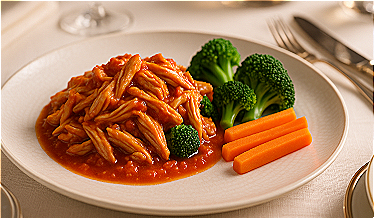
Valore calorico (per 100 g di prodotto)
Senza pelle, petto: ~120–165 kcal/100 g; proteine ~24–31 g, grassi ~2–5 g, carboidrati ~0 g.
Sovracoscia (senza pelle): ~160–205 kcal/100 g; grassi ~6–12 g.
Valori variabili in funzione di aggiunta di grassi, salse e sale (sodio da <100 mg a >600 mg/100 g se salamoia).
Principali sostanze contenute
Proteine miofibrillari (actina, miosina), sarcoplasmatiche e collagene; profilo amminoacidico completo (ricco in lisina e leucina).
Lipidi: quota dipendente dal taglio; prevalenza MUFA/PUFA su SFA (vedi profilo dei grassi). Colesterolo ~60–90 mg/100 g.
Minerali (P, K, Se) e vitamine del gruppo B (B3, B6); sodio dipendente da processi (salamoie, condimenti).
Marcatori: umidità, proteine (% Kjeldahl/Dumas), grassi (Soxhlet), NaCl (%), pH tipico 5,8–6,3, aw elevata (>0,97).
Processo di produzione
Materie prime: tagli disossati → eventuale salamoia/marinata (acqua, sale, zuccheri, spezie; fosfati dove permesso) → cottura (bollitura/poaching, vapore, forno, sous-vide).
Raffreddamento rapido → sfilacciatura (manuale o tamburo/lame) → eventuale reidratazione con jus/brodo → confezionamento (sottovuoto o MAP) → refrigerazione/surgelazione.
Controlli sotto GMP/HACCP con CCP su tempo-temperatura, raffreddamento, igiene e assenza di corpi estranei.
Proprietà sensoriali e tecnologiche
Succosità legata a cotture delicate (sous-vide/poaching) e a reintegro liquidi (jus).
Struttura: fibre lunghe favoriscono legatura di salse; triti fini per ripieni/basi.
Legame acqua migliorabile con sale moderato, amidi/fibre o (dove consentito) fosfati; pH influenza resa e tenerezza.
Impieghi alimentari
Tacos/burritos/quesadillas, insalate proteiche, panini/panini “pulled”, pasta/risi, zuppe/ramen/pho, ripieni (torte salate, verdure), topping pizza.
Dosaggi: ingrediente principale (30–60% in piatti pronti) o componente (10–30%) in salse e farciture; validare con prove pilota.
Nutrizione e salute
Alta densità proteica con grassi variabili secondo il taglio; carboidrati ~nulli salvo condimenti.
Sodio: monitorare in prodotti pronti (salamoie/salse).
Allergie alla carne di pollo rare; attenzione a eventuali allergeni introdotti da marinate/salse (es. soia, latte, glutine).
Profilo dei grassi
Petto senza pelle: grassi totali bassi; pattern indicativo MUFA (ac. oleico) e PUFA (ac. linoleico) > SFA (ac. palmitico/stearico).
Sovracoscia: grassi maggiori ma ancora MUFA/PUFA prevalenti.
SFA (grassi saturi): da moderare in generale; MUFA (grassi monoinsaturi) e PUFA (grassi polinsaturi) risultano in genere favorevoli/neutralmente associati ai lipidi ematici quando bilanciati. TFA industriali assenti; MCT non caratteristici.
Qualità e specifiche (temi tipici)
Umidità, proteine, grassi, sale (NaCl), pH, attività dell’acqua (aw).
Microbiologia: Salmonella assente in 25 g; Listeria monocytogenes conforme (reg. locale); TVC, Enterobatteri entro limiti.
Sensoriale: fibre integre, assenza di note ossidate, sulfuree o acide anomale.
Metalli/residui (se richiesti), corpi estranei; per IQF: glassa e peso netto conformi.
Conservazione e shelf-life
Refrigerato (0–4 °C): confezioni integre MAP/sottovuoto secondo TMC del produttore; una volta aperto 3–5 giorni.
Surgelato (≤−18 °C): 6–12 mesi; scongelare rapidamente in frigo e non ricongelare.
Minimizzare fluttuazioni termiche; applicare FIFO.
Allergeni e sicurezza
Funzioni INCI in cosmesi
Troubleshooting
Carne secca/stopposa: cottura eccessiva o raffreddamento lento → preferire sous-vide/poaching, raffreddare rapidamente, reidratare con jus/gelatina.
Sfilacciatura difficile: temperatura troppo bassa o fibre non gelatinizzate → sfilacciare tiepido-caldo (50–60 °C nucleo).
Essudazione eccessiva in pack: ridurre sale/fosfati, calibrare pH, aumentare tempo di riposo post-cottura.
Sapore piatto: aggiungere sale acido (agrumi/aceto), umami (brodo concentrato, funghi), grassi aromatici (olio EVO/pollo).
Sodio alto: riformulare salamoia, usare erbe/spezie e acidi per mantenere la sapidità percepita.
Sostenibilità e filiera
Valutare benessere animale, antibiotico-responsabilità, alimentazione e impronta ambientale.
In stabilimento: recupero ossa/pelli per brodi e gelatine; gestione reflui verso target BOD/COD; imballi riciclabili; tracciabilità GMP/HACCP.
Conclusione
Il pollo sfilacciato è un ingrediente versatile, proteico e neutro nel gusto, ideale per piatti pronti e preparazioni domestiche. Controlli su cottura, umidità, pH/sale e microbiologia garantiscono sicurezza, succosità e ripetibilità del risultato.
Mini-glossario
MUFA — grassi monoinsaturi (es. oleico): in genere favorevoli/neutralmente associati ai lipidi ematici.
PUFA — grassi polinsaturi (n-6/n-3): benefici se bilanciati nella dieta; attenzione all’eccesso di n-6.
SFA — grassi saturi: da moderare perché in eccesso possono aumentare LDL.
TFA — grassi trans: evitare quelli industriali; non tipici dei prodotti non idrogenati.
MCT — trigliceridi a media catena: non caratteristici del pollo.
aw — attività dell’acqua: nel cotto è alta; richiede refrigerazione/surgelazione.
MAP/ATM — atmosfera modificata: gas alimentari per estendere la shelf-life.
GMP/HACCP — good manufacturing practice / hazard analysis and critical control points: sistemi igienico-preventivi con CCP definiti.
CCP — critical control point: fase in cui un controllo previene/riduce un pericolo.
BOD/COD — domanda biochimica/chimica di ossigeno: indicatori dell’impatto dei reflui di processo.
FIFO — first in, first out: rotazione scorte che usa prima i lotti più vecchi.
Bibliografia__________________________________________________________________________
English DR, MacInnis RJ, Hodge AM, Hopper JL, Haydon AM, Giles GG. Red meat, chicken, and fish consumption and risk of colorectal cancer. Cancer Epidemiol Biomarkers Prev. 2004 Sep;13(9):1509-14.
Abstract. Background: Red meat and processed meat consumption have been associated with increased risk of colorectal cancer in some, but not all, relevant cohort studies. Evidence on the relationship between risk of colorectal cancer and poultry and fish consumption is inconsistent. Methods: We conducted a prospective cohort study of 37,112 residents of Melbourne, Australia recruited from 1990 to 1994. Diet was measured with a food frequency questionnaire. We categorized the frequency of fresh red meat, processed meat, chicken, and fish consumption into approximate quartiles. Adenocarcinomas of the colon or rectum were ascertained via the Victorian Cancer Registry. Results: We identified 283 colon cancers and 169 rectal cancers in an average of 9 years of follow-up. For rectal cancer, the hazard ratios [95% confidence intervals (95% CI)] in the highest quartile of consumption of fresh red meat and processed meat were 2.3 (1.2-4.2; P for trend = 0.07) and 2.0 (1.1-3.4; P for trend = 0.09), respectively. The corresponding hazard ratios (95% CIs) for colon cancer were 1.1 (0.7-1.6; P for trend = 0.9) and 1.3 (0.9-1.9; P for trend = 0.06). However, for neither type of meat was the heterogeneity between subsites significant. Chicken consumption was weakly negatively associated with colorectal cancer (hazard ratio highest quartile, 0.7; 95% CI, 0.6-1.0; P for trend = 0.03), whereas hazard ratios for fish consumption were close to unity. Conclusion: Consumption of fresh red meat and processed meat seemed to be associated with an increased risk of rectal cancer. Consumption of chicken and fish did not increase risk.
Chong EW, Simpson JA, Robman LD, Hodge AM, Aung KZ, English DR, Giles GG, Guymer RH. Red meat and chicken consumption and its association with age-related macular degeneration. Am J Epidemiol. 2009 Apr 1;169(7):867-76. doi: 10.1093/aje/kwn393.
Abstract. Age-related macular degeneration (AMD) is the leading cause of blindness among older people, and diet has been postulated to alter risk of AMD. To evaluate associations between red meat and chicken intake and AMD, the authors conducted a cohort study of 6,734 persons aged 58-69 years in 1990-1994 in Melbourne, Australia. Meat intake was estimated from a food frequency questionnaire at baseline. At follow-up (2003-2006), bilateral digital macular photographs were taken and evaluated for AMD (1,680 cases of early AMD, 77 cases of late AMD). Logistic regression was used to estimate odds ratios, adjusted for age, smoking, and other potential confounders. Higher red meat intake was positively associated with early AMD; the odds ratio for consumption of red meat > or =10 times/week versus <5 times/week was 1.47 (95% confidence interval: 1.21, 1.79; P-trend < 0.001). Similar trends toward increasing prevalence of early AMD were seen with higher intakes of fresh and processed red meat. Conversely, consumption of chicken > or =3.5 times/week versus <1.5 times/week was inversely associated with late AMD (odds ratio = 0.43, 95% confidence interval: 0.20, 0.91; P-trend = 0.007). These results suggest that different meats may differently affect AMD risk and may be a target for lifestyle modification.
Navas-Carretero S, Cuervo M, Abete I, Zulet MA, Martínez JA. Frequent consumption of selenium-enriched chicken meat by adults causes weight loss and maintains their antioxidant status. Biol Trace Elem Res. 2011 Oct;143(1):8-19. doi: 10.1007/s12011-010-8831-x.
Abstract. To assess the effects of a moderately high-protein intake on the body composition, biochemical, and antioxidant status parameters in young adults depending on either selenium- (Se) or non-enriched chicken consumption. The volunteers (n = 24) that completed the 10-week nutritional intervention were distributed in two parallel groups and randomly assigned to follow an isocaloric diet with moderately high content in protein (30% energy), either with the consumption of four 200 g portions/week of Se- or non-enriched chicken breasts. Blood samples were taken at the beginning and at the end of the study and body composition was monitored during the trial. There was a significant reduction in weight, accompanying a decrease on fat mass in both groups, while fat-free mass remained unchanged during the 10 weeks of intervention, without differences between both dietary groups. Selenium blood levels and plasma glutathione peroxidase activity, as well as lipid, glucose, and selected inflammation biomarkers remained stable during the intervention period in both dietary groups. Frequent chicken consumption, within a controlled diet with a moderately high content in protein, produced a slight but statistically significant weight reduction mainly due to the loss of fat mass. An extra Se supplementation (22 μg/day) in the Se-enriched chicken breast did not affect tachyphylactic antioxidant status of the participants neither inflammatory-related markers after weight loss.
Barbosa ACS, Mendes PS, Mattos G, Fuchs RHB, Marques LLM, Beneti SC, Heck SC, Droval AA, Cardoso FAR. Comparative analysis of the use of natural and synthetic antioxidants in chicken meat: an update review. Braz J Biol. 2023 Oct 23;83:e275539. doi: 10.1590/1519-6984.275539.
Abstract. The search for healthy foods has attracted the industry's attention to developing products that use natural ingredients, including natural antioxidants. Antioxidants act as free radicals or oxygen scavengers, inhibiting lipid oxidation and adversely affecting meat products' sensory and nutritional quality. Several synthetic antioxidants have been used in the meat industry; however, studies point to health risks related to their consumption. Such fact drives research into natural antioxidants extracted from grains, oilseeds, spices, fruits, and vegetables, which may have a health-promoting effect. This manuscript evaluates the effectiveness of several natural antioxidants in improving the quality and shelf life of chicken meat products during processing, storage, and distribution. The potential effects of natural antioxidants widely used in chicken products are also discussed. It can be concluded that these natural antioxidants are possible substitutes for synthetic ones. However, their use can affect the product's characteristics.
Connolly G, Campbell WW. Poultry Consumption and Human Cardiometabolic Health-Related Outcomes: A Narrative Review. Nutrients. 2023 Aug 11;15(16):3550. doi: 10.3390/nu15163550.
Abstract. Poultry meats, in particular chicken, have high rates of consumption globally. Poultry is the most consumed type of meat in the United States (US), with chicken being the most common type of poultry consumed. The amounts of chicken and total poultry consumed in the US have more than tripled over the last six decades. This narrative review describes nutritional profiles of commonly consumed chicken/poultry products, consumption trends, and dietary recommendations in the US. Overviews of the scientific literature pertaining to associations between, and effects of consuming chicken/poultry on, body weight and body composition, cardiovascular disease (CVD), and type II diabetes mellitus (T2DM) are provided. Limited evidence from randomized controlled trials indicates the consumption of lean unprocessed chicken as a primary dietary protein source has either beneficial or neutral effects on body weight and body composition and risk factors for CVD and T2DM. Apparently, zero randomized controlled feeding trials have specifically assessed the effects of consuming processed chicken/poultry on these health outcomes. Evidence from observational studies is less consistent, likely due to confounding factors such as a lack of a description of and distinctions among types of chicken/poultry products, amounts consumed, and cooking and preservation methods. New experimental and observational research on the impacts of consuming chicken/poultry, especially processed versions, on cardiometabolic health is sorely needed.
Toh DWK, Wong CH, Fam J, Kim JE. Daily consumption of essence of chicken improves cognitive function: a systematically searched meta-analysis of randomized controlled trials. Nutr Neurosci. 2021 Mar;24(3):236-247. doi: 10.1080/1028415X.2019.1619984.
Abstract. Essence of chicken (EC) is a dietary supplement with potential benefits on one's cognitive performance. The purpose of this meta-analysis is to evaluate the effects of consuming EC on cognitive function, applying extensively represented domains. Six databases were systematically searched to yield 1760 articles. These articles were independently screened to obtain 8 eligible articles with a pooled population of 794 subjects which is more than twice the population size considered in the previous meta-analyses. Largely, favorable effects on cognitive function were observed following daily EC intake, specifically in the working memory domain (standardized mean difference: 0.31, 95% CI: 0.16, 0.46), one of the core components in executive function which showed statistically significant results. Furthermore, the observed results were also robust to sensitivity analyses and subgroup analyses. This suggests that when consumed daily, EC may improve the mental processing aspect of cognitive function amongst the healthy population.
Ahmad S, Ahmed I, Haider S, Batool Z, Ahmed SB. Daily consumption of commercial chicken feed and meat lead to alterations in serum cholesterol and steroidal sex hormones in female rats. Pak J Pharm Sci. 2017 Jan;30(1 Suppl):257-261.
Abstract. Poultry consumption is increased worldwide owing to better taste, easy availability and low cost. The present study was designed to investigate the effects of the chicken feed, conventional chicken meat and organic chicken meat on the % growth rate, serum cholesterol, progesterone, testosterone and estrogen levels in female rats. Hundred female Albino Wistar rats were randomly assigned to four groups (n=25). Group I was control rats fed on standard chow, group II treated with commercial chicken feed, group III rats fed with conventional chicken meat and group IV with organic chicken meat for a period of 6 weeks. % Growth rate, serum cholesterol, progesterone, testosterone and estrogen levels were estimated after the treatment. The present study showed significant increase in growth rate, serum cholesterol levels and imbalance in serum steroidal hormone levels. It is therefore, suggested from the present study that the intake of commercial chicken feed and commercial chicken meat may be the potential cause of development of polycystic ovary syndrome in females due to steroid hormonal imbalance.




