



Red Bell Peppers( Capsicum annuum)
Fruit of the Solanaceae family harvested at different ripeness stages (green = unripe; yellow/orange/red = ripe). Includes blocky/bell, horn/corno, quadrangular, and thin-flesh types (for drying). Used fresh, roasted/smoked, preserved (grilled in oil, brined/pickled), dried (e.g., paprika), and as color extracts.
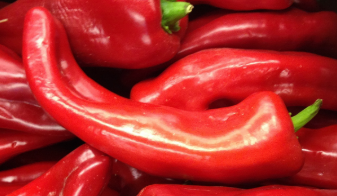
Common name: Red bell pepper
Source plant: Capsicum annuum L. (family Solanaceae)
Kingdom: Plantae
Clade: Angiosperms
Clade: Eudicots
Order: Solanales
Family: Solanaceae
Genus: Capsicum
Species: Capsicum annuum L.
Note: Red bell peppers are simply the fully ripe fruits of sweet (non-pungent) Capsicum annuum cultivars. They are green at the immature stage and turn red as they ripen, becoming sweeter, more aromatic and richer in carotenoids and vitamin C.
Cultivation and growing conditions of red bell peppers
Climate:
Prefer warm, temperate to warm–subtropical climates.
Sensitive to low temperatures and frost.
Need a relatively long, warm growing season to complete ripening from green to red.
Exposure:
Require full sun (6–8 hours per day).
Shade reduces yield, sweetness and colour intensity.
Soil:
Thrive in fertile, deep, well-drained, medium-textured soils.
Ideal pH: slightly acidic to neutral (about 6–7).
Poorly adapted to heavy, compact or waterlogged soils, which favour root rot and fungal diseases.
Watering:
Need regular, moderate irrigation, keeping the soil consistently slightly moist.
Strong alternation between drought and heavy watering can cause:
blossom-end rot
fruit cracking
flower and fruit drop
Slightly reducing irrigation in the last weeks can favour more intense red colouring.
Temperature:
Optimal seed germination: about 20–28 °C.
Optimal vegetative growth and fruit development: 20–30 °C.
Growth slows significantly below about 12–14 °C.
Fertilization:
Benefit from a good basal supply of organic matter (compost, well-rotted manure).
Phosphorus and potassium are important for flowering, fruit set and fruit quality.
Nitrogen should be applied in moderation: excess nitrogen → vigorous foliage, fewer fruits and more susceptibility to disorders.
Crop management:
Early weed control during initial growth stages.
Organic mulching helps maintain stable soil moisture and limit weed competition.
Staking can be useful in tall or heavily loaded plants to prevent lodging or branch breakage.
Light pinching can encourage branching and more uniform fruiting.
Harvest:
Fruits can be picked green, but to obtain red bell peppers they must be left on the plant until fully ripe and uniformly red.
Red fruits are sweeter, more aromatic and have higher antioxidant content than green ones.
Regular picking of ripe fruits stimulates continued flowering and fruit set.
Propagation:
By seed, usually sown in protected seedbeds or trays.
Seedlings are transplanted when outdoor temperatures are reliably mild and the risk of frost has passed.
Caloric value (per 100 g, edible portion)
~20–31 kcal • Water ~90–93 g • Carbohydrates ~4–6 g (mainly glucose/fructose) • Fiber ~1.5–2.5 g • Protein ~0.9–1.3 g • Fat ~0.2–0.4 g • Sodium ~2–5 mg.
Very high vitamin C (green ~80–120 mg, red ~120–150+ mg/100 g); provitamin A carotenoids higher in red/orange fruit.
Key constituents
Carotenoids: in reds capsanthin, capsorubin, β-carotene; in yellows violaxanthin, lutein; in greens chlorophylls.
Volatiles: methoxypyrazines (e.g., IBMP → “green” note), light terpenes, C6 aldehydes.
Polyphenols: quercetin, luteolin (concentrated in skins).
Capsaicinoids: negligible in sweet peppers (no pungency); some cultivars carry capsinoids (non-pungent).
Minerals: K, Mn, Cu; nitrates generally low (↑ with intensive fertilization).
Lipid profile (per 100 g; always specified)
Total fat 0.2–0.4 g with a percentage distribution largely PUFA and MUFA but nutritionally insignificant at typical intakes:
SFA ~10–20% • MUFA ~25–35% • PUFA ~45–60% (n-6 predominant; n-3 trace). Cholesterol: absent.
Production and processing
Field/greenhouse cultivation → harvest at target color → grading/washing → fresh use or processing:
Roasting/charring → peeling; pack under MAP or in oil/brine.
Acidification/pickling (pH < 4.6 for safety).
Drying (air/sun/oven) → paprika; possible smoking (e.g., pimentón de la Vera).
Extraction with solvents/oil → paprika extract (E160c); standardized in ASTA color units.
Sensory and technological properties
Aroma: green-herbaceous (methoxypyrazines) to sweet-fruity in ripe fruit, with caramelized/smoky notes from roasting.
Color: chlorophyll (green) → carotenoids (yellow/red) during ripening.
Texture: cell walls rich in pectin; brief blanching and calcium additions (e.g., CaCl₂) help retain crispness in pickles.
Color stability: carotenoids are lipophilic and sensitive to light/O₂/heat; encapsulation/oil carriers and antioxidants (tocopherols/rosemary extract) improve stability.
Food applications
Crudités and salads, soffritto/bases, stuffed peppers, grilled/roasted antipasti and sandwiches, sauces (e.g., ajvar, romesco), pickles, paprika as spice/color, paprika extract (E160c) for snacks, cheeses, sauces.
Indicative industrial dosages: paprika 0.05–0.5% (per ASTA target); E160c according to color yield and local limits.
Nutrition and health
Low energy, high vitamin C and carotenoids (in ripe fruit); useful fiber. Non-pungent (no capsaicin). Sensitive individuals may experience allergy (see below) or reflux with large raw portions. (No health claims without authorization.)
Quality and specifications (typical topics)
Ripeness/color, firmness (shear), °Brix, organic acids (pH), pesticide residues within MRLs, microbiology on ready-to-eat items (pathogens absent). For paprika: moisture, ASTA color, particle size, aflatoxins/ochratoxin (where relevant), metals; for extracts: total carotenoids, oxidative status, residual solvents.
Storage and shelf life
Fresh peppers: 7–10 °C, RH 90–95% (chilling injury below ~7 °C → pitting/softening); avoid high ethylene (accelerates senescence). Roasted: keep refrigerated; pickled/in oil: meet pH/aw criteria. Paprika: store dark and dry (low aw) in barrier packs (low OTR) to limit fading; apply FIFO.
Allergens and safety
Pepper is not among the EU major 14 allergens, but specific allergies are reported (LTP Cap a 1) and cross-reactivity (e.g., birch/latex–fruit syndromes). Microbiological risks arise from post-harvest contamination (hygienic handling/wash). Ensure appropriate pH in acidified preserves.
INCI functions in cosmetics
Entries: Capsicum Annuum Fruit Extract, Capsicum Annuum (Paprika) Extract. Roles: colorant, antioxidant/skin conditioning (carotenoids). Prevent photodegradation (amber/barrier packs).
Sustainability and supply chain
Field or greenhouse crops; manage irrigation and fertilization (leaching risk). Improvements: IPM (integrated pest management), by-product recovery for carotenoids/pectin, reduced greenhouse plastics, effluent management to BOD/COD targets, recyclable packaging.
Troubleshooting
Over-green/“bell pepper” note (methoxypyrazines) → use ripe fruit; roast/peel; balance with acid and sweetness.
Paprika/extract fading → light/O₂/heat → upgrade barrier, lower T, add permitted antioxidants.
Soft pickles → pectin breakdown → brief blanch, add CaCl₂, control pH and process temperature.
Cooked/browned off-notes → overcooking → use shorter cooks and moderate finishing heat.
Conclusion
Sweet pepper combines low calories, very high vitamin C, and carotenoid-rich color with wide versatility from fresh use to paprika and extracts. Performance depends on ripeness, management of light/O₂/heat, and appropriate processing (roasting, drying, acidification).
Fresh pepper contains phenols, flavonoids, capsaicinoids, ascorbic acid, all components that exert an antioxidant activity. In the treated pepper there are fewer phytochemical components and the antioxidant activity is lower (1). Cooking the pepper subtracts at least 60% of vitamin C.
Capsaicin is the alkaloid that gives the pepper its spicy taste, it is a component with antioxidant properties.
An extract from the leaves of pepper significantly inhibited inflammatory cytokine production, inhibited cell proliferation without producing cytotoxicity, and suppressed the expression of inflammatory proteins (2).
Among the polyphenols present, caffeic acid, quercetin and kaempferol have the highest amounts and have shown antimicrobial activity (3).
From green bell pepper, an extract of pectic polysaccharides showed antineoplastic activity in breast cancer, in vitro and in vivo (4).

