Brodo di pollo (chicken broth)
Descrizione
• Preparazione liquida ottenuta per bollitura lenta di ossa/carcasse e carni di pollo con verdure aromatiche (es. cipolla, carota, sedano), erbe e spezie in acqua.
• Varianti: brodo chiaro, fondo bruno (con ossa/aromi arrostiti), consommé (brodo chiarificato), “bone broth” (estrazione prolungata per massima gelatina).
• Profilo sensoriale: salato–umami, note carnee/rostite, vegetali e spezie; colore da giallo paglierino (chiaro) ad ambra (bruno).
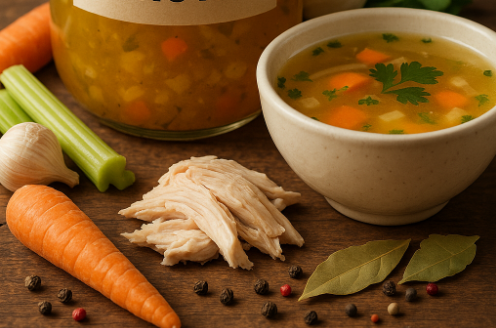
Valore calorico (per 100 g di prodotto)
• Brodo casalingo/industriale pronto: tipicamente ~5–20 kcal/100 g (dipende da solidi, gelatina e grasso residuo).
• Concentrati/paste ricostituiti secondo etichetta: di norma ~5–15 kcal/100 g.
• Il sodio può essere elevato nelle versioni pronte/da dado: verificare l’etichetta.
Principali sostanze contenute
• Acqua; NaCl (se aggiunto); aminoacidi/peptidi solubili; nucleotidi 5′ (5′-IMP, 5′-GMP) responsabili dell’umami; gelatina/collagene (da tessuti connettivi); acidi organici lievi.
• Lipidi: frazioni di grasso di pollo in microgocce (variabili, spesso rimosse in parte).
• Micronutrienti tracciabili dalle ossa/verdure; aromi volatili caratteristici.
• Parametri tipici: pH ~5,5–6,4, °Brix basso (solidi solubili), torbidità (NTU) secondo stile.
Processo di produzione
• Materie prime: ossa/carcasse e ritagli di pollo, mirepoix (cipolla–carota–sedano), aromi.
• Estrazione: acqua fredda → riscaldamento graduale → sobbollire (2–6 h per brodo chiaro; più lungo per bone broth) con schiumatura delle impurità.
• Filtrazione/raffreddamento rapido → sgrasso (rimozione cappello di grasso) → regolazione di sale → confezionamento.
• Opzioni industriali: cotture in pressione, enzimi per estrazione proteica, chiarifica (filtri/gelatina), pastorizzazione/sterilizzazione (retort) o aseptico; gestione sotto GMP/HACCP con CCP su tempo/T°, igiene e chiusure.
Proprietà sensoriali e tecnologiche
• Umami sinergico: 5′-IMP/5′-GMP potenziano il glutammato degli ingredienti, aumentando la sapidità percepita.
• Gelatina: apporta corpo e mouthfeel; in raffreddamento può gelificare (utile per salse/riduzioni).
• Grassi: veicolano aromi e conferiscono lucidità; un eccesso può dare untuosità.
• Colore: più ambra con tostatura di ossa/aromi (fondo bruno) e riduzioni.
Impieghi alimentari
• Base per zuppe, risotti, salse/fondi (demi-glace), brasati/stufati, ripieni e gravy.
• Dosaggi tipici: uso tal quale; per concentrati/polveri 0,3–2% sul prodotto finito (secondo specifiche del fornitore e prove pilota).
• In riduzione (2–4×) aumenta intensità e viscosità.
Nutrizione e salute
• Basso apporto calorico alle diluizioni d’uso; sale spesso il principale fattore nutrizionale → considerare versioni a ridotto sodio o bilanciamento in ricetta.
• Gelatina/collagene contribuiscono al mouthfeel; evitare claim salutistici non autorizzati.
• Possibili amine biogene basse; gestione corretta del freddo limita crescita microbica.
Profilo dei grassi
• Grassi totali modesti (variabili); derivano da grasso di pollo.
• Pattern indicativo (del grasso residuo): SFA (grassi saturi) ~28–35%, MUFA (grassi monoinsaturi) ~35–45%, PUFA (grassi polinsaturi) ~15–25%; impatto trascurabile alle dosi d’uso.
• Nota salute: maggiore quota MUFA/PUFA rispetto a SFA è in genere favorevole/neutrale per i lipidi ematici.
Qualità e specifiche (temi tipici)
• Sale (NaCl), pH, °Brix/solidi, torbidità/colore (Lab*), grasso totale (e stabilità emulsione).
• Microbiologia: assenza patogeni; per prodotti retort assenza gas/bombaggi; per refrigerati catena del freddo.
• Sensory: profilo pulito, assenza di ossidato/ammine e note amarognole da sovraestrazione.
• Tracciabilità e conformità GMP/HACCP; CCP su cottura/raffreddamento/confezionamento.
Conservazione e shelf-life
• Refrigerato (0–4 °C): 2–4 giorni; congelato: 6–12 mesi (in contenitori idonei).
• Shelf-stable (sterilizzato/aseptico): 12–24 mesi chiuso; dopo apertura refrigerare e consumare entro pochi giorni.
• Proteggere da luce/ossigeno; applicare FIFO.
Allergeni e sicurezza
• Il pollo non è allergene maggiore UE; attenzione a sedano/carote/cipolla e spezie (potenziali allergeni/etichette).
• Sodio elevato: considerare target di riduzione sale.
• Evitare corpi estranei; filtrazione adeguata; igiene rigorosa su linee e utensili.
Troubleshooting
• Brodo torbido quando si vuole chiaro: evitare ebollizione vigorosa; schiumare, filtrare finemente o chiarificare (raft).
• Gusto piatto: aumentare tempo di estrazione, usare ossa ricche di collagene (zampe/collo), correggere sale a fine cottura.
• Untuosità eccessiva: raffreddare e sgrassare; emulsionare solo la quota desiderata.
• Note amare: sovraestrazione/temperature troppo alte → ridurre tempo, evitare vegetali amaricanti in eccesso (es. foglie di sedano).
• Instabilità in frigo: raffreddare rapidamente, porzionare, mantenere <4 °C.
Sostenibilità e filiera
• Upcycling di ossa/carcasse dalla lavorazione avicola → riduzione sprechi.
• Effluenti di cottura con carico BOD/COD da gestire; ottimizzare energia (recupero calore).
• Imballaggi riciclabili; audit fornitori e tracciabilità sotto GMP/HACCP.
Conclusione
Il brodo di pollo è una base culinaria versatile che fornisce umami, corpo e aromi carnee–vegetali. Selezione delle materie prime, controllo di tempo/temperatura, corretta chiarifica/sgrasso e gestione igienica assicurano un prodotto stabile, pulito e ripetibile per zuppe, risotti, salse e riduzioni.
Mini-glossario
• 5′-IMP / 5′-GMP — 5′-inosinato / 5′-guanosinato: nucleotidi sapidi che potenziano l’umami (non confondere GMP con Good Manufacturing Practice).
• °Brix — solidi solubili totali: indicatore della concentrazione del brodo.
• NTU — nephelometric turbidity unit: misura della torbidità.
• aw — attività dell’acqua: più è bassa, maggiore è la stabilità; nei brodi è alta, quindi serve trattamento termico/freddo.
• SFA — grassi saturi: in eccesso possono aumentare LDL; nel brodo sono bassi.
• MUFA — grassi monoinsaturi (es. oleico): in genere neutrali/favorevoli; nel brodo sono bassi.
• PUFA — grassi polinsaturi (n-6/n-3): utili se bilanciati; nel brodo sono bassi.
• GMP/HACCP — good manufacturing practice / hazard analysis and critical control points: quadri per igiene e sicurezza con CCP definiti.
• BOD/COD — domanda biochimica/chimica di ossigeno: indicatori dell’impatto dei reflui di processo.
• FIFO — first in, first out: rotazione scorte che usa prima i lotti più vecchi.
Bibliografia__________________________________________________________________________
English DR, MacInnis RJ, Hodge AM, Hopper JL, Haydon AM, Giles GG. Red meat, chicken, and fish consumption and risk of colorectal cancer. Cancer Epidemiol Biomarkers Prev. 2004 Sep;13(9):1509-14.
Abstract. Background: Red meat and processed meat consumption have been associated with increased risk of colorectal cancer in some, but not all, relevant cohort studies. Evidence on the relationship between risk of colorectal cancer and poultry and fish consumption is inconsistent. Methods: We conducted a prospective cohort study of 37,112 residents of Melbourne, Australia recruited from 1990 to 1994. Diet was measured with a food frequency questionnaire. We categorized the frequency of fresh red meat, processed meat, chicken, and fish consumption into approximate quartiles. Adenocarcinomas of the colon or rectum were ascertained via the Victorian Cancer Registry. Results: We identified 283 colon cancers and 169 rectal cancers in an average of 9 years of follow-up. For rectal cancer, the hazard ratios [95% confidence intervals (95% CI)] in the highest quartile of consumption of fresh red meat and processed meat were 2.3 (1.2-4.2; P for trend = 0.07) and 2.0 (1.1-3.4; P for trend = 0.09), respectively. The corresponding hazard ratios (95% CIs) for colon cancer were 1.1 (0.7-1.6; P for trend = 0.9) and 1.3 (0.9-1.9; P for trend = 0.06). However, for neither type of meat was the heterogeneity between subsites significant. Chicken consumption was weakly negatively associated with colorectal cancer (hazard ratio highest quartile, 0.7; 95% CI, 0.6-1.0; P for trend = 0.03), whereas hazard ratios for fish consumption were close to unity. Conclusion: Consumption of fresh red meat and processed meat seemed to be associated with an increased risk of rectal cancer. Consumption of chicken and fish did not increase risk.
Chong EW, Simpson JA, Robman LD, Hodge AM, Aung KZ, English DR, Giles GG, Guymer RH. Red meat and chicken consumption and its association with age-related macular degeneration. Am J Epidemiol. 2009 Apr 1;169(7):867-76. doi: 10.1093/aje/kwn393.
Abstract. Age-related macular degeneration (AMD) is the leading cause of blindness among older people, and diet has been postulated to alter risk of AMD. To evaluate associations between red meat and chicken intake and AMD, the authors conducted a cohort study of 6,734 persons aged 58-69 years in 1990-1994 in Melbourne, Australia. Meat intake was estimated from a food frequency questionnaire at baseline. At follow-up (2003-2006), bilateral digital macular photographs were taken and evaluated for AMD (1,680 cases of early AMD, 77 cases of late AMD). Logistic regression was used to estimate odds ratios, adjusted for age, smoking, and other potential confounders. Higher red meat intake was positively associated with early AMD; the odds ratio for consumption of red meat > or =10 times/week versus <5 times/week was 1.47 (95% confidence interval: 1.21, 1.79; P-trend < 0.001). Similar trends toward increasing prevalence of early AMD were seen with higher intakes of fresh and processed red meat. Conversely, consumption of chicken > or =3.5 times/week versus <1.5 times/week was inversely associated with late AMD (odds ratio = 0.43, 95% confidence interval: 0.20, 0.91; P-trend = 0.007). These results suggest that different meats may differently affect AMD risk and may be a target for lifestyle modification.
Navas-Carretero S, Cuervo M, Abete I, Zulet MA, Martínez JA. Frequent consumption of selenium-enriched chicken meat by adults causes weight loss and maintains their antioxidant status. Biol Trace Elem Res. 2011 Oct;143(1):8-19. doi: 10.1007/s12011-010-8831-x.
Abstract. To assess the effects of a moderately high-protein intake on the body composition, biochemical, and antioxidant status parameters in young adults depending on either selenium- (Se) or non-enriched chicken consumption. The volunteers (n = 24) that completed the 10-week nutritional intervention were distributed in two parallel groups and randomly assigned to follow an isocaloric diet with moderately high content in protein (30% energy), either with the consumption of four 200 g portions/week of Se- or non-enriched chicken breasts. Blood samples were taken at the beginning and at the end of the study and body composition was monitored during the trial. There was a significant reduction in weight, accompanying a decrease on fat mass in both groups, while fat-free mass remained unchanged during the 10 weeks of intervention, without differences between both dietary groups. Selenium blood levels and plasma glutathione peroxidase activity, as well as lipid, glucose, and selected inflammation biomarkers remained stable during the intervention period in both dietary groups. Frequent chicken consumption, within a controlled diet with a moderately high content in protein, produced a slight but statistically significant weight reduction mainly due to the loss of fat mass. An extra Se supplementation (22 μg/day) in the Se-enriched chicken breast did not affect tachyphylactic antioxidant status of the participants neither inflammatory-related markers after weight loss.
Barbosa ACS, Mendes PS, Mattos G, Fuchs RHB, Marques LLM, Beneti SC, Heck SC, Droval AA, Cardoso FAR. Comparative analysis of the use of natural and synthetic antioxidants in chicken meat: an update review. Braz J Biol. 2023 Oct 23;83:e275539. doi: 10.1590/1519-6984.275539.
Abstract. The search for healthy foods has attracted the industry's attention to developing products that use natural ingredients, including natural antioxidants. Antioxidants act as free radicals or oxygen scavengers, inhibiting lipid oxidation and adversely affecting meat products' sensory and nutritional quality. Several synthetic antioxidants have been used in the meat industry; however, studies point to health risks related to their consumption. Such fact drives research into natural antioxidants extracted from grains, oilseeds, spices, fruits, and vegetables, which may have a health-promoting effect. This manuscript evaluates the effectiveness of several natural antioxidants in improving the quality and shelf life of chicken meat products during processing, storage, and distribution. The potential effects of natural antioxidants widely used in chicken products are also discussed. It can be concluded that these natural antioxidants are possible substitutes for synthetic ones. However, their use can affect the product's characteristics.
Connolly G, Campbell WW. Poultry Consumption and Human Cardiometabolic Health-Related Outcomes: A Narrative Review. Nutrients. 2023 Aug 11;15(16):3550. doi: 10.3390/nu15163550.
Abstract. Poultry meats, in particular chicken, have high rates of consumption globally. Poultry is the most consumed type of meat in the United States (US), with chicken being the most common type of poultry consumed. The amounts of chicken and total poultry consumed in the US have more than tripled over the last six decades. This narrative review describes nutritional profiles of commonly consumed chicken/poultry products, consumption trends, and dietary recommendations in the US. Overviews of the scientific literature pertaining to associations between, and effects of consuming chicken/poultry on, body weight and body composition, cardiovascular disease (CVD), and type II diabetes mellitus (T2DM) are provided. Limited evidence from randomized controlled trials indicates the consumption of lean unprocessed chicken as a primary dietary protein source has either beneficial or neutral effects on body weight and body composition and risk factors for CVD and T2DM. Apparently, zero randomized controlled feeding trials have specifically assessed the effects of consuming processed chicken/poultry on these health outcomes. Evidence from observational studies is less consistent, likely due to confounding factors such as a lack of a description of and distinctions among types of chicken/poultry products, amounts consumed, and cooking and preservation methods. New experimental and observational research on the impacts of consuming chicken/poultry, especially processed versions, on cardiometabolic health is sorely needed.
Toh DWK, Wong CH, Fam J, Kim JE. Daily consumption of essence of chicken improves cognitive function: a systematically searched meta-analysis of randomized controlled trials. Nutr Neurosci. 2021 Mar;24(3):236-247. doi: 10.1080/1028415X.2019.1619984.
Abstract. Essence of chicken (EC) is a dietary supplement with potential benefits on one's cognitive performance. The purpose of this meta-analysis is to evaluate the effects of consuming EC on cognitive function, applying extensively represented domains. Six databases were systematically searched to yield 1760 articles. These articles were independently screened to obtain 8 eligible articles with a pooled population of 794 subjects which is more than twice the population size considered in the previous meta-analyses. Largely, favorable effects on cognitive function were observed following daily EC intake, specifically in the working memory domain (standardized mean difference: 0.31, 95% CI: 0.16, 0.46), one of the core components in executive function which showed statistically significant results. Furthermore, the observed results were also robust to sensitivity analyses and subgroup analyses. This suggests that when consumed daily, EC may improve the mental processing aspect of cognitive function amongst the healthy population.
Ahmad S, Ahmed I, Haider S, Batool Z, Ahmed SB. Daily consumption of commercial chicken feed and meat lead to alterations in serum cholesterol and steroidal sex hormones in female rats. Pak J Pharm Sci. 2017 Jan;30(1 Suppl):257-261.
Abstract. Poultry consumption is increased worldwide owing to better taste, easy availability and low cost. The present study was designed to investigate the effects of the chicken feed, conventional chicken meat and organic chicken meat on the % growth rate, serum cholesterol, progesterone, testosterone and estrogen levels in female rats. Hundred female Albino Wistar rats were randomly assigned to four groups (n=25). Group I was control rats fed on standard chow, group II treated with commercial chicken feed, group III rats fed with conventional chicken meat and group IV with organic chicken meat for a period of 6 weeks. % Growth rate, serum cholesterol, progesterone, testosterone and estrogen levels were estimated after the treatment. The present study showed significant increase in growth rate, serum cholesterol levels and imbalance in serum steroidal hormone levels. It is therefore, suggested from the present study that the intake of commercial chicken feed and commercial chicken meat may be the potential cause of development of polycystic ovary syndrome in females due to steroid hormonal imbalance.




