Peperoncino in polvere (chili powder; Capsicum spp., fam. Solanaceae)
Descrizione
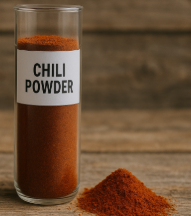
• Spezia ottenuta da peperoncini essiccati e macinati (polvere pura), oppure come miscela in stile statunitense (“chili powder blend”) che può includere cumino, origano, aglio, paprika e sale.
• Profilo sensoriale da dolce–affumicato (paprika) a decisamente piccante (cayenna/habanero), con note fruttate, verdi ed erbacee.
• Il grado di piccantezza si esprime in SHU (Scoville heat units) o in capsaicinoidi totali.
Valore calorico (per 100 g di prodotto)
• Tipico ~280–360 kcal/100 g (varia per cultivar e contenuto di semi/olio).
• Indicativo (polvere pura): carboidrati 50–60 g, fibre 25–35 g, proteine 10–15 g, grassi 10–17 g; sodio naturalmente basso (più alto nelle miscele con sale).
Principali sostanze contenute
• Capsaicinoidi: capsaicina e diidrocapsaicina (driver della piccantezza; spesso 0,1–1,0% p/p nelle varietà piccanti).
• Carotenoidi: capsantina, capsorubina, zeaxantina, β-carotene (colore rosso/arancio; attività antiossidante).
• Composti volatili: note fruttate/erbacee (terpeni, aldeidi).
• Acidi organici e polifenoli minori.
• Olio fisso dei semi (trigliceridi) con prevalenza di PUFA (linoleico n-6) e quota di MUFA (oleico).
• Marcatori analitici: SHU o capsaicinoidi (HPLC), valore colore ASTA, umidità e aw.
Processo di produzione
• Essiccazione dei peperoncini interi (aria calda, sole controllato, essiccatoi) fino all’umidità target.
• Rimozione di peduncoli/impurezze → eventuale tostatura leggera → macinazione (granulometria a specifica).
• Sanitizzazione (vapore o tecnologie equivalenti) → setacciatura → confezionamento in imballi barriera, sotto GMP/HACCP.
Proprietà sensoriali e tecnologiche
• La piccantezza aumenta con calore/tempo di cottura breve e grassi (che estraggono capsaicinoidi).
• Ottima dispersibilità in grasso/alcool; in acquoso può servire emulsione.
• Contribuisce a colore, aroma e browning; sinergie con cumino, aglio, cipolla e acidi (aceto, lime).
Impieghi alimentari
• Salse (es. chili, enchilada), rub e marinature, legumi, stufati, condimenti per snack e salumi, mix per barbecue.
• Dosaggi tipici: polvere pura 0,05–1,0%; miscele “chili powder” 0,5–5% (titolare su piccantezza/colore con prove pilota).
Nutrizione e salute
• Fonte di fibre e carotenoidi; grassi e sodio bassi se pura. Attività antiossidante ed antimicrobica.
• Capsaicina: può favorire percezione di calore e lieve termogenesi, ma può irritare mucose/IG in soggetti sensibili.
• Per persone con reflusso, ulcere o pelle/mucose sensibili: moderare o scegliere varietà dolci. Evitare claim salutistici non autorizzati.
Profilo dei grassi
• Tenore lipidico moderato solo se ricca di semi; nel complesso: PUFA > MUFA >> SFA (valori assoluti bassi a porzione).
• Nota: l’impatto nutrizionale dei grassi è trascurabile alle dosi d’uso tipiche.
Qualità e specifiche (temi tipici)
• Umidità (tipico ≤10–12%), aw, granulometria, colore ASTA, capsaicinoidi/SHU.
• Microbiologia (TVC, lieviti/muffe), assenza di patogeni; pesticidi/metalli nei limiti; controllo micotossine (es. aflatossine, OTA) nelle spezie.
• Adulterazioni: verificare assenza di coloranti non autorizzati e fraudi (es. semi/steli eccessivi).
Conservazione e shelf-life
• Conservare al fresco, asciutto, al riparo da luce/ossigeno; richiudere bene.
• Polveri sensibili a caking e perdita di colore: usare imballi barriera e, se necessario, sachets essiccanti.
• Shelf-life tipica 12–24 mesi se i parametri restano in specifica (applicare FIFO).
Allergeni e sicurezza
• Il peperoncino non è allergene maggiore UE, ma può causare irritazione cutanea/oculare e reazioni in individui sensibili.
• In produzione: DPI per polveri; evitare cross-contamination; gestione CCP in HACCP.
Funzioni INCI in cosmesi
• Voci tipiche: Capsicum Annuum/Capsicum Frutescens Fruit Extract/Oleoresin.
• Ruoli: rubefacente/riscaldante, stimolante cutaneo a basse dosi, colorante naturale rosso (oleoresine). Gestire sensibilizzazione e limiti d’uso.
Troubleshooting
• Colore spento/ossidazione: luce/ossigeno → imballi barriera, riempimento a bassa O₂.
• Aroma “polveroso” o rancido: eccesso di semi/irrancidimento → selezione materie prime, T° bassa, rotazione FIFO.
• Piccantezza incostante: variabilità di cultivar/partita → standardizzare con blend e controllo HPLC/SHU.
• Caking: UR elevata → migliorare barriera, antiagglomerante consentito, essiccanti.
Sostenibilità e filiera
• Upcycling di semi/steli per estrarre olio o oleoresine; valorizzazione scarti.
• Gestione reflui verso target BOD/COD; imballaggi riciclabili; audit e tracciabilità fornitori in GMP/HACCP.
• Tutela del personale contro polveri/capsaicina (ventilazione, DPI).
Conclusione
Il peperoncino in polvere offre colore, aroma e piccantezza modulabile con ottima versatilità applicativa. Selezione della varietà, controllo di SHU/capsaicinoidi, protezione da luce/umidità e standard di qualità igienica garantiscono risultati puliti e ripetibili in cucina e industria.
Mini-glossario
• SHU — Scoville heat units: unità della piccantezza; correlate al contenuto di capsaicinoidi.
• ASTA — Valore colore standardizzato per spezie (indice della saturazione cromatica).
• aw — Attività dell’acqua: più è bassa, maggiore è la stabilità microbiologica.
• SFA — Grassi saturi: da moderare; eccessi possono aumentare LDL (qui in tracce).
• MUFA — Grassi monoinsaturi (es. oleico): generalmente neutrali/favorevoli per i lipidi ematici (qui bassi).
• PUFA — Grassi polinsaturi (es. linoleico n-6): utili se bilanciati rispetto agli n-6 complessivi della dieta.
• GMP/HACCP — Good manufacturing practice / hazard analysis and critical control points: quadri per igiene e prevenzione; definire i CCP.
• BOD/COD — Domanda biochimica/chimica di ossigeno: indicatori dell’impatto dei reflui.
• CCP — Critical control point: fase in cui un controllo previene/riduce un pericolo.
Bibliografia__________________________________________________________________________
Azlan A, Sultana S, Huei CS, Razman MR. Antioxidant, Anti-Obesity, Nutritional and Other Beneficial Effects of Different Chili Pepper: A Review. Molecules. 2022 Jan 28;27(3):898. doi: 10.3390/molecules27030898.
Abstract. Fruits and vegetables are important components of a healthy diet. They are rich sources of vitamins and minerals, dietary fibre and a host of beneficial non-nutrient substances including plant sterols, flavonoids and other antioxidants. It has been reported that reduced intake of fruits and vegetables may increase the risk of non-communicable diseases (NCDs). Chili pepper, is a common and important spice used to enhance taste and nutrition. Over the years, reports have shown its potential as antioxidant and an anti-obesity agent. Obesity is a serious health concern as it may initiate other common chronic diseases. Due to the side effects of synthetic antioxidants and anti-obesity drugs, scientists are now focusing on natural products which produce similar effects to synthetic chemicals. This up-to-date review addresses this research gap and presents, in an accessible format, the nutritional, antioxidant and anti-obesity properties of different chili peppers. This review article serves as a reference guide for use of chili peppers as anti-obesity agents.
Valková V, Ďúranová H, Ivanišová E, Galovičová L, Godočíková L, Borotová P, Kunová S, Miklášová K, Lopašovský ĽL, Mňahončáková E, Kačániová M. Antioxidant and antimicrobial activities of fruit extracts from different fresh chili peppers. Acta Sci Pol Technol Aliment. 2021 Oct-Dec;20(4):465-472. doi: 10.17306/J.AFS.0977.
Abstract. Background: The aim of the current study was to assess the antimicrobial and antioxidant potential of ethanol extracts obtained from the fruit of five species of fresh chili pepper, Capsicum (C.) baccatum L. (Aji Amarillo), C. chinense (Fidalgo Roxa), C. annuum (Cherry Chocolate), C. pubescens (Rocoto Orange) and C. frutescens (Peruvian Purple). Methods: To obtain the ethanol extracts, accelerated solvent extraction (ASE) was applied. DPPH assay was used to determine the antioxidant activity of the extract samples. The disc diffusion method was used to measure antimicrobial activity against nine investigated microorganism species. Results: The tested extract samples exhibited DPPH radical scavenging activities ranging from 0.24 ±0.01 (Peruvian Purple) to 0.72 ±0.02 (Aji Amarillo) mg TEAC∙g–1 dw. The differences between all the varieties were statistically significant (P < 0.05; except for the Cherry Chocolate and Rocoto Orange), and the potential of antioxidant capacity increased in the following manner: Peruvian Purple < Fidalgo Roxa < Rocoto Orange < Cherry Chocolate < Aji Amarillo. The results from the antimicrobial evaluation showed that the Capsicum extracts had no uniform inhibition activity against tested gram-negative, gram-positive bacteria, and yeast. Specifically, Aji Amarillo fruit extract revealed the strongest antimicrobial activity against S. pneumoniae (6.33 ±0.58 mm), followed by Cherry Chocolate against S. pneumoniae (5.33 ±0.58 mm), Rocoto Orange against S. enterica (5.27 ±0.58 mm), Fidalgo Roxa against C. albicans (4.67 ±0.58 mm), and Peruvian Purple against S. pneumoniae (4.57 ±0.58 mm). Conclusions: Considering these results, Capsicum spp. can be used as a source of novel antioxidant and antimicrobial compounds.
Kang C, Zhang Y, Zhu X, Liu K, Wang X, Chen M, Wang J, Chen H, Hui S, Huang L, Zhang Q, Zhu J, Wang B, Mi M. Healthy Subjects Differentially Respond to Dietary Capsaicin Correlating with Specific Gut Enterotypes. J Clin Endocrinol Metab. 2016 Dec;101(12):4681-4689. doi: 10.1210/jc.2016-2786.
Abstract. Context: Previous population studies in evaluating the beneficial effects of capsaicin (CAP) have yielded inconclusive results, and the mechanisms responsible for possible benefit remain unclear. Objective: The objective was to assess the effect of dietary CAP on metabolic and immune profiles and its potential associations with gut microbial patterns in healthy adults. Design: In a 6-week controlled feeding trial, subjects were given the weight maintenance diet sequentially contained with 0, 5, 0, and 10 mg/d CAP from chili powder. Setting and participants: The study was conducted in 12 healthy subjects enrolled in Third Military Medical University in Chongqing. Main outcome measures: At the end of each period, anthropometric and basal metabolism measures together with blood and fecal samples were collected. Plasma metabolic and inflammatory markers and gut microbial ecology of each subject were subsequently assessed. Result: Dietary CAP increased the Firmicutes/Bacteroidetes ratio and Faecalibacterium abundance, accompanied with increased plasma levels of glucagon-like peptide 1 and gastric inhibitory polypeptide and decreased plasma ghrelin level. Further enterotype analysis revealed that these subjects could be clustered into Bacteroides enterotype (E1) and Prevotella enterotype (E2), and the above beneficial effects were mainly obtained in E1 subjects. Moreover, E1 subjects had significantly higher fecal Faecalibacterium abundance and butyrate concentration after CAP interventions than those in E2 subjects. Conclusion: Our study showed that gut enterotypes may influence the beneficial effects of dietary CAP, providing new evidence for the personalized nutrition guidance of CAP intervention on health promotion linking with gut microbiota patterns.
Hernández Gómez YF, González Espinosa J, Ramos López MÁ, Arvizu Gómez JL, Saldaña C, Rodríguez Morales JA, García Gutiérrez MC, Pérez Moreno V, Álvarez Hidalgo E, Nuñez Ramírez J, Jones GH, Hernández Flores JL, Campos Guillén J. Insights into the Bacterial Diversity and Detection of Opportunistic Pathogens in Mexican Chili Powder. Microorganisms. 2022 Aug 20;10(8):1677. doi: 10.3390/microorganisms10081677.
Abstract. Chili powder is the most frequently consumed spice in Mexican diets. Thus, the dissemination of microorganisms associated with chili powder derived from Capsicum annuum L. is significant during microbial quality analysis, with special attention on detection of potential pathogens. The results presented here describe the initial characterization of bacterial community structure in commercial chili powder samples. Our results demonstrate that, within the domain Bacteria, the most abundant family was Bacillaceae, with a relative abundance of 99% in 71.4% of chili powder samples, while 28.6% of samples showed an average relative abundance of 60% for the Enterobacteriaceae family. Bacterial load for aerobic mesophilic bacteria (AMB) ranged from 104 to 106 cfu/g, while for sporulated mesophilic bacteria (SMB), the count ranged from 102 to 105 cfu/g. Bacillus cereus sensu lato (s.l.) was observed at ca. ˂600 cfu/g, while the count for Enterobacteriaceae ranged from 103 to 106 cfu/g, Escherichia coli and Salmonella were not detected. Fungal and yeast counts ranged from 102 to 105 cfu/g. Further analysis of the opportunistic pathogens isolated, such as B. cereus s.l. and Kosakonia cowanii, using antibiotic-resistance profiles and toxinogenic characteristics, revealed the presence of extended-spectrum β-lactamases (ESBLs) and Metallo-β-lactamases (MBLs) in these organisms. These results extend our knowledge of bacterial diversity and the presence of opportunistic pathogens associated with Mexican chili powder and highlight the potential health risks posed by its use through the spread of antibiotic-resistance and the production of various toxins. Our findings may be useful in developing procedures for microbial control during chili powder production.
Mena Navarro MP, Espinosa Bernal MA, Alvarado Osuna C, Ramos López MÁ, Amaro Reyes A, Arvizu Gómez JL, Pacheco Aguilar JR, Saldaña Gutiérrez C, Pérez Moreno V, Rodríguez Morales JA, García Gutiérrez MC, Álvarez Hidalgo E, Nuñez Ramírez J, Hernández Flores JL, Campos Guillén J. A Study of Resistome in Mexican Chili Powder as a Public Health Risk Factor. Antibiotics (Basel). 2024 Feb 13;13(2):182. doi: 10.3390/antibiotics13020182.
Abstract. Chili powder is an important condiment around the world. However, according to various reports, the presence of pathogenic microorganisms could present a public health risk factor during its consumption. Therefore, microbiological quality assessment is required to understand key microbial functional traits, such as antibiotic resistance genes (ARGs). In this study, metagenomic next-generation sequencing (mNGS) and bioinformatics analysis were used to characterize the comprehensive profiles of the bacterial community and antibiotic resistance genes (ARGs) in 15 chili powder samples from different regions of Mexico. The initial bacterial load showed aerobic mesophilic bacteria (AMB) ranging between 6 × 10³ and 7 × 10⁸ CFU/g, sporulated mesophilic bacteria (SMB) from 4.3 × 10³ to 2 × 10⁹ CFU/g, and enterobacteria (En) from <100 to 2.3 × 10⁶ CFU/g. The most representative families in the samples were Bacillaceae and Enterobacteriaceae, in which 18 potential pathogen-associated species were detected. In total, the resistome profile in the chili powder contained 68 unique genes, which conferred antibiotic resistance distributed in 13 different classes. Among the main classes of antibiotic resistance genes with a high abundance in almost all the samples were those related to multidrug, tetracycline, beta-lactam, aminoglycoside, and phenicol resistance. Our findings reveal the utility of mNGS in elucidating microbiological quality in chili powder to reduce the public health risks and the spread of potential pathogens with antibiotic resistance mechanisms.




