Aglio essiccato (Allium sativum L.; fam. Amaryllidaceae)
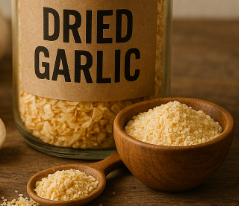
Descrizione
• Prodotto ottenuto da spicchi d’aglio sani e maturi, pelati, affettati e essiccati fino a bassa umidità, quindi ridotti a scaglie, granuli o polvere (talvolta con antiagglomeranti consentiti).
• Profilo sensoriale solforato–aromatico con lieve dolcezza; intensità e pulizia dipendono da cultivar, processo e protezione da umidità/ossigeno.
• Sinonimi commerciali: aglio disidratato, aglio in scaglie, aglio granulare, aglio in polvere.
Valore calorico (per 100 g di prodotto)
• ~320–350 kcal/100 g; carboidrati ~65–75 g, fibre ~8–12 g, proteine ~14–18 g, grassi ~0,5–1,0 g; sodio naturalmente basso.
• In uso culinario i dosaggi sono piccoli (grammi), quindi l’apporto energetico per porzione è modesto.
Principali sostanze contenute
• Precursori solforati: alliin e alliinasi → in presenza di acqua formano allicina e tiosulfinati correlati (responsabili dell’aroma).
• Composti volatili caratteristici (solfuri di allile: diallil di-/tri-solfuro, ecc.).
• Fruttani (inulina/FOS) e altre fibre; amminoacidi/peptidi; potassio e micronutrienti.
• Parametri tipici: umidità bassa; aw target < 0,60; pH (sospensione) ~5,5–6,5.
Processo di produzione
• Selezione bulbi → pelatura, lavaggio, affettatura/lamellatura.
• Essiccazione (aria calda, sottovuoto o tunnel) fino all’umidità target → raffreddamento e deaerazione.
• Riduzione di pezzatura (scaglie/granuli/polvere) e setacciatura (mesh a specifica).
• Sanitizzazione (vapore o equivalenti) → confezionamento in imballi barriera secondo GMP/HACCP.
Proprietà sensoriali e tecnologiche
• Aroma pronto e pulito; le note sulfuree si sviluppano dopo idratazione (alliinasi → allicina).
• Funzionalità: elevata dispersibilità, buona adesione su superfici (dry rub), contributo a umami e browning (Maillard).
• Prodotto igroscopico: rischio caking senza adeguata barriera o antiagglomeranti.
Impieghi alimentari
• Condimenti, mix spezie, rub per carni/pesci/verdure, salse, marinature, zuppe, ripieni, snack aromatizzati.
• Prodotti da forno salati (grissini, crackers, focacce).
• Dosaggi tipici: 0,1–1,0 % in ricetta (ottimizzare con prove pilota). Equivalenze indicative: 1 cucchiaino raso di polvere ≈ 1–2 spicchi medi (variabile per potenza/fornitore).
Nutrizione e salute
• Fonte di fibre (fruttani) e composti organosolforati; grassi trascurabili.
• Trattamenti termici prolungati riducono i tiosulfinati termolabili (allicina).
• Rilevanza FODMAP: i fruttani possono dare disturbi GI in soggetti sensibili → usare con moderazione.
Profilo dei grassi
• Tenore lipidico molto basso; quando presenti, quote in tracce di SFA, MUFA e PUFA senza rilievo nutrizionale.
Qualità e specifiche (temi tipici)
• Granulometria (mesh), umidità (tipico ≤6–7 %), aw, carica microbica (TVC, lieviti/muffe) e assenza di patogeni.
• Volatili caratteristici (GC–MS), alliin/allicina o allicina potenziale (HPLC) secondo specifica.
• Ceneri, metalli/pesticidi entro limiti; sensoriale: colore uniforme (avorio–giallo), assenza di note bruciate/ossidate.
Conservazione e shelf-life
• Conservare al fresco, asciutto, ben chiuso, al riparo da luce e odori; preferire imballi a barriera al vapore.
• Dopo apertura: richiudere ermeticamente (sacchetti con zip/valvola; sachets essiccanti).
• Shelf-life tipica 12–24 mesi se aw e imballo restano in specifica; applicare FIFO.
Allergeni e sicurezza
• L’aglio non è allergene maggiore UE, ma sono possibili ipersensibilità individuali (anche professionali).
• Le spezie disidratate possono veicolare Salmonella/spore: preferire lotti sanitizzati e rispettare HACCP.
• Antiagglomeranti e coadiuvanti: dichiarare secondo normativa.
Funzioni INCI in cosmesi
• Voci tipiche: Allium Sativum Bulb Powder/Extract.
• Ruoli: masking, blando antiossidante, skin conditioning; gestire l’odore caratteristico in formula.
Troubleshooting
• Impaccamento/caking: umidità → imballi barriera, antiagglomerante consentito, essiccanti.
• Aroma debole: lotto vecchio/ossidato → ruotare (FIFO), migliorare barriera, ridurre O₂.
• Note amare/bruciate: tostatura eccessiva → ridurre T/tempo o aggiungere in fase più avanzata.
• Punti scuri: surriscaldamento/ossidazione → rivedere curva termica e qualità della materia prima.
Sostenibilità e filiera
• Upcycling di bucce/scarti per estratti fenolici o compost.
• Gestione effluenti verso target BOD/COD; efficienza energetica in essiccazione; imballaggi riciclabili.
• Tracciabilità e audit fornitori in GMP/HACCP.
Conclusione
L’aglio essiccato unisce praticità, stabilità e aroma immediato. Specifiche chiare (granulometria, aw, marcatori aromatici) e corretta protezione da umidità e ossigeno garantiscono qualità costante e ottima resa in numerose applicazioni.
Mini-glossario
• aw — Attività dell’acqua: quota di acqua “libera” disponibile per i microrganismi; più è bassa, maggiore è la stabilità.
• FOS — Frutto-oligosaccaridi: fibre fermentabili (categoria FODMAP); possibili fastidi GI in soggetti sensibili.
• GC–MS — Gas-cromatografia/spettrometria di massa: profilazione dei volatili aromatici dell’aglio.
• HPLC — High-performance liquid chromatography: quantifica alliin/allicina o marker correlati.
• GMP — Good manufacturing practice: buone pratiche per igiene e coerenza di processo.
• HACCP — Hazard analysis and critical control points: sistema preventivo con CCP definiti.
• BOD/COD — Domanda biochimica/chimica di ossigeno: indicatori del carico organico degli effluenti.
• CFU — Colony forming units: stima dei microrganismi vitali.
• FIFO — First in, first out: rotazione scorte che privilegia i lotti più vecchi.
• SFA — Grassi saturi: eccessi possono aumentare LDL; qui presenti solo in tracce.
• MUFA — Grassi monoinsaturi (es. oleico): in genere favorevoli/neutrali; qui in tracce.
• PUFA — Grassi polinsaturi (n-6/n-3): benefici se bilanciati; qui in tracce.
Studi
Nell'aglio sono presenti Potassio e Magnesio, oltre a Vitamina C, B9, B6 e B1.
Recenti studi hanno dimostrato la sua efficacia contro l'ipertensione (1) le malattie degenerative del sistema cardiovascolare (2) l'aumento del colesterolo e il rischio dell'arteriosclerosi (3).
La sua assunzione diminuisce il rischio di tumore alla prostata (4).
Utile nel processo di guarigione delle ferite (5).
Aglio studi
Bibliografia_______________________________________________________________________
(1) Ried K, Frank OR, Stocks NP. Aged garlic extract reduces blood pressure in hypertensives: a dose-response trial. Eur J Clin Nutr. 2013 Jan;67(1):64-70. doi: 10.1038/ejcn.2012.178.
Abstract. Background/objectives: Hypertension affects about 30% of adults worldwide. Garlic has blood pressure-lowering properties and the mechanism of action is biologically plausible. Our trial assessed the effect, dose-response, tolerability and acceptability of different doses of aged garlic extract as an adjunct treatment to existing antihypertensive medication in patients with uncontrolled hypertension. Subjects/methods: A total of 79 general practice patients with uncontrolled systolic hypertension participated in a double-blind randomised placebo-controlled dose-response trial of 12 weeks. Participants were allocated to one of three garlic groups with either of one, two or four capsules daily of aged garlic extract (240/480/960 mg containing 0.6/1.2/2.4 mg of S-allylcysteine) or placebo. Blood pressure was assessed at 4, 8 and 12 weeks and compared with baseline using a mixed-model approach. Tolerability was monitored throughout the trial and acceptability was assessed at 12 weeks by questionnaire. Results: Mean systolic blood pressure was significantly reduced by 11.8±5.4 mm Hg in the garlic-2-capsule group over 12 weeks compared with placebo (P=0.006), and reached borderline significant reduction in the garlic-4-capsule group at 8 weeks (-7.4±4.1 mm Hg, P=0.07). Changes in systolic blood pressure in the garlic-1-capsule group and diastolic blood pressure were not significantly different to placebo. Tolerability, compliance and acceptability were high in all garlic groups (93%) and highest in the groups taking one or two capsules daily. Conclusions: Our trial suggests aged garlic extract to be an effective and tolerable treatment in uncontrolled hypertension, and may be considered as a safe adjunct treatment to conventional antihypertensive therapy.
(2) Zeb I, Ahmadi N, Nasir K, Kadakia J, Larijani VN, Flores F, Li D, Budoff MJ. Aged garlic extract and coenzyme Q10 have favorable effect on inflammatory markers and coronary atherosclerosis progression: A randomized clinical trial. Cardiovasc Dis Res. 2012 Jul;3(3):185-90. doi: 10.4103/0975-3583.98883. -
Abstract. Background: Aged garlic extract (AGE) and coenzyme Q10 (CoQ10) have been shown to affect multiple cardiovascular risk factors. The current study evaluates the effect of AGE combined with CoQ10 on inflammatory markers and progression of coronary atherosclerosis compared with placebo. Methods and results: In this placebo-controlled, double-blind, randomized trial, 65 intermediate risk firefighters (age 55 ± 6 years) were treated with a placebo capsule or a capsule containing AGE and CoQ10 (AGE+CoQ10, 1200 and 120 mg, respectively) daily for 1 year. All participants underwent coronary artery calcium (CAC) scanning and C-reactive protein (CRP) at baseline and at 12 months. At 1 year, mean CAC progression was significantly lower in AGE+CoQ10 (32 ± 6 vs. 58 ± 8, P = 0.01) than placebo. Similarly, CRP were significantly decreased in AGE+CoQ10 compared with placebo (-0.12 ± 0.24 vs. 0.91 ± 0.56 mg/L, P < 0.05). After adjustment for age, gender, conventional cardiac risk factors, and statin therapy, AGE+CoQ10 was associated with 3.99 fold (95% 1.3-12.2, P = 0.01) lack of CAC progression compared with the placebo. Conclusion: AGE+CoQ10 are associated with beneficial effects on inflammatory markers and reduced progression of coronary atherosclerosis.
(3) Lu Y, He Z, Shen X, Xu X, Fan J, Wu S, Zhang D. Cholesterol-lowering effect of allicin on hypercholesterolemic ICR mice. Oxid Med Cell Longev. 2012;2012:489690. doi: 10.1155/2012/489690.
Abstract. Allicin was discussed as an active compound with regard to the beneficial effects of garlic in atherosclerosis. The aim of this study was to investigate the cholesterol-lowering properties of allicin. In order to examine its effects on hypercholesterolemia in male ICR mice, this compound with doses of 5, 10, or 20 mg/kg body weight was given orally daily for 12 weeks. Changes in body weight and daily food intake were measured regularly during the experimental period. Final contents of serum cholesterol, triglyceride, glucose, and hepatic cholesterol storage were determined. Following a 12-week experimental period, the body weights of allicin-fed mice were less than those of control mice on a high-cholesterol diet by 38.24 ± 7.94% (P < 0.0001) with 5 mg/kg allicin, 39.28 ± 5.03% (P < 0.0001) with 10 mg/kg allicin, and 41.18 ± 5.00% (P < 0.0001) with 20 mg/kg allicin, respectively. A decrease in daily food consumption was also noted in most of the treated animals. Meanwhile, allicin showed a favorable effect in reducing blood cholesterol, triglycerides, and glucose levels and caused a significant decrease in lowering the hepatic cholesterol storage. Accordingly, both in vivo and in vitro results demonstrated a potential value of allicin as a pronounced cholesterol-lowering candidate, providing protection against the onset of atherosclerosis.
(4) Zhou XF, Ding ZS, Liu NB.Allium vegetables and risk of prostate cancer: evidence from 132,192 subjects Asian Pac J Cancer Prev. 2013;14(7):4131-4.
Abstract. Objective: To evaluate the relationship between allium vegetable intake and risk of prostate cancer. Methods: A systematic literature search up to May 2013 was carried out in PubMed, EMBASE, Scopus, Web of Science, Cochrane register, and Chinese National Knowledge Infrastructure (CNKI) databases, and the references of retrieved articles were also screened. The summary relative risks with 95% confidence interval for the highest versus the lowest intake of allium vegetables were calculated. Heterogeneity and publication bias were also evaluated. Results: A total of nine epidemiological studies consisting of six case-control and three prospective cohort studies were included. We found a significantly decreased risk of prostate cancer for intake of allium vegetables (OR = 0.82, 95% CI 0.70, 0.97). Moreover, in the subgroup analysis stratified by allium vegetable types, significant associations were observed for garlic (OR = 0.77, 95% CI 0.64-0.91) but not onions (OR = 0.84, 95% CI 0.62-1.13). Conclusions: Allium vegetables, especially garlic intake, are related to decreased risk of prostate cancer. Because of the limited number of studies, further well-designed prospective studies are warranted to confirm the findings of our study.
Salem S, Salahi M, Mohseni M, Ahmadi H, Mehrsai A, Jahani Y, Pourmand G.Major dietary factors and prostate cancer risk: a prospective multicenter case-control study. Nutr Cancer. 2011;63(1):21-7. doi: 10.1080/01635581.2010.516875.
Abstract. The association between diet and prostate cancer (PC) risk, although suggestive, still remains largely elusive particularly in the Asian population. This study sought to further evaluate the possible effects of different dietary factors on risk of PC in Iran. Using data from a prospective hospital-based multicenter case-control study, dietary intakes of red meat, fat, garlic, and tomato/tomato products, as well as thorough demographic and medical characteristics, were determined in 194 cases with the newly diagnosed, clinicopathologically confirmed PC and 317 controls, without any malignant disease, admitted to the same network of hospitals. Odds ratios (ORs) and corresponding 95% confidence intervals (CIs) were obtained after adjustment for major potential confounders, including age, body mass index, smoking, alcohol, education, occupation, family history of PC, and total dietary calories. Comparing the highest with the lowest tertile, a significant trend of increasing risk with more frequent consumption was found for dietary fat (OR: 1.79, 95% CI: 1.71-4.51), whereas inverse association was observed for tomato/tomato products (OR: 0.33, 95% CI: 0.16-0.65). A nonsignificant increase in PC risk was revealed for dietary red meat (OR: 1.69, 95% CI: 0.93-3.06). For garlic consumption, a borderline reduction in risk was observed (OR: 0.58, 95% CI: 0.32-1.01; P = 0.05). In conclusion, our study supports the hypothesis that total fat may increase PC risk and tomatoes/tomato products and garlic may protect patients against PC.
Colli JL, Amling CL. Chemoprevention of prostate cancer: what can be recommended to patients? Curr Urol Rep. 2009 May;10(3):165-71. Review.
Abstract. Prostate cancer is third to lung and colon cancer as the cause of cancer-related deaths in American men. It is estimated that there will have been more than 28,000 deaths and 186,000 new cases in 2008 that will impose a significant burden on national health care costs. Chemoprevention aims to reduce both incidence and mortality through the use of agents to prevent, reverse, or delay the carcinogenic process. This study provides clinicians with information on some chemoprevention agents that have been considered to reduce prostate cancer risks, including 5-alpha-reductase inhibitors; statins (a class of compounds used to reduce cholesterol); NSAIDs; selenium; vitamins E and D; lycopene; allium vegetables (garlic, scallions, onions, chives, and leeks); soy/isoflavones; and green tea polyphenols. The evidence to support prostate cancer risk reduction benefits for each chemoprevention agent based on a review of the literature is provided.
(5) Alhashim M, Lombardo J. Effect of Topical Garlic on Wound Healing and Scarring: A Clinical Trial. Dermatol Surg. 2019 Sep 2. doi: 10.1097/DSS.0000000000002123.
Abstract. Background: Historically, garlic containing compounds have been used on wounds to improve healing and ward off infection. Researchers have tested many of these ancient ointments, discovering that garlic is a common ingredient in those that are effective. Objective: To determine the efficacy of topical garlic on surgical wounds compared with Vaseline by analysis of visual analog scales and digital photograph analysis. Materials and methods: Seventeen patients with 2 skin excisions applied a 30% garlic ointment to one surgical wound and Vaseline to the other surgical wound twice daily. They were followed up at 2 weeks and 4 weeks post-op. Digital photographs were taken of the sites, and wound visual analog scales were filled out by the patient and the physician. Results: Patients and the onsite physician stated the garlic site healed better in 59% and 65% of the wounds, respectively, at 2 weeks. At 4 weeks, the patients and the onsite physician stated the garlic site healed better in 76% and 88% of wounds, respectively. Digital photograph analysis revealed less erythema at the garlic sites (p-value = .02). Conclusion: Surgical wounds treated with 30% garlic ointment healed with more cosmetically appealing scars than the Vaseline-treated sites.




