Pasta di tamarindo (Tamarindus indica L.; fam. Fabaceae)
Descrizione
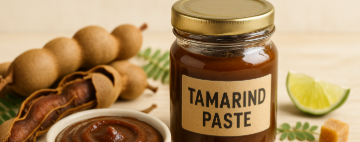
• Preparazione ottenuta dalla polpa dei baccelli maturi di tamarindo, reidratata/macerata, setacciata per rimuovere semi/fibre e concentrata fino alla consistenza pastosa.
• Profilo sensoriale acidulo–agrodolce, con note fruttate, caramellate e leggermente speziate; colore bruno–ambra.
• Disponibile come pulp (polpa setacciata), paste concentrata e concentrato sottovuoto; alcune versioni includono sale e/o zucchero.
Valore calorico (per 100 g di prodotto)
• Variabile con umidità e °Brix: ~180–270 kcal/100 g.
• Tipico (pasta semplice, senza zuccheri aggiunti): carboidrati 40–65 g (zuccheri 25–40 g), fibre 4–8 g, proteine 2–4 g, grassi 0,2–1,0 g, sodio molto basso salvo aggiunte.
Principali sostanze contenute
• Acidi organici: tartarico (prevalente), malico, citrico → determinano pH acido (~2,5–3,5) e la spiccata acidità.
• Zuccheri: glucosio, fruttosio, saccarosio.
• Pectine/polisaccaridi: contribuiscono a viscosità e corpo; fibre solubili e insolubili.
• Polifenoli: proantocianidine/tannini (attività antiossidante in vitro).
• Minerali: potassio elevato; calcio, magnesio in tracce.
• Marcatori analitici: °Brix/TSS, acidità totale espressa come acido tartarico, pH, colore L, a, b***, viscosità (es. Brookfield).
Processo di produzione
• Materie prime: baccelli maturi, sani, privi di muffe.
• Estrazione: macerazione della polpa in acqua calda, disintegrazione e setacciatura (rimozione semi/fibre).
• Concentrazione: evaporazione a bassa temperatura (sottovuoto) fino al °Brix target; eventuale aggiunta di sale/zucchero.
• Stabilizzazione: pastorizzazione/hot-fill o riempimento asettico; confezionamento in imballi barriera secondo GMP/HACCP.
Proprietà sensoriali e tecnologiche
• Aroma/sapore: spiccata acidità bilanciata da dolcezza naturale; complessità fruttata e melassata.
• Reologia: pasta viscosa e pseudoplastica; buona capacità legante e glassante.
• Funzionalità: acidificante naturale, esalta umami e browning (Maillard) in cottura; maschera note ossidative leggere.
Impieghi alimentari
• Cucine asiatiche (chutney, curry, salse per pad thai), latino–americane (agua de tamarindo), mediorientali (salse agrodolci), marinature e glasse.
• Snack, condimenti, bevande, confetteria agrodolce.
• Dosaggi tipici: 0,5–5,0 % in ricetta o q.b. per l’equilibrio agrodolce; da definire con prove pilota.
Nutrizione e salute
• Grassi trascurabili; carboidrati e fibre come principali contributori energetici.
• L’elevata acidità può risultare fastidiosa per soggetti sensibili (es. reflusso); valutare la diluizione.
• I polifenoli mostrano attività antiossidante in vitro; evitare indicazioni salutistiche senza autorizzazione.
• Sodio basso nelle paste senza sale; verificare le versioni “seasoned”.
Profilo dei grassi
• Tenore lipidico basso (tracce); quando presenti: prevalenza di PUFA in tracce su MUFA/SFA.
Qualità e specifiche (temi tipici)
• °Brix/TSS, pH e acidità titolabile (come tartarico), viscosità, colore.
• Microbiologia: assenza patogeni; totale aerobica, lieviti/muffe entro limiti.
• Contaminanti: metalli (es. Pb) e pesticidi entro specifica; 5-HMF come indicatore di riscaldamento.
• Sensoriale: assenza di muffe, note bruciate o amare; profilo agrodolce pulito.
Conservazione e shelf-life
• Conservare al fresco e al buio, in contenitori ermetici a bassa permeabilità al vapore/ossigeno.
• Dopo apertura: refrigerare 0–4 °C e consumare entro 2–4 settimane; evitare contaminazioni crociate.
• Applicare FIFO; evitare cicli termici che favoriscono imbrunimenti e separazioni.
Allergeni e sicurezza
• Il tamarindo non è allergene maggiore UE, ma sono possibili sensibilità individuali.
• Acidità elevata → attenzione a materiali di contatto (compatibilità) e a denti/esofago in consumo diretto concentrato.
• Gestione igienica e tracciabilità secondo HACCP; controllo di corpi estranei (frammenti di semi/baccello).
Funzioni INCI in cosmesi
• Voci tipiche: Tamarindus Indica Fruit Extract, Tamarindus Indica Seed Gum (xyloglucano), Tamarind Extract.
• Ruoli: umettante/filmogeno, lenitivo leggero, supporto texture; gli acidi organici possono dare micro-esfoliazione delicata.
Troubleshooting
• Muffe/superficie frizzata: attività dell’acqua localmente alta/ri-contaminazione → migliorare pastorizzazione, igiene e barriera; usare hot-fill adeguato.
• Imbrunimento eccessivo: riscaldamento prolungato → abbassare T/tempo, concentrare sottovuoto, limitare O₂.
• Separazione di fase: variabilità di pectine/°Brix → omogeneizzazione, eventuale standardizzazione con pectine.
• Acidità troppo marcata: dosi alte o bassa tamponatura della matrice → bilanciare con zuccheri, sale o grassi; usare blend.
Sostenibilità e filiera
• Upcycling di gusci/semi: estrazione di polisaccaridi (gomma di tamarindo) e farine funzionali.
• Gestione effluenti con target BOD/COD; recupero calore nei concentratori; imballi riciclabili.
• Produzione sotto GMP/HACCP con tracciabilità e approvvigionamenti responsabili.
Conclusione
La pasta di tamarindo è un acidificante naturale ricco di carattere agrodolce e di funzionalità tecnologiche (corpo, glassatura, esaltazione dell’umami). Specifiche chiare (°Brix, pH, acidità, viscosità), corretta stabilizzazione e buona protezione da ossigeno/calore garantiscono qualità stabile e resa applicativa ampia.
Mini-glossario
• °Brix — Gradi Brix: percentuale di TSS (solidi solubili totali); guida concentrazione e dolcezza percepita.
• TSS — Solidi solubili totali: zuccheri/acidi/sali; correlati a densità e resa.
• pH — Indice di acidità/alcalinità; governa sapore, conservabilità e stabilità pectica.
• aw — Attività dell’acqua: quota di acqua “libera”; più è bassa, maggiore è la stabilità microbica.
• 5-HMF — 5-Idrossimetilfurfurale: marcatore di trattamenti termici/Imbrunimento.
• SFA — Grassi saturi: da moderare; eccessi possono aumentare LDL.
• MUFA — Grassi monoinsaturi (es. oleico): in genere favorevoli/neutrali per il profilo lipidico.
• PUFA — Grassi polinsaturi (es. n-6/n-3): benefici se bilanciati; nelle paste di tamarindo sono in tracce.
• n-6 / n-3 — Famiglie di PUFA (omega-6/omega-3): rapporto equilibrato preferibile.
• GMP — Good manufacturing practice: buone pratiche per igiene e coerenza di processo.
• HACCP — Hazard analysis and critical control points: sistema preventivo con CCP definiti.
• BOD/COD — Domanda biochimica/chimica di ossigeno: indicatori del carico organico degli effluenti.
• FIFO — First in, first out: rotazione scorte che privilegia i lotti più vecchi.
Bibliografia__________________________________________________________________________
Escalona-Arranz JC, Garcia-Diaz J, Perez-Rosés R, De la Vega J, Rodríguez-Amado J, Morris-Quevedo HJ. Effect of Tamarindus indica L. leaves' fluid extract on human blood cells. Nat Prod Res. 2014;28(18):1485-8. doi: 10.1080/14786419.2014.911296.
Abstract. Tamarind leaves are edible; however, their saponin content could be toxic to human blood cells. In this article, the effect of tamarind leaf fluid extract (TFE) on human blood cells was evaluated by using several tests. Results revealed that TFE did not cause significant haemolysis on human red blood cells even at the lowest evaluated concentration (20 mg/mL). Blood protein denaturalisation ratio was consistently lower than in control at TFE concentrations greater than 40 mg/mL. Erythrocyte membrane damage caused by the action of oxidative H2O2 displayed a steady reduction with increasing TFE concentrations. In the reactive oxygen species (ROS) measurement by using flow cytometry assay, leucocyte viability was over 95% at tested concentrations, and a high ROS inhibition was also recorded. Protective behaviour found in TFE should be attributed to its polyphenol content. Thus, tamarind leaves can be regarded as a potential source of interesting phytochemicals.
Amado J, Morris-Quevedo HJ, Mwasi LB, Cabrera-Sotomayor O, Machado-García R, Fong-Lórez O, Alfonso-Castillo A, Puente-Zapata E. Antioxidant and toxicological evaluation of a Tamarindus indica L. leaf fluid extract. Nat Prod Res. 2016;30(4):456-9. doi: 10.1080/14786419.2015.1019350.
Abstract. In the scientific community, there is a growing interest in Tamarindus indica L. leaves, both as a valuable nutrient and as a functional food. This paper focuses on exploring its safety and antioxidant properties. A tamarind leaf fluid extract (TFE) wholly characterised was evaluated for its anti-DPPH activity (IC50 = 44.36 μg/mL) and its reducing power activity (IC50 = 60.87 μg/mL). TFE also exhibited a high ferrous ion-chelating capacity, with an estimated binding constant of 1.085 mol L(-1) while its influence over nitric oxide production in human leucocytes was irregular. At low concentrations, TFE stimulated NO output, but it significantly inhibited it when there was an increase in concentration. TFE was also classified as a non-toxic substance in two toxicity tests: the acute oral toxicity test and the oral mucous irritability test. Further toxicological assays are needed, although results so far suggest that TFE might become a functional dietary supplement.
Komakech R, Kim YG, Matsabisa GM, Kang Y. Anti-inflammatory and analgesic potential of Tamarindus indica Linn. (Fabaceae): a narrative review. Integr Med Res. 2019 Sep;8(3):181-186. doi: 10.1016/j.imr.2019.07.002.
Abstract. Chronic inflammation is one of the causes of a number of non-infectious diseases in the world. Over the years, Tamarindus indica has played fundamental roles in traditional medicine as an anti-inflammatory and analgesic drug. It is a commercialized biocompatible medicinal plant species with a wide range of therapeutic window and with suggested LD50 greater than 5000 mg kg-1 body weight when administered to the Wistar rats. This review examined the anti-inflammatory and analgesic potential and mechanism of various extracts from T. indica pulp, leaves, seeds, stem bark, and roots. The preclinical studies provided strong pharmacological evidence for the anti-inflammatory and analgesic activities of the different parts of T. indica and this may be attributed to the various bioactive compounds in it including alkaloids, flavonoids, tannins, phenols, saponins, and steroids. The anti-inflammatory and analgesic effects of the extracts from the different parts of T. indica may be due to its ability to inhibit a number of biological processes including cyclooxygenase-2 (COX-2) expression, inducible nitric oxide synthase (iNOS), 5-lipoxygenase biosynthesis, and tumor necrosis factor-α. The analgesic activity of T. indica may also be through the activation of the opioidergic mechanism at both the peripheral and central levels. Although further pre-clinical studies still need to be conducted, these results demonstrated that T. indica has potent anti-inflammatory and analgesic activities and hence provides justification for its use in traditional medicine to treat body pain and other inflammatory related diseases including arthritis and offers a basis for future clinical studies and possible drug development.
Bhadoriya SS, Ganeshpurkar A, Narwaria J, Rai G, Jain AP. Tamarindus indica: Extent of explored potential. Pharmacogn Rev. 2011 Jan;5(9):73-81. doi: 10.4103/0973-7847.79102.
Abstract. Tamarindus is a monotypic genus and belongs to the subfamily Caesalpinioideae of the family Leguminosae (Fabaceae), Tamarindus indica L., commonly known as Tamarind tree is one of the most important multipurpose tropical fruit tree species in the Indian subcontinent. Tamarind fruit was at first thought to be produced by an Indian palm, as the name Tamarind comes from a Persian word "Tamar-I-hind," meaning date of India. Its name "Amlika" in Sanskrit indicates its ancient presence in the country. T.indica is used as traditional medicine in India, Africa, Pakistan, Bangladesh, Nigeria,and most of the tropical countries. It is used traditionally in abdominal pain, diarrhea and dysentery, helminthes infections, wound healing, malaria and fever, constipation, inflammation, cell cytotoxicity, gonorrhea, and eye diseases. It has numerous chemical values and is rich in phytochemicals, and hence the plant is reported to possess antidiabetic activity, antimicrobial activity, antivenomic activity, antioxidant activity, antimalarial activity, hepatoprotective activity, antiasthmatic activity, laxative activity, and anti-hyperlipidemic activity. Every part of the plant from root to leaf tips is useful for human needs. Thus the aim of the present review is to describe its morphology, and explore the phytochemical constituents, commercial utilization of the parts of the plant, and medicinal and pharmacologic activities so that T. indica's potential as multipurpose tree species can be understood.
Ghaly MF, Albalawi MA, Bendary MM, Shahin A, Shaheen MA, Abu Eleneen AF, Ghoneim MM, Elmaaty AA, Elrefai MFM, Zaitone SA, Abousaty AI. Tamarindus indica Extract as a Promising Antimicrobial and Antivirulence Therapy. Antibiotics (Basel). 2023 Feb 24;12(3):464. doi: 10.3390/antibiotics12030464.
Abstract. The worldwide crises from multi-drug-resistant (MDR) bacterial infections are pushing us to search for new alternative therapies. The renewed interest in medicinal plants has gained the attention of our research group. Tamarindus indica L. (T. indica) is one of the traditional medicines used for a wide range of diseases. Therefore, we evaluated the antimicrobial activities of ethanolic extract of T. indica. The inhibitions zones, minimum inhibitory concentration (MIC), minimum bactericidal concentration (MBC), and fractional inhibitor concentration indices (FICI) against Gram+ve and -ve pathogens were detected. The bioactive compounds from T. indica extract were identified by mass spectroscopy, thin-layer chromatography, and bio-autographic assay. We performed scanning electron microscopy (SEM) and molecular docking studies to confirm possible mechanisms of actions and antivirulence activities, respectively. We found more promising antimicrobial activities against MDR pathogens with MIC and MBC values for Staphylococcus aureus (S. aureus) and Pseudomonas aeruginosa (P. aeruginosa), i.e., (0.78, 3.12 mg/mL) and (1.56, 3.12 mg/mL), respectively. The antimicrobial activities of this extract were attributed to its capability to impair cell membrane permeability, inducing bacterial cell lysis, which was confirmed by the morphological changes observed under SEM. The synergistic interactions between this extract and commonly used antibiotics were confirmed (FICI values < 0.5). The bioactive compounds of this extract were bis (2-ethylhexyl)phthalate, phenol, 2,4-bis(1,1-dimethylethyl), 1,2-benzenedicarboxylic acid, and bis(8-methylnonyl) ester. Additionally, this extract showed antivirulence activities, especially against the S. aureus protease and P. aeruginosa elastase. In conclusion, we hope that pharmaceutical companies can utilize our findings to produce a new formulation of T. indica ethanolic extract with other antibiotics.




